












Contents
Risk of ruin is the probability that your bankroll reaches a specified zero balance, minimum balance or lower threshold under a particular staking strategy and time horizon. To estimate it, define the event first, convert your bankroll into bankroll units where appropriate, and choose a model that matches the stakes and payouts. Even a positive expected return does not guarantee that your bankroll will survive an unfavourable run.
Your bankroll is separate money you can afford to lose, not your total savings. If you have not established that boundary, start with the basics of bankroll management.
What counts as ruin?
Choose a lower threshold and an endpoint for observation first. Without them, a quoted “risk of ruin” is ambiguous.
| Event | What it measures | When observation ends |
|---|---|---|
| Reaching zero with flat staking and no upper target | Probability of eventually exhausting the bankroll with a fixed monetary stake | Unlimited horizon |
| Ruin before reaching a target | Probability of reaching zero before a specified upper balance | At zero or the upper target |
| Reaching a lower threshold within a finite number of bets | Probability of touching the threshold at least once within the specified number of bets | After the specified number of bets |
| Falling below a level tied to the starting bankroll | Probability of reaching a fixed level relative to the starting balance | Within the chosen horizon |
| Drawdown from a previous peak | A decline relative to the bankroll’s earlier maximum | Under the chosen model and horizon |
Falling from an initial 1000 to 500 is not the same event as a 50% drawdown from a future peak. If the bankroll first rises to 1600, half of that peak is 800, while the fixed starting-level threshold remains 500.
A drawdown may never recover. Ruin is a terminal event only for the specified bankroll and model rules: a new deposit changes the starting conditions rather than undoing a threshold crossing that has already happened.
How do you convert a bankroll into bankroll units?
Divide the starting bankroll B by the fixed monetary stake S: n = B/S.
A bankroll of 1000 currency units and a stake of 20 gives 1000/20 = 50 bankroll units. The stake is 2% of the starting bankroll. With flat staking, it remains 20 after losses.
Proportional staking works differently. If you stake 2% of the current balance, a balance of 800 means a stake of 16. The same initial 50 bankroll units therefore does not imply the same risk under different staking rules.
The numerical examples below assume stable, independent outcomes, no deposits or withdrawals, and costs included in the edge or net win rate. If your actual edge is unknown, these examples illustrate model behaviour; they do not establish that your gambling is safe.
What is the exact formula for fixed, even-money bets?
For independent bets that return +1 or −1 bankroll unit at decimal odds of 2.00, the probability of reaching zero over an unlimited horizon is ((1−e)/(1+e))^n when the edge is positive.
Let p be the win probability, q = 1−p the loss probability, and n an integer number of bankroll units. A win earns one unit of net profit; a loss costs one unit. Then:
- Edge:
e = 2p−1. - If
p > 0.5:r = (q/p)^n = ((1−e)/(1+e))^n. - If
p ≤ 0.5: the risk of ruin for a finite bankroll over an unlimited horizon is 100%.
This is the classic gambler’s ruin model. Its derivation is covered in the MIT Mathematics for Computer Science textbook, PDF.
Enter the edge into the formula as a decimal: 2% means e = 0.02, not 2. It is also not equal to p−0.5: when p = 0.51, the edge in this model is 2%.
You cannot automatically apply this formula to odds of −110, arbitrary sports-betting payouts, blackjack or slots. For a binary bet at decimal odds d, with no pushes or additional costs, the edge is p*d−1. Odds of −110 correspond to 21/11, so the break-even win probability is 11/21 = 52.38%. Those returns are no longer symmetric +1/−1 outcomes.
Win probability alone does not describe the full risk. You also need the payout sizes and their distribution, or a suitable estimate of standard deviation.
How do edge and bankroll size change the risk?
Risk is highly sensitive to both the number of bankroll units and the edge. A larger bankroll does not automatically compensate for an inaccurate edge estimate.
The table shows unlimited-horizon risk of ruin for independent +1/−1 bets. Percentages are rounded to two decimal places.
| Bankroll units | Edge 0.5% | Edge 1% | Edge 2% |
|---|---|---|---|
| 25 | 77.88% | 60.65% | 36.78% |
| 50 | 60.65% | 36.79% | 13.53% |
| 100 | 36.79% | 13.53% | 1.83% |
| 200 | 13.53% | 1.83% | 0.03% |
With a hypothetical 2% edge and 50 bankroll units, the calculation is ((1−0.02)/(1+0.02))^50, giving 13.53%. With 100 units, it is 1.83%. Doubling the number of units squares the risk, not the survival probability.
But if the edge at 100 units is only 1%, the risk returns to 13.53%. With zero edge, it is 100% over an unlimited horizon.
To reproduce the first example in the risk of ruin calculator:
- Open the Advantage betting tab.
- Enter
2in the edge-per-bet field. - Enter
50in the bankroll-units field. - Enter
1in the target-risk-of-ruin field.
Results update immediately when you change the numeric fields or sliders. The risk is 13.53%, and the required bankroll for the selected target is 116 units. There is no separate calculate button to press.
Advantage betting calculator with a 2% edge, 50 bankroll units and a 1% target risk of ruin
Local calculator version checked 2026-10-12, not production: the 2% edge and 50-unit example.
How many bankroll units do you need for a chosen risk?
For the same model, use the inverse formula n ≥ ceil(ln(target)/ln((1−e)/(1+e))), where target is the target risk as a decimal and ceil means rounding up to a whole number.
With a hypothetical 2% edge and a 1% target, you need 116 units. Their risk of ruin is 0.97%. For a bankroll of 1000, the fixed stake must be no more than 8.62 currency units after rounding down to two decimal places.
A stake of 8.62 gives 1000/8.62 = 116.009 units. The exact formula above assumes an integer number of equal steps to zero; a 116-unit calculation requires a bankroll consistent with that condition. A small remainder at a stake of 8.62 does not itself worsen the calculation, but you still need a rule for handling that remainder and the minimum stake.
A target of 1% or 5% is a hypothetical personal choice, not a professional standard or a guarantee that your money will be preserved.
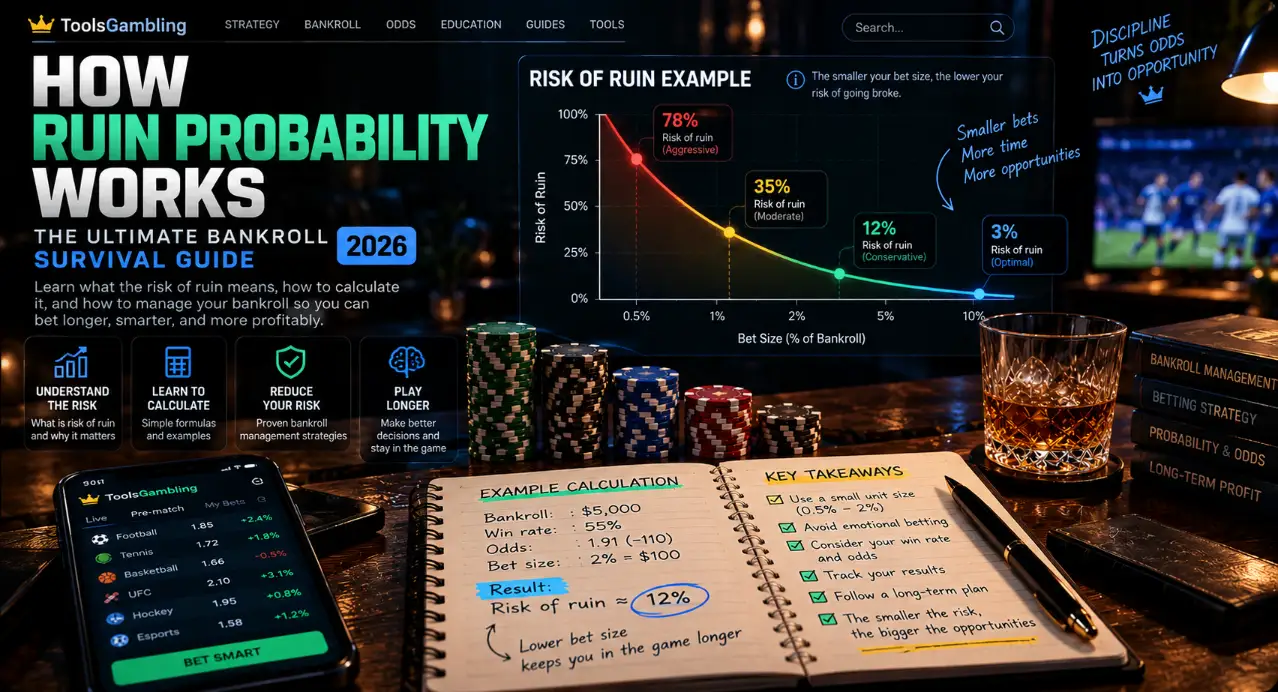
What does the risk chart show?
The chart shows how risk falls as the number of bankroll units increases in the fixed-stake model with equal gains and losses.
The stored values are rounded to two decimal places. Small differences from the exact formula in the final digit do not change the comparison. A value of 0.00 represents a very small rounded risk, not a mathematical zero.
What is the risk of ruin before reaching a target?
If you stop at an upper balance, calculate the probability of reaching zero before that target, rather than unlimited-horizon risk of ruin.
For the same +1/−1 model, a starting bankroll n and a target N, where 0 < n < N, let r = q/p. Then:
- Probability of reaching the target:
(1−r^n)/(1−r^N). - Risk of ruin before the target:
1−(1−r^n)/(1−r^N). - When
p = 0.5, the probability of reaching the target isn/N.
For example, starting with 20 units, targeting 40 and having a 50% win probability gives a 50% risk of ruin before the target. Without an upper target, unlimited-horizon risk is 100%. There is no contradiction: these are different events. The formula does not tell you how long reaching a boundary will take.
To check the example, open Gambler's ruin in the calculator. Enter 50 in the win-probability-per-bet field, 20 in the starting-bankroll-units field and 40 in the exit-target-units field. The risk is 50%. A target value of 0 means there is no upper exit point.
Gambler’s ruin calculator showing a 50% win probability, 20 starting units, a 40-unit target and 50% risk of ruin
Local calculator version checked 2026-10-12, not production: ruin before an upper target, rather than unlimited-horizon ruin.
Stopping at a target or loss limit changes the event and how much you play, but does not create a positive expected return. Nor does it contradict eventual ruin with a negative edge in an unlimited-play, fixed-stake model.
How do you account for poker variance?
For fixed-stakes poker, you can use the diffusion model r ≈ exp(−2*w*B/s²) if net win rate and standard deviation refer to the same sample interval.
Here:
wis the expected net win rate in big blinds per 100 hands.sis the standard deviation of the result of a 100-hand block, in big blinds.Bis the entire bankroll balance in big blinds.
Win rate here is not the percentage of hands won. Square the standard deviation once, and do not divide the bankroll by 100. Only win rate and standard deviation refer to 100 hands; bankroll is the full balance in big blinds.
The formula is exact for the corresponding Brownian-motion model and an approximation for discrete poker play. The probability of reaching a lower boundary is discussed in Karl Sigman’s Columbia notes on Brownian motion, §1.8, 2006, PDF.
With w = 5, s = 100 and B = 1000, the result is exp(−2*5*1000/100²) = 36.79%. With a bankroll of 2000 big blinds, the risk is 13.53%.
In the calculator, open Win rate + variance. Enter 5 in the win-rate field, 100 in the standard-deviation field and 1000 in the bankroll field. The result is 36.79%.
Poker example with a win rate of 5 big blinds per 100 hands, standard deviation of 100 big blinds per 100 hands and a 1000-big-blind bankroll
Local calculator version checked 2026-10-12, not production: bankroll is the full balance, not a per-100-hand figure.
For a hypothetical target risk of 1%, the inverse formula is B ≥ −s²*ln(0.01)/(2*w). With the same parameters, the unrounded result is 4605.1702 big blinds; rounding up gives 4606. If you budget in whole 100-big-blind buy-ins, you need 47 buy-ins, or 4700 big blinds, rather than 4606. This is a formula-based calculation: the interface does not provide a separate poker inverse calculation.
Doubling variance doubles the required bankroll. Doubling standard deviation quadruples variance, so it also quadruples the required bankroll.
The model assumes a constant net win rate and standard deviation, fixed stakes and an unlimited horizon. Real estimates are uncertain: results may be dependent, and the player pool or playing conditions may change. A profitable observed sample does not confirm a true edge. Read more in the guide to poker variance and downswings.
What does a Kelly fraction tell you about bankroll risk?
A Kelly fraction can help estimate the probability of falling to a fixed level relative to the starting bankroll. It does not guarantee survival or describe every kind of drawdown.
The Kelly criterion maximises expected logarithmic growth under a correct model. It does not minimise every form of risk. A Kelly fraction of 0.5 means half the full-Kelly stake, not a stake of 50% of the bankroll. The full stake calculation is covered in the Kelly criterion guide.
In a continuous approximation for small stakes, the probability of ever reaching a fraction a of the starting bankroll is estimated as a^(2/f−1), where f is the Kelly fraction. This approximation is discussed in William Chin’s undated paper, §2.2, PDF.
For a threshold of a = 0.5:
| Kelly fraction | Risk of falling to half the starting bankroll |
|---|---|
| 1 | 50% |
| 0.5 | 12.5% |
| 0.25 | 0.78125%, or approximately 0.78% |
To reproduce the second example, open Kelly drawdown. Enter 0.5 in the Kelly-fraction field and 50 in the drawdown field. The result is 12.5%.
Despite the interface’s drawdown wording, this example concerns a fixed threshold of 50% of the starting bankroll. It is not a 50% drawdown from a future peak or a probability of loss during a 500-bet session.
Kelly drawdown calculator with a Kelly fraction of 0.5 and a 12.5% risk of reaching half the starting bankroll
Local calculator version checked 2026-10-12, not production: the calculation uses a fixed threshold relative to the initial bankroll.
In an ideal proportional-staking model, a stake below 100% of the current balance does not produce an exact zero within a finite number of steps if money is infinitely divisible. In practice, minimum stakes, rounding, withdrawals, dependent outcomes and model errors create a practical lower threshold. “Not reaching exact zero” does not mean preserving a usable bankroll.
Why is a losing streak different from ruin?
A losing streak describes a sequence of outcomes. Ruin means reaching a monetary threshold under a chosen staking plan.
With a 55% win probability, the probability of ten losses in one preselected window is 0.45^10 = 0.000340506, or 0.03405%, not 0.34%.
There are 991 overlapping ten-bet windows in 1000 bets. They are not independent, so you cannot simply multiply the probability for one window by 991 and call it the exact session probability of a streak. That calculation also does not predict how many streaks you will observe.
Ruin can occur with wins interspersed among losses. It depends on the bankroll, lower threshold and stake size. A large bankroll does not prove an edge, and variance does not “owe” you a recovery.
Increasing stakes to chase losses changes stake sizes and violates the fixed-stake formula’s assumptions. A session limit or loss budget limits participation, but does not correct a negative expected return.
When is Monte Carlo simulation useful?
Monte Carlo simulation is useful for questions involving a finite number of bets, proportional staking and a chosen lower threshold, rather than exact zero over an unlimited horizon.
The calculator’s simulation tab uses configurable binary-bet odds, stakes as a fraction of the current balance, and a lower threshold expressed as the percentage of bankroll remaining. It runs 3000 simulations with a fixed random seed. A threshold crossing counts even if the balance later recovers, and simulated paths continue after crossing it.
This is therefore not a simulation of automatic stopping at a loss limit, nor an exact calculation of reaching zero. It does not validate your edge or replace data about actual payouts. The settings are explained in the risk of ruin calculator instructions.
How do you turn the calculation into a loss plan?
Choose an affordable budget, test less favourable assumptions, and decide your staking and stopping rules before you play.
- Separate the bankroll from essential spending. Set an amount you can lose without affecting everyday life.
- Write down the event and horizon. For example, reaching a lower threshold within a specified number of bets, or reaching zero before an upper target.
- Use conservative net parameters. Include costs, and do not treat a lucky short sample as a proven edge.
- Check payouts and units. The
+1/−1formula requires matching outcomes. In the poker model, win rate and standard deviation refer to 100 hands; bankroll is the full balance. - Test sensitivity. Compare the result with a lower edge or win rate and a higher standard deviation.
- Choose the plan before playing. Decide whether stakes will be fixed or proportional. If the estimated risk is too high, you can reduce the stake, limit participation or choose not to play.
- Set a loss budget and stopping rule. Do not build in mandatory replenishment or loss chasing.
- Review the calculation when conditions change. Withdrawals, different stakes or changed playing conditions alter the original model.
For recreational casino gambling, the main practical limit is a finite budget and stopping after an affordable loss. RTP describes the long-run proportion of betting turnover returned to players, not win probability or risk of ruin. No bankroll size creates a positive edge where none exists; see the explanation of the house edge.
Do not gamble with housing money or borrowed funds. If you cannot stick to your limit, stop. Participate only if you are at least 18, meet any higher local minimum age, and gambling is legal where you are.
Frequently Asked Questions
Only if the payouts are known and the chosen model fits. The same win probability produces different edges at different odds. More complex outcomes require a payout distribution or suitable estimates of net win rate and standard deviation.
Do not treat a profitable short run as proof of an edge or present a calculation as a numerical measure of safety. For recreational gambling, set an affordable loss budget and a finite horizon. Use hypothetical parameters only to test sensitivity.
No. Replenishing the bankroll is not a required part of bankroll management. It changes the calculation’s starting conditions and can turn a planned, limited loss into continued loss chasing.
Not directly. This model assumes a constant net win rate and standard deviation at fixed stakes. Tournament payout structures require a different model.
Evgeniy Volkov
Verified ExpertFullstack developer with a background in mathematics. I build the calculators and game-style tools on ToolsGambling with Pixi.js and modern web tech, and every result uses transparent probability formulas you can verify yourself.