












Contents
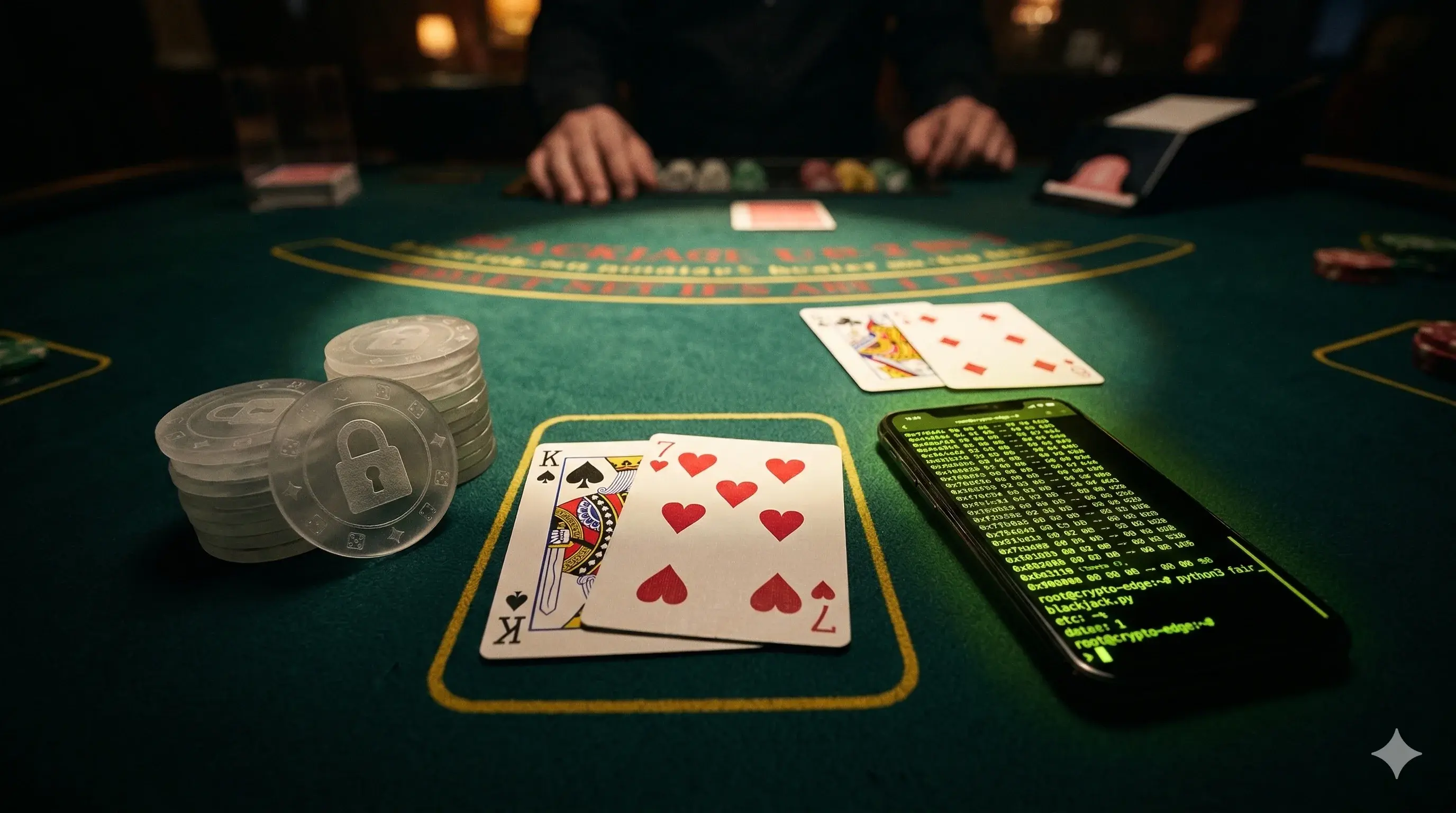
You hit a natural blackjack at a crypto casino. The payout is instant, the Bitcoin hits your wallet in seconds. But how do you know the game wasn't rigged? How do you know that 10-hand losing streak last night was just variance and not a crooked algorithm?
In 2026, the answer is provably fair blackjack, a system that lets you verify every single hand with the same cryptography that secures Bitcoin itself. No trust required. No auditor middlemen. Just math you can check yourself.
This guide shows you exactly how it works, gives you a free SHA-256 verification tool, and tells you what to look for (and what to avoid) in provably fair casinos.
TL;DR, Provably Fair Blackjack Quick Reference
Key Verification Numbers
| Feature | Traditional RNG | Provably Fair | Live Dealer |
|---|---|---|---|
| Verification | Trust auditor | Verify yourself | Watch video |
| RTP | 99.0–99.5% | 99.0–99.5% | 99.0–99.5% |
| Proof of fairness | Audit report | SHA-256 hash | Camera feed |
| Speed | Instant | Instant | 30–60 sec/hand |
| Trust model | Casino + auditor | Math only | Casino + video |
| Can you verify individual hands? | No | Yes | Partially |
The One Thing to Remember
Provably fair doesn't change the odds, it proves the odds are real. A provably fair blackjack game with 6:5 payouts still has a terrible house edge. The crypto just guarantees the casino isn't making it worse than advertised.
What Is Provably Fair Blackjack?
How Traditional Online Blackjack Works
In a standard online blackjack game, you trust two things: the casino's Random Number Generator (RNG) and the third-party auditor (eCOGRA, iTech Labs, GLI) who certifies it. You click "Hit," the server decides the card, and you see the result. If you suspect something's off, your only option is... trust the audit report.
That's a lot of trust. The RNG is a black box. The auditor visits periodically, not on every hand. And even the best auditors have missed manipulation before.
How Provably Fair Changes the Game
Provably fair blackjack adds a cryptographic layer that makes cheating mathematically detectable. Here's the core idea:
- Before the hand: The casino generates a server seed, hashes it (SHA-256), and shows you the hash
- You can't reverse the hash: So you can't predict the outcome
- After the hand: The casino reveals the actual server seed
- You verify: Hash the seed yourself, if the hash matches, the game was fair
This is called a commitment scheme. The casino commits to the result before you bet. If they change it afterward, the hash won't match. It's the same principle behind Bitcoin's blockchain, and it's used across other crypto games too, including crash games like Aviator. If you play both, our Aviator provably fair verification guide covers the HMAC-SHA256 crash point derivation in detail.
Why Blackjack Is Different from Dice/Crash Games
Most provably fair games (dice, crash, mines) generate a single random number. Blackjack is more complex, it requires shuffling an entire 52-card deck. The HMAC-SHA512 output must map to a full Fisher-Yates shuffle, producing a specific card order for dealing.
This means the verification is more involved: you're not just checking a number, you're reconstructing the entire deck and confirming the dealt cards match. That's exactly what our provably fair checker does, and the inline tool below does specifically for blackjack hands.
How SHA-256 Verification Works (Step-by-Step)
Step 1: Casino Generates a Server Seed
The casino creates a random string (the server seed). This seed, combined with your client seed and a nonce, will determine the entire deck order for your blackjack hand.
Example server seed: a1b2c3d4e5f6a7b8c9d0e1f2a3b4c5d6
Step 2: You Receive the Hash (Pre-Game Commitment)
Before the hand starts, the casino hashes the server seed with SHA-256 and shows you the result:
SHA-256("a1b2c3d4e5f6a7b8c9d0e1f2a3b4c5d6")
= 7f83b1657ff1fc53b92dc18148a1d65dfc2d4b1fa3d677284addd200126d9069
You can see this hash, but you cannot reverse it to find the server seed. SHA-256 is a one-way function, there's no shortcut, no backdoor, no way to go backward.
Step 3: You Set Your Client Seed
You provide your own random string (client seed). This is your influence on the game, it ensures the casino can't pre-calculate the outcome before you play.
Example client seed: myRandomSeed2026
Step 4: The Hand Is Dealt
The system combines: HMAC-SHA512(server_seed, client_seed:nonce) → 128 hex characters → Fisher-Yates shuffle → 52-card deck → deal cards.
You see your hand: A♠ K♥ = 21. Blackjack!
Step 5: Server Seed Revealed, You Verify
After the hand (or when you rotate seeds), the casino reveals the actual server seed. Now you verify:
- Hash the revealed seed with SHA-256
- Compare with the hash you received in Step 2
- If they match → the casino didn't change the seed → the hand was fair
Worked Example with Real Hashes
Let's walk through a real verification:
| Step | Value |
|---|---|
| Server seed | a1b2c3d4e5f6a7b8c9d0e1f2a3b4c5d6 |
| Pre-game hash (SHA-256) | 7f83b165...9069 |
| Client seed | myRandomSeed2026 |
| Nonce | 42 |
| HMAC-SHA512 input | myRandomSeed2026:42 |
| Result | Full deck order → deal cards |
If you hash the revealed server seed and get 7f83b165...9069, match! The hand was provably fair.
If the hash is anything else, the casino cheated. Screenshot it, report it, leave.
Before comparing the two systems side-by-side, it helps to anchor the base concept, our what is provably fair gambling explainer walks through the three variables (server seed, client seed, nonce) that every blackjack implementation relies on.
Provably Fair vs Traditional Blackjack: Trust Comparison (2026)
| Game Type | Verifiability Score |
|---|---|
| Provably Fair BJ | 95 |
| Live Dealer (Camera) | 60 |
| RNG + eCOGRA Audit | 40 |
| Land-Based Casino | 30 |
| RNG No Audit | 10 |
RTP and House Edge Comparison
Here's what most guides get wrong: provably fair doesn't improve your odds. The house edge is determined by the game rules (payout ratio, dealer rules, number of decks), not by the fairness mechanism.
| Game Type | House Edge | Verification |
|---|---|---|
| Provably Fair BJ (3:2, S17) | 0.5% | SHA-256 per hand |
| Traditional RNG BJ (3:2, S17) | 0.5% | Annual audit |
| Live Dealer BJ (3:2, S17) | 0.5% | Video feed |
| Provably Fair BJ (6:5) | 1.9% | SHA-256 per hand |
The difference isn't in the math, it's in what you can prove. Use our house edge calculator to compare specific rule variations.
What Provably Fair Does NOT Guarantee
Provably fair proves the game wasn't rigged after the bet. It does NOT guarantee:
- Fair game rules, A 6:5 payout is still terrible even if provably fair
- Correct implementation, A bug in the shuffle algorithm could produce biased results
- Payout, The casino could still refuse to pay winnings
- Responsible limits, No built-in protection against problem gambling
- Regulatory compliance, Most provably fair casinos operate in gray jurisdictions
How to Verify Your Provably Fair Blackjack Hand
Using Our Free SHA-256 Verifier
The tool above lets you verify any provably fair blackjack hand. Enter your server seed hash (pre-game), the revealed server seed (post-game), your client seed, and the nonce. The tool will:
- Hash the server seed with SHA-256
- Compare it with your pre-game hash
- Generate the HMAC-SHA512 output
- Run the Fisher-Yates shuffle to reconstruct the deck
- Show you the dealt cards
For a more detailed verification with HMAC-SHA512 breakdown, visit our full provably fair verification tool.
Reading the Verification Output
What a Passing Verification Looks Like
When everything checks out, you'll see:
- HASH MATCH: PASS (green), the server seed produces the committed hash
- PLAYER HAND: The cards you were dealt, with blackjack total
- DEALER HAND: The dealer's cards, with total
- DECK INTEGRITY: 52/52 unique cards, no duplicates, no missing cards
- VERDICT: VERIFIED FAIR
What a Failing Verification Means
If the hash doesn't match, one of two things happened:
- You entered incorrect data, double-check your copy-paste (most common)
- The casino changed the server seed, this is fraud. The SHA-256 hash of the revealed seed doesn't match what they committed to before the hand
A legitimate provably fair casino should never produce a hash mismatch. If it does, stop playing immediately.
Can Provably Fair Blackjack Be Cheated?
Casino-Side Manipulation Attempts
The commitment scheme makes post-bet manipulation detectable, but there are theoretical attack vectors:
| Attack | How It Works | Detectable? |
|---|---|---|
| Seed change after bet | Casino reveals different seed | Yes, hash mismatch |
| Pre-selected seeds | Generate millions of seeds, pick favorable ones | Partially, statistical analysis over many hands |
| Biased PRNG | Weak randomness in seed generation | No, requires source code audit |
| Selective seed rotation | Only rotate when results favor player | Yes, track rotation patterns |
The bottom line: provably fair makes blatant cheating impossible but doesn't prevent subtle statistical manipulation in seed selection. This is why reputable casinos also get audited.
Player-Side Exploits: Do They Exist?
Short answer: no. The SHA-256 hash is a one-way function. You can see the hash of the server seed before the hand, but you cannot reverse it. Even with every GPU on Earth, finding the pre-image of a SHA-256 hash would take longer than the age of the universe.
The only "exploit" is changing your client seed frequently, which ensures your influence on each hand is unpredictable.
Known Vulnerabilities in Real Implementations
Real-world provably fair systems have had issues:
- Insufficient seed entropy: Some casinos used predictable seeds (timestamps, sequential numbers). A proper seed needs at least 256 bits of cryptographic randomness
- Client-side verification only: If the casino's own verifier is the only way to check, they control the verification tool too. Always use an independent verifier
- Nonce manipulation: Some implementations let the server skip nonces. A transparent system should increment nonces sequentially with no gaps
One place provably fair tooling matters most is auditing casino streamers, the creators whose content is built on 'watch me win' clips. Viewers rarely check whether the streamer's hand outcomes hold up under SHA-256 verification, and they almost never see the lost-session footage that gets edited out. Our streamer analyzer scores a streamer on affiliate disclosure, math plausibility of advertised win rates, and visible session sampling, so you can decide whether their content matches what the math allows.
Provably Fair Blackjack Casinos: What to Look For (2026)
Essential Verification Features
When choosing a provably fair blackjack casino in 2026, check for:
- Pre-game hash visible, You must see the SHA-256 hash before placing your bet
- Client seed control, You should be able to set and change your own client seed
- Seed history, Access to all previous server seeds and nonces for retroactive verification
- Open-source verification, The verification algorithm should be published, not proprietary
- Independent tools, The casino should encourage using third-party verifiers (like ours)
- Standard 3:2 payouts, Even provably fair casinos can offer bad rules. Check the payout table
Red Flags to Avoid
- Casino only offers its own verification tool (no independent verification)
- Client seed is auto-generated and cannot be changed
- Seed history is incomplete or expires
- No visible hash before the bet is placed
- Withdrawal delays or KYC demands that appeared after winning
- Sign-up bonuses with impossibly high wagering requirements
The Math: From Hash to Cards
How HMAC-SHA512 Maps to a 52-Card Deck
This is where provably fair blackjack gets technically interesting. Here's the exact process:
The HMAC-SHA512 output is a 128-character hex string (64 bytes). This is used as a source of randomness for a Fisher-Yates shuffle:
Deck = [0, 1, 2, ..., 51]  // Standard deck mapping

For i = 51 down to 1:
    Take 4 bytes from HMAC output
    j = bytes_to_int(4 bytes) % (i + 1)
    Swap Deck[i] and Deck[j]
Each card maps to an index:
| Index | Card | Index | Card | Index | Card | Index | Card |
|---|---|---|---|---|---|---|---|
| 0 | 2♠ | 13 | 2♥ | 26 | 2♦ | 39 | 2♣ |
| 1 | 3♠ | 14 | 3♥ | 27 | 3♦ | 40 | 3♣ |
| ... | ... | ... | ... | ... | ... | ... | ... |
| 12 | A♠ | 25 | A♥ | 38 | A♦ | 51 | A♣ |
The shuffled deck is then dealt in order: Player Card 1, Dealer Card 1, Player Card 2, Dealer Card 2.
Use our RTP calculator to understand how the mathematical edge works independently of the fairness mechanism, and our wagering calculator to evaluate bonus terms at provably fair casinos.
Why You Can't Predict the Next Hand
Even knowing the algorithm doesn't help you predict outcomes. Here's why:
- You see the hash, not the seed: SHA-256 is a one-way function, no reversal
- Your client seed adds entropy: The casino doesn't know your seed until you play
- The nonce changes every hand: Same seeds, different nonce = completely different deck
- HMAC-SHA512 is uniform: Output bits are statistically indistinguishable from true randomness
The security proof is based on the same mathematics securing every HTTPS connection on the internet. If someone broke SHA-256, they'd have bigger targets than your blackjack game.
Think you might be on a losing streak? Check the session simulator to see how variance works over hundreds of hands, even in a perfectly fair game, long losing runs are mathematically inevitable.
Looking to improve your actual blackjack play? Our blackjack strategy flashcards trainer teaches perfect basic strategy, and understanding early payout options can help you manage risk at provably fair tables. If you're playing Spanish 21 variants, the strategy adjustments apply equally whether the game is provably fair or traditionally audited.
For crypto casino players wondering how to grow a small bankroll, provably fair blackjack with proper strategy offers one of the lowest house edges available, just make sure you're playing 3:2 rules and check the blackjack surrender option if available.
SHA-256 math behind provably-fair blackjack is straightforward, but 'understanding that it's fair' and 'doing the EV computation on your hand in real time' are different skills. Our gambling math IQ test covers the EV side with 10 timed questions so you can tell if your game-level decision-making is as sharp as your trust in the RNG.
If SHA-256 and hash commitments feel abstract, start with our plain-English what is provably fair gambling guide, it explains the system with an envelope analogy before the blackjack math. Expanding beyond blackjack? The same Provably Fair mechanics power dice, crash, and other crypto-native titles, see our provably fair bitcoin games roundup for the full catalog, with notes on which platforms expose the seed hash cleanly.
Verify the deal, then play it right: our blackjack basic strategy chart has the optimal move.
Frequently Asked Questions
Provably fair blackjack is an online blackjack variant where every hand can be independently verified using cryptographic hashes (SHA-256). The casino commits to a deck order before you play, and you can prove the results weren't manipulated after the hand.
After the hand, the casino reveals the server seed. You hash it with SHA-256 and compare it to the pre-game commitment hash. If they match, the hand was fair. Use our free checker above or any SHA-256 tool to verify.
The cryptographic commitment scheme prevents the casino from changing results after your bet. However, a dishonest casino could use a biased seed selection algorithm or refuse to reveal seeds. Always verify seeds yourself — don't trust the casino's own verifier.
Provably fair blackjack operates in the same legal framework as other online gambling. It's legal where online gambling is legal. The provably fair mechanism itself is a transparency feature, not a regulatory classification. Most provably fair casinos operate under Curacao or similar crypto-friendly licenses.
The house edge in provably fair blackjack is typically 0.5-2%, same as traditional online blackjack. Provably fair guarantees the game isn't rigged — it doesn't change the mathematical house edge built into the rules.
SHA-256 is a one-way hash function. The casino hashes the server seed before the game and shows you the hash. After the game, they reveal the actual seed. You hash it yourself — if the output matches the pre-game hash, the seed wasn't changed. It's mathematically impossible to find two different inputs that produce the same SHA-256 hash.
Both use random number generation, but provably fair adds cryptographic verification. With RNG blackjack, you trust the casino and its auditor (like eCOGRA). With provably fair, you can independently verify every single hand using SHA-256 hashes — no trust required.
Not necessarily. Provably fair guarantees the game isn't manipulated, but the house edge is set by the game rules, not the fairness mechanism. A provably fair blackjack game paying 6:5 on naturals still has a worse edge than a traditional 3:2 game.
The client seed is a random string you provide (or the casino generates for you) that influences the game outcome. Combined with the server seed and nonce, it determines the deck order. You can change your client seed anytime to ensure the casino can't predict your influence on the result.
A nonce is a counter that increments with each bet. It ensures that even with the same server and client seeds, every hand produces a different result. The combination of server_seed + client_seed + nonce creates a unique hash for each game round.
No. You receive the SHA-256 hash of the server seed before the hand, but SHA-256 is a one-way function — you cannot reverse it to find the server seed. Without the server seed, you cannot calculate the deck order. This is cryptographically guaranteed.
The HMAC-SHA512 of server_seed and client_seed:nonce produces 128 hex characters. These bytes are used as random values in a Fisher-Yates shuffle algorithm to arrange a standard 52-card deck. Each card position is determined by a portion of the hash output.
They solve different trust problems. Live dealer lets you watch cards dealt in real-time via video. Provably fair gives you cryptographic proof of fairness. Live dealer can't prove the shoe wasn't pre-arranged; provably fair can't show you a human dealer. For verification purists, provably fair wins.
If your SHA-256 hash of the revealed server seed doesn't match the pre-game commitment, the casino altered the server seed after seeing your bet — that's cheating. Screenshot everything, report to the licensing authority, and stop playing at that casino immediately.
Yes, if the implementation is correct. HMAC-SHA512 is a cryptographically secure pseudo-random function. Given a properly generated server seed, the output is indistinguishable from true randomness. The key requirement is that the server seed has sufficient entropy (randomness) — at least 256 bits.
Evgeniy Volkov
Verified ExpertFullstack developer with a background in mathematics. I build the calculators and game-style tools on ToolsGambling with Pixi.js and modern web tech, and every result uses transparent probability formulas you can verify yourself.