












Contents
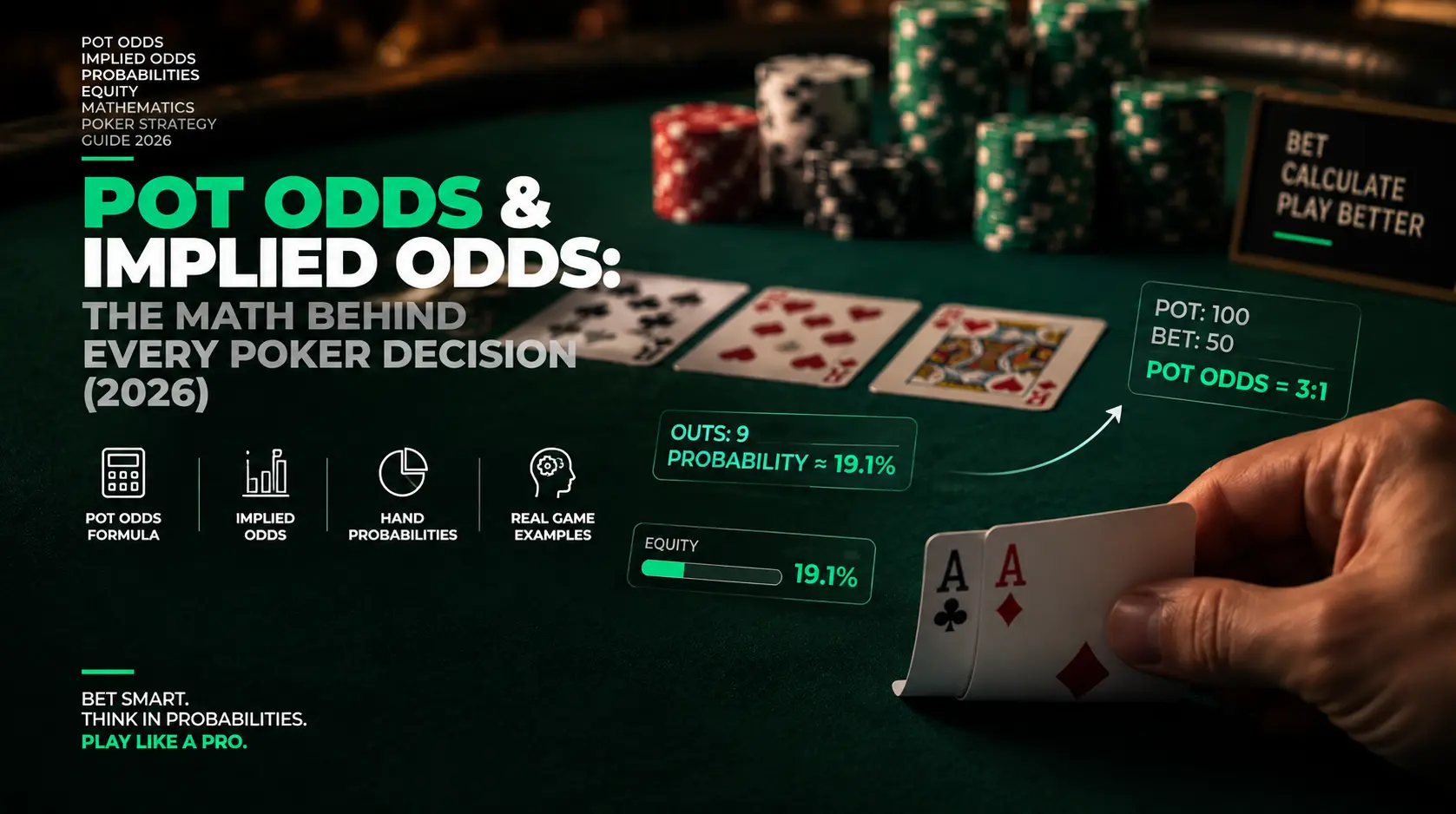
Pot odds are the price of calling now; implied odds account for extra opponent chips you might win later. First compare the current price with your modeled equity against the opponent’s assumed range. Then assess whether the future payoff is realistic and which future losses the calculation leaves out.
The price follows directly from the pot and call amounts. Equity and future payoffs depend on assumptions: an unknown opponent range cannot be replaced with certainty about the result.
| Concept | What it tells you | Known amount or estimate? |
|---|---|---|
| Pot odds | Available reward relative to the incremental call | Calculated from current amounts |
| Equity | Expected pot share at showdown, including shares of ties | Calculated for specified hands or ranges; the range itself may be an assumption |
| Implied odds | How extra future opponent money changes the price of the decision | The payoff is estimated, not promised |
| Reverse implied odds | Exposure to extra future losses, including after improving | Requires assumptions about future actions and losing outcomes |
Which pot amount should you use?
Use the pot currently in the middle, including the opponent’s bet but excluding your pending call. Call this amount S, and let C be the incremental amount you must pay to call.
Then:
- pot odds as a ratio:
S:C; - required equity:
C/(S+C).
Your earlier contributions are already in the pot. Do not count them again as part of the current call’s cost.
The pot odds calculator uses a different input: P is the pot before the opponent’s bet. Heads-up, with one opponent making a bet equal to your call C, S=P+C and the final pot after your call is P+2C.
For P=100 and C=50:
| Quantity | Result |
|---|---|
| Pot before the opponent’s bet | 100 |
| Pot after their bet, before your call | 150 |
| Cost to call | 50 |
| Pot after your call | 200 |
| Pot odds | 150:50 = 3:1 |
| Required equity | 50/200 = 25% |
The threshold is 25%, not 33.3%. Divide the call amount by the pot after your call, not by 150.
With no further betting or rake, the call’s expected value (EV) is EV=e*(P+2C)-C, where e is equity expressed as a decimal. At an assumed 30% equity, 0.30*200-50=+10 chips. Folding has EV 0 from the current decision point: earlier contributions are sunk.
At 25% equity, calling breaks even in this model. Positive EV means an average advantage if the assumptions are correct, not a guaranteed win in an individual hand. Equity is also not simply outright-win frequency: it includes your share of tied pots.
All examples below use chips on one consistent unit scale. The screenshots display pot amounts in dollars and EV in chips; reproduce the calculations using the same numerical values as units on that scale.
How does bet size change the price of a call?
A larger bet relative to the pot before the bet requires more equity to call. The table assumes one opponent, a call equal to their bet, no rake, and no further betting.
| Bet relative to the pot before the bet | Pot odds | Required equity |
|---|---|---|
| 1/4 pot | 5:1 | 16.7% |
| 1/3 pot | 4:1 | 20.0% |
| 1/2 pot | 3:1 | 25.0% |
| 2/3 pot | 5:2 | 28.6% |
| 3/4 pot | 7:3 | 30.0% |
| 1 pot | 2:1 | 33.3% |
| 1.5 pots | 5:3 | 37.5% |
| 2 pots | 3:2 | 40.0% |
Percentages are rounded to one decimal place. These are calling thresholds, not the bettor’s required bluff-success rates.
How do you reproduce the direct calculation?
Enter 100, 50, and 30 in the three main fields; the results update automatically. There is no Calculate button to press.
- Open the pot odds calculator.
- Enter
100in Pot size (before the bet). - Enter
50in Bet to call. - Enter
30in Your equity.
The results show a 25% threshold, 3:1 pot odds, a final pot of 200, and EV of +10 chips. The threshold does not measure hand strength: 30% equity is an input assumption here, not something established by the price.
Local calculator test with a pot of 100, call of 50, equity of 30%, and required equity of 25%
Local test example using 100/50/30, not a test of the published version. Pot amounts are displayed in dollars and EV in chips; the calculation uses one consistent unit scale.
The screenshot also shows MDF of 66.7% and bluff success of 33.3%. MDF is the minimum defense frequency for a range in a simplified model; the second figure concerns the bettor’s bluff price. Neither is the equity you need to call. These figures do not mean you should defend exactly 66.7% of your range against every real opponent.
How do outs differ from equity?
Outs help estimate the probability of improving, but not necessarily your chance of winning or your equity. A clean out produces a winning improvement under the stated model. A dirty out may improve your hand while still leaving it beaten. A card that completes both a flush and a straight counts only once.
For example, with A♠5♠ on the turn board K♠8♠2♥7♦, four of the 13 spades are known, leaving nine flush-completing candidates. Knowing only your hand and the board leaves 52 − 6 = 46 unseen cards, so the probability of completing the flush on the river is 9/46 ≈ 19.6%, rounded to one decimal place. These are candidate flush-completing cards, not guaranteed winning outs: 2♠ pairs the board’s 2♥ and could turn a possible opponent set into a full house. This flush-hit probability is not your equity against an opponent’s range.
With a fixed number of available outs, there are 47 unseen cards after the flop and 46 after the turn:
- probability of hitting on the next card:
outs/unseen cards; - probability of hitting at least once from flop to river:
1-((47-outs)/47)*((46-outs)/46).
This model assumes the outs remain appropriate after a turn miss. It does not automatically account for the opponent’s range, their improvements, or outcomes in which your completed hand loses.
| Outs | Flop → turn | Turn → river | Flop → river |
|---|---|---|---|
| 2 | 4.3% | 4.3% | 8.4% |
| 4 | 8.5% | 8.7% | 16.5% |
| 6 | 12.8% | 13.0% | 24.1% |
| 8 | 17.0% | 17.4% | 31.5% |
| 9 | 19.1% | 19.6% | 35.0% |
| 12 | 25.5% | 26.1% | 45.0% |
| 15 | 31.9% | 32.6% | 54.1% |
These figures are rounded to one decimal place and describe hit probability, not full showdown equity.
The rule of 2 and 4 is an approximation: multiply outs by 2 for one card and by 4 for two cards. For nine outs, 9*4=36%, while the exact probability in this model is about 34.97%.
A flop call normally buys only the turn card. You can use the roughly 35% two-card probability only when you will see both cards without further unmodeled payments—for example, in a relevant all-in situation. Even then, hitting does not automatically mean winning. A made hand on the river needs an equity estimate against a range, not a count of draw outs.
How do you check nine outs in the tool?
Set nine outs and select the turn; the probability of hitting with one card to come is 19.6%. In the outs estimator, enter 9 and choose Turn (1 card to come).
Local outs-calculator test showing nine outs on the turn and a 19.6% probability of hitting
Local test with nine outs and one card to come. The displayed 19.6% is the exact model probability, 9/46, rounded to one decimal place—not a rule-of-2 estimate. The interface label “Equity from outs” represents hit probability under a clean-out model here, not actual equity against an opponent’s range.
The optional Use button copies the rounded 19.6% result into the main equity field. Copying it does not remove the clean-out assumption.
For full counting guidance, read poker outs and the rule of 2 and 4. Use the equity calculator for explicitly specified hands and ranges; it cannot detect an opponent’s true range. The integrated card estimator in the pot odds calculator plays against uniformly random hand or hands, not the opponent’s actual betting range.
How do you calculate implied odds?
Add only the average extra opponent chips you expect to win conditional on a successful outcome. Call this amount X. It is a conditional average that includes winning outcomes where the opponent pays nothing more.
X excludes your own future matched wagers that are returned when you win. It represents extra net opponent money, not the entire future pot.
For a simplified draw model, assume:
- every hit wins;
- every miss leads to a fold with no further cost;
- there are no ties, rake, or extra losing bets;
eis the probability of success under this model.
Then:
- required equity:
C/(P+2C+X); - implied-odds ratio:
(P+C+X):C; - expanded-model EV:
e*(P+2C+X)-C; - minimum extra payoff:
Xmin=max(0,C/e-P-2C).
With P=100, C=50, an illustrative 20% success probability, and X=100, the threshold is 16.7%, the ratio is 5:1, and expanded-model EV is +10. Without the future payoff, EV is −10. The minimum required X is 50 chips.
The 20% figure is an illustrative assumption, not the exact probability for nine outs. At 9/46=19.565%, the minimum payoff is 55.56 chips, or 55.6 rounded. If the possible payoff is 100, you need to receive it in about 55.6% of successful outcomes, rather than the 50% required under the 20% assumption. Rounding can change a marginal decision.
If future play involves extra costs, losses after hitting, or different payoff outcomes, you need a fuller EV tree. A single X value does not describe all those risks.
How realistic is the future payoff?
Estimate the average payoff, not the opponent’s whole remaining stack or the bet you hope to collect. If the opponent pays another 100 chips in only 40% of successful outcomes and nothing in the other 60%, X=40.
Keeping the assumed success probability at 20%:
| Future payoff conditional on success | Average X | Expanded-model EV |
|---|---|---|
| 100 in 40% of outcomes, otherwise 0 | 40 | 0.20*240-50 = −2 |
| 100 in 60% of outcomes, otherwise 0 | 60 | 0.20*260-50 = +2 |
With a possible payoff of 100, you need payment in at least 50% of successful outcomes. If the collectible effective remaining stack after the current call is only 30, it cannot bridge the required 50 even if every success gets paid.
Heads-up, that ceiling is the smaller of your remaining stack and the opponent’s remaining stack after this call. Depth alone does not ensure a payoff. Consider the opponent’s range strength, position, how visibly the draw comes in, how well concealed your hand is, whether you can make the nuts, their willingness to pay, and their chance of improving later.
Set-mining with a pocket pair is one application of implied odds to a concealed strong hand. But not every set wins or gets paid; no universal stack-multiple rule replaces the calculation.
PokerStars Learn’s guide to implied odds provides context for assessing future payment through stack sizes and position. The formulas here are independently derived from the stated model; expected payment is not treated as certain.
How do you enable implied odds in the calculator?
Keep the pot at 100 and the call at 50, change equity to 20, and add an expected payoff of 100. This reproduces the expanded example but does not establish that the payoff is realistic.
- Enter
20in Your equity. - Enable Add implied odds.
- Enter
100in Extra chips you expect to win if you hit.
The adjusted threshold is 16.7% and the ratio is 5:1. The call verdict uses this threshold and therefore supports calling under the entered model.
Local implied-odds test with a pot of 100, call of 50, assumed success probability of 20%, and extra payoff of 100
Local test of the expanded example. The original 25% threshold and base EV of −10 remain on the card; the adjusted threshold is 16.7%.
The EV card displays the base model excluding X, so its −10 does not contradict the expanded calculation’s +10. The prompt about approximately 50 extra chips means the minimum required future payoff, not a reverse implied odds loss.
The calculator does not estimate payment likelihood, future losing bets, rake, or ICM.
What does the historical teaching example show?
The example illustrates future-money accounting, but its model assumes a guaranteed river payment. Page 18 of Joe Pasquale’s UCSD Poker Strategies material, Spring 2006, uses a pot of 16, a call of 6, and a future opponent payment of 6. The model assumes the opponent will certainly pay that 6 on the river; this is an assumption, not a guarantee in actual play.
The original teaching material gives:
- direct pot odds:
22:6 ≈ 3.7:1; - implied odds:
28:6 ≈ 4.7:1.
Two lines showing a future pot of 28 and implied odds of 28:6 ≈ 4.7:1
Joe Pasquale, UCSD, Poker Strategies, Spring 2006, page 18. The English original is unchanged; these are two lines from an example, not rules for a contemporary poker room.
The 28 in the implied-odds ratio is the available net reward, including the opponent’s future 6, not the literal final gross pot. The pot after the current call is 28. Future matched bets of 6 each increase it to 40. Subtract your current 6 and future 6, and the reward is 28.
Our calculation at a separately assumed 20% success probability gives a direct threshold of 6/28=21.43% and an adjusted threshold of 6/34=17.65%. This illustrates payoff accounting; it is not the exact equity of the source’s hand or a guarantee that calling was correct in that hand.
When do reverse implied odds change the decision?
Improving can lead to extra losses instead of a payoff. A low flush against a possible higher flush, a low straight, or an apparently strong hand on a paired board can all improve without becoming the winner.
Sections 3.4.1–3.4.2 of Denis Richard Papp’s 1998 thesis discuss implied and reverse implied effects of future betting. For practical calculations, this is a reason not to treat every improvement as a clean win.
Be less confident in the clean-out model when a non-nut draw can lose to a stronger hand or the opponent can improve later. Even a nut draw does not promise payment. Distinguish raw equity from equity realization: a theoretical showdown share does not describe every cost and fold on the way there.
You cannot simply enter negative X: the tool limits extra chips to nonnegative values. Assess future losses separately.
How does the calculation change in other situations?
The price formula remains C/(S+C), but you must clarify the eligible pot, equity, and future-action assumptions.
River calls and all-ins
On the river, compare the price with equity against the betting range; against an all-in, do not add future money from that opponent. With P=100 and C=50, a bluff-catcher needs the betting range to contain 25% bluffs only if it beats every bluff, loses to every value hand, and there are no ties or other outcomes.
If the opponent is all-in on the flop, there is also no future payment from them, but showdown equity must account for both remaining cards. A known price does not remove uncertainty about the range.
Calling after a raise
Count only the unpaid difference, not the entire bet again. If the current eligible pot is S=220 and the additional call costs C=40, the final pot is 260 and the threshold is 40/260=15.4%, rounded.
Earlier contributions are sunk. Read more about why being pot-committed does not automatically require continuing.
Multiway pots and side pots
Include chips already committed to a pot you can win, but not hoped-for future calls. Players behind you may still raise, and equity against multiple ranges differs from equity against one.
When different all-in amounts create side pots, evaluate each eligible share separately. Do not count chips from a pot you are not entitled to win as part of your reward.
Rake and tournament payouts
Rake reduces the payable pot, while ICM can change the value of chips in terms of prize money. In a hypothetical example where 10 chips are removed from the final pot of 200, the threshold is 50/190=26.3%, and EV at 30% equity is 0.30*190-50=+7. This is an illustrative model, not a claim about any room’s rake.
In a tournament, positive chip EV does not necessarily mean positive prize-money EV. See the ICM explanation; the pot odds calculator does not perform this calculation automatically.
How can you review a past hand?
Review a saved hand and record the assumptions alongside the result. You do not need to start a new game or deposit money.
- Record the pot before the bet
Pand the current eligible potS. - Identify only the incremental call amount
C. - Record the cards, available runout, and assumed opponent range.
- Separate hit probability from equity; flag dirty outs and double-counted outs.
- Estimate average future payoff
X, including successful outcomes with no payment, and the collectible effective remaining-stack ceiling. - Record future-loss risks, rake, and any potential ICM effects.
- Compare the price with your chosen estimate and save the calculation with its assumptions.
Practice 1. The pot before the bet is 100, the call costs 50, equity is 30%, and there is no further betting or rake. Answer: the threshold is 25%, pot odds are 3:1, and EV is +10. Calling has positive EV under the stated model.
Practice 2. Use the same amounts, a 20% success probability, and a possible extra payoff of 100. If 40% of successful outcomes get paid, X=40 and EV is −2. If 60% get paid, X=60 and EV is +2. The decision changes because of the realistic average payoff, not merely because a large stack exists.
Frequently Asked Questions
Yes. Use the same unit for every money field, including extra chips X. Ratios and percentages stay unchanged; EV is numerically in your chosen input unit despite the UI’s chips label. Never mix units.
In a heads-up scenario with a single bet and a call equal to that bet, the before-bet pot is P = S − C. With 150 visible and a bet of 50, enter 100 in the before-bet field. Do not apply this shortcut blindly to raises or side pots.
You can calculate pot odds from the amounts without cards. Equity requires an explicitly assumed range or matchup. The integrated estimator uses uniformly random opponent hands; it does not identify the opponent’s actual betting range.
Evgeniy Volkov
Verified ExpertFullstack developer with a background in mathematics. I build the calculators and game-style tools on ToolsGambling with Pixi.js and modern web tech, and every result uses transparent probability formulas you can verify yourself.