












Contents
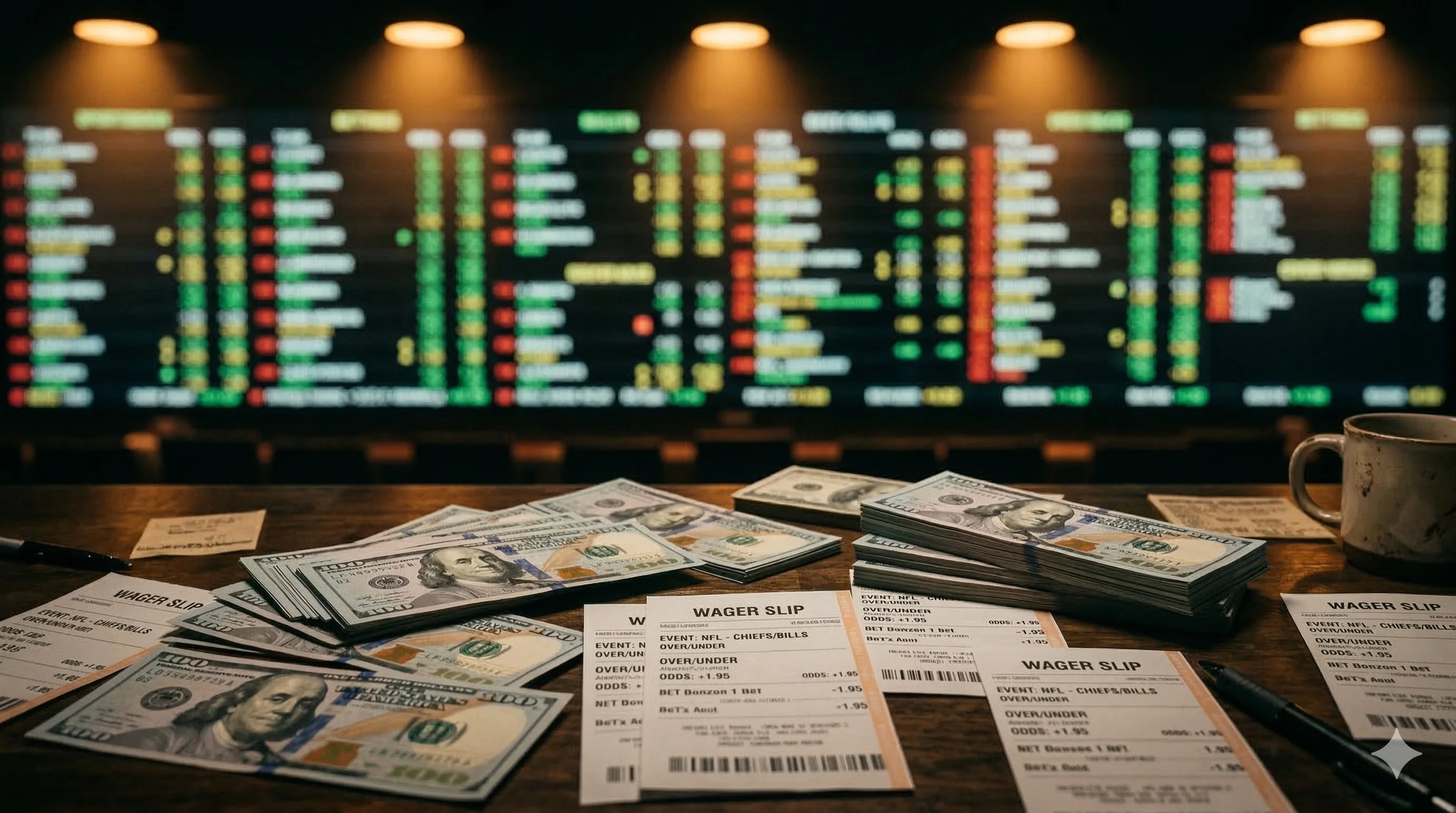
Super Bowl Sunday, 2024. While 123 million viewers watch the Chiefs and 49ers battle it out, sportsbooks across the country are tracking a different number, $23.1 billion in total wagers. That number? It's called the handle.
Handle is the total amount of money wagered on a game, market, or event. Not the sportsbook's profit. Not the number of bets. Just the raw dollar volume flowing through the window. If 50,000 people bet an average of $200 on the Super Bowl, the handle is $10 million, regardless of who wins.
Understanding handle separates casual bettors from people who actually know how betting odds work. A huge portion of that Super Bowl handle comes from prop bet sheets and party pools, casual money that moves the lines. By the end of this guide, you'll know exactly how to read handle data, spot sharp money, and use it to make smarter bets in 2026.
TL;DR, Handle Explained in 30 Seconds
Key Numbers at a Glance
| Term | Definition | Example |
|---|---|---|
| Handle | Total $ wagered | $10M bet on a game |
| Hold | Sportsbook's profit % | 5% of $10M = $500K |
| Revenue | Dollar profit (hold × handle) | $500K |
| Tickets | Number of individual bets | 50,000 bets |
| Handle % | % of money on each side | 68% Side A / 32% Side B |
| Ticket % | % of bets on each side | 41% Side A / 59% Side B |
The key insight: when handle% and ticket% diverge, sharp money is talking. If 68% of the money is on Side A but only 41% of tickets, large, informed bets are pushing the handle. That's the signal professional bettors track.
What Does "Handle" Mean in Sports Betting?
Handle Definition, The Simple Version
Handle = total dollars wagered. That's it.
If a sportsbook takes 10,000 bets on tonight's Lakers game, and the average bet size is $75, the handle on that game is $750,000. It doesn't matter who wins, what the odds are, or how many bets were placed on each side, the handle is just the total money in.
Think of it like a poker pot. Every chip pushed into the middle counts toward the pot size. Handle works the same way, every dollar wagered counts, win or lose.
Handle vs Revenue, What's the Difference?
People confuse these constantly. Here's the distinction:
- Handle = total money wagered (the full pie)
- Revenue = the sportsbook's cut (a slice of the pie)
If $10 million is wagered on an NFL Sunday, that's the handle. The sportsbook might keep $700,000 of that, that's the revenue (also called Gross Gaming Revenue or GGR). The rest goes back to winning bettors.
Revenue depends on outcomes. Handle doesn't. A book can have a $50M handle and lose money if favorites sweep the board. That's why understanding edge in betting matters, the house edge is built into the odds, not guaranteed on every event.
Handle vs Hold, What's the Difference?
Hold is the sportsbook's profit expressed as a percentage of handle.
In plain English: if a book takes $10M in wagers and keeps $500K, the hold is 5%.
Typical hold rates in the US (2026):
| Bet Type | Hold % | What It Means |
|---|---|---|
| Straight bets (sides/totals) | 4.5–6% | Book keeps $45–60 per $1,000 wagered |
| Parlays | 15–25% | The real moneymaker for sportsbooks |
| Futures | 20–40% | Long exposure = higher hold |
| Live/in-play | 6–10% | Faster markets, wider margins |
| Industry average | ~7.2% | Across all bet types |
Notice how parlays have 3-4x the hold of straight bets? That's why sportsbooks promote parlays so aggressively. It's not rigged, it's just better business.
Handle vs Tickets, Why the Gap Matters
This is where handle gets interesting for sharp bettors.
Tickets count the number of individual bets. Handle counts the dollars. When these two percentages don't match, it tells you something important about who is betting.
Example:
- Game: Chiefs -3 vs Bills +3
- Ticket split: 62% Chiefs / 38% Bills
- Handle split: 45% Chiefs / 55% Bills
Wait, more people bet on the Chiefs, but more money is on the Bills? That means the Bills bettors are placing much larger wagers on average. In the industry, large wagers usually come from sharp bettors, not the public.
This handle-ticket divergence is one of the most reliable indicators of where professional handicappers are putting their money.
How Handle Works in Practice (2026)
Handle Breakdown Example
Let's walk through a real-world scenario. Alabama vs LSU, Saturday night primetime.
Before kickoff:
- Total handle: $10,000,000
- Tickets on Alabama -7: 71% (the public loves Bama)
- Handle on Alabama -7: 52%
- Tickets on LSU +7: 29%
- Handle on LSU +7: 48%
What this tells us:
The public is heavily backing Alabama (71% of tickets). But nearly half the money is on LSU. Since fewer bettors are on LSU yet they're generating almost equal handle, those LSU bets are significantly larger.
Average bet calculation:
- Alabama bettors: 71% of ~100,000 tickets = ~71,000 bets × avg $73 = $5.2M
- LSU bettors: 29% of ~100,000 tickets = ~29,000 bets × avg $166 = $4.8M
LSU bettors are wagering 2.3x more per bet than Alabama bettors. That's a sharp signal.
What Is a "False Handle" in Betting?
Not every handle spike means sharp money. A false handle is when dollar volume surges without informed opinion behind it.
How to Spot a False Handle Signal
False handles typically come from:
- Celebrity/influencer picks, Drake bets $500K on a UFC fight. His followers pile in. The handle spikes, but nobody has an edge.
- Promotional credits, Sportsbooks give away $200 in free bets. Thousands of new users bet on the same popular team. The handle inflates artificially.
- Viral social media, A TikTok "lock of the century" sends 50,000 people to bet the same side. High handle, zero edge.
- Steam chasing, Bettors see a line move and pile in, assuming sharps caused it. Sometimes the original move was a false handle itself.
Real Example of False Handle
Super Bowl 2023: a famous rapper publicly backed the Eagles money line for $1.1M. Within hours, Eagle money line handle spiked 340% at multiple books. The line barely moved, because the books knew this was public celebrity money, not sharp opinion.
The lesson: volume without information is just noise. Always check whether handle is driven by size (sharp) or by count (public) before acting on it.
How Sharp Money Shows Up in Handle Data
Sharp money is the holy grail of handle analysis. Here's how to read it like a professional bettor.
When High Handle = Smart Money
The classic sharp signal:
- Handle %: 65%+ on one side
- Ticket %: below 45% on the same side
- Line movement: toward the high-handle side
This means a small number of bettors are placing large wagers, and the sportsbook is adjusting the line in response. Books don't move lines because of tweet volume, they move lines because of dollar exposure.
Key threshold: when the handle% exceeds the ticket% by 20+ percentage points on the same side, there's a high probability sharp money is involved.
When High Handle Is Misleading
High handle ≠ smart money when:
- Handle% tracks ticket% closely (within 5%), this is just balanced public action
- The event is a major public spectacle (Super Bowl, March Madness finals), casual money floods in
- Line doesn't move despite lopsided handle, books are comfortable with their exposure, suggesting the money isn't from respected accounts
- Reverse steam, a line moves sharply, then bounces back. The original move was likely a false signal.
Handle and Reverse Line Movement
Reverse line movement (RLM) is the most powerful handle-based signal in sports betting. It occurs when:
- The majority of tickets are on Side A
- The line moves toward Side B (making Side A cheaper)
This only makes sense if heavy handle on Side B is forcing the move. The book is essentially saying: "We're more worried about the dollar exposure on Side B than the number of tickets on Side A."
Step-by-Step: Reading Handle + Line Movement
Here's a real process for analyzing handle with line movement:
- Check opening line: Bills +3 (-110)
- Check ticket split: 64% on Chiefs -3
- Check handle split: 58% on Bills +3
- Watch line movement: Bills +3 → Bills +2.5
The line moved toward the Bills (from +3 to +2.5) despite the public being on the Chiefs. This is textbook RLM, sharp money on the Bills forced the move.
When you see this pattern, it doesn't guarantee the Bills will cover. But historically, RLM sides win at a rate of approximately 53-55%, which is well above the ~52.4% break-even threshold at -110 odds. That's an edge worth tracking.
| Event | Estimated Handle ($B) |
|---|---|
| Super Bowl LVIII | 23.1 |
| March Madness | 15.5 |
| College Football Playoff | 2.0 |
| World Cup Final 2022 | 1.8 |
| NFL Conference Championships | 1.5 |
| NBA Finals (total) | 1.2 |
| Kentucky Derby | 0.3 |
How Sportsbooks Use Handle to Set Lines
Sportsbooks don't set lines based on what they think will happen, they set lines to balance their handle. The goal is to collect roughly equal money on both sides and profit from the vig.
Here's the process behind the scenes:
- Opening line, Set by the head trader or an algorithm based on power ratings, injuries, and market data
- Early sharp action, Professional bettors hit the openers within minutes. This is the highest-value period because lines are least efficient
- Handle monitoring, The trading desk watches handle accumulate in real-time. If one side gets too heavy, they adjust
- Line movement, Move the line 0.5–1 point toward the overloaded side. This makes the other side more attractive
- Game-day surge, 60-70% of public handle comes in the final 2 hours before kickoff. Books brace for this
- Closing line, The most efficient point. Research shows the closing line is the best predictor of outcomes
The key insight: sportsbooks move lines based on handle, not on who they think will win. If $8M is on the Chiefs and $2M is on the Bills, the book moves the Chiefs line to attract Bills money, even if they personally like the Chiefs.
This is why handle data matters. It's not opinion, it's what people are actually risking their money on.
Biggest Betting Handles in Sports History (2026)
Super Bowl Handle by Year
The Super Bowl is the single largest betting event in the US. Here's how the legal handle has grown:
| Year | Super Bowl | Legal US Handle | Year-over-Year |
|---|---|---|---|
| 2024 | LVIII (Chiefs vs 49ers) | $23.1B | +35% |
| 2023 | LVII (Chiefs vs Eagles) | $16.0B | +62% |
| 2022 | LVI (Rams vs Bengals) | $7.6B | +78% |
| 2021 | LV (Bucs vs Chiefs) | $4.3B | +21% |
| 2020 | LIV (Chiefs vs 49ers) | $3.5B | , |
The explosion tracks directly with state-by-state legalization. In 2020, 18 states had legal sports betting. By 2024, it was 38 states + DC.
March Madness Handle
March Madness generates the second-highest handle in US sports betting. The 2024 tournament saw an estimated $15.5 billion in total handle across 67 games, roughly $231M per game.
What makes March Madness unique for handle analysis:
- Public pools inflate ticket counts (office brackets → casual bets), much like office pools and Super Bowl board templates add millions to the informal handle each February
- Sharp money concentrates on conference tournaments and first-round games where lines are softest
- Handle swings wildly between rounds, first-round Fridays can see 5x the handle of Sweet 16 games
World Cup and Other Major Events
| Event | Estimated Global Handle | Year |
|---|---|---|
| FIFA World Cup Final 2022 | ~$1.8B | 2022 |
| Kentucky Derby | ~$300M | 2024 |
| College Football Playoff | ~$2.0B | 2024 |
| NFL Conference Championships | ~$1.5B | 2024 |
| NBA Finals (per game) | ~$200M | 2024 |
| NCAA March Madness | ~$15.5B | 2024 |
Global handle across all sports betting is estimated at $1.7 trillion annually in 2026. The US alone accounts for roughly $120 billion of that, and growing.
What Does Handle Mean in Specific Sports?
Handle in Football Betting (NFL/College)
Football dominates US betting handle. The NFL alone generates more weekly handle than any other sport, with a typical Sunday slate exceeding $1 billion in combined handle across legal US sportsbooks.
Key handle patterns in football:
- Monday Night Football gets 3-4x the handle of a standard 1pm Sunday game
- Primetime games attract disproportionate public money (more casual bettors watching)
- College football Saturdays see heavy handle on ranked matchups, while FCS games get almost none
- Playoff games see handle spikes of 200-500% vs regular season
NFL handle data is particularly useful because the weekly schedule creates natural comparison points. You can track how handle flows differently for Thursday vs Sunday vs Monday games.
Handle in MLB Betting
Baseball generates the most consistent daily handle of any sport, 162 games per team means action every single day from April to October.
MLB handle patterns are unique:
- Money line dominant, unlike football, most MLB handle goes on money lines, not spreads
- Run line handle has grown significantly since 2022 (more public awareness of -1.5 spreads)
- Sharp money hits early in MLB because public bettors wait until game time to bet on pitching matchups
- Total (over/under) handle often exceeds side handle on high-profile pitching matchups
Handle in NBA Betting
NBA handle peaks during the playoffs, with Conference Finals and Finals generating 3-5x regular-season handle per game.
Regular season NBA handle patterns:
- National TV games (ESPN, TNT) generate 2-3x more handle than League Pass games
- Player prop handle has exploded, some books report prop handle exceeding traditional side/total handle
- Live betting handle in NBA is the highest of any sport (fast pace = more in-game wagering)
- Back-to-back (B2B) games see sharp handle fade the tired team
How to Use Handle Data for Smarter Bets
Where to Find Handle Data
Finding reliable handle data isn't always easy. Here are the best sources in 2026:
| Source | Data Type | Cost | Reliability |
|---|---|---|---|
| State Gaming Commissions | Monthly aggregate handle by sport | Free | Official but delayed (30-60 days) |
| Action Network | Game-level handle% and ticket% | Free/Premium | Good, aggregated from multiple books |
| DraftKings/FanDuel apps | In-app handle indicators | Free with account | Limited to their own book's data |
| Vegas Insider | Handle movement and line history | Free | Good for historical data |
| US Integrity | Suspicious handle alerts | Industry only | Gold standard for integrity monitoring |
The most actionable data for individual bettors is game-level handle% vs ticket% from aggregators like Action Network. This lets you run the handle-ticket divergence analysis described above.
3 Handle-Based Betting Strategies
Strategy 1: Follow the Sharp Divergence
When handle% exceeds ticket% by 20+ points on the same side, track the result. Historically, the high-handle/low-ticket side covers approximately 54-55% of the time against the spread.
Best applied to: NFL sides, NBA totals, college basketball spreads.
Strategy 2: Fade the Public on Marquee Events
For major events (Super Bowl, MNF, Conference Finals), the public floods the popular side with small bets. Handle% often stays balanced because sharp money takes the other side. Look for: high ticket% (>65%) on the favorite but handle% below 55% on the same side.
Best combined with: value bet analysis and line shopping.
Strategy 3: Monitor Handle for Teaser Key Numbers
In NFL teasers, handle data reveals which key numbers sharps are targeting. When handle% spikes on specific teaser legs crossing 3 and 7, it validates the Wong teaser approach. Track handle distribution across teaser configurations to identify which combinations attract professional money.
Pro tip: always convert your odds to implied probability before comparing handle signals. A sharp signal at -110 is worth more than the same signal at -250.
Frequently Asked Questions
Handle is the total amount of money wagered on a game, event, or market. If 10,000 bettors place an average of $50 each, the handle is $500,000.
Handle is total money wagered. Hold is the sportsbook's profit — the percentage of handle they keep. A $10M handle with 5% hold means $500K profit for the book.
A high handle means a large amount of money has been wagered on a particular event or side. It may indicate sharp action, public interest, or both — context matters.
Sportsbooks monitor handle to manage risk. When too much money lands on one side, they move the line to attract action on the other side and balance their exposure.
A false handle occurs when high dollar volume doesn't reflect sharp opinion. For example, a celebrity endorsement or viral social media post can spike handle without any edge behind it.
State gaming commissions publish monthly handle reports. Sites like Action Network, BetMGM, and DraftKings show handle percentages for individual games.
Reverse line movement happens when the line moves toward the side with less ticket percentage but more handle percentage — a strong indicator of sharp money.
The total Super Bowl LVIII handle in 2024 was estimated at $23.1 billion across legal and offshore markets, making it the largest single-event handle in US sports betting history.
No. High handle can come from a few large public bettors, promotional credits, or viral picks. True sharp signals require handle% to diverge significantly from ticket%.
NFL handle refers to the total money wagered on NFL games. The NFL consistently generates the highest weekly handle of any US sport, with Sunday slates often exceeding $1B combined.
Tickets count the number of individual bets placed. Handle counts total dollars. If 1,000 bets average $10 each, tickets = 1,000 and handle = $10,000.
Handle data alone won't guarantee wins, but comparing handle% vs ticket% helps identify where sharp money is landing. When the two diverge, sharps are likely on the high-handle side.
US sportsbooks typically hold 5-8% of handle on traditional bets and 15-25% on parlays. The industry average hold rate is around 7.2% across all bet types.
Sportsbooks move lines based on liability, not opinion. A massive handle imbalance on one side forces them to adjust the line to limit potential losses.
Football (NFL + college) generates the largest annual handle in the US, followed by basketball (NBA + college), baseball (MLB), and then combat sports and soccer.
Evgeniy Volkov
Verified ExpertFullstack developer with a background in mathematics. I build the calculators and game-style tools on ToolsGambling with Pixi.js and modern web tech, and every result uses transparent probability formulas you can verify yourself.