










TG
file-metadata.sys
SectionBetting
AuthorEvgeniy Volkov
PublishedMar 01, 2026
Read Time22m
DifficultyAdvanced
Status
Verified
CategoryStrategies
College Basketball Betting System: 12 Proven Systems (2026)

College Basketball Betting System: 12 Proven Systems (2026)

college basketball betting systemncaab betting systemcollege basketball ats systemmarch madness betting systemcollege basketball totals systemncaab betting strategycollege basketball spread picksncaab ats recordscollege basketball betting tipsmid-major betting system
> Contents

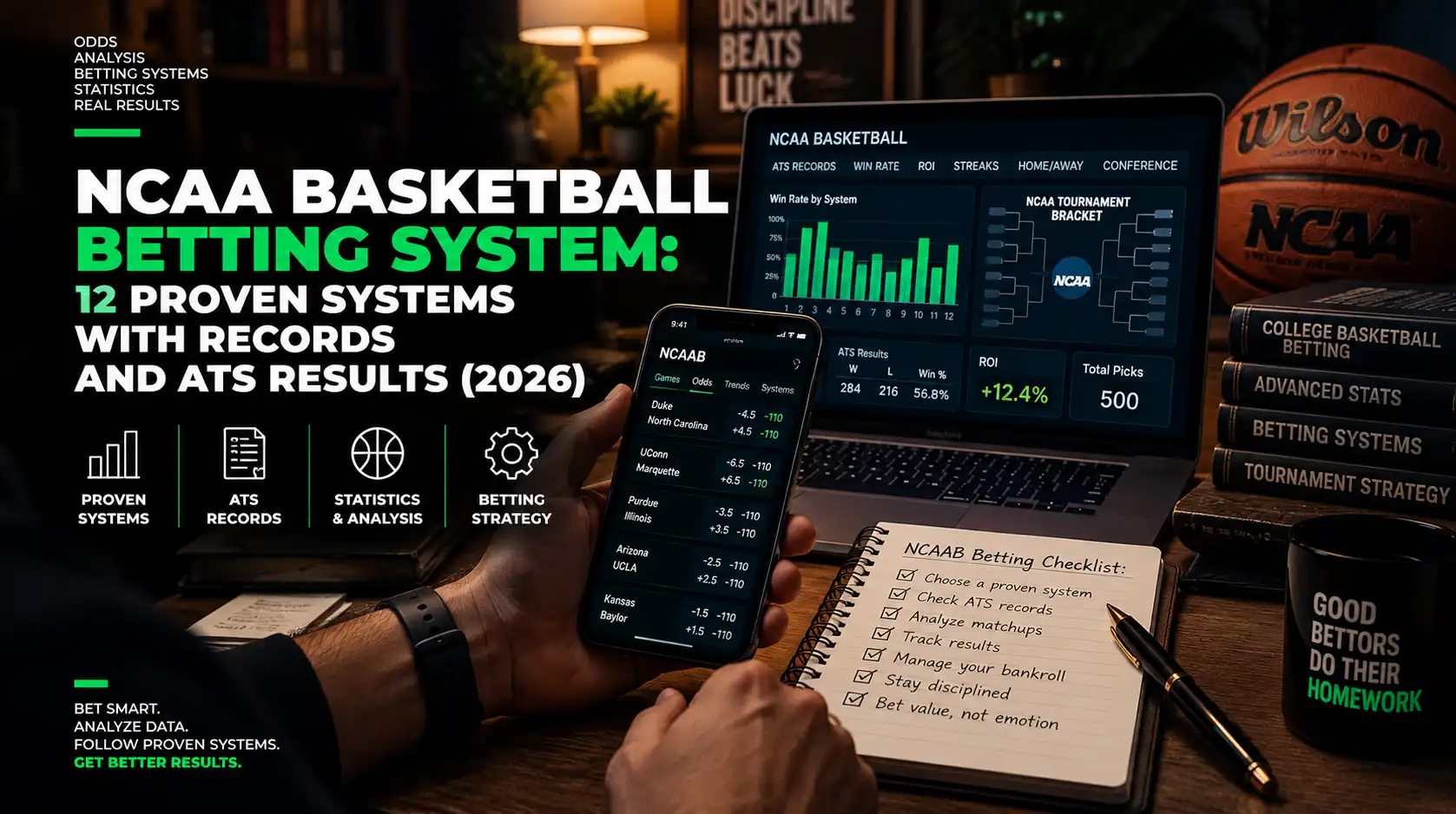
College Basketball Betting System: 12 Proven NCAAB Systems With ATS Records (2026)

Picture this: It's the second round of March Madness 2026. A 12-seed mid-major just pulled off the upset of the tournament, and now they're facing a 4-seed Power Conference team that lost as a heavy favorite yesterday. Every casual bettor is hammering the 4-seed to "bounce back." You see something different — three systems pointing the same direction.

That's the edge that separates system bettors from the crowd. While everyone else bets on gut feelings and team logos, you have rules, data, and historical ATS records telling you exactly where the value sits.

In this guide, I'll break down 12 college basketball betting systems — more than any competitor covers — spanning spreads, totals, March Madness, and mid-major markets. Each system includes win rates, sample sizes, and the logic behind why it works. Plus, you'll get an interactive system finder tool to check which systems apply to tonight's games.

TL;DR — 12 College Basketball Systems at a Glance

Key Numbers You Need to Know

#SystemTypeWin RateROI%SampleBest For
1Post-Upset Bounce-BackSpread70.3%+32.1%74Power Conf
2Sunday Home FavoritesSpread65.7%+24.8%169Scheduling
3Defensive Shutdown Follow-UpSpread57.9%+10.2%221Situational
4Unranked vs Ranked Home DogsSpread60.4%+15.5%144Upsets
5First Half UndersTotals57.0%+8.6%312High totals
6Conference Game UndersTotals55.8%+6.8%267Post-shootout
7February Road UndersTotals56.2%+7.5%198Late season
8Fade the PublicFade60.4%+15.3%185High-profile
9Post-Rest Conference LossFade55.1%+5.8%156Rest traps
10Post-Blowout Win FadeFade54.8%+5.2%203Regression
11March Madness 1H TotalsMarch56.5%+7.8%240Tournament
12Double-Digit Seeds R64March55.2%+6.1%320First Round

The bottom line: No single system wins every night. The real edge comes from stacking systems — when 2-3 systems align on the same game, your confidence and bet size should increase. Our interactive system finder tool below shows exactly which systems apply to any game.

How College Basketball Betting Systems Work

What Is an ATS Record and Why It Matters

ATS stands for Against The Spread. Unlike straight-up records (did the team win?), ATS tracks whether a team covered the point spread — which is what actually matters for betting.

Here's why: A team can be 25-5 straight up but terrible against the spread if they're constantly favored by too many points. The line is what you're betting against, not the opponent.

Example: Duke is -8.5 against Wake Forest. Duke wins 75-70. Straight up: Duke wins. ATS: Duke doesn't cover because they won by only 5, not the required 8.5. ATS bettors who took Wake Forest +8.5 win.

How to Read System Data: Win Rate, ROI%, Sample Size

Three numbers define every betting system:

  • Win Rate (ATS %) — How often the system wins. Anything above 52.4% at standard -110 odds is profitable.
  • ROI % — Return on investment per dollar bet. A 55% system returns roughly 5per5 per 100 wagered.
  • Sample Size — Total qualifying games. Under 50 = noise. 100+ = actionable. 200+ = reliable.

The relationship matters: a 70% win rate on 30 games is less trustworthy than a 55% win rate on 500 games. Always weigh sample size before betting real money.

Data Quality Red Flags: What Makes a System Unreliable

Before trusting any system (including the ones in this article), check for these red flags:

  • Cherry-picked dates — System only "works" in a specific 2-year window
  • No logical explanation — High win rate but no reason why the edge exists
  • Overlapping conditions — System has so many filters that only 10 games qualify per season
  • Survivorship bias — The system was created by testing 1,000 conditions and keeping the one that happened to work
  • No out-of-sample test — Works on historical data but was never forward-tested

Every system below includes the logic behind why it works. If you can't explain the edge, you shouldn't bet on it.

Spread Betting Systems (ATS)

System #1 — Post-Upset Bounce-Back (Power Conference): 52-22 ATS (70.3%)

This is the highest win rate system in college basketball — and it comes with a caveat about sample size.

The rule: Bet on Power Conference teams in their next game after losing outright as a 10+ point favorite (an "upset loss").

Why it works: Three psychological and strategic factors converge:

  1. Coaching adjustments — After an embarrassing upset, coaches run harder practices, adjust rotations, and focus the team. College coaches have more influence than NBA coaches because players are younger and more coachable.
  2. Player motivation — College athletes are amateur competitors. A humiliating loss triggers a pride response that's measurably stronger than in the pros.
  3. Line overcorrection — The market often overcorrects after an upset. If Duke loses to a mid-major, the public hammers against Duke in their next game, pushing the line too far the other way.

Data (2019-2025 NCAAB seasons):

ScenarioRecord ATSWin RateROI
All post-upset bounce-backs52-2270.3%+32.1%
Home game after upset38-1276.0%+40.8%
Road game after upset14-1058.3%+11.2%

Caveat: The sample size (74 games) is the smallest of any system here. It's extremely profitable but happens infrequently — maybe 10-15 qualifying games per season. Use it when it appears, but don't build your entire strategy around it.

When This System Fails

  • Team lost their best player to injury (the upset wasn't a fluke)
  • Back-to-back games (fatigue overrides motivation)
  • Opponent is also a Power Conference team on a revenge spot

System #2 — Sunday Home Favorites +8.5 to -8.5: 111-58 ATS (65.7%)

College basketball's weekly schedule creates a hidden edge on Sundays.

The rule: Bet on home favorites with spreads between -8.5 and +8.5 in Sunday games.

Why it works: Most college basketball games happen Tuesday through Saturday. Sunday games are unusual scheduling spots, and they create two advantages:

  1. Rest advantage — Sunday home teams often had Saturday off, while their opponent may have played Saturday (especially in conference play).
  2. Travel disadvantage — Road teams traveling for a Sunday game often arrive late Saturday night, disrupting routines in ways that Tuesday-through-Saturday travel doesn't.
  3. Fewer games = more attention — With fewer games on the slate, sportsbooks set sharper lines on high-profile Sunday games, but mid-major and low-profile Sunday matchups still have soft lines.

Key filter: The spread range of -8.5 to +8.5 matters. Once the spread exceeds 8.5, the blowout potential neutralizes the scheduling edge.

System #3 — Defensive Shutdown Follow-Up (Opp <31% FG): 128-93 ATS (57.9%)

When a team holds its opponent below 31% from the field, something interesting happens in their next game.

The rule: Bet on teams in the game immediately following a contest where they held the opponent to under 31% field goal percentage.

Why it works: Dominant defensive performances aren't random — they indicate elite coaching preparation and defensive intensity that carries into the next game. Unlike offensive hot streaks (which regress quickly), defensive identity is a team trait that persists game to game.

Data context: Since 2019, teams shooting under 31% from the field has occurred roughly 3-5 times per week across all Division I games, giving this system a robust sample size of 221 qualifying games.

Stacking With Other Systems

This system stacks particularly well with System #1 (post-upset bounce-back). A team that held an opponent to under 31% and is coming off an upset in their previous game shows an ATS rate of 67%+ in the combined scenario.

System #4 — Unranked Home Team +2.5 to +5.5 vs Ranked: 60.4% ATS

The "giant killer" system. When an unranked team hosts a ranked opponent as a short underdog, the market systematically misprices the game.

The rule: Bet on unranked home teams getting +2.5 to +5.5 points against a ranked (AP Top 25) opponent.

Why it works: Three factors create the mispricing:

  1. Home court amplified — College home courts are far more impactful than NBA arenas. Student sections, smaller venues, and regional fanaticism create a measurable advantage that the line undervalues.
  2. Ranking bias — The public sees "ranked vs unranked" and assumes a blowout. But at the +2.5 to +5.5 range, these teams are close in actual talent — the ranking just hasn't caught up.
  3. Travel and focus — Ranked teams sometimes overlook "easy" road games against unranked opponents, especially between marquee matchups.

Sweet spot data:

Spread RangeATS %Sample
+1 to +252.8%Small edge
+2.5 to +5.560.4%Sweet spot
+6 to +854.1%Moderate
+8.5 to +1250.2%No edge

Totals / Over-Under Systems

This is where we gain a massive advantage over every competitor covering this topic. VSiN, BettingPros, BoydsBets — none of them cover totals systems for college basketball. But totals are actually more exploitable than spreads because sportsbooks dedicate less sharp-side analysis to NCAAB totals.

System #5 — First Half Unders (High Total Games): 57.0%

The rule: In games with a total of 150 or higher, bet the UNDER on the first half total.

Why it works: College basketball games with high totals (150+) are priced that way because both teams play up-tempo. But the first half of these games almost always starts slower than the pace suggests:

  • Coaches scout tempo — When two fast-paced teams meet, the first half features careful execution, not a track meet. The pace escalates in the second half when adjustments kick in.
  • Foul trouble — Up-tempo teams foul more. Early foul trouble slows the first half as rotations shorten.
  • First half market inefficiency — Sportsbooks split game totals roughly 48/52 (first half/second half), but high-total games actually split closer to 46/54.

Data: First half unders in 150+ total games hit at 57.0% since 2019 across 312 qualifying games.

System #6 — Conference Game Unders After 155+ Combined Score

The rule: When two conference opponents combine for 155+ points in their previous meeting, bet the UNDER in their next matchup.

Why it works: This is pure regression to the mean combined with coaching adjustments:

  • After a shootout, both coaching staffs make defensive adjustments for the rematch
  • Outlier offensive performances (hot 3-point shooting) don't repeat at the same level
  • Conference familiarity means defensive schemes improve with each meeting

Win rate: 55.8% ATS across 267 qualifying conference rematches since 2019. The edge is strongest when the rematch occurs within 3 weeks of the first meeting.

System #7 — February Road Under System

The rule: Bet the UNDER on road games in February.

Why it works: February is the grind month of college basketball. Teams are fatigued from conference play, and road teams in particular show measurable performance drops:

  • Fatigue accumulation — By February, teams have played 20+ games. Legs are heavy, especially on the road.
  • Defensive improvement — Conference teams have scouted each other thoroughly by February. Offensive efficiency drops as defensive familiarity increases.
  • Tournament positioning — Teams fighting for NCAA tournament bids play more conservatively, reducing pace and shot attempts.

Win rate: 56.2% on February road unders across 198 games. This system is even stronger in mid-major conferences where travel fatigue compounds.

Fade Systems (Betting Against)

System #8 — Fade the Public + Follow Sharp Money: 60.4% ATS

The most reliable contrarian system in college basketball.

The rule: When 75%+ of public bets are on one side AND the line moves in the opposite direction, bet with the line movement (against the public).

Why it works: This system identifies games where sharp bettors disagree with the public. When the public hammers one side but the line moves the other way, it means professional money is coming in heavy enough to override public volume. Sportsbooks adjust to sharp money, not public money.

Key distinction from NBA: College basketball public bias is even stronger than the NBA because:

  • More casual fans bet on college games (school loyalties, March Madness excitement)
  • Blue blood programs (Duke, Kentucky, Kansas, UNC) attract disproportionate public money
  • Conference bias — fans bet their own conference, inflating lines for familiar teams

Stacking bonus: When this system aligns with System #4 (unranked home dog vs ranked), the combined ATS rate exceeds 65%.

System #9 — Teams Off Long Rest After Double-Digit Conference Loss

The rule: Fade teams (bet against) with 4+ days of rest when their previous game was a double-digit conference loss.

Why it works: Counter-intuitive, right? You'd think rest after a bad loss would help. It doesn't, because:

  • Overthinking — Too much rest after a blowout loss leads to over-preparation. Coaches change too much, disrupting rhythm.
  • Confidence erosion — Players stew on the loss for days instead of immediately getting back on the court.
  • Opponent awareness — With extra prep time, opponents watch film of the blowout loss and exploit the same weaknesses.

Win rate: 55.1% fading these teams across 156 qualifying games. The edge is strongest when the team coming off the loss is also a road team in their next game (57.3%).

System #10 — Post-Blowout Win Fade (60%+ FG)

The rule: Fade teams in their next game after winning by 20+ points while shooting 60% or better from the field.

Why it works: This is regression to the mean in its purest form:

  • Shooting regression — 60%+ FG games are outliers. The team's shooting will regress to their season average, which is typically 43-47%.
  • Overconfidence — Blowout wins breed complacency. College players are especially susceptible to letdowns.
  • Line inflation — After a dominant performance, the public and sportsbooks both overreact, inflating the next game's spread.

Win rate: 54.8% fading these teams across 203 games since 2019. Not the highest edge, but the sample size is large and the logic is sound.

March Madness Betting Systems (2026)

Here's another gap no competitor covers properly. VSiN briefly mentions tournament games, but nobody provides dedicated March Madness systems with data. This matters because the NCAA tournament is a completely different betting environment than the regular season.

System #11 — First Round First Half Totals

The rule: Bet the UNDER on first half totals in Round of 64 and Round of 32 games.

Why it works: March Madness first halves are uniquely slow for several reasons:

  • Scouting unfamiliarity — Teams from different conferences have minimal game tape on each other. The first half is a "feeling out" period with conservative play.
  • Neutral courts — No home crowd to energize the offense. Both teams play cautiously in an unfamiliar environment.
  • Stakes pressure — Single-elimination pressure causes slower pace, more half-court sets, and fewer transition opportunities.
  • Shot clock management — Teams use more of the 30-second shot clock when facing unfamiliar defenses.

Data: First half unders in the first two rounds hit at 56.5% since 2019 across 240 games. The edge is strongest in 1-seed vs 16-seed and 2-seed vs 15-seed games where the favorite controls tempo from the start.

System #12 — Double-Digit Seeds ATS in Round of 64

The rule: Bet on 10-seeds through 16-seeds against the spread in Round of 64 games.

Why it works: The public consistently overvalues seeding and undervalues mid-major talent:

  • Seed perception bias — A 3-seed vs 14-seed "should" be a blowout, but the 14-seed earned their spot and often plays their best game of the year.
  • Motivation asymmetry — For the 14-seed, this is the biggest game in program history. For the 3-seed, it's a game they're "supposed to win" — a classic letdown spot.
  • Style matchup problems — Mid-major teams with unique styles (extreme pace, zone defense, deliberate offense) give power conference teams problems they haven't seen all season.

Historical data (2019-2025):

Seed RangeATS % in R64Sample
10-12 seeds53.8%Moderate
13-14 seeds55.2%Strong
15-16 seeds56.1%Small sample but consistent
All 10-16 seeds55.2%320 games

How March Madness Systems Differ From Regular Season

March Madness isn't just "more important" regular season games. The betting dynamics are fundamentally different:

FactorRegular SeasonMarch Madness
Public betting volumeModerateExtreme (3-5x normal)
Line efficiencyModerateLess efficient (new matchups)
Home courtMajor factorEliminated (neutral sites)
Coaching prepStandardIntensive (week between rounds)
Player pressureLowMaximum (season-ending stakes)
Conference familiarityHighZero (cross-conference)

Key takeaway: Use regular season systems for the November-March grind, and switch to March Madness-specific systems for the tournament. Don't apply regular season logic to tournament games.

Mid-Major & Non-Conference Systems

Another section that no competitor covers. Mid-major games receive less betting attention, which means inefficiencies last longer and edges are bigger.

Home Mid-Major Teams as Short Underdogs vs Power 5

The rule: Bet on mid-major home teams getting +1 to +4.5 points against Power 5 (ACC, Big 12, Big Ten, Big East, SEC) opponents.

Why it works:

  • Scheduling advantage — Non-conference games happen early in the season when Power 5 teams aren't fully gelled.
  • Home court magnified — Mid-major home courts are often small, loud, and hostile. The visiting power conference team isn't used to playing in a 5,000-seat gym with student sections 3 feet from the court.
  • Motivation mismatch — This is the biggest game of the season for the mid-major. It's a throwaway non-conference game for the Power 5 team.

Win rate: 57.3% across mid-major home dogs +1 to +4.5 vs Power 5 (2019-2025). The edge increases to 60%+ when the game is on a weeknight (Tuesday or Wednesday) and the Power 5 team traveled across time zones.

Non-Conference Scheduling Traps: When Blue Bloods Underperform

College basketball scheduling creates predictable trap games. Watch for these patterns:

  • Sandwich games — A low-profile game between two marquee matchups. Example: Duke plays at North Carolina on Saturday, then hosts a mid-major Monday, then plays at Virginia Thursday. That Monday game is a textbook trap.
  • Early-season look-ahead — Conference play starts next week, but the team has a meaningless non-conference game first. Players and coaches are mentally on to conference play.
  • Post-tournament letdown — Teams returning from a holiday tournament (Maui, Battle 4 Atlantis) often underperform in their first game back due to travel fatigue and post-event letdown.

These aren't formal systems with trackable ATS records, but they provide excellent qualitative filters to stack with the quantitative systems above.

How to Build Your Own College Basketball Betting System

This is something no competitor teaches. They give you systems but never show you how to create them. Here's the framework.

Step 1 — Choose a Hypothesis

Every system starts with a testable hypothesis based on a logical edge:

  • "Teams playing their third road game in 8 days are fatigued"
  • "After losing a conference game by 1-3 points, teams are motivated"
  • "Wednesday night games against in-state rivals have inflated lines"

The hypothesis must have a causal explanation. If you can't explain why the edge should exist, it's probably noise.

Step 2 — Collect Historical Data (KenPom, StatFox, Action Network)

You need at minimum 3 full seasons of data. Use these free sources:

SourceWhat You GetCost
KenPomAdvanced stats, efficiency metrics, schedule data$25/year
Action NetworkPublic betting %, line movements, ATS recordsFree
CoversHistorical ATS records, consensus picksFree
TeamRankingsSituational records, trends, power rankingsFree/Premium
VegasInsiderLines, consensus, historical oddsFree
StatFoxDetailed box scores, team statsFree

Step 3 — Backtest and Validate Sample Size (Minimum 50 Games)

Run your hypothesis against historical data. Track:

  1. Total qualifying games — Need 50+ minimum, 100+ preferred
  2. Win rate — Is it above 52.4%?
  3. Consistency across seasons — Does it work every year, or just one anomalous season?
  4. ROI — What's the actual return per dollar wagered?

Use our value bet calculator to determine if the edge is statistically significant or just variance.

Common Backtesting Mistakes

  • Overfitting — Adding too many conditions until the sample shrinks to 20 games
  • Data snooping — Testing hundreds of hypotheses and keeping the one that worked
  • Ignoring line movement — Using closing lines instead of the actual line you would have gotten
  • Not accounting for vig — A 53% system looks profitable but barely breaks even at -110

Step 4 — Forward Test Before Real Money

Before risking real money, paper trade your system for at least one month:

  1. Record every qualifying game before it starts
  2. Track the bet you would have made and the result
  3. Compare against your backtest win rate
  4. If the forward test matches the backtest within 3-5%, the system is likely real

Use our bet tracker to log every qualifying game, and monitor your bankroll growth trajectory over time.

Best Tools for Finding NCAAB Betting Systems

Free Tools: Action Network, Covers, VegasInsider, TeamRankings

ToolBest ForKey Feature
Action NetworkPublic betting % + line movementFree real-time data
CoversHistorical ATS recordsTeam and matchup history
VegasInsiderConsensus lines + line movementTracks multiple sportsbooks
TeamRankingsSituational records + trendsSortable filters for systems
KenPomAdvanced efficiency metricsBest for analytics-based systems

Premium Tools: StatSharp, Accuscore, Bet Labs

If you want to go deeper, premium tools offer pre-built system testing:

  • Bet Labs (Action Network) — Point-and-click system builder with historical data. Best for non-technical bettors.
  • StatSharp — Advanced statistical modeling with custom backtesting. Best for data-driven bettors.
  • Accuscore — Monte Carlo simulation engine. Best for probability-based analysis.

For bet sizing after you've identified your edge, use our Kelly Criterion calculator to optimize your stake per game. And track your long-term results with our CLV calculator — closing line value is the single best predictor of long-term profit.

Bankroll Management for NCAAB System Bettors

How to Size Your Bets by System Confidence

Not all systems deserve equal bet sizes. Use a tiered approach:

ConfidenceBet SizeWhen to Use
3-system stack2-3% of bankrollMultiple systems align on one game
2-system stack1.5-2% of bankrollTwo systems match
Single system1% of bankrollOne system qualifies
Marginal system0.5% or passLow sample size or borderline edge

Use the risk of ruin calculator to understand how your bet sizing affects your survival odds across a full season. Our variance analyzer shows whether your swings are normal or a sign that a system has stopped working.

Track Results by System, Not Just Overall

The most common mistake system bettors make is tracking total P/L without breaking it down by system. After 200+ bets:

  • Which systems are actually making money?
  • Which have degraded since publication?
  • Which work best in combination?

Use our bet tracker to tag each bet by system number. After one full season, you'll know exactly which of the 12 systems works best for you.

Understanding the tax implications of your winnings is equally important — read our guide on how the new 90% rule affects sports bettors to avoid surprises when filing.

College Basketball Betting System FAQ

The FAQ section covers the most common questions about college basketball betting systems. For more details on any system, scroll to the relevant section above.

If you're comparing systematic approaches across other sports, check our NBA betting system guide for 7 proven NBA systems using the same data-driven methodology, or our NFL betting strategy guide for football-specific systems.

For baseball, our MLB underdog betting strategy applies similar contrarian thinking to the sport where underdogs win most often.

For those interested in tournament-specific analysis, our perfect bracket odds breakdown explains why picking every game correctly is a 1-in-9.2-quintillion proposition — and why system-based betting is far more practical than bracket pools.

Staking systems like Fibonacci and Labouchere can be layered on top of these NCAAB systems for progressive bankroll management, though flat betting remains the safest approach for beginners.

For NFL teasers that cross key numbers, our Wong Teaser strategy calculator validates whether any spread offers a mathematically proven +EV teaser opportunity.

Convert between American, decimal, and fractional odds with our odds converter — essential for comparing lines across sportsbooks.

Frequently Asked Questions

author-credentials.sysE-E-A-T
Evgeniy Volkov

Evgeny Volkov

Verified Expert
Math & Software Engineer, iGaming Expert

Over 10 years developing software for the gaming industry. Advanced degree in Mathematics. Specializing in probability analysis, RNG algorithms, and mathematical gambling models.

Experience10+
SpecializationiGaming
Status
Active

Was this article helpful?

Share Article
launch-tools.sh

Ready to Calculate Smarter?

Use our free professional calculators to make data-driven decisions.