












Contents
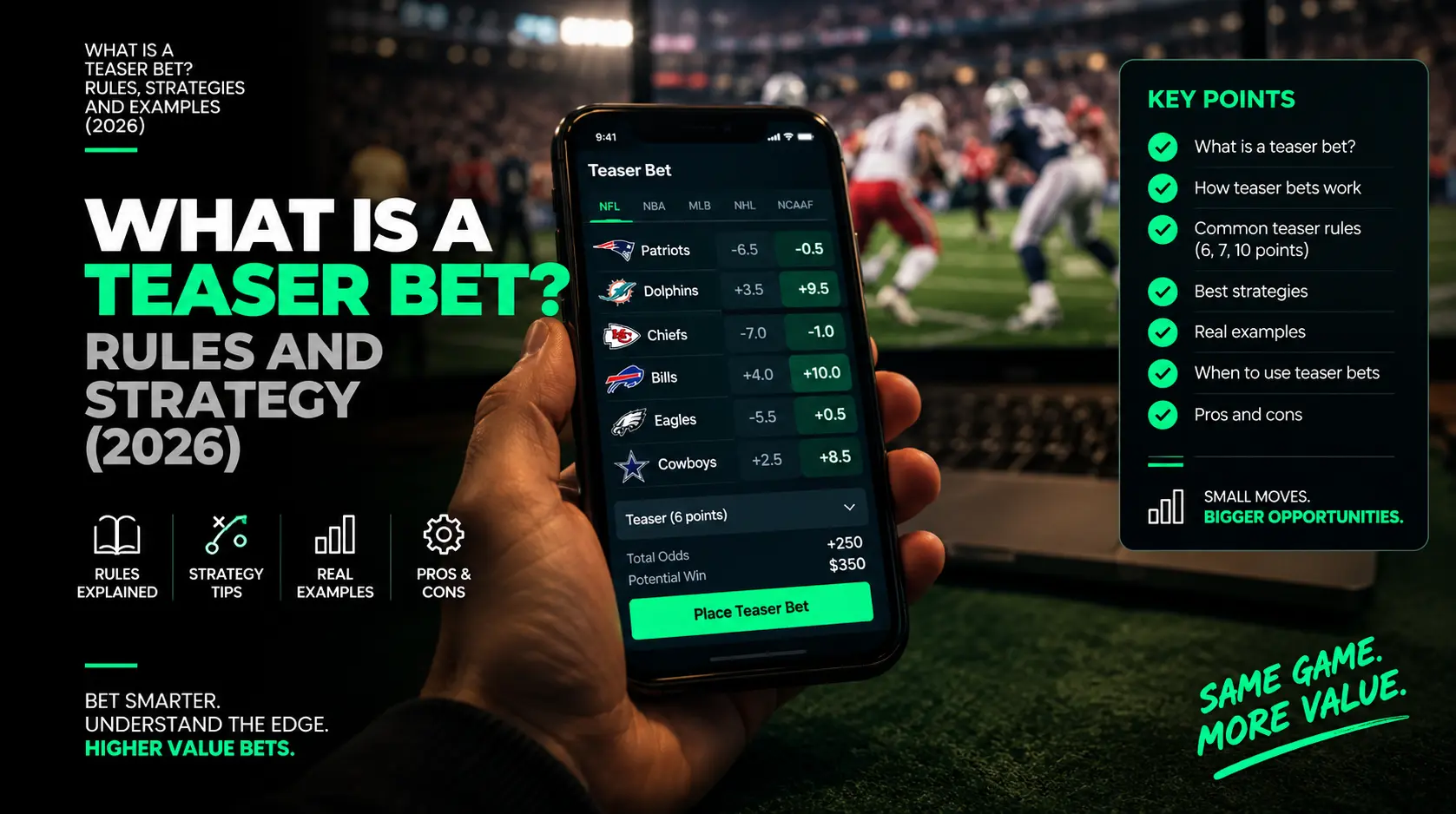
A teaser bet combines two or more spread or total selections and moves their lines a fixed number of points in your favor. In exchange for easier conditions, you receive a reduced payout compared with a parlay on the original lines. All legs normally need to win, but pushes and void selections have special settlement rules.
The important distinction is points versus odds. A six-point adjustment changes what your selection needs to do to win; it does not add six to its odds. The direction depends on whether you selected a favorite, an underdog, an over or an under.
How does a teaser change spreads and totals?
A teaser makes the selected condition easier: a negative spread becomes less demanding, a positive spread increases, an over moves down and an under moves up. Here are the four directions for a six-point adjustment.
| Selection | Original line | Teaser line | What wins |
|---|---|---|---|
| Favorite with a negative spread | −7.5 | −1.5 | The team must win by at least 2 points instead of 8 |
| Underdog with a positive spread | +2.5 | +8.5 | The team can win outright or lose by no more than 8 points instead of 2 |
| Over | Over 47.5 | Over 41.5 | The teams must score at least 42 combined points instead of 48 |
| Under | Under 47.5 | Under 53.5 | The teams must score no more than 53 combined points instead of 47 |
These favorable line adjustments are described in DraftKings’ official teaser rules.
A spread’s sign applies to the team you selected. A negative spread requires that team to win by a sufficient margin; a positive spread allows it to lose within the stated margin. The totals above refer to both teams’ combined score, not one team’s points.
A worked two-game teaser example
Both legs of this hypothetical six-point teaser win, even though both would lose at their original spreads. The following imaginary scores show exactly how the adjustment changes settlement.
| Selection | Original spread | Teaser spread | Selected team’s final score | Settlement check |
|---|---|---|---|---|
| Team A | −7.5 | −1.5 | Wins 24–21; margin +3 | Original: 3 − 7.5 = −4.5, a loss. Teaser: 3 − 1.5 = +1.5, a win |
| Team B | +2.5 | +8.5 | Loses 20–27; margin −7 | Original: −7 + 2.5 = −4.5, a loss. Teaser: −7 + 8.5 = +1.5, a win |
The scoring margin is measured from the selected team’s perspective. Add its spread to that margin: a positive result wins, a negative result loses, and zero requires the applicable push rules.
Assume the whole ticket has hypothetical American odds of -120 and a $120 stake. This is an illustrative price, not a current sportsbook offer.
- If both legs win, the net profit is $100.
- The total return is $220, including the original $120 stake.
- If one leg wins and the other loses, the ticket ordinarily loses: $0 return and the $120 stake lost.
A void selection is a separate issue. Some special teaser products refund the entire ticket when a leg is void, regardless of the other results. That exception does not mean an ordinary losing teaser is refundable.
Teaser vs parlay: what is different?
A teaser differs from a regular parlay in its line adjustments, pricing and settlement rules. Choosing favorable alternate lines and combining them in a parlay does not automatically create an official teaser.
| Bet type | Number of selections | Line adjustment | Pricing and settlement |
|---|---|---|---|
| Straight bet | 1 | Uses the selected line | One selection settles under its market rules |
| Regular parlay | 2 or more | No built-in teaser adjustment | Under uncomplicated assumptions, decimal prices multiply; all legs must win |
| Teaser | 2 or more | Spreads or totals move a fixed number of points in your favor | Usually priced through a sportsbook payout table based on legs, points and league; special push and void rules apply |
| Alternate-line parlay | 2 or more | You choose other available spreads or totals | Uses the selected prices and parlay rules, not automatically teaser rules |
| Pleaser | 2 or more | Lines move against you | Harder conditions offer a larger potential payout; availability and settlement depend on the sportsbook |
For example, a six-point pleaser could move a favorite from −7.5 to −13.5, requiring a win by at least 14 points. This illustrates the direction of the adjustment, not an available price.
Here is a payout comparison using two hypothetical tickets and the same $120 stake:
| Ticket | Odds | Total return if it wins | Net profit |
|---|---|---|---|
| Regular parlay with two legs at -110 each | Combined decimal odds ≈ 3.6446 | $437.36 | $317.36 |
| Two-leg teaser | American odds -120 | $220 | $100 |
The regular-parlay calculation assumes straightforward multiplication of decimal prices, with no special adjustments, pushes, voids or fees. The combined odds are approximate, and dollar amounts are rounded to cents.
This illustrates the tradeoff: easier teaser lines come with a smaller payout. It does not represent currently available prices or either ticket’s actual chance of winning.
Which sports and teaser types are available?
Teasers are offered in American football and basketball, among other sportsbook-specific products, but the point adjustment and allowed combinations vary. Six points is not a universal teaser rule.
DraftKings’ rules list these options:
| Sport | Regular | Super | Monster |
|---|---|---|---|
| American football, such as the NFL | 6, 6.5 or 7 points | 3 legs, 10 points | 4 legs, 13 points |
| Basketball, such as the NBA | 4, 4.5 or 5 points | 3 legs, 8 points | 4 legs, 10 points |
Regular, Super and Monster are official product names here, not universal categories used by every sportsbook.
With a four-point basketball adjustment, −5.5 becomes −1.5 and +3.5 becomes +7.5. More points are not automatically better: the payout and settlement rules may change too. Other sportsbooks may offer different options.
How do teaser push and void rules work?
A push means a selection lands exactly on its adjusted spread or total; a void means a selection is canceled or declared invalid under the sportsbook’s rules. Neither automatically means the whole teaser is refunded.
For example, a team at +7 that loses by exactly 7 produces a push: its margin plus the spread equals zero. That is not a tied game. A void selection, by contrast, may result from a canceled event or another rule-based reason unrelated to score equality.
The table below summarizes DraftKings’ official rules, rather than universal sportsbook terms.
| Teaser type and condition | Settlement |
|---|---|
| Three-leg Regular: one push or void, with no losing leg | Reduced to a two-leg teaser and repriced |
| Two-leg Regular: one push or void, with no losing leg | No action; stake refunded |
| Regular: a losing leg | Ordinarily a losing ticket; do not assume a push plus a loss produces a refund |
| Super or Monster: any void selection | Entire ticket is no action and refunded, regardless of other results |
| Super or Monster: a push, with no void selection | Entire ticket loses |
Official DraftKings rule fragment stating that a push loses the whole Super or Monster teaser ticket only if no leg is void
Official English rule fragment captured 2026-10-09. The image shows only the table’s final rule: a push loses the whole Super or Monster teaser ticket only if no leg is void. If any leg is void, the entire ticket is refunded regardless of the other legs’ results.
Other sportsbooks may settle these situations differently. The house rules applicable to your ticket prevail, including overtime and canceled-game provisions.
What break-even win rate does a teaser need?
The break-even win rate depends on the price of the whole ticket, not each individual leg. For negative American odds of −a, the threshold is a / (a + 100), assuming only two outcomes: a full win or a full loss of the stake.
| Whole-ticket American odds | Decimal odds, rounded | Break-even win rate |
|---|---|---|
| -110 | 1.9091 | 52.38% |
| -120 | 1.8333 | 54.55% |
| -130 | 1.7692 | 56.52% |
The chart shows that a -120 ticket needs to win about 54.55% of the time to break even. This is a price threshold, not an actual win probability or a guarantee. The calculation assumes no pushes, voids or fees.
Making each spread easier to cover does not necessarily make the combined ticket profitable. As a purely mathematical illustration, two independent legs with a 70% chance each would win together 49% of the time; three would win together 34.3% of the time. These are not estimates of sports outcomes. Independence can fail in real games, and moving a line across a particular scoring margin does not establish the ticket’s true probability.
How do you check a teaser price in the calculator?
Enter the whole ticket’s price once in the implied probability calculator. Do not enter its two leg prices as alternative outcomes of one market: the teaser is one combined wager.
- Select the American tab.
- Click Clear to start with a single outcome.
- Enter -120 in the Odds for outcome 1 field.
- Leave the optional probability estimate blank; this example does not supply an estimate.
Whole-ticket odds of -120 entered in Odds for outcome 1 on the calculator’s American tab
Input for the hypothetical whole-ticket price. The gray 54.5 in the optional probability field is placeholder text, not an entered estimate.
For -120, the calculator displays 54.55% implied probability and 1.83 decimal odds, rounded to two decimal places.
Calculator result for -120 showing 54.55% implied probability and rounded decimal odds of 1.83
Conversion of the hypothetical -120 price. The displayed 1.83 is rounded; the table above uses the more detailed 1.8333.
The tool converts odds. It does not account for teams, spreads, totals or correlations, predict outcomes, or prove a teaser has positive expected value. A single price also cannot reveal the sportsbook’s margin or remove it from implied probability; that requires a full set of mutually exclusive outcomes in the relevant market.
What should you check on the bet slip?
Check that the slip is actually configured as a teaser and that its adjusted lines, whole-ticket price and settlement rules match the product you selected. Several favorable spreads on one slip are not enough to establish this.
Interfaces differ by sportsbook; bet365’s official instructions describe its own process. Without assuming every operator uses the same controls, verify:
- Eligible markets: At least two qualifying spread or total selections.
- Bet type: The sportsbook’s Teaser option, if offered, rather than an ordinary alternate-line parlay.
- Point adjustment: The number of points applied to each selection.
- Adjusted lines: The spread signs and the direction of each total adjustment.
- Whole-ticket price: Distinguish it from individual-leg prices.
- Payout amounts: Separate total return, including the stake, from net profit.
- Settlement rules: Check pushes, voids, overtime and canceled games.
- Stake limits: Check the applicable minimum and maximum.
You can stop after verifying the slip. None of these checks requires placing a real wager.
What risks remain, and what should you read next?
The main risk remains losing the entire stake when one ordinary leg loses. More favorable lines do not guarantee profit. Risk only money you can afford to lose.
For more detail on American football spreads, see the NFL teaser strategy guide. A Wong teaser, named after Stanford Wong, targets certain six-point NFL spread adjustments around 3 and 7—frequently recurring scoring margins. The Wong teaser strategy and calculator guide explains that pattern in more detail.
Crossing those margins alone does not prove positive expected value. First understand the whole-ticket price and settlement rules: they determine what happens when the ticket wins, pushes or contains a void selection.
Frequently Asked Questions
Do not assume soccer or hockey offers the same six-point teaser product as American football. Available sports, markets and combinations depend on the sportsbook. Check whether it offers an official teaser product and read its rules.
There is no universal maximum. Each sportsbook sets its own limits on selections, mixed-sport tickets and selections from the same game.
No. One price gives an implied probability, but calculating the sportsbook's margin requires prices for a complete set of mutually exclusive outcomes in the same market.
With whole-number scores, a team cannot land exactly on a half-point spread: the selection either wins or loses. An integer spread can produce a push, which must be settled under the teaser's rules.
Evgeniy Volkov
Verified ExpertFullstack developer with a background in mathematics. I build the calculators and game-style tools on ToolsGambling with Pixi.js and modern web tech, and every result uses transparent probability formulas you can verify yourself.