












Contents
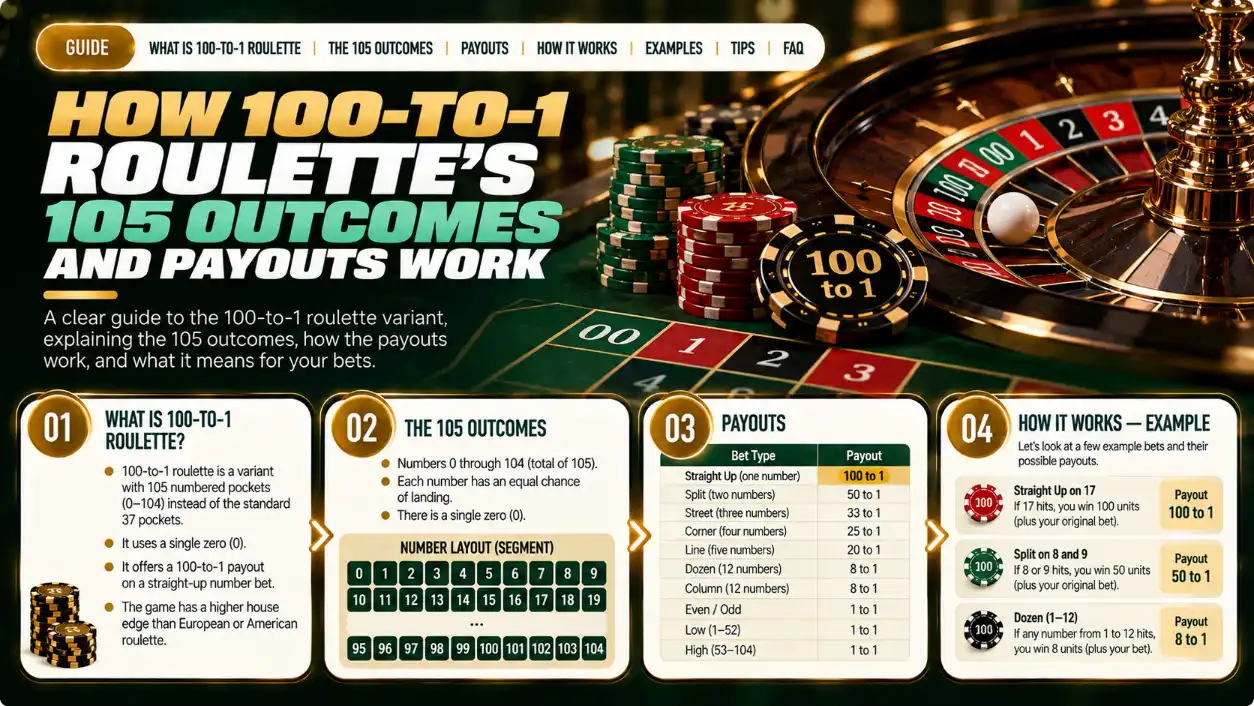
100-to-1 Roulette has 105 pockets: numbers 1–100 plus five separate symbol pockets. A 100:1 payout means profit of 100 times your stake plus your stake back, for a total return of 101 times your stake—not 100× total.
These rules concern the named game, not ordinary video roulette, Red Door Roulette, or a different game offering a Lightning 100× multiplier. The official help PDF confirms 105 outcomes and a theoretical RTP range of 92.86–96.19%. It does not provide a detailed payout table and directs players to the in-game paytable for exact awards.
Schematic showing 100 numbered cells from 1 to 100 and five separate symbol outcomesExplanatory schematic, not a game screenshot or actual betting layout. It does not show chip placements or red/black assignments.
What do the nine bet classes pay?
The table below lists profit payouts from 100:1 for one outcome to 1:1 for 50 outcomes, with the stake-inclusive return shown separately.
Payouts come from BetMGM’s operator article dated May 25, 2024, cross-checked against Wizard of Odds, updated August 3, 2026. During verification on October 15, 2026, the operator page timed out; its full search-cached text was inspected instead. This is an operator-specific table, not confirmation that every version uses identical terms.
The RTP and house edge calculations assume 105 equally likely pockets. Theoretical RTP is the share of turnover returned through payouts over time; house edge is one minus RTP. Percentages below are rounded to five decimal places.
| Bet class | Outcomes covered | Profit payout | Gross return, including stake | Theoretical RTP | House edge |
|---|---|---|---|---|---|
| Straight-up: one number or symbol | 1 | 100:1 | 101× stake | 96.19048% | 3.80952% |
| Two-outcome bet | 2 | 49:1 | 50× stake | 95.23810% | 4.76190% |
| Three-outcome bet | 3 | 32:1 | 33× stake | 94.28571% | 5.71429% |
| Corner bet | 4 | 24:1 | 25× stake | 95.23810% | 4.76190% |
| Five-outcome bet | 5 | 19:1 | 20× stake | 95.23810% | 4.76190% |
| Ten-outcome bet | 10 | 9:1 | 10× stake | 95.23810% | 4.76190% |
| Fifteen-outcome bet | 15 | 11:2 | 6.5× stake | 92.85714% | 7.14286% |
| Twenty-outcome bet | 20 | 4:1 | 5× stake | 95.23810% | 4.76190% |
| Even-money bet | 50 | 1:1 | 2× stake | 95.23810% | 4.76190% |
Coverage counts are used for the 3-, 5-, 10-, 15-, and 20-outcome groups because position names differ between sources. BetMGM uses Neighbors for two numbers and Split for three, while Loto-Québec help calls a position between two numbers split. Check the coverage and payout odds in your version rather than relying on the name. A five-outcome group, for example, is not an ordinary three-number roulette street.
The 11:2 payout means 5.5:1 profit and a gross return of 6.5 times the stake. A winning 2-unit bet on 15 outcomes therefore returns 13 units, giving net profit of 11 units if it is the only bet. This calculation assumes no payout cap reduces the award.
Why doesn’t an even-money bet win half the time?
An even-money bet covers 50 of the 105 outcomes, so its win probability under the equal-likelihood model is 50/105 = 0.47619048, not 50%.
That leaves 55 outcomes outside its coverage. “Even-money” describes the 1:1 profit payout, not equal chances of winning and losing. This bet’s theoretical RTP is 95.23810%, and its house edge is 4.76190%.
How do you calculate gross return and net profit for a spin?
Add the returned stake to the profit on each winning position, then subtract all stakes placed on the spin, including losing bets.
For stake and profit payout :
For a bet covering outcomes under the equally likely 105-pocket model:
RTP is expressed as a proportion in this formula; multiply by 100 for a percentage. These formulas assume the stated paytable applies and no payout cap reduces the calculated credit.
Complete settlement example with two bets
With 2 units on one numbered pocket and 3 units on a ten-number row containing that number, the total stake is 5 units.
Using the table’s 100:1 and 9:1 profit payouts, the full round settles as follows:
- The selected number hits: both bets win. The straight-up bet returns , and the row returns . Gross credit is 232, so the net round result is .
- Another number in that row hits: only the row wins, returning 30. The net result is . The lost 2-unit straight-up stake is already included in the 5 units subtracted.
- Neither bet wins: gross credit is 0, and the net result is .
For comparison, the winning 2-unit straight-up bet alone would return 202 units for net profit of 200 units.
No rounding is needed in these examples. They assume both positions are permitted by your version’s paytable and no payout cap reduces the award. A winning example does not imply that session profit is likely.
What should you check in your own version?
Open your version’s help or paytable and confirm the 105 pockets, each position’s coverage, the payout convention, and current limits before applying these calculations. The official help identifies the in-game paytable as the source for exact awards.
Check the following:
- The game has numbers 1–100 plus five separate symbol pockets.
- The selected position covers the expected number of outcomes.
- The displayed payout means either profit excluding the returned stake or total return including it.
- The current bet limit permits the stake amount.
- The current payout cap does not reduce the calculated award.
A bet limit and a payout cap are different restrictions. Dated operator limits should not be applied to every version. If your paytable differs from this article’s table, use your version’s payouts and recalculate rather than imposing these figures.
What can the ToolsGambling RTP calculator estimate?
The ToolsGambling RTP calculator estimates turnover, expected loss, and expected return. It does not settle individual spins or predict a session’s outcome.
For an illustrative single-outcome bet calculation:
- Set the RTP slider to 96.2%.
- Enter 1 in the stake field.
- Select calculation by number of spins.
- Enter 100 in the spin-count field.
The result is 100 units of turnover and 3.80 units of expected loss. The 96.2% input is a rounded proxy for the exact theoretical RTP of 96.19048%, because the slider moves in 0.1-percentage-point steps. Using the exact theoretical value, expected loss is 3.80952 units.
The calculator does not store this game’s nine payout classes or verify its rules. Expected loss is a mathematical estimate based on the inputs—not a promise that your actual loss over 100 spins will match it.
Frequently Asked Questions
100-to-1 Roulette has numbers 1–100 and five symbol pockets that BetMGM calls zero pockets, though each bears a shape rather than the numeral 0. Each red/black or odd/even bet covers only 50 numbered outcomes out of 105, so it loses when a symbol lands.
Not under a model of independent spins with 105 equally likely outcomes: the chance of a selected outcome remains 1/105. Spin history alone does not establish that a particular version has independent, equally likely outcomes.
Evgeniy Volkov
Verified ExpertFullstack developer with a background in mathematics. I build the calculators and game-style tools on ToolsGambling with Pixi.js and modern web tech, and every result uses transparent probability formulas you can verify yourself.