











Blackjack Basic Strategy Chart 2026
An interactive basic strategy chart that recalculates every cell the moment you change a rule. Set the decks, soft 17, double, split and surrender rules, and the chart shows the exact hit, stand, double, split or surrender for every hand, with the live house edge for that exact game.
Build your blackjack chart
Table rules
House edge for these rules
6 decks · S17 · DAS · Late surrender · 3:2
0.43%
Expected loss per unit bet, before any side bets
- Deck count+0.00%
- Double after split-0.14%
- Late surrender-0.09%
The edge is computed from the dealer probabilities and the expected value of every action, with the 3:2 blackjack bonus included. A green number lowers the edge in your favour, a red number raises it. Deck count uses published per-deck figures because it is a near-composition effect.
Your interactive strategy chart
6 decks · S17 · DAS · Late surrender · 3:2Hard totals (no usable ace)
| Hand | 2 | 3 | 4 | 5 | 6 | 7 | 8 | 9 | 10 | A |
|---|---|---|---|---|---|---|---|---|---|---|
| 5 | 5 versus dealer 2: Hit | 5 versus dealer 3: Hit | 5 versus dealer 4: Hit | 5 versus dealer 5: Hit | 5 versus dealer 6: Hit | 5 versus dealer 7: Hit | 5 versus dealer 8: Hit | 5 versus dealer 9: Hit | 5 versus dealer 10: Hit | 5 versus dealer A: Hit |
| 6 | 6 versus dealer 2: Hit | 6 versus dealer 3: Hit | 6 versus dealer 4: Hit | 6 versus dealer 5: Hit | 6 versus dealer 6: Hit | 6 versus dealer 7: Hit | 6 versus dealer 8: Hit | 6 versus dealer 9: Hit | 6 versus dealer 10: Hit | 6 versus dealer A: Hit |
| 7 | 7 versus dealer 2: Hit | 7 versus dealer 3: Hit | 7 versus dealer 4: Hit | 7 versus dealer 5: Hit | 7 versus dealer 6: Hit | 7 versus dealer 7: Hit | 7 versus dealer 8: Hit | 7 versus dealer 9: Hit | 7 versus dealer 10: Hit | 7 versus dealer A: Hit |
| 8 | 8 versus dealer 2: Hit | 8 versus dealer 3: Hit | 8 versus dealer 4: Hit | 8 versus dealer 5: Hit | 8 versus dealer 6: Hit | 8 versus dealer 7: Hit | 8 versus dealer 8: Hit | 8 versus dealer 9: Hit | 8 versus dealer 10: Hit | 8 versus dealer A: Hit |
| 9 | 9 versus dealer 2: Hit | 9 versus dealer 3: Double | 9 versus dealer 4: Double | 9 versus dealer 5: Double | 9 versus dealer 6: Double | 9 versus dealer 7: Hit | 9 versus dealer 8: Hit | 9 versus dealer 9: Hit | 9 versus dealer 10: Hit | 9 versus dealer A: Hit |
| 10 | 10 versus dealer 2: Double | 10 versus dealer 3: Double | 10 versus dealer 4: Double | 10 versus dealer 5: Double | 10 versus dealer 6: Double | 10 versus dealer 7: Double | 10 versus dealer 8: Double | 10 versus dealer 9: Double | 10 versus dealer 10: Hit | 10 versus dealer A: Hit |
| 11 | 11 versus dealer 2: Double | 11 versus dealer 3: Double | 11 versus dealer 4: Double | 11 versus dealer 5: Double | 11 versus dealer 6: Double | 11 versus dealer 7: Double | 11 versus dealer 8: Double | 11 versus dealer 9: Double | 11 versus dealer 10: Double | 11 versus dealer A: Hit |
| 12 | 12 versus dealer 2: Hit | 12 versus dealer 3: Hit | 12 versus dealer 4: Stand | 12 versus dealer 5: Stand | 12 versus dealer 6: Stand | 12 versus dealer 7: Hit | 12 versus dealer 8: Hit | 12 versus dealer 9: Hit | 12 versus dealer 10: Hit | 12 versus dealer A: Hit |
| 13 | 13 versus dealer 2: Stand | 13 versus dealer 3: Stand | 13 versus dealer 4: Stand | 13 versus dealer 5: Stand | 13 versus dealer 6: Stand | 13 versus dealer 7: Hit | 13 versus dealer 8: Hit | 13 versus dealer 9: Hit | 13 versus dealer 10: Hit | 13 versus dealer A: Hit |
| 14 | 14 versus dealer 2: Stand | 14 versus dealer 3: Stand | 14 versus dealer 4: Stand | 14 versus dealer 5: Stand | 14 versus dealer 6: Stand | 14 versus dealer 7: Hit | 14 versus dealer 8: Hit | 14 versus dealer 9: Hit | 14 versus dealer 10: Hit | 14 versus dealer A: Hit |
| 15 | 15 versus dealer 2: Stand | 15 versus dealer 3: Stand | 15 versus dealer 4: Stand | 15 versus dealer 5: Stand | 15 versus dealer 6: Stand | 15 versus dealer 7: Hit | 15 versus dealer 8: Hit | 15 versus dealer 9: Hit | 15 versus dealer 10: Surrender | 15 versus dealer A: Hit |
| 16 | 16 versus dealer 2: Stand | 16 versus dealer 3: Stand | 16 versus dealer 4: Stand | 16 versus dealer 5: Stand | 16 versus dealer 6: Stand | 16 versus dealer 7: Hit | 16 versus dealer 8: Hit | 16 versus dealer 9: Surrender | 16 versus dealer 10: Surrender | 16 versus dealer A: Surrender |
| 17 | 17 versus dealer 2: Stand | 17 versus dealer 3: Stand | 17 versus dealer 4: Stand | 17 versus dealer 5: Stand | 17 versus dealer 6: Stand | 17 versus dealer 7: Stand | 17 versus dealer 8: Stand | 17 versus dealer 9: Stand | 17 versus dealer 10: Stand | 17 versus dealer A: Stand |
| 18 | 18 versus dealer 2: Stand | 18 versus dealer 3: Stand | 18 versus dealer 4: Stand | 18 versus dealer 5: Stand | 18 versus dealer 6: Stand | 18 versus dealer 7: Stand | 18 versus dealer 8: Stand | 18 versus dealer 9: Stand | 18 versus dealer 10: Stand | 18 versus dealer A: Stand |
| 19 | 19 versus dealer 2: Stand | 19 versus dealer 3: Stand | 19 versus dealer 4: Stand | 19 versus dealer 5: Stand | 19 versus dealer 6: Stand | 19 versus dealer 7: Stand | 19 versus dealer 8: Stand | 19 versus dealer 9: Stand | 19 versus dealer 10: Stand | 19 versus dealer A: Stand |
| 20 | 20 versus dealer 2: Stand | 20 versus dealer 3: Stand | 20 versus dealer 4: Stand | 20 versus dealer 5: Stand | 20 versus dealer 6: Stand | 20 versus dealer 7: Stand | 20 versus dealer 8: Stand | 20 versus dealer 9: Stand | 20 versus dealer 10: Stand | 20 versus dealer A: Stand |
Soft totals (ace counted as 11)
| Hand | 2 | 3 | 4 | 5 | 6 | 7 | 8 | 9 | 10 | A |
|---|---|---|---|---|---|---|---|---|---|---|
| A,2 | A,2 versus dealer 2: Hit | A,2 versus dealer 3: Hit | A,2 versus dealer 4: Hit | A,2 versus dealer 5: Double | A,2 versus dealer 6: Double | A,2 versus dealer 7: Hit | A,2 versus dealer 8: Hit | A,2 versus dealer 9: Hit | A,2 versus dealer 10: Hit | A,2 versus dealer A: Hit |
| A,3 | A,3 versus dealer 2: Hit | A,3 versus dealer 3: Hit | A,3 versus dealer 4: Hit | A,3 versus dealer 5: Double | A,3 versus dealer 6: Double | A,3 versus dealer 7: Hit | A,3 versus dealer 8: Hit | A,3 versus dealer 9: Hit | A,3 versus dealer 10: Hit | A,3 versus dealer A: Hit |
| A,4 | A,4 versus dealer 2: Hit | A,4 versus dealer 3: Hit | A,4 versus dealer 4: Double | A,4 versus dealer 5: Double | A,4 versus dealer 6: Double | A,4 versus dealer 7: Hit | A,4 versus dealer 8: Hit | A,4 versus dealer 9: Hit | A,4 versus dealer 10: Hit | A,4 versus dealer A: Hit |
| A,5 | A,5 versus dealer 2: Hit | A,5 versus dealer 3: Hit | A,5 versus dealer 4: Double | A,5 versus dealer 5: Double | A,5 versus dealer 6: Double | A,5 versus dealer 7: Hit | A,5 versus dealer 8: Hit | A,5 versus dealer 9: Hit | A,5 versus dealer 10: Hit | A,5 versus dealer A: Hit |
| A,6 | A,6 versus dealer 2: Hit | A,6 versus dealer 3: Double | A,6 versus dealer 4: Double | A,6 versus dealer 5: Double | A,6 versus dealer 6: Double | A,6 versus dealer 7: Hit | A,6 versus dealer 8: Hit | A,6 versus dealer 9: Hit | A,6 versus dealer 10: Hit | A,6 versus dealer A: Hit |
| A,7 | A,7 versus dealer 2: Stand | A,7 versus dealer 3: Double | A,7 versus dealer 4: Double | A,7 versus dealer 5: Double | A,7 versus dealer 6: Double | A,7 versus dealer 7: Stand | A,7 versus dealer 8: Stand | A,7 versus dealer 9: Hit | A,7 versus dealer 10: Hit | A,7 versus dealer A: Hit |
| A,8 | A,8 versus dealer 2: Stand | A,8 versus dealer 3: Stand | A,8 versus dealer 4: Stand | A,8 versus dealer 5: Stand | A,8 versus dealer 6: Stand | A,8 versus dealer 7: Stand | A,8 versus dealer 8: Stand | A,8 versus dealer 9: Stand | A,8 versus dealer 10: Stand | A,8 versus dealer A: Stand |
| A,9 | A,9 versus dealer 2: Stand | A,9 versus dealer 3: Stand | A,9 versus dealer 4: Stand | A,9 versus dealer 5: Stand | A,9 versus dealer 6: Stand | A,9 versus dealer 7: Stand | A,9 versus dealer 8: Stand | A,9 versus dealer 9: Stand | A,9 versus dealer 10: Stand | A,9 versus dealer A: Stand |
Pairs (splitting decisions)
| Hand | 2 | 3 | 4 | 5 | 6 | 7 | 8 | 9 | 10 | A |
|---|---|---|---|---|---|---|---|---|---|---|
| 2,2 | 2,2 versus dealer 2: Split | 2,2 versus dealer 3: Split | 2,2 versus dealer 4: Split | 2,2 versus dealer 5: Split | 2,2 versus dealer 6: Split | 2,2 versus dealer 7: Split | 2,2 versus dealer 8: Hit | 2,2 versus dealer 9: Hit | 2,2 versus dealer 10: Hit | 2,2 versus dealer A: Hit |
| 3,3 | 3,3 versus dealer 2: Split | 3,3 versus dealer 3: Split | 3,3 versus dealer 4: Split | 3,3 versus dealer 5: Split | 3,3 versus dealer 6: Split | 3,3 versus dealer 7: Split | 3,3 versus dealer 8: Hit | 3,3 versus dealer 9: Hit | 3,3 versus dealer 10: Hit | 3,3 versus dealer A: Hit |
| 4,4 | 4,4 versus dealer 2: Hit | 4,4 versus dealer 3: Hit | 4,4 versus dealer 4: Hit | 4,4 versus dealer 5: Split | 4,4 versus dealer 6: Split | 4,4 versus dealer 7: Hit | 4,4 versus dealer 8: Hit | 4,4 versus dealer 9: Hit | 4,4 versus dealer 10: Hit | 4,4 versus dealer A: Hit |
| 5,5 | 5,5 versus dealer 2: Double | 5,5 versus dealer 3: Double | 5,5 versus dealer 4: Double | 5,5 versus dealer 5: Double | 5,5 versus dealer 6: Double | 5,5 versus dealer 7: Double | 5,5 versus dealer 8: Double | 5,5 versus dealer 9: Double | 5,5 versus dealer 10: Hit | 5,5 versus dealer A: Hit |
| 6,6 | 6,6 versus dealer 2: Split | 6,6 versus dealer 3: Split | 6,6 versus dealer 4: Split | 6,6 versus dealer 5: Split | 6,6 versus dealer 6: Split | 6,6 versus dealer 7: Hit | 6,6 versus dealer 8: Hit | 6,6 versus dealer 9: Hit | 6,6 versus dealer 10: Hit | 6,6 versus dealer A: Hit |
| 7,7 | 7,7 versus dealer 2: Split | 7,7 versus dealer 3: Split | 7,7 versus dealer 4: Split | 7,7 versus dealer 5: Split | 7,7 versus dealer 6: Split | 7,7 versus dealer 7: Split | 7,7 versus dealer 8: Hit | 7,7 versus dealer 9: Hit | 7,7 versus dealer 10: Hit | 7,7 versus dealer A: Hit |
| 8,8 | 8,8 versus dealer 2: Split | 8,8 versus dealer 3: Split | 8,8 versus dealer 4: Split | 8,8 versus dealer 5: Split | 8,8 versus dealer 6: Split | 8,8 versus dealer 7: Split | 8,8 versus dealer 8: Split | 8,8 versus dealer 9: Split | 8,8 versus dealer 10: Split | 8,8 versus dealer A: Split |
| 9,9 | 9,9 versus dealer 2: Split | 9,9 versus dealer 3: Split | 9,9 versus dealer 4: Split | 9,9 versus dealer 5: Split | 9,9 versus dealer 6: Split | 9,9 versus dealer 7: Stand | 9,9 versus dealer 8: Split | 9,9 versus dealer 9: Split | 9,9 versus dealer 10: Stand | 9,9 versus dealer A: Stand |
| 10,10 | 10,10 versus dealer 2: Stand | 10,10 versus dealer 3: Stand | 10,10 versus dealer 4: Stand | 10,10 versus dealer 5: Stand | 10,10 versus dealer 6: Stand | 10,10 versus dealer 7: Stand | 10,10 versus dealer 8: Stand | 10,10 versus dealer 9: Stand | 10,10 versus dealer 10: Stand | 10,10 versus dealer A: Stand |
| A,A | A,A versus dealer 2: Split | A,A versus dealer 3: Split | A,A versus dealer 4: Split | A,A versus dealer 5: Split | A,A versus dealer 6: Split | A,A versus dealer 7: Split | A,A versus dealer 8: Split | A,A versus dealer 9: Split | A,A versus dealer 10: Split | A,A versus dealer A: Split |
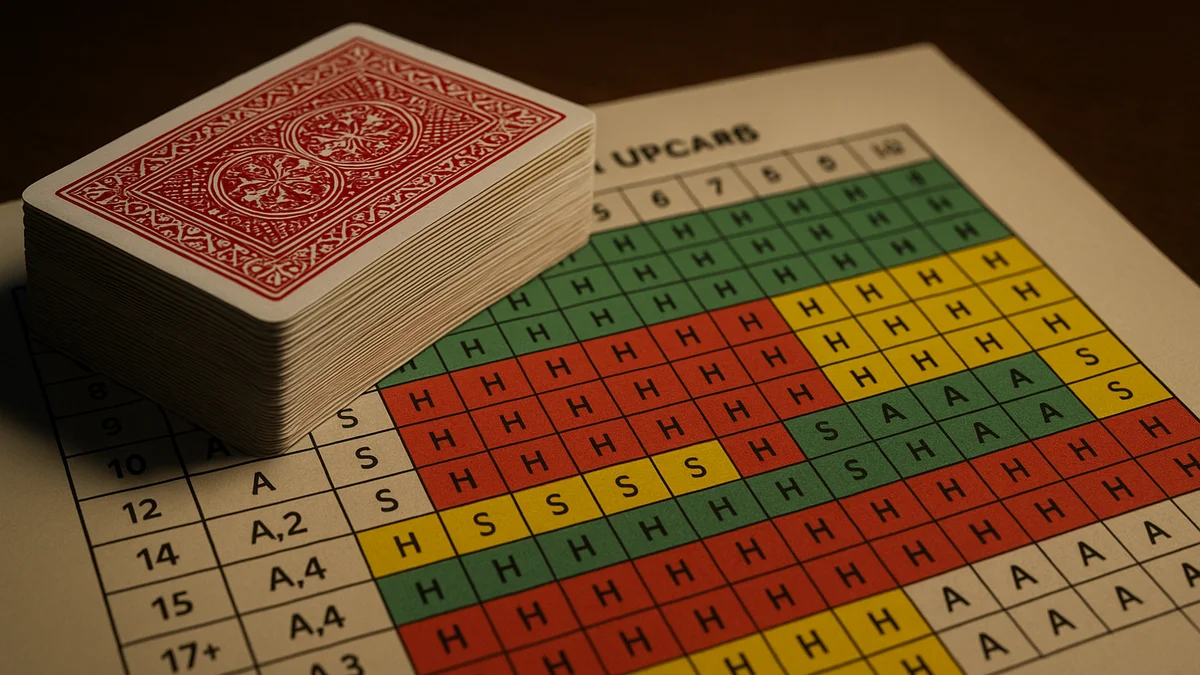
Read your hand down the left, the dealer upcard across the top. Each cell shows the best play by letter first, colour second, so it stays readable in print and for colour-blind players. Letters: H hit, S stand, D double, P split, R surrender.
Look up one hand
Pick your two cards and the dealer upcard to get the exact play and a short reason. Suits do not matter in blackjack, so any suit works.
Pick both of your cards and the dealer upcard to see the play.
Train it: quick quiz
We deal a random hand against a random upcard. Call the play, and we grade it against the chart for your current rules. This is how the chart sticks.
Blackjack basic strategy, explained
Basic strategy is the single play for every hand that loses the least money over time. It is not a hunch or a system someone sold you. It is the answer math gives when you ask what to do with, say, a 16 against a dealer 10. This chart computes that answer for the exact rules you pick, which is why it can be right for a single-deck game and an eight-deck shoe at the same time. As of the standard six-deck game still runs near a half-percent edge with perfect play, and most of the money players give back comes from small deviations from the chart below.
A quick walkthrough of what the colours and letters mean and the two rules that carry most of the chart. Then come back and try the interactive version above.
What basic strategy actually is
The house edge it removes
Walk up to a six-deck table and play on feel, and you hand the house roughly two percent. Play every hand by this chart and that drops to about half a percent. You did not change the rules or count a single card. You just stopped making the mistakes the casino is counting on, like standing on 16 versus a 10 out of fear or never doubling a soft hand. That gap, from two percent down to half a percent, is the entire value of basic strategy, and it is free.
Why this is not card counting
Basic strategy assumes a fresh, well-shuffled deck and ignores the cards already out. That makes it perfectly legal and welcome in every casino, because it still leaves the house with a small edge. Card counting tracks the cards that have been dealt to find moments the player is ahead, which is a different skill and a different risk. Basic strategy is the floor everyone should stand on first, and the natural next step is the full breakdown in our guide to optimal blackjack strategy.
How to read the strategy chart
Hard totals
A hard hand has no ace, or an ace that has to count as one, so it cannot turn into two totals. Find your total on the left, run across to the dealer upcard, and play the cell. The pattern is simple once you see it. Against a dealer 2 through 6, the upcards that bust the most, you stand on stiff totals of 12 to 16 and let the dealer take the risk. Against a 7 through ace you have to hit those same totals, because a dealer who is unlikely to bust will out-draw you.
Soft totals
A soft hand holds an ace counted as 11, so it can never bust on the next card. That safety is why soft hands play more aggressively. Soft 13 through 17 are doubling hands against the dealer weak cards, because you get a free shot at a strong total with no bust risk. Soft 18, the hand new players misplay most, is not an automatic stand. It stands against 2, 7 and 8, doubles against 3 through 6, and actually hits against a 9, 10 or ace, because an 18 loses to the totals those cards make.
Pairs
When your two cards match you can split them into two hands. Aces and eights always split, no exceptions. Tens and fives never split: two tens is already a 20, and a pair of fives is a strong 10 you would rather double. The rest depend on the upcard and on whether doubling after a split is allowed, which is exactly why the chart shifts when you toggle DAS. The most expensive pair mistake is splitting tens to chase two hands, covered in our piece on why you never split tens.
The action codes
Every cell is a single letter so it reads fast at the table. H means hit, take another card. S means stand, take nothing. D means double, put out a second equal bet and take exactly one card. P means split a pair into two hands. R means surrender, give up the hand and keep half your bet. When a double or surrender is not allowed by the rules you set, the chart falls back to the best legal play automatically, so you never see an action you cannot make.
The rules that change the chart
Dealer stands or hits soft 17
This is the single rule that moves the edge the most, and the one casinos quietly changed to take money back. When the dealer hits soft 17 instead of standing, the house edge rises by about a fifth of a percent, and a handful of cells change. You start doubling 11 against an ace, doubling soft 19 against a 6, and surrendering more against a dealer ace. Toggle the S17 and H17 buttons and watch those exact cells flip. Always check the felt or the screen for which rule is in play before you sit down.
Number of decks
Fewer decks favour the player. A single-deck game shaves almost half a percent off the edge compared with six decks, and a few plays get sharper, like doubling 11 against an ace. The reason is composition: with fewer cards, drawing your first ten makes the next ten less likely, which nudges close decisions. If you want the full picture of how the dealing shoe works, read what a shoe is in blackjack and for the one-versus-two-deck question see double-deck blackjack.
Double after split
When a casino lets you double after splitting a pair, splitting becomes more valuable, so you split more pairs. With DAS you split 2s, 3s and 6s against more dealer cards, and you split 4s against a 5 or 6. Turn DAS off and those marginal splits turn back into hits, because without the option to double the second card, the split is no longer worth the extra bet. This is a real money rule worth roughly a sixth of a percent.
Surrender
Late surrender lets you fold the worst hands and keep half your bet. It only ever applies to a few cells, mainly 16 against a 9, 10 or ace and 15 against a 10, but it is a clean saving worth about a tenth of a percent when it is offered. Most players never use it because they do not know it exists. Turn it on in the rules to see exactly which hands change, and read the full breakdown in our guide to when to surrender.
3:2 versus 6:5 payout, the biggest trap
This one does not change a single cell of the chart, and that is exactly why it is dangerous. A fair table pays 3:2 on a blackjack, so a ten-dollar bet returns fifteen. A 6:5 table pays only twelve on the same blackjack, and that shortfall alone adds about 1.4 percent to the house edge, more than triple the cost of hitting soft 17. No amount of perfect play claws it back, because you make the same moves either way. Flip the payout toggle above and watch the edge jump from roughly half a percent to nearly two. If a table pays 6:5, walk to one that pays 3:2. It is the single most expensive rule on the felt and the easiest one to avoid.
How to use this blackjack chart on ToolsGambling
Live rule filters on ToolsGambling
Start by matching the rules to your table. Set the deck count, choose whether the dealer hits or stands on soft 17, set the doubling and surrender rules, and tick DAS if the casino allows it. The whole chart and the house edge update instantly, because every cell is recomputed from the math, not pulled from a stored picture. That is the difference between this tool and a static image: change one rule and you see precisely which hands and how much edge move.
Single-hand lookup
If you only want the answer to one spot, use the lookup. Pick your two cards and the dealer upcard, and it returns the play plus one line on why. It detects pairs and soft hands for you, so you do not have to work out whether your ace is soft, and it follows the same rules you set above. It is built for the questions players actually ask mid-session, like what to do with 8,8 against a 10.
Print, save and share
The print button gives you a clean, ink-friendly chart for the rules you set, ready to save as a PDF or carry as a pocket card. The share button copies a link that reopens the chart with your exact rules, so you can send a six-deck H17 chart to a friend and they see the same cells you do. Everything here is free on ToolsGambling.com, with no signup and no app.
Worked hands players get wrong
12 against a 2 or 3
This one feels wrong and is right. A 12 against a dealer 2 or 3 is a hit, even though you might bust. The dealer 2 and 3 do not bust often enough to let you stand, so taking a card wins more in the long run. Against a 4, 5 or 6 it flips to a stand, because those upcards bust often enough to carry you. The same logic runs through the low stiff totals, and we cover the close 13-versus-2 spot in 13 versus a dealer 2.
16 against a 10
The worst hand in blackjack. A hard 16 against a dealer 10 loses most of the time no matter what you do, so if late surrender is offered, you surrender and keep half. If it is not, you hit, because standing on 16 against a 10 is even worse. The exception is when your 16 is a pair of 8s, which you split instead, since two hands starting with 8 are far better than one stuck on 16.
A pair of 8s
Always split eights, against everything, including a 10 and an ace. A pair of 8s is a 16, the worst total you can hold, so playing it as one hand is a near-guaranteed loss. Splitting turns one terrible hand into two hands that each start at 8, which win far more often. It can feel like throwing good money after bad against a 10, but the math is clear and it is one of the few absolute rules in the game.
Soft 18 (ace and 7)
Soft 18 is the most misplayed hand in blackjack because 18 feels like enough. It is not. Against a dealer 9, 10 or ace, an 18 is an underdog, so you hit and try to improve with no bust risk. Against a 3 through 6 you double. You only stand pat against a 2, 7 or 8. New players stand on every 18 and quietly bleed money on the strong upcards, which the chart fixes in one glance.
Common mistakes the chart fixes
Standing on stiff hands out of fear
Standing on 12 through 16 against a dealer 7 or higher is the most expensive habit in the game. It feels safe to not bust, but you are handing the dealer the pot, because a strong upcard will beat your weak total most of the time. The chart tells you to hit those hands, and over a session that single fix is worth more than every other tweak combined.
Never doubling or splitting
Doubling and splitting are how basic strategy claws edge back, and timid players skip both. If you only ever hit or stand, you leave money on the table on exactly the hands where you are supposed to press: 11 against a weak card, soft doubles, and pairs of aces and eights. The chart marks every one of these, so there is no guessing.
Using the wrong chart for the rules
A chart printed for a six-deck S17 game is wrong at an H17 table, and a player following it will misplay 11 against an ace and a few soft hands all night. That is the whole point of making this chart live: set the actual rules and you get the actual right plays. For more habits worth dropping, see our list of blackjack tips.
What comes after basic strategy
Card counting
Basic strategy gets you to about a half-percent disadvantage. It does not make blackjack a winning game on its own, and anyone who tells you otherwise is selling something. The only legal way to flip the edge is card counting, which tracks the cards already dealt to bet more when the deck favours you. It is harder than it sounds and casinos push back on it, but if you want to understand the tools, start with card counting software.
Bankroll and discipline
Perfect play still loses slowly, so the money question is how long your bankroll lasts and how much you risk per hand. Decide your unit and your stop-loss before you sit down, and never raise your bet to chase a losing streak. Our guide to blackjack bankroll management covers the numbers, and if you want to drill the chart away from the table, the printable strategy flashcards.
Variance and rule variants
Perfect play does not smooth out the swings. Even at half a percent you will hit brutal cold runs, and knowing what a normal losing streak looks like keeps you from blaming the chart or chasing losses. We ran the numbers on how long streaks actually get in our piece on blackjack losing streak odds It also pays to know the table variant you are sitting at. A rule like a 6-card Charlie quietly helps the player, and we break down how it works and how rare it is in our guide to the 6-card Charlie rule.
Blackjack terms in this chart
- Basic strategy
- The mathematically best play for every hand, given the rules, that minimises the house edge without counting cards.
- Hard and soft hands
- A soft hand holds an ace counted as 11 and cannot bust on the next card. A hard hand has no such ace.
- House edge
- The casino's long-run advantage as a percentage of each bet. Around half a percent for a standard six-deck game with perfect play.
- S17 and H17
- Whether the dealer stands on a soft 17 (S17) or hits it (H17). H17 is worse for the player by about a fifth of a percent.
- DAS
- Double after split: the casino lets you double the bet on a hand created by splitting a pair. It lowers the house edge.
- Surrender
- Folding a hand to keep half your bet. Late surrender is offered after the dealer checks for blackjack.
- Upcard
- The dealer's face-up card. The single most important piece of information for choosing your play.
- Double down
- Doubling your bet for exactly one more card. The chart marks every hand where doubling has the highest expected value.
Free casino tools on ToolsGambling.com
Use the strategy chart for free, just like every tool here. Pair it with these to see what the game costs and how long your money lasts.
- House Edge Calculator
- Session Simulator
- RTP Calculator
- Loss Calculator
- Win Probability Calculator
- Gambler's Fallacy Demonstration
- Gambling Math IQ Test
Play responsibly
Basic strategy lowers the cost of playing, it does not make blackjack a way to earn. Bet only money you can afford to lose, set limits, never chase losses, and if the game stops being fun, get free, confidential help at BeGambleAware.org.
Blackjack strategy FAQ
Related casino tools

Evgeniy Volkov
Verified ExpertFullstack developer with a background in mathematics. I build the calculators and game-style tools on ToolsGambling with Pixi.js and modern web tech, and every result uses transparent probability formulas you can verify yourself.