













Contents
Aviator is a crash game from SPRIBE, while 1win is the operator where you can open it. The round logic is simple: place your bet before takeoff, cash out before the crash, and your gross payout equals stake × multiplier at the moment you cash out. If you do not cash out in time, the stake is lost. Winning rounds are possible, but there is no strategy that guarantees long-term profit.
Quick game facts
Aviator is a rising-multiplier game with two separate betting panels, and SPRIBE publishes an RTP of 97%, which means a 3% house edge in theory. The practical way in is to open 1win, go to the casino, search for Aviator, and confirm that the provider is SPRIBE. You should also be 18+ and allowed to use gambling services where you are. If you use our partner route, we may earn a commission, but that does not change the game math or your need to check the operator's current terms.
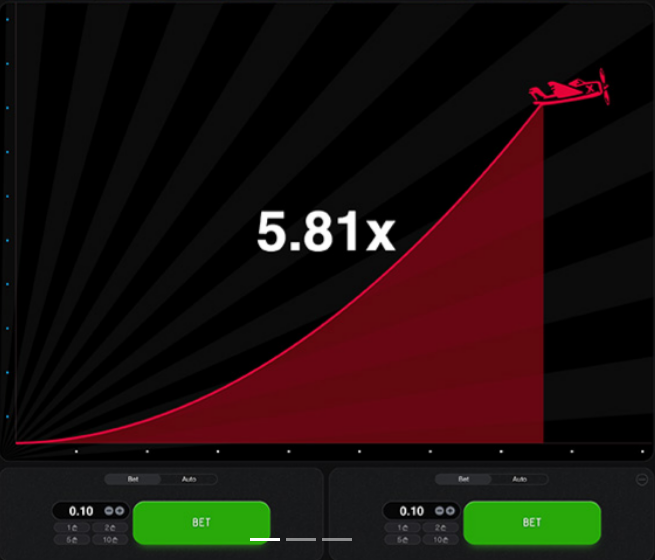
Aviator game panels with multiplier and stake fields The illustrated game panel shows a central 5.81x multiplier and 0.10 stake fields on both panels. It is an interface example, not a record of a $1 stake, a 2x target, or an actual win.
How to enter Aviator through 1win
Open 1win, enter the casino section, search for Aviator, and check that SPRIBE is listed as the provider before you start. That matters more than any marketing label around the game card, because the provider determines the core mechanic and published RTP.
How one round works step by step
You choose a stake, confirm Bet before takeoff, watch the multiplier rise, and press Cash Out before the round crashes. If your bet has been accepted but the next round has not started yet, the interface may still allow cancellation for that pending entry. After settlement, you can check My Bets or round history to see whether the bet was accepted, canceled, won, or lost. Your own cash out only settles your own bet; it does not end the shared round for everyone else.
- Choose the amount in one panel or both panels.
- Press Bet before the plane takes off.
- Watch the multiplier rise.
- Press Cash Out manually, or let Auto Cashout handle it if enabled.
- Review My Bets or history after the round.
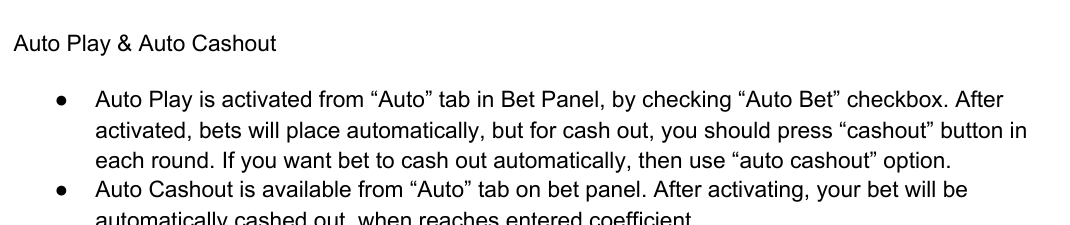
Source for the mechanic and the separate Auto Bet / Auto Cashout functions: spribe-Aviator.pdf. The PDF does not show an edition date, so treat it as a rules reference rather than proof of current 1win labels.
Rules image showing separate automatic bet entry and auto cashout actions The rules image is useful for one practical point: Auto Bet places entries automatically, while Auto Cashout settles a live bet automatically if the chosen multiplier is reached.
Mobile play changes convenience, not probability
On a phone, the workflow is the same as in a browser: bet before takeoff and cash out before the crash. What mobile can change is convenience, and Auto Cashout can reduce the need for manual timing. What it does not change is the probability of a successful result or the math of the round.
Gross payout vs net profit
Aviator displays a gross payout, but your real result is net profit after subtracting the original stake. With a $1 bet cashed out at 1.2x, the gross payout is $1.20 and the net profit is $0.20. At 1.5x the profit is $0.50, at 2x it is $1, at 3x it is $2, at 5x it is $4, and at 10x it is $9.
| Stake | Target | Gross payout | Net profit if successful |
|---|---|---|---|
| $1 | 1.2x | $1.20 | $0.20 |
| $1 | 1.5x | $1.50 | $0.50 |
| $1 | 2x | $2.00 | $1.00 |
| $1 | 3x | $3.00 | $2.00 |
| $1 | 5x | $5.00 | $4.00 |
| $1 | 10x | $10.00 | $9.00 |
That also explains why low targets can feel safer without being universally better. One failed 1.2x bet wipes out five successful $0.20 profits. One failed 1.5x bet wipes out two successful $0.50 profits. An earlier target gives you a smaller win when it lands; a higher target pays more but should be expected to land less often under a simple model.
How to set Auto Cashout at 2.00x
Auto Bet and Auto Cashout are not the same setting. Auto Bet only places the next entry automatically, while Auto Cashout tells the game where to settle an active bet. A clear example is this: open the Auto tab, enter amount $1, enable Auto Cashout, type 2.00x, check the toggle state, and then place the bet. If you use both panels, remember that each panel has its own controls.
- Open the Auto tab.
- Enter amount $1.
- Enable Auto Cashout.
- Enter 2.00x.
- Check which toggles are on for that panel.
- Place the bet and monitor the next round.
Auto Bet alone does not automatically cash out. That distinction matters a lot in practice. It is also better not to leave the game running unattended just because an automatic setting is available.
Strategy comparison: what changes and what does not
Strategies in Aviator change risk shape and session behavior, not the built-in edge. A fixed scheme keeps exposure easy to read. Manual cash out gives discretion but adds timing pressure. Two bets in the same round let you combine an early and a late target, but they are still tied to the same crash point. Progression systems increase turnover fast. History reading can feel convincing, yet it does not give a reliable signal for the next round.
| Strategy | How it behaves | Main benefit | Main risk |
|---|---|---|---|
| Fixed amount + fixed target | Same stake and same exit each round | Clear exposure and simple tracking | Cannot reverse the house edge |
| Manual cash out | You decide during the round | Flexible and responsive | Timing mistakes and emotional exits |
| Split into 2 bets | Two targets on the same crash round | Different payoff shapes in one round | Higher total turnover and correlated outcomes |
| Martingale | Increase stake after losses | Can recover prior losses only in limited cases | Stakes escalate very fast and hit bankroll or limits |
| History or pattern hunting | Watches past crash points | Gives a feeling of structure | Past results are not reliable predictors |
A fixed plan is useful because you know exactly how much you are risking each round, but it does not remove the 3% theoretical edge. Manual cash out can suit players who want discretion, yet a faster finger does not create value by itself. Two-bet play changes the payoff profile, not the round distribution. Martingale looks neat on paper and dangerous in actual bankroll terms. Pattern hunting is the weakest idea of the lot because previous multipliers are descriptive, not predictive.
Two-bet example: same round, shared risk
Take two bets of $1 each, with targets at 1.5x and 5x. If the crash happens before 1.5x, both bets lose and the net result is -$2. If the first bet reaches 1.5x but the second bet loses, the total payout is $1.50 and the net result is -$0.50 because both original $1 stakes must be counted. If both targets are reached, the total payout is $6.50 and the net result is +$4.50. If the first target were 2x and the second bet still lost, the net result would be exactly $0.
The key point is correlation: both bets live inside the same crash round, so they are not independent and they do not create automatic insurance. Also, staking $1 on each panel means $2 total turnover per round, which is double the turnover of a single $1 bet. That is different from splitting one total $1 stake across two ideas.
Martingale at 2x: the arithmetic gets big quickly
With a base stake of $1 and a 2x target, a losing sequence runs 1, 2, 4, 8, 16, 32, 64. After those seven losses, the cumulative loss is $127. The next required bet is $128, and you would need $255 from the start to survive the whole sequence and place that next step.
That recovery only produces a net gain of $1 if you can actually place and successfully cash out the full next stake. In real play, bankroll limits, table limits, or your own stop point can break the sequence first. And below a 2x target, ordinary doubling does not automatically recover prior losses anyway, so progression should not be treated as a safety system.
What RTP 97% really means
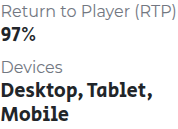
SPRIBE publishes an official RTP of 97%, so the theoretical house edge is 3%. On 100 bets of $1 each, turnover is $100. Under that RTP, the expected return is $97 and the expected loss is $3. This is expectation over turnover, not a fee charged on each individual cash out and not a promise about your next session.
If you bet $1 on each of the two panels for 100 rounds, your turnover becomes $200, and the same 3% edge implies an expected loss of $6 under the same assumptions. Source for the published RTP: https://spribe.co/games/aviator.
Provider page showing the published RTP of 97% This provider screenshot is useful as a quick check that the published RTP is 97%, which is where the 3% house edge comes from.
Turnover, balance, and withdrawal are different things
Turnover is the total amount wagered across your bets. Your cash balance is the money currently sitting in the gaming account. A bank or wallet withdrawal is a separate cashier process handled by the operator. So a successful in-game cash out increases gaming balance, but it is not the same as money already withdrawn externally.
Conditional probabilities by target: model, not exact Aviator distribution
Before the numbers, one caveat is essential: the table below uses an idealized mathematical model, p(target) = 0.97 / target, assuming independent rounds and one fixed target. It is not a verified exact Aviator implementation, and it cannot be derived from RTP alone. Real rounding, caps, ties, and other implementation details can matter.
| Target | Conditional probability under the model |
|---|---|
| 1.2x | 80.83% |
| 1.5x | 64.67% |
| 2x | 48.50% |
| 3x | 32.33% |
| 5x | 19.40% |
| 10x | 9.70% |
Used carefully, this model shows the trade-off clearly: lower targets land more often, while higher targets pay more when they do land. What it does not do is predict the next crash or guarantee a profitable session. Within the model, the long-run expectation remains about -3% of total amount wagered.
How to use the RTP calculator for Aviator-style turnover math
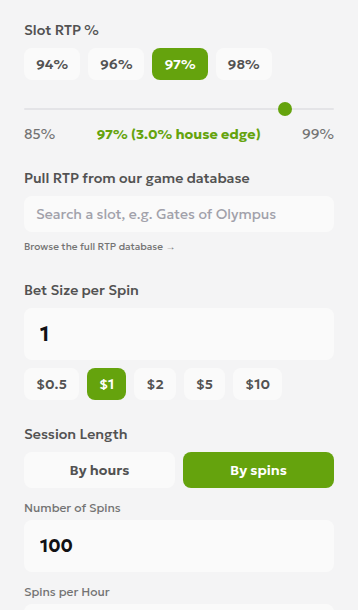
The most practical tool for this part is the RTP calculator. Set RTP to 97, choose the “By spins” mode, enter a $1 stake and 100 spins, and treat “spins” simply as 100 bets for a generic one-bet-per-round scenario. Then the basic interpretation is: $100 total wagered, $97 expected return, and $3 expected loss.
Mobile RTP calculator settings with 97% RTP, $1 stake, and 100 bets entered This screen shows the input side of the calculation: 97% RTP, a $1 stake, and 100 bets entered through the calculator's spins-based turnover mode.
Mobile RTP calculator results showing turnover, expected return, and expected loss This result screen is the useful part: read it as turnover math, not as a forecast for the next round or the best cash-out target.
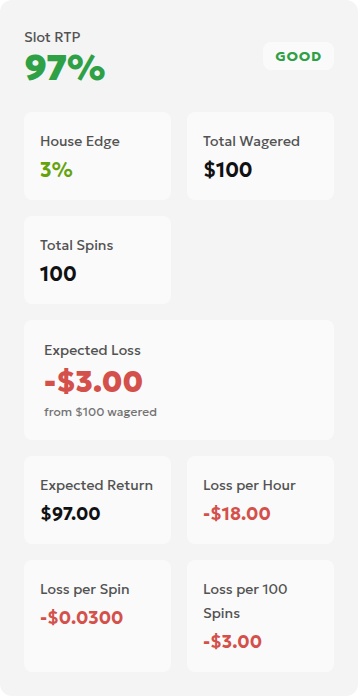
The calculator is not predicting crash points, session profit probability, or the next winning round. It is only converting RTP and total wagered amount into expected return and expected loss. Its slot-style labels do not change that generic turnover logic.
History, Provably Fair, and common misconceptions
Past multipliers are history, not signals. A run of low crashes does not make a high multiplier “due,” and a recent high one does not make another high one less likely by itself. Provably Fair is useful for verifying completed rounds, not for forecasting future ones. SPRIBE's completed-round verification reference is here: https://spribe.co/provably-fair.
If you want the practical extension of that idea, the useful next reads are our guide to Aviator predictor claims and our crash multiplier frequency article. The short rule for actual play is simpler: set an affordable session loss limit in advance and stop when you hit it, instead of trying to recover everything immediately.
Cash out in the game vs withdrawing money
In Aviator, Cash Out settles an active bet and credits your gaming balance. A withdrawal is what happens later in the cashier when you move funds to a bank card, wallet, or another payment method. KYC, operator limits, and bonus terms can all matter at that stage.
If you need the operator process, see how 1win withdrawal works. If your account is not ready yet, the 1win registration guide is the next logical step. Check the operator's current terms directly rather than assuming any fixed processing speed or promotion applies.
Frequently Asked Questions
It depends on the actual screen, currency, and operator settings. Check the live stake field in your interface instead of relying on one fixed number from a review.
Yes. If the crash comes before both target levels, both bets lose. The two panels do not automatically insure each other.
Auto Bet only places entries for new rounds. Auto Cashout sets the level where an active bet is settled automatically. They are separate toggles and do different jobs.
Because the payout is only available before the round ends. Once the crash point is reached, that bet is already settled as a loss and cannot be revived.
Evgeniy Volkov
Verified ExpertFullstack developer with a background in mathematics. I build the calculators and game-style tools on ToolsGambling with Pixi.js and modern web tech, and every result uses transparent probability formulas you can verify yourself.