












Contents
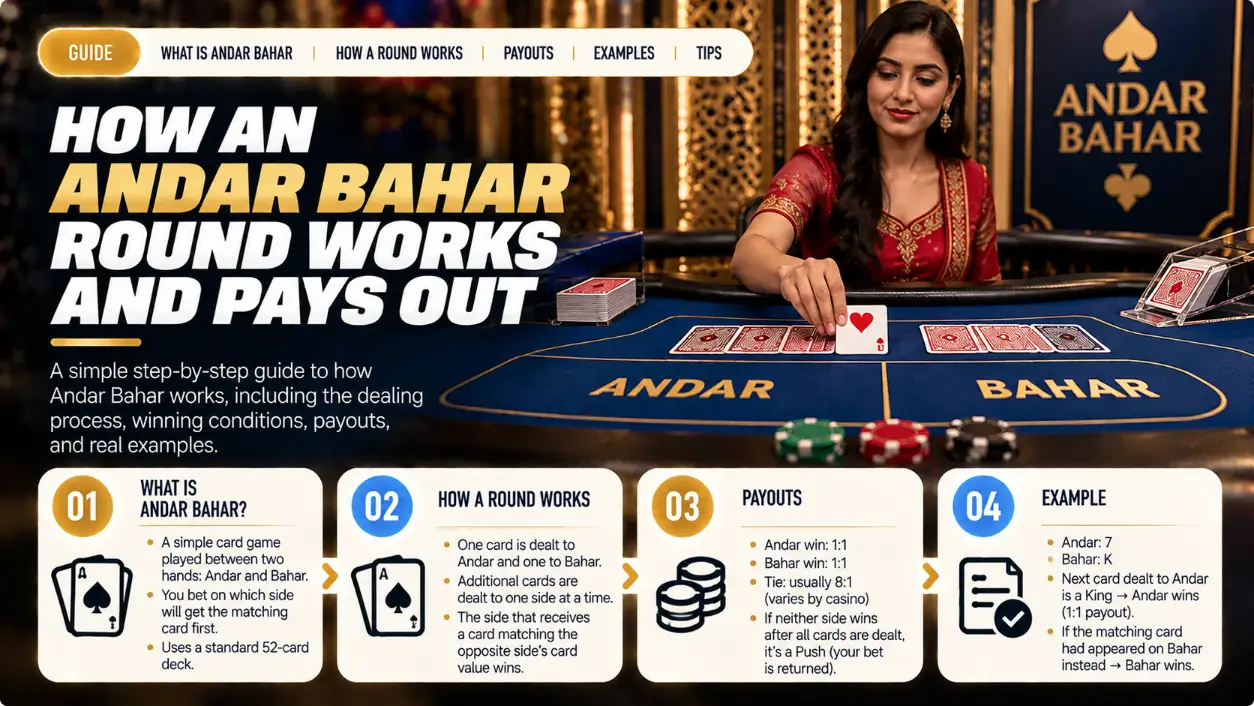
In Andar Bahar, the winning side is the first to receive a card of the same rank as the middle card; suit does not matter. In the version covered here, Andar receives the first card, then the sides alternate. Andar wins slightly more often, but its payout is lower.
All figures below apply only to the version documented in Evolution Services SA Game Rules V2.7.4, Andar Bahar section, pages 306–307: one 52-card deck, Andar dealt first, and winning total returns of ×1.9 on Andar and ×2 on Bahar, including the original stake. This is an analysis of that document, hosted on a third-party mirror, not confirmation of any current live table’s rules or interface.
Which Rules Should You Check?
Check the dealing order and paytable before comparing the two wagers. Both the probability of winning and the house edge depend on those rules.
The documented version uses this sequence:
- The 52-card deck is reshuffled before each round.
- The middle card is revealed before bets are accepted.
- When the betting timer ends, the first card goes to Andar and the second to Bahar.
- Cards continue alternating between the sides until the first rank match.
- A winning Andar wager returns ×1.9 the stake in total; a winning Bahar wager returns ×2.
The middle card, called the “Joker” card in these rules, is an ordinary card that sets the target rank. No extra wild joker is added to the deck. If the middle card is Q♣, for example, any of the three remaining queens will match, regardless of suit.
The dealing order and payouts come from Evolution Services SA V2.7.4, pages 306–307. If your table uses a different order or paytable, do not apply the percentages below to it.
How Does a Round Play Out?
The round ends as soon as either side receives a card of the target rank. The following is a constructed teaching example, not a record of actual play:
- The middle card is revealed as Q♣.
- After it is revealed, you place a wager on Andar or Bahar.
- Betting closes, and alternating dealing begins.
- Andar receives 4♦; Bahar receives 8♥.
- The next cards are 9♠ on Andar and 2♣ on Bahar.
- The fifth card is Q♥ on Andar. It matches Q♣ by rank, so Andar wins and the round ends.
Teaching diagram of an Andar Bahar round: Q♣ in the middle and matching Q♥ on Andar at card five
Teaching diagram, not a game screenshot: cards 1, 3 and 5 go to Andar; the fifth card Q♥ matches the middle Q♣ by rank.
In this sequence, odd-numbered positions belong to Andar and even-numbered positions belong to Bahar. What matters is the position of the first rank match—not the number of cards of any suit or cards that would have appeared later.
What Does a 10-Unit Wager Return?
A winning 10-unit Andar wager returns 19 units, while a winning 10-unit Bahar wager returns 20 units. Both totals include the original stake, so the net profits are 9 and 10 units, respectively.
The table uses the multipliers in Evolution Services SA V2.7.4, page 306. Each row represents a separate 10-unit wager. These hypothetical settlements assume the documented main-bet payouts; no rounding is needed.
| Round outcome | Your wager | Total return, including stake | Net profit or loss |
|---|---|---|---|
| First match on Andar, as in the example | Andar | 19 units | +9 units |
| First match on Andar, as in the example | Bahar | 0 units | −10 units |
| First match on Bahar | Andar | 0 units | −10 units |
| First match on Bahar | Bahar | 20 units | +10 units |
For the last two rows, imagine a different round in which the first five cards do not match the middle card and the sixth card is a queen on Bahar. This is a separate hypothetical example, not a continuation of the round that already ended in the diagram.
Do not confuse a total-return multiplier with profit odds. On Andar, ×1.9 means a total return of 1.9 times the stake but a net profit of only 0.9 times the stake: profit odds of 0.9:1. On Bahar, ×2 corresponds to profit odds of 1:1.
Which Side Wins More Often and Has the Lower House Edge?
In this version, Andar wins about 51.5006% of rounds and Bahar wins 48.4994%. Andar also has the lower house edge: about 2.15%, compared with 3.00% on Bahar. These results depend on both the fixed Andar-first order and the stated payouts.
After the middle card is revealed, 51 cards remain, including three cards of the target rank. Let be the position of the first match in the subsequent deal. Then:
The denominator counts the possible positions of the three matching cards. In the numerator, the first matching card is fixed at position , and the other two must appear later. Summing the probabilities for odd positions gives Andar’s win probability; summing those for even positions gives Bahar’s.
| Measure | Andar | Bahar |
|---|---|---|
| Probability of winning | 51.5006% | 48.4994% |
| Winning total return, including stake | ×1.9 | ×2 |
| House edge | 2.15% | 3.00% |
The house edge is calculated as:
Before rounding, the win probabilities are 0.5150060024 and 0.4849939976, and the house edges are 2.1488595% and 3.0012005%. The table rounds win probabilities to four decimal places in percentage form and house edges to two. The calculation is independently cross-checked against the Wizard of Odds analysis, updated August 3, 2026. That is a mathematical cross-check for this version, not a universal paytable.
House edge is the long-run expected loss as a share of the amount wagered, not the probability of losing a single round. Andar’s more frequent wins do not remove the negative expected value: its lower payout preserves the house edge.
What Changes in Other Versions?
Other versions require a fresh check of the dealing order, betting windows, and payouts. The percentages in this article should not be transferred to them.
Pagat’s description of Andar Bahar variants includes rules in which the first side depends on the middle card’s color. That is not a fixed Andar-first game.
Evolution Services SA V2.7.4, pages 309–311 separately describes an OTT game with two betting windows. Its betting sequence and calculations should not be combined with the version analyzed here. Side bets also have their own paytables; the main side’s win probability cannot substitute for a separate analysis.
Past results do not predict the next winning side. Under the documented rules on pages 306–307, the deck is reshuffled before every round, so previous Andar or Bahar wins do not change the next round’s probabilities.
How Can You Estimate Expected Loss with ToolsGambling?
The ToolsGambling house-edge calculator estimates expected loss from total wagering, not the outcome of a session. It has no Andar Bahar preset, so you need to enter a custom house edge.
- Use the custom house-edge input.
- Enter 2.15% for Andar or 3.00% for Bahar.
- Set the stake to 10 units.
- Click “By rounds”.
- Enter 100 in “Number of Rounds”.
Assuming the same wager size in every round, total wagering is 1,000 units. Expected loss is approximately 21.5 units on Andar or 30 units on Bahar. This example uses rounded house edges, so the estimates are approximate.
The calculator multiplies total wagering by the entered house edge. It does not calculate either side’s win probability or guarantee that actual losses will be close to the estimate: over 100 rounds, you could finish ahead or lose substantially more. For more on the measure itself, see the house-edge guide.
Evgeniy Volkov
Verified ExpertFullstack developer with a background in mathematics. I build the calculators and game-style tools on ToolsGambling with Pixi.js and modern web tech, and every result uses transparent probability formulas you can verify yourself.