












Contents
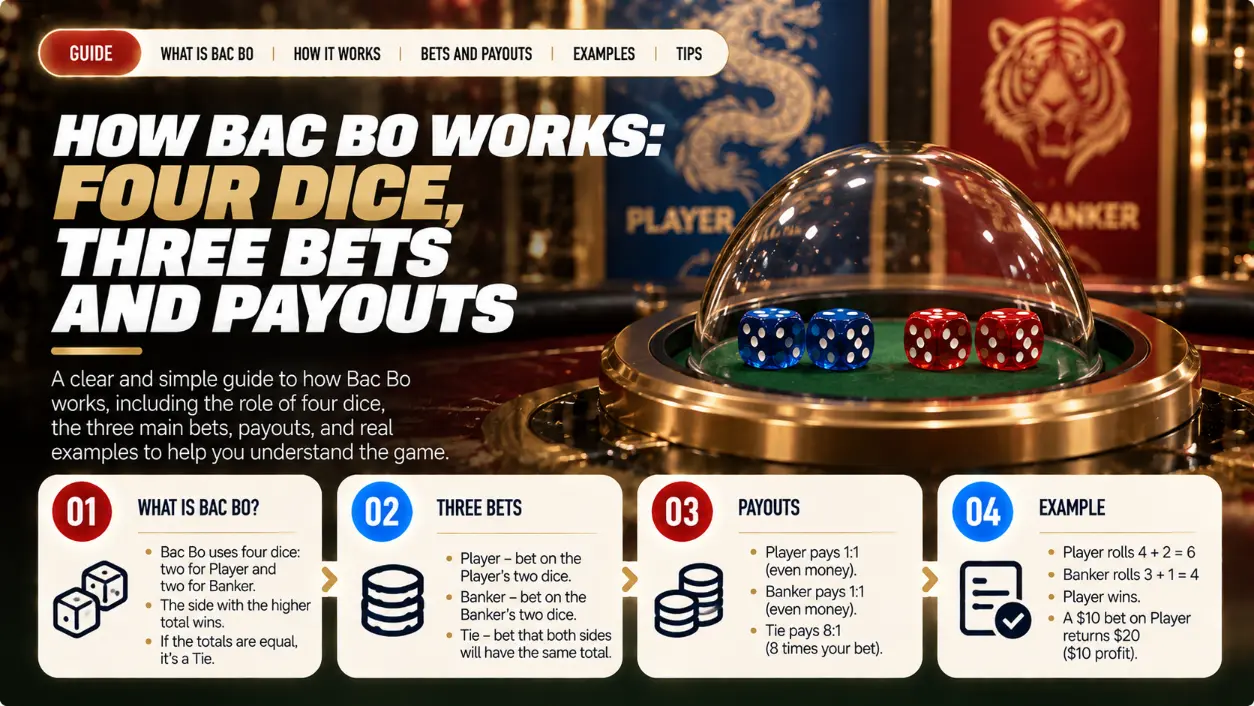
Bac Bo uses four six-sided dice: two for Player and two for Banker. Add each side’s dice; the higher two-dice total wins, and equal totals produce a Tie. Player and Banker wins pay 1:1 net profit. On a Tie, those bets return 90% of the stake, while a winning Tie bet pays 4:1 to 88:1 net profit, depending on the matching total.
For example, Player rolling 2 + 5 and Banker rolling 3 + 4 produces a 7:7 Tie. A separate $10 Tie bet returns $50: $40 profit plus the $10 stake. A $10 bet on either side returns $9, a $1 loss.
This guide covers the schedule in Evolution Services v2.7.4, page 188, with the 90% return on tied side bets confirmed by win2day’s official rules. It does not cover card baccarat, Football Studio Dice or Lightning Bac Bo.
How the Dice Roll and the Winner Is Decided
Compare the full two-dice totals, each ranging from 2 to 12. The higher total wins; equal totals mean Tie. Do not discard the tens digit as in card baccarat.
Evolution v2.7.4 describes this sequence:
- Four dice sit in individual shakers, two assigned to each side.
- The first Player die and the first Banker die settle.
- The side with the higher first die has its second die settle first.
- Once all four dice have settled, the two totals determine the result.
Player and Banker are side labels, not people at the table. The settling sequence does not change the calculation: both dice count toward each side’s total.
What Are the Bac Bo Bets and Payouts?
Player and Banker bets pay 1:1 net profit when the selected side wins. A Tie bet pays between 4:1 and 88:1 when the totals match. If the round is a Tie, Player and Banker bets return only 90% of their stakes.
| Bet | Winning condition | Winning payout |
|---|---|---|
| Player | Player’s total is higher | 1:1 net profit plus the original stake |
| Banker | Banker’s total is higher | 1:1 net profit plus the original stake |
| Tie | Both totals are equal | Net profit from the Tie payout table plus the original stake |
A bet on the losing side loses its entire stake. A tied Player or Banker bet is not a win or a full refund: a $10 stake returns $9, leaving a $1 loss.
Tie Payout Table
The Tie payout depends on the matching two-dice total, not the sum of all four dice. For example, “2 or 12” means a 2:2 or 12:12 Tie.
| Matching total on each side | Net profit odds | Net profit on $10 | Gross return, including stake |
|---|---|---|---|
| 2 or 12 | 88:1 | $880 | $890 |
| 3 or 11 | 25:1 | $250 | $260 |
| 4 or 10 | 10:1 | $100 | $110 |
| 5 or 9 | 6:1 | $60 | $70 |
| 6, 7 or 8 | 4:1 | $40 | $50 |
The 88:1 payout applies only to a 2:2 or 12:12 Tie—not to every Tie.
This schedule appears in both the Evolution v2.7.4 document and win2day’s rules. The operator’s rules also confirm that the original stake is retained on a win: the quoted odds describe net profit, not the entire amount returned.
Worked Round: Player 2 + 5 Against Banker 3 + 4
Both sides total 7, so the result is Tie and the Tie bet pays 4:1 net profit. Player and Banker bets each return 90% of their stakes.
Conditional Bac Bo diagram: Player dice 2 and 5 and Banker dice 3 and 4, both totals 7.
Original conditional diagram, not a game screenshot.
The table compares three separate hypothetical $10 bets. It does not assume or recommend placing all three at once. These amounts are exact, so no rounding is needed; the example illustrates the stated schedule rather than a recorded live round.
| Separate bet | Settlement at 7:7 | Gross return, including stake | Net result |
|---|---|---|---|
| $10 on Player | 90% of the stake returned | $9 | −$1 |
| $10 on Banker | 90% of the stake returned | $9 | −$1 |
| $10 on Tie | 4:1: $40 profit plus the $10 stake | $50 | +$40 |
What Happens to Each Bet Under Every Outcome?
A winning $10 Player or Banker bet returns $20; a losing one returns nothing; a tied one returns $9. A $10 Tie bet returns $50 to $890 only when both totals match.
Each cell below shows gross return; net result for a separate $10 bet.
| Round outcome | Player bet | Banker bet | Tie bet |
|---|---|---|---|
| Player’s total is higher | $20; +$10 | $0; −$10 | $0; −$10 |
| Banker’s total is higher | $0; −$10 | $20; +$10 | $0; −$10 |
| Equal totals | $9; −$1 | $9; −$1 | $50, $70, $110, $260 or $890; respectively +$40, +$60, +$100, +$250 or +$880 |
For a Tie, use the matching total to select the correct payout from the earlier table. A $9 return on a $10 side bet is a 10% loss, not a winning payout or a push.
What Is the Theoretical Cost of These Bets?
For this schedule, the house edge is approximately 1.1265% on Player and Banker and 4.4753% on Tie. These figures assume independent, fair six-sided dice with equally likely faces and no additional payout restrictions.
An independent exhaustive enumeration produces:
- 1,296 possible four-dice outcomes:
6^4 = 1296; - 575 Player wins;
- 575 Banker wins;
- 146 Ties.
For either side bet, the 575 winning outcomes and 575 losing outcomes cancel out. Each of the 146 Ties loses 0.1 stake:
(146 × 0.1) / 1296 × 100% ≈ 1.1265%
For the Tie bet, weighting all five payout levels across the possible outcomes gives a house edge of 4.4753%.
| Bet | House edge | RTP — theoretical return |
|---|---|---|
| Player or Banker | 1.1265% | 98.87% |
| Tie | 4.4753% | 95.52% |
House edge is rounded to four decimal places and RTP to two. Evolution’s quoted 98.87% agrees with the main-bet calculation; it does not apply to the Tie bet. RTP is neither the probability of winning a round nor a guarantee that you will recover that share of your money.
How to Estimate Expected Loss With the Calculator
The ToolsGambling house edge calculator estimates expected loss using a manually entered house edge. It has no Bac Bo preset.
- Select the option for entering a custom house edge.
- Enter 1.1265% for a Player or Banker bet.
- Click By rounds to reveal the Number of Rounds field.
- Enter 10 as the bet amount and 100 in Number of Rounds.
- To compare the Tie bet, change the house edge to 4.4753%, leaving the other inputs unchanged.
Assuming a fixed $10 bet in each of 100 rounds, total wagering is $1,000. The calculator displays an expected loss of $11.30 for a side bet or $44.80 for Tie. It rounds RTP to two decimal places before calculating: a custom house edge of 1.1265% becomes 98.87% RTP, while 4.4753% becomes 95.52% RTP. Expected loss is then calculated using that rounded RTP. The tool labels monetary amounts in dollars.
Using the original values without intermediate rounding, the exact model gives expected losses of $11.27 for a side bet and $44.75 for Tie, rounded to the nearest cent. These are separate model results, not the values displayed by the calculator.
These are mathematical expectations, not session forecasts. The calculator does not settle an individual round or predict the next roll.
What Should You Check Before Betting at a Table?
Use these payouts and theoretical figures only if the table’s own rules match this schedule. Confirm the three bet options, the 90% return on tied side bets and every level of the Tie payout table.
Check that:
- the available bets are Player, Banker and Tie;
- Player and Banker wins pay 1:1;
- a Tie returns 90% of a Player or Banker stake, not the full amount;
- Tie pays 88:1 for 2/12, 25:1 for 3/11, 10:1 for 4/10, 6:1 for 5/9 and 4:1 for 6/7/8;
- the quoted payout odds represent net profit, with the winning stake returned separately.
If any point differs, do not automatically apply this guide’s payouts or house edge figures. The Bac Bo name alone does not establish that every operator uses this exact version.
Frequently Asked Questions
No. A house edge calculator estimates expected loss from the inputs you provide. It does not predict rolls or calculate payouts for an individual round.
Evgeniy Volkov
Verified ExpertFullstack developer with a background in mathematics. I build the calculators and game-style tools on ToolsGambling with Pixi.js and modern web tech, and every result uses transparent probability formulas you can verify yourself.