












Contents
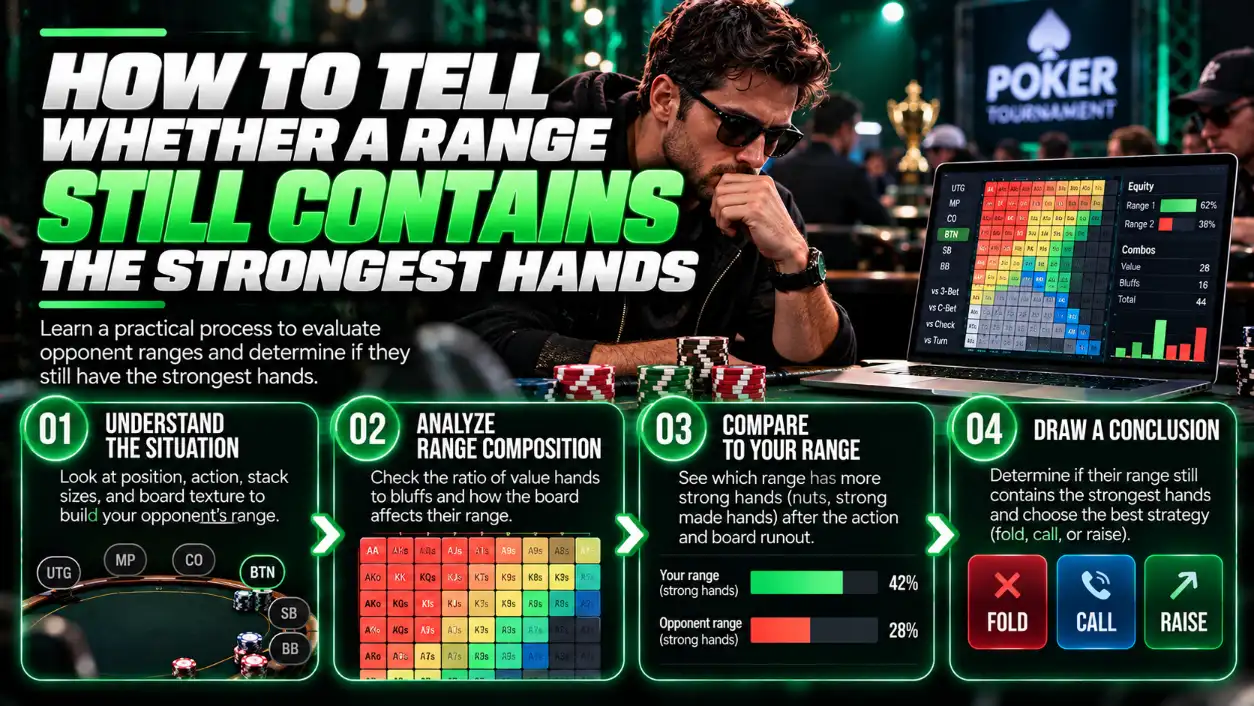
A capped range in poker is a range from which your assumptions about the full line exclude the strongest relevant hands on the current board. One check or call does not establish that a range is capped. Consider positions, previous bets, bet sizes, known cards, and the possibility of slow-playing strong hands.
An uncapped range still contains the strongest relevant hands after the full line. That does not mean the player’s actual hand is strong or that betting big against them is necessarily a good idea.
For example, on Q♣7♦2♠, the big blind can still have QQ after check-calling. That is top set and the strongest possible hand on this flop. But when the river is K♣, KK becomes the strongest hand, so the conclusion now depends on whether the preflop model excluded it.
How to Read a Range from the Full Line
Look beyond the last action and ask which strong hands are still consistent with the entire hand.
- Define the starting range. Account for position, effective stack, and the sequence of raises. Do not replace a range with one guessed hand.
- Separate actions from assumptions. Calling a 4-bet does not prove that AA and KK are absent. Excluding them requires a separate assumption about which hands the player would 5-bet.
- Recheck the strong hands after each action. A check, call, or bet does not automatically remove a particular hand class.
- Reassess the strongest possible hand on each new street. A hand can remain in the range without remaining the strongest hand on the current board.
- Account for blockers. Community cards and Hero’s cards reduce the number of available combos: specific two-card combinations.
For a starting framework, see the guide to preflop ranges. For the raise sequence, see the 4-bet guide.
Worked Hand: What Remains After Each Action?
BB retains QQ on the flop in both models. The difference concerns AA and KK: Model A excludes them after preflop, while Model B retains them as slow-plays, meaning strong hands played passively. Both models are hypothetical teaching examples, not solver output or player-population data.
The game is six-handed no-limit Texas hold’em. The effective stack, meaning the maximum the players can risk against each other, is 100 bb before the hand; bb means one big blind as a unit of measurement. BTN is the player on the button, and BB is the player in the big blind. The small blind folds, leaving two players in the hand. This teaching model has no antes or rake.
Hero holds A♠5♠ on the BTN.
| Action | Strong hands still possible in BTN’s range | Strong hands still possible in BB’s range |
|---|---|---|
| BTN raises to 2.5 bb | AA, KK, QQ | AA, KK, QQ have not yet been excluded |
| BB 3-bets to 11 bb | AA, KK, QQ | AA, KK, QQ |
| BTN 4-bets to 24 bb | AA, KK, QQ | AA and KK remain possible before BB responds; QQ is also not excluded |
| BB calls | AA, KK, QQ | Model A: QQ; Model B: QQ, AA, KK |
| Flop Q♣7♦2♠, BB checks | AA, KK, QQ | Both models contain QQ; Model B also contains AA and KK |
| BTN makes a 12 bb c-bet | AA, KK, QQ | QQ remains; AA and KK depend on the model |
| BB calls | AA, KK, QQ | QQ remains in both models; AA and KK remain in Model B |
| Turn 3♥, BB checks | AA, KK, QQ | Checking does not automatically remove QQ or any retained AA and KK |
| BTN checks back | The check itself does not exclude AA, KK, or QQ | QQ remains; AA and KK remain under Model B’s assumptions |
| River K♣, BB checks | KK is possible; AA and QQ are also not excluded | Model A: QQ, but no KK; Model B: KK, AA, and QQ |
The table tracks strong hands rather than listing complete ranges. These hands remain possible in BTN’s range even though we know Hero’s actual hand is A♠5♠.
After the 4-bet call, the pot is 48.5 bb: 24 + 24 + 0.5. After the 12 bb bet and call, it is 72.5 bb. The turn and river checks do not change the pot. Each player has 64 bb behind on the river (100 − 24 − 12), so any bet larger than 64 bb is impossible.
Teaching diagram showing that BB retains QQ after check-calling Q♣7♦2♠, while the presence of KK on the K♣ river depends on the preflop model
Original teaching diagram: actions do not automatically remove strong hands, and a new card changes which hands are strongest in a range.
Why Does K♣ Change the Conclusion?
BB is uncapped on the flop in both models because QQ remains possible. On the K♣ river, BB is capped only in Model A, which excluded KK preflop.
Model A: Assume BB 5-bets AA and KK, so neither remains after the 4-bet call. On Q♣7♦2♠, BB still has the strongest possible hand: 3 combos of QQ. On the K♣ river, KK becomes the strongest hand. BB cannot have it, but BTN can: BB is capped, while BTN is uncapped—provided we assume BTN sometimes checks back the turn with KK for pot control.
Model B: Allow BB to call the 4-bet with AA and KK as slow-plays. BB then retains 3 combos of KK on the river. The range is uncapped despite the flop check-call and subsequent checks.
Capped and uncapped describe whether the strongest relevant hands are present. They are not the same as range advantage, which concerns overall range strength, or nut advantage, which concerns the relative concentration of the strongest hands. They also do not describe range shape: a condensed range focuses on medium-strength hands, a polarized range contains strong hands and bluffs, and a linear range includes hands in descending order of strength.
Check Back or Bluff All-In for 64 bb?
In this local river model, shoving 64 bb into 72.5 bb with A♠5♠ has an expected value of +20.00 bb in Model A and −6.53 bb in Model B; the remaining stack is too small for a pot-sized bet. Checking back has EV = 0 only under this model’s assumptions.
Expected value (EV) is the average net result of an action across the specified outcomes and their weights. It is not the result of a single hand.
First, separate the arithmetic we can verify from the assumptions:
| Verifiable component | Model assumption |
|---|---|
| The river pot is 72.5 bb | Which hands BB retains in a narrow preflop calling range that excludes AKo |
| The bet is an all-in of 64 bb, the remaining stack | Which hands BB calls or folds |
| The combo count after accounting for known cards | Every listed combo has equal weight |
| The formula’s result for the specified inputs | A♠5♠ never wins when called and never wins after checking back |
This calculation does not consider a raise by BB, other bet sizes, mixed action frequencies, rake, or future game dynamics.
Model A: 13 Combos Without AA or KK
With the specified call/fold split, bluffing has 20.00 bb more EV than checking back.
BB’s range is QQ,JJ,AQs,AKs. After accounting for the Q♣7♦2♠3♥K♣ board and Hero’s A♠5♠:
| BB’s hands | Combos | Assumed response to the bet |
|---|---|---|
| 3 | Call | |
| JJ | 6 | Fold |
| AQs | 2 | Fold |
| AKs | 2 | Call |
| Total | 13 | 5 calls, 8 folds |
Hero’s A♠ is a blocker: it removes A♠Q♠, A♠K♠, and three AA combinations. The community cards separately remove combinations containing Q♣ and K♣, including A♣Q♣ and A♣K♣.
This is a deliberately narrow teaching calling range without AKo. If BB also calls the 4-bet with AKo, that adds 7 live top-pair combos that call the river: Model A becomes 12 calls versus 8 folds, with EV −9.40 bb even without slow-played AA and KK. Excluding AKo therefore affects the conclusion more than the AA/KK assumption does.
Fold equity is the benefit you gain from the possibility that your opponent folds. For a pure bluff that never wins when called, the break-even fold rate is:
B / (P + B) = 46.89%
Here, P is the 72.5 bb pot and B is the 64 bb all-in. With a fold rate of F:
EV of betting = F × P − (1 − F) × B
In Model A, the fold rate is 61.54%, and the bet’s EV is +20.00 bb. The percentage and EV are rounded separately; the calculation uses the exact ratio of 8 folds to 13 combos.
Checking back has EV = 0 because A♠5♠ never wins at showdown in this local model and Hero invests nothing more. That is not a universal property of checking.
Model B: Add 3 AA and 3 KK Combos
Adding 3 AA combos and 3 KK combos, all of which call, makes the bluff worse than checking back: EV = −6.53 bb.
BB now has 19 combos: 11 calls and 8 folds. The fold rate falls to 42.11%, below the 46.89% threshold.
BB’s assumed responses are neither observed player frequencies nor advice for actual play. We are changing the assumptions to see how the result changes.
How Much Do Additional Strong Hands Matter?
With four additional slow-play combos that call, the bluff is still marginally profitable (+0.24 bb); with five, it loses money, so break-even lies between 4 and 5 combos.
The number of folds stays at 8. Only the number of additional calls changes:
| Additional slow-play combos | Bet EV, bb |
|---|---|
| 0 | +20.00 |
| 1 | +14.00 |
| 2 | +8.80 |
| 3 | +4.25 |
| 4 | +0.24 |
| 5 | −3.33 |
| 6 | −6.53 |
This is a sensitivity check on the assumptions, not an estimate of how often BB actually slow-plays AA and KK.
Teaching diagram showing the EV of a 64 bb all-in bluff falling from +20.00 bb with no additional slow-play combos to −6.53 bb with six, crossing zero between four and five
Original teaching diagram: additional calls from strong hands change the bluff’s result even though the eight folding combos stay the same.
How to Reproduce the Count in the Range Builder
The range builder removes only board cards and groups combos by made-hand class, not by the tokens you enter. Account for Hero’s A♠5♠ separately.
- Enter
QQ,JJ,AQs,AKsin the “Range notation” field and press “Apply to grid”. - Set the board to Q♣7♦2♠3♥K♣ in the “Board (optional)” block.
- The “How your range hits the board” block displays “Across 15 combos in range (cards on the board are removed).” The 15 combos are grouped as “Set” — 3 (QQ), “Top pair” — 3 (AKs), and “Middle pair” — 9 (6 JJ + 3 AQs; both hands fall into this class). Subtract A♠Q♠ and A♠K♠ because of Hero’s A♠ to get 13 combos.
- Add
AA,KKin the “Range notation” field while retaining the original hands, then press “Apply to grid”. - The “How your range hits the board” block now displays “Across 24 combos in range (cards on the board are removed).” The 24 combos are grouped as “Set” — 6 (QQ and KK), “Overpair” — 6 (AA), “Top pair” — 3, and “Middle pair” — 9. In addition to the two combos already excluded, subtract the three AA combos containing A♠ to get 19 combos: 3 AA and 3 KK added to the base model.
This check reproduces the combinatorics. The call/fold split and EV calculation are separate assumptions of the teaching model, not strategic conclusions produced by the tool.
What to Check Before Calling a Range Capped
First identify the strongest possible hand on the current board, then check whether the opponent’s entire line really excludes it.
Do not conclude “a check means capped”: BB still has QQ on our flop. Do not assume the aggressor is automatically uncapped either; the presence of strong hands also needs to be checked against the full line. And do not treat the absence of the strongest hands as a requirement to bet big. In this example, the bluff’s result depends on the specific assumed calls and folds.
Use this sequence: board → strongest possible hand → full line and bet sizes → possible slow-plays → blockers and combos → calculation using explicitly stated opponent responses. If a key assumption changes the sign of EV, as retaining slow-played AA and KK or including AKo in the preflop calling range does here, the conclusion must remain conditional.
Evgeniy Volkov
Verified ExpertFullstack developer with a background in mathematics. I build the calculators and game-style tools on ToolsGambling with Pixi.js and modern web tech, and every result uses transparent probability formulas you can verify yourself.