












Contents
Raise with one pair or better; fold with anything below A-K high. With A-K high, raise if at least one of these conditions applies:
- The dealer upcard is 2 through Q and matches the rank of one of your cards.
- The dealer upcard is A or K, and you have Q or J.
- No card in your hand matches the dealer upcard’s rank, you have Q, and the upcard ranks below your fourth-highest card.
Otherwise, fold A-K high. This is a simplified, near-optimal strategy, not a perfect solution for every possible hand.
The version matters: this guide covers only the base game under the U.S. rules/paytable named by Wizard of Odds, which supplies the rules, strategy and corresponding figures. Its page was updated on August 3, 2026; the rules were checked on October 16, 2026.
How a Hand Works and How Much You Wager
Place an ante before the deal, receive five cards, then either fold or raise exactly 2× the ante. The dealer also receives five cards, with exactly one dealer upcard visible before your decision.
Caribbean Stud Poker is played against the dealer, not other players. This strategy uses your five cards and the dealer upcard; other players’ hidden cards are not needed.
- Place your ante before the deal.
- Check your five cards and the dealer upcard.
- To fold, end your participation and lose the ante.
- To raise, add exactly twice your ante.
- After the dealer reveals their hand, check qualification and compare hands.
With a $10 ante, the raise is $20, making $30 at risk—not $20. The original ante remains in play. Folding requires no additional wager, so your loss is limited to $10.
The raise size (2× the ante), dealer qualification (A-K-4-3-2 or better) and settlement when the dealer does not qualify, wins or ties were checked against New Jersey Chapter 69F. The raise paytable follows the Wizard of Odds U.S. table; a casino may use a different paytable or set a maximum payout on the raise. The progressive jackpot is a separate optional side bet with its own paytable and expected value, excluded from the house edge figures here. This is not ordinary stud poker between players, since you play only against the dealer; Louisiana Stud is a different game with its own rules and payouts.
When the Dealer Qualifies
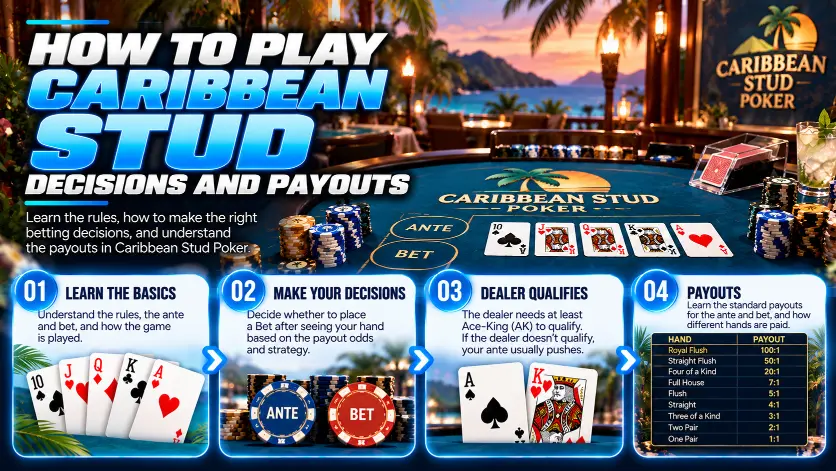
The dealer qualifies with A-K-4-3-2 or any stronger five-card hand. The strongest nonqualifying hand is A-Q-J-10-9.
An ace alone is insufficient. Qualification depends on the complete hand, so an A or K upcard does not establish that the dealer qualifies.
After you raise, settlement works as follows:
| Condition | Settlement |
|---|---|
| Dealer does not qualify | Ante earns 1:1 profit; raise is returned without profit |
| Dealer qualifies; your hand wins | Ante earns 1:1 profit; raise earns profit according to the raise paytable |
| Dealer qualifies; dealer’s hand wins | Ante and raise are lost |
| Exact tie | Both stakes are returned without profit |
A nonqualifying dealer does not trigger the raise paytable, however strong your hand is. Only the ante earns profit; the raise is simply returned.
A tie is also not a win. You recover your stakes, but your net result is zero.
The Raise Paytable
The raise pays 1:1 to 100:1 profit, but only when the dealer qualifies and your hand wins. The ante separately earns 1:1 profit.
| Your winning hand | Profit on the raise |
|---|---|
| Royal flush | 100:1 |
| Straight flush | 50:1 |
| Four of a kind | 20:1 |
| Full house | 7:1 |
| Flush | 5:1 |
| Straight | 4:1 |
| Three of a kind | 3:1 |
| Two pair | 2:1 |
| One pair or high card | 1:1 |
X:1 means X units of profit plus the return of the winning stake. It does not mean total cash returned.
For example, a $20 raise at 2:1 earns $40 profit, with the $20 raise returned separately. A $10 ante adds $10 profit and the return of that $10 stake. The complete settlement appears below.
Never apply the raise’s payout odds to the entire $30 wager. The ante and raise are settled separately.
Applying the Strategy to Six Hands
Check for one pair or better first. Only apply the three additional conditions when you have A-K high; this avoids testing exceptions when the decision is already clear.
Here, “A-K high” means a hand with no pair or stronger combination whose two highest cards are A and K. To identify your fourth-highest card, arrange all five cards in descending rank.
| Your cards | Dealer upcard | Decision and reason |
|---|---|---|
9♠ 9♦ A♣ 6♥ 3♣ | K♥ | Raise: you have a pair of nines. The A-K-high conditions are unnecessary. |
A♠ Q♦ J♣ 9♥ 3♣ | 7♦ | Fold: your hand is below A-K high. Having A, Q and J does not change that. |
A♠ K♦ 9♣ 7♥ 3♠ | 9♦ | Raise: the upcard is within 2–Q and matches your nine’s rank. |
A♥ K♠ J♣ 8♦ 4♥ | K♣ | Raise: the upcard is K and you have J, meeting the second condition. |
A♥ K♠ Q♦ 7♣ 4♠ | 5♥ | Raise: you have Q, no rank matches, and 5 is below your fourth-highest card, 7. |
A♥ K♠ 9♦ 6♣ 3♠ | Q♥ | Fold: no Q matches, the upcard is neither A nor K, and you have no Q. None of the conditions applies. |
A match always means the same rank, not suit. Thus, 9♣ and 9♦ satisfy the first condition despite their different suits.
In the fifth hand, the order is A, K, Q, 7, 4: compare the upcard 5 with 7, not the lowest card, 4. In the sixth hand, A-K high alone is insufficient to raise.
Raise-or-fold decision chart covering pairs, A-K high and the three dealer-upcard conditions
Original instructional diagram. The rules and raise paytable at the actual table remain decisive.
Money Outcomes with a $10 Ante
With a $10 ante, folding produces a −$10 net result; raising brings your total wager to $30. Track profit, stakes returned and net result separately.
“Profit” below means money paid above winning stakes. “Net result” is the change in your money after accounting for everything wagered.
| Hand outcome | Total wagered | Profit | Stakes returned | Net result |
|---|---|---|---|---|
| Fold | $10 | $0 | $0 | −$10 |
| Dealer does not qualify after a raise | $30 | $10 on ante | $30 | +$10 |
| Win with one pair or A-K high, raise pays 1:1 | $30 | $10 + $20 = $30 | $30 | +$30 |
| Win with two pair, raise pays 2:1 | $30 | $10 + $40 = $50 | $30 | +$50 |
| Lose after a raise | $30 | $0 | $0 | −$30 |
| Exact tie | $30 | $0 | $30 | $0 |
Total cash returned equals profit plus stakes returned. Subtract the total wagered to find the net result.
When the dealer does not qualify, you receive $40: $10 profit plus $30 in returned stakes. Your net result is only +$10. A winning pair or A-K-high hand returns $60 in total, for +$30 net. Winning with two pair returns $80, for +$50 net.
Every paytable win assumes the dealer qualifies and your hand is stronger. No rounding is needed: the $10 ante, $20 raise and listed payout odds produce exact amounts.
Settlement breakdown for a 10-dollar ante and 20-dollar raise, separating profit, stakes returned and net result
Profit, stakes returned and net result are different amounts: recovering your own stakes does not increase your net profit.
Why the Figures Are 5.224% and 2.555%
5.224% is the house edge per initial ante; 2.555% is the element of risk per average total wager. They use different denominators, rather than predicting two different session results.
For optimal strategy, an independent weighted summation of the Wizard of Odds outcome table gives:
- Total combinations: 19,933,230,517,200.
- Weighted net result: −1,041,372,912,372 ante units.
- Expected value (EV): ≈ −0.0522 per ante unit.
- House edge: ≈ 5.224%.
This house edge is measured against the initial ante, not the combined ante and raise in each hand. Because you do not always raise, the average total wager is neither one ante nor three antes.
The model’s average total wager is about 2.045 ante units (about 2.0445 in the outcome table). Dividing the expected loss by that amount gives an element of risk of about 2.555%.
For the simplified strategy above, Wizard of Odds reports a 5.225% house edge, compared with 5.224% for optimal strategy under the same paytable. Their closeness does not make the simplified strategy perfect.
None of these figures promises a particular evening’s loss. They describe long-term mathematics under specified rules and strategy; individual hands and sessions can differ.
Using the ToolsGambling Calculator
In the house edge calculator, select Caribbean Stud and enter the ante as the bet size. Do not enter the ante plus raise: the house edge used here is measured against the initial ante.
Use it as follows:
- Select Caribbean Stud, which presets 5.22% and 50 rounds per hour.
- Enter the ante of $10 in “Bet Size per Round”. The field hint refers to an average stake per hand, but enter only the ante here because the edge is measured per ante.
- Keep or change “Rounds per Hour” as an editable pace assumption, and set “Hours Played” to 2 for this example or your chosen duration for another estimate.
With $10, 50 rounds per hour and 2 hours, the tool shows “Total Wagered” of $1,000—the sum of antes, not the full turnover including raises (about $2,045 per 100 hands); “Expected Loss” of $52.20; and “Loss per Hour” of $26.10.
5.22% is the rounded preset of 5.224%.
The pace of 50 rounds per hour is not a promised playing speed: changing it changes the estimated volume of play over time, not the payout rules or the decision for particular cards.
ToolsGambling house edge calculator: Caribbean Stud 5.22%, 10 ante, 50 rounds per hour, 2 hours, expected loss 52.20
Three cropped parts of the ToolsGambling interface: with a 1,000 is the sum of antes; “Expected Loss” is 26.10.
The calculator gives a long-run estimate under these assumptions and does not decide a particular hand; use the strategy conditions above for decisions.
Frequently Asked Questions
Not in this version: the raise is exactly 2× the ante.
No. The minimum qualifying hand is A-K-4-3-2; any stronger five-card hand also qualifies.
The edge figures and money examples apply only to the checked U.S. paytable without the jackpot side bet. With a different paytable, a raise payout cap or a jackpot bet, recalculate using that table's rules.
No. It provides long-term estimates under your chosen assumptions, not decisions or predictions for a particular hand.
Evgeniy Volkov
Verified ExpertFullstack developer with a background in mathematics. I build the calculators and game-style tools on ToolsGambling with Pixi.js and modern web tech, and every result uses transparent probability formulas you can verify yourself.