












Contents
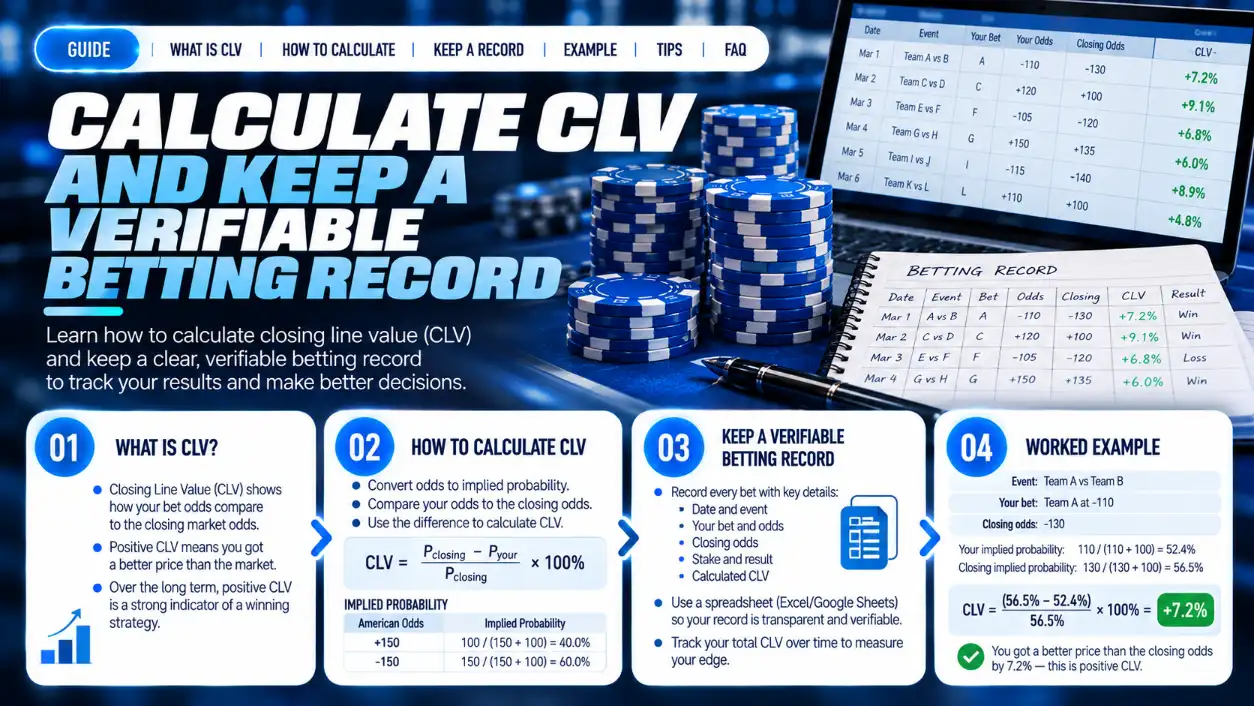
To calculate closing line value (CLV), divide your accepted decimal odds by the closing decimal odds for the same selection, subtract one, and multiply by 100%. To make that comparison auditable, record the source, the bet acceptance time, and the closing-price timestamp in UTC. If you cannot verify the closing odds, leave CLV blank.
CLV compares prices under matching market and settlement conditions. It does not replace a pre-bet value assessment or measure your realized betting returns.
Calculate raw CLV first
Raw CLV measures the difference between your accepted odds and the closing odds, without adjusting for bookmaker margin:
CLV = (accepted decimal odds / closing decimal odds − 1) × 100%
Suppose you took 2.10 and the same selection closed at 1.90:
(2.10 / 1.90 − 1) × 100% = +10.53%
This is a hypothetical two-way pre-match market, not a real bet. The fixture, selection, numerical line, and settlement rules are assumed to match. Percentages throughout this guide are rounded to two decimal places unless another precision is shown.
Hypothetical CLV calculation: entry odds of 2.10, closing sides at 1.90 and 1.90, raw CLV of +10.53%, and modeled no-vig EV of +5.00%Hypothetical example only: raw CLV is +10.53% and modeled no-vig EV is +5.00%. The chart is not evidence of a real bet.
Positive raw CLV means your accepted odds were higher than the chosen closing odds. That alone does not establish a profit or positive expected value.
Separate raw CLV from no-vig expected value
Modeled expected value (EV) requires a probability estimate; a ratio of two prices is not enough.
If both sides of this two-way market close at 1.90, proportional margin removal produces a 50% no-vig probability estimate for each side. At accepted odds of 2.10:
EV = (2.10 × 50% − 1) × 100% = +5.00%
The proportional method starts with each side’s implied probability—one divided by its decimal odds—and divides it by the sum of both implied probabilities.
This is a model estimate, not a validated real-world probability. It depends on the margin-removal method and the quality of the closing prices; the close is not guaranteed to be an efficient price. Raw CLV of +10.53% and modeled no-vig EV of +5.00% are different measurements.
Match the market before comparing prices
Compare only the same selection in the same market under the same settlement conditions. Matching a team name or fixture is not enough.
Check these details before calculating:
- The same fixture and selection.
- The same market and match period.
- The same numerical handicap or total, where applicable.
- The same settlement rules, including overtime and pushes.
- A closing source selected in advance.
- A documented closing-time rule and a timestamp in UTC.
Do not compare changed handicaps or totals directly. A different numerical line changes the bet’s terms, so a simple odds ratio no longer measures CLV for the same selection.
Name both the bookmaker that accepted the bet and the bookmaker or specific external benchmark used for the close. “Market close” without an identifiable source and timestamp is not auditable.
Set a repeatable closing-time rule
Choose your closing-time rule before collecting results, then apply it consistently.
For example: “Use the last available pre-match price from the selected source before the event actually starts.” Record the price timestamp in UTC and the evidence used to establish the actual start time. Do not silently substitute a price from another time when the required record is missing.
If the source cannot confirm a suitable closing price, retain the bet in your log but leave CLV blank and explain why. Missing data is not zero CLV.
Enter the prices in the ToolsGambling calculator
For a single bet, open the CLV calculator and enter your accepted odds, the same selection’s closing odds, and—if available—the other side’s closing odds.
- Select decimal odds.
- Enter
2.10as your accepted odds. - Enter
1.90as the closing odds for your selection. - Enter
1.90in the optional field for the opposite side’s closing odds.
These inputs produce +10.53% raw CLV and +5.00% modeled no-vig EV using proportional margin removal. Without the opposite side’s closing odds, there is no no-vig EV estimate.
The calculator also accepts American and fractional odds. All examples here use decimal odds.
Process multiple bets without losing the audit trail
In batch mode, enter one bet per line: accepted odds, closing odds for that selection, and closing odds for the opposite side.
2.10,1.90,1.90
1.95,1.90,1.90
1.80,1.90,1.90
Commas, semicolons, and tabs are accepted separators. Keep these limitations in mind:
- A row with an invalid accepted price or same-side closing price is skipped without a separate entry in the summary. If only the optional opposite-side closing price is invalid, the row remains in the raw CLV calculations but has no EV. Reconcile both the processed row count and the EV sample against your original log.
- The reported average is unweighted: larger stakes do not receive more weight.
- The 30-row threshold controls the interface’s wording, not whether skill has been demonstrated.
- Batch input text is stored in the browser, but it does not contain receipts or supporting evidence.
The single-bet share-link and PDF features are also separate from your audit log. Neither replaces the underlying records.
Build a log someone else can check
Keep one row per bet, with separate saved evidence for acceptance and closing prices. Version your spreadsheet so another person can reconstruct each calculation.
| Field | What to record |
|---|---|
| Fixture ID | A stable identifier and a readable event name |
| Market, selection, and line | Market type, selection, match period, and numerical handicap or total where applicable |
| Settlement rules | Overtime treatment, pushes, and other relevant conditions |
| Accepting bookmaker | Exact name of the bookmaker that accepted the bet |
| Acceptance record | Confirmed acceptance status, UTC timestamp, and receipt source |
| Accepted odds | Decimal odds from the receipt—not a price displayed before acceptance |
| Closing source | Named bookmaker or specific external benchmark |
| Closing rule and timestamp | Definition of the close and the actual price timestamp in UTC |
| Closing odds | Your selection’s price and the opposite side’s price, if available |
| Stake | Amount staked in monetary units |
| Settlement and net result | Whether the bet has settled, plus net profit, loss, or a push |
| CLV and modeled EV | Separate fields, left blank when supporting data is insufficient |
| Evidence and version | Links or paths to saved records and the spreadsheet version |
Retain negative CLV values and losing bets. Removing them would make the log an incomplete record of your decisions.
Example of a linked audit record
The following hypothetical row connects the calculation to its supporting records. “Demo Bookmaker A” and “Demo Bookmaker B” are invented names used in this hypothetical example, not real sources; use exact source names in your own log.
| Fixture, market, and rules | Acceptance | Odds and stake | Close | Evidence | Result |
|---|---|---|---|---|---|
DEMO-A; two-way winner market for a hypothetical match; selection A; no numerical line; regulation time only; actual start October 14, 2026, at 15:00:00 UTC | Demo Bookmaker A; accepted October 14, 2026, at 12:00:00 UTC | 2.10; 10 monetary units | Demo Bookmaker B — named closing benchmark; last available pre-match snapshot October 14, 2026, at 14:59:00 UTC; both sides 1.90 | Hypothetical files: receipt-A.png, close-A.png, event-A.png — hypothetical event record confirming the 15:00:00 UTC start; spreadsheet version v1 | Settled, win; net profit +11; raw CLV +10.53%; modeled no-vig EV +5.00% |
File names alone do not establish what happened: the saved materials must be available for inspection. When you correct a record, save a new spreadsheet version so the inputs behind each calculation remain traceable.
Compare CLV with actual results separately
Positive average raw CLV can coexist with negative modeled EV and a realized loss. Track all three rather than treating CLV as a substitute for profit.
The example below uses three hypothetical bets of 10 monetary units each. Both closing sides are 1.90 in every case, giving a 50% no-vig probability estimate under proportional margin removal. The settlement results are hypothetical.
| Bet | Accepted odds | Closing odds: selection / opposite side | Raw CLV | Modeled no-vig EV | Settlement | Net result |
|---|---|---|---|---|---|---|
| A | 2.10 | 1.90 / 1.90 | +10.53% | +5.00% | Win | +11 |
| B | 1.95 | 1.90 / 1.90 | +2.63% | −2.5% | Loss | −10 |
| C | 1.80 | 1.90 / 1.90 | −5.26% | −10% | Loss | −10 |
For this set:
- Unweighted average raw CLV: +2.63%.
- Average modeled no-vig EV: −2.5%.
- Net result: −9 on total stakes, or turnover, of 30.
- Yield: −30%.
Net profit excludes the returned stake: winning bet A earns +11, not the full payout. Yield is realized net profit divided by total stakes, whereas ROI on starting bankroll uses the starting bankroll as its denominator. They are not interchangeable.
For pre-bet assessment, see the value betting guide. For the distinction between betting returns and bankroll-based ROI, see ROI in betting.
Know where this method applies
The worked no-vig calculation applies to a matched two-way pre-match market. Other market types require additional information or a different comparison protocol.
| Situation | Scope and limitation |
|---|---|
| Two-way pre-match market | Use matching selections, lines, periods, and settlement rules; both closing prices are needed for the proportional no-vig estimate |
| Three-way market | Normalization requires all three closing prices; the current tool accepts only one opposite-side price |
| Changed handicap or total | Different numerical lines are not directly comparable |
| Live bet | It does not share the same pre-match close; do not apply this protocol unchanged |
| No verified closing price | Leave CLV blank and record the reason |
The historical-price method is also covered in Sportmonks’ guide to closing line value, published August 21, 2026. The calculations and tool limitations described here reflect ToolsGambling’s raw price-edge and proportional two-way no-vig calculations.
The audit standard is practical: another person should be able to reproduce your comparison from the saved sources, timestamps, and matching market terms. A correctly calculated percentage is not enough without that record.
Frequently Asked Questions
No. The calculator uses 30 rows as a threshold for its on-screen verdict, not as proof of skill. There is no universal number of bets that establishes skill; comparable markets, reliable sources, and a complete log all matter.
Evgeniy Volkov
Verified ExpertFullstack developer with a background in mathematics. I build the calculators and game-style tools on ToolsGambling with Pixi.js and modern web tech, and every result uses transparent probability formulas you can verify yourself.