










Contents
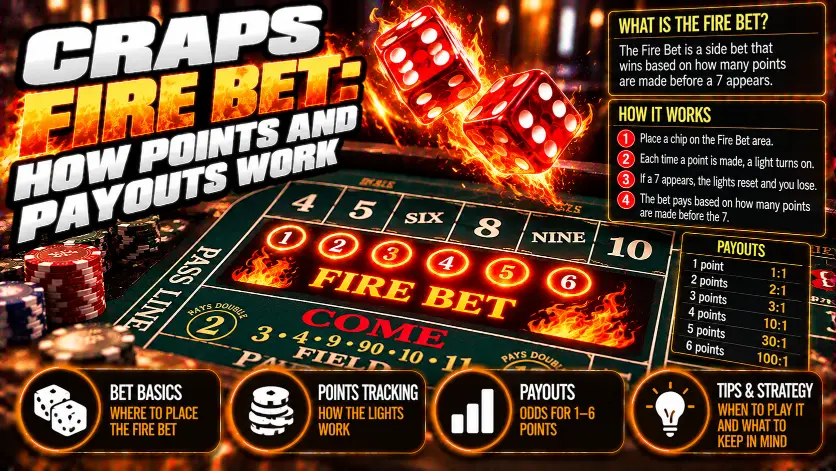
A Fire Bet in craps is a side bet that pays on how many different points the shooter makes before a seven-out. In the most common paytable, four unique points pay 24 to 1, and the house edge is 20.76%.
These payouts come from Wizard of Odds paytable A. The Pennsylvania regulation supplies the settlement and stake rules, not the payouts, and not every live table is the same. Wizard’s calculation assumes a come-out seven does not lose the bet; the wrong assumption that it does gives a house edge of 36.61% instead of 20.76%.
How the bet works
You place the Fire Bet before a new shooter’s first come-out roll, and it is settled at the shooter’s seven-out.
Under 58 Pa. Code § 623a.11, the stake is a minimum of $1 and a maximum of $5, in $1 increments. These are Pennsylvania’s limits, not universal Fire Bet limits.
In the Wizard of Odds probability model, come-out results of 2, 3, 7, 11 and 12 do not count as points or change the bet’s state. For the Fire Bet, what counts is the sequence of come-out, point and seven-out, not just the numbers rolled. If you need the distinction between a come-out roll, an established point and a seven-out, see how to play craps.
Which points count
Only unique points made from 4, 5, 6, 8, 9 and 10 count. Making a point again adds nothing, and the order does not matter.
A point must first be established and then rolled again before a seven-out. Simply rolling one of those numbers is not enough.
For example, if the shooter makes 4, 6, 4 again, 8 and 10, you have four unique points. The repeated 4 does not become a fifth unique point, so a long run of rolls alone does not determine the Fire Bet result.
How to read the paytable
A payout of 24 to 1 means $24 in net profit for each $1 winning stake, with the stake returned separately. Read every payout row, not just the largest payout.
The three paytables, probabilities and house-edge figures below come from the Wizard of Odds Fire Bet analysis.
Diagram: Fire Bet paytable A — 4 points 24 to 1, 5 points 249 to 1, 6 points 999 to 1, 0–3 points loseEducational diagram of paytable A from Wizard of Odds. Odds are from the ToolsGambling calculation; this is not a specific casino’s table.
| Unique points made | Paytable A | Paytable B | Paytable C |
|---|---|---|---|
| 0–2 | Lose | Lose | Lose |
| 3 | Lose | Lose | 6 to 1 |
| 4 | 24 to 1 | 10 to 1 | 29 to 1 |
| 5 | 249 to 1 | 200 to 1 | 149 to 1 |
| 6 | 999 to 1 | 2000 to 1 | 299 to 1 |
| House edge | 20.76% | 24.86% | 20.73% |
Paytable A is the most common of these paytables. Pennsylvania’s regulation requires four or more unique points to win. Paytable C pays on three, so it is not the variant described by that regulation.
Paytable B illustrates why the top payout is not enough to judge the whole paytable: it pays more for six points but has a higher house edge than A.
Probabilities and a $5 example
Under paytable A’s rules, the probability of a winning result is 1.06%, and the average loss on a $5 bet is $1.04.
The Wizard of Odds distribution of unique points made is the same for all three paytables:
| Unique points made | Probability |
|---|---|
| 0 | 59.39% |
| 1 | 26.08% |
| 2 | 10.13% |
| 3 | 3.34% |
| 4 | 0.880% |
| 5 | 0.164% |
| 6 | 0.0162% |
Exactly four points occur about once in 114 bets, five about once in 610, and six about once in 6,156. These are long-run frequencies, not a promise of a win after that many bets. The probability of three or more points is 4.40%; the probability of four or more is 1.06%, regardless of which paytable applies.
For a $5 stake under paytable A, your net profit is:
| Result | Net profit |
|---|---|
| Four unique points | $120 |
| Five unique points | $1,245 |
| Six unique points | $4,995 |
These profits exclude your returned stake. With zero to three unique points, you lose the stake.
The average loss of $1.04 is rounded to the nearest cent.
The house edge of 20.76% is the average share of each bet kept by the house over the long run, not your probability of losing a single bet. The house edge calculator explains that relationship. Your actual result on one bet is not the average loss.
To estimate expected losses per session, use the casino loss calculator with assumptions that match your paytable and total amount wagered.
What changes the conclusion
The paytable and the rule used to end the bet change the calculation. Under these rules, the published house edges are 20.76% for A, 24.86% for B and 20.73% for C.
The incorrect come-out-seven assumption described above is a calculation error, not an alternative rule to apply to the standard Fire Bet. In that calculation, the wrong rule applies only to the shooter’s first decisive roll, not to every come-out after a point is made.
| Condition | House edge |
|---|---|
| Paytable A, come-out seven does not lose | 20.76% |
| Paytable A, wrong assumption “a seven on the first roll loses” | 36.61% |
| Paytable B | 24.86% |
| Paytable C | 20.73% |
With the payouts for five and six points unchanged, the conditional fair payout for four points would be about 47.6 to 1. Under those assumptions, that hypothetical payout would remove the calculated house edge. It is a mathematical comparison, not an available payout or a way to make a profit.
What to check at the table
Before you hand over chips, check the posted paytable, betting deadline and point-counting rules with the dealer.
- Look at the payouts for three, four, five and six unique points to identify the paytable.
- Confirm the minimum stake, maximum stake and permitted increments.
- Confirm when betting closes for the new shooter.
- Ask how made unique points are marked and repeats are checked.
- Check whether the displayed payouts describe net profit or include the returned stake.
Pennsylvania’s regulation also requires casino surveillance to be notified when four different points have been made so payouts can be confirmed. This is a verification requirement, not an extra prize.
Limits and mistakes
The Fire Bet is a bet on a rare result, not a profit strategy, and calculations for main craps bets do not apply to it.
The ToolsGambling craps payout calculator covers main craps bets; it does not calculate the Fire Bet.
Avoid counting a repeated point as new, counting a number before its point has been made, confusing net profit with total payout, or assuming every table uses paytable A. Your table’s rules and posted paytable decide settlement; the figures here describe only the variants covered above.
Frequently Asked Questions
Under Pennsylvania rules, you must place it before a new shooter’s first come-out roll. Ask the dealer about the betting deadline before the shooter starts.
No. Paytables A and B pay from four unique points, while paytable C pays from three. Check your table’s paytable to find the winning threshold.
By Wizard of Odds’ calculation, no: a come-out seven does not end the bet, because a seven-out only happens after a point is established. Treating it as an immediate loss gives an incorrect house-edge figure. Check this rule with the dealer before betting.
No. The ToolsGambling craps payout calculator covers main craps bets, not the Fire Bet. Use the separate Fire Bet paytable and the rules at your table.
Evgeniy Volkov
Verified ExpertFullstack developer with a background in mathematics. I build the calculators and game-style tools on ToolsGambling with Pixi.js and modern web tech, and every result uses transparent probability formulas you can verify yourself.