












Contents
Hot Shooter Jackpot is a craps side bet on how many times the shooter rolls before a seven-out; the payout depends on the pay table the table uses. According to the Wizard of Odds table, 57.1% of the time a seven-out comes on 7 rolls or fewer, and the bet loses.
Key takeaways
- By the Wizard of Odds table, the chance of 16 or more rolls is 13.2%.
- Both tables pay 99 to 1 net at the top. Wizard writes this as 100 for 1, including the returned stake. The threshold is 51 rolls for Wizard and 50 for PA.
- Both tables pay 2 to 1 net for 16–23 rolls. Wizard writes this as 3 for 1, including the returned stake. The top-range thresholds differ.
- The expected value depends on the pay table and on whether the count includes the seven-out. For PA we show two of our readings of the law; there are six variants in all, and the expected value is negative in every one.
By ToolsGambling's calculation, the Wizard of Odds table with a count that includes the seven-out gives an expected value of −9.90% per unit staked, matching Wizard's published house edge. Counting only rolls before the seven-out gives −22.28%; this is an alternative counting variant. Under these assumptions, this is a conditional result, not a universal figure for the bet. The roll-count convention (whether the seven-out is included) has the largest effect on the result, followed by the top prize.
What is Hot Shooter Jackpot, and where is it offered?
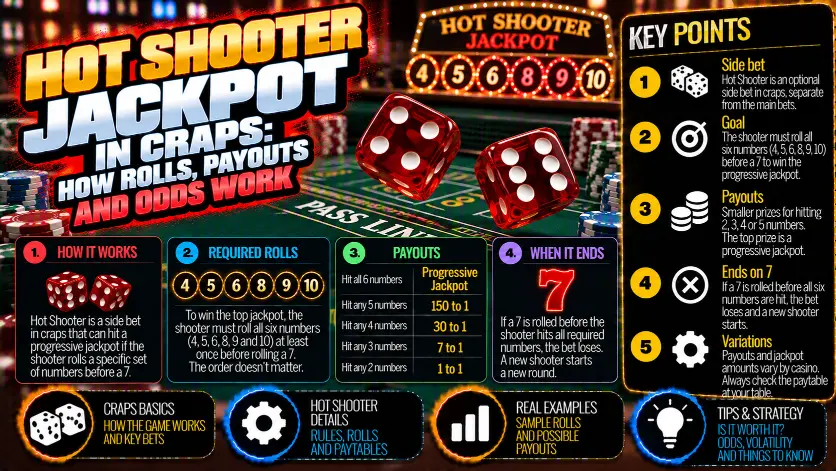
Hot Shooter Jackpot is a side bet on the length of a shooter's run, rather than on the dice total of an individual roll.
The shooter is the person rolling the dice. Rolling a seven after a point has been established ends that shooter's turn (seven-out).
The bet is placed before the run starts. Under Wizard's rule, it is made when a new shooter takes the dice; under 58 Pa. Code § 623c.4(c), before the come-out roll that establishes the point.
Wizard of Odds' author writes that he heard of the bet at one casino in North Carolina, with no confirmation. That report does not confirm its availability at any particular table today.
How are the rolls counted?
Wizard counts the seven-out itself, while the Pennsylvania rule speaks of rolls after the come-out roll and before the next seven-out.
These conventions assign different totals to the same run. Including the final roll can move the result into a different payout range.
Not every seven is a seven-out: its effect depends on the stage of the game. For the come-out roll, the point and how a shooter's turn ends, see how to play craps.
How do the Wizard and Pennsylvania pay tables differ?
The payout scale is the same in both tables; they differ in the top-tier threshold (51 for Wizard, 50 for PA) and the roll-count convention.
In the tables below, “to 1” means net profit relative to the stake; a winning bet also returns the original stake. Wizard writes the same scale as “X for 1”, including the returned stake, so its 100 for 1 is 99 to 1 net. A push returns the stake without profit.
The Wizard of Odds table includes the seven-out in the count. Our calculation with the same count gives the same 9.90% house edge.
The Pennsylvania version in 58 Pa. Code § 623c.4 applies only to fully automated electronic or hybrid tables and counts rolls after the come-out roll, before the next seven-out (how exactly, see the expected value section).
| Wizard: rolls including the seven-out | Wizard net profit | PA: rolls before the seven-out | PA net profit |
|---|---|---|---|
| 7 or fewer | Loss | 7 or fewer | Loss |
| 8–15 | Push | 8–15 | Push |
| 16–23 | 2 to 1 | 16–23 | 2 to 1 |
| 24–31 | 4 to 1 | 24–31 | 4 to 1 |
| 32–39 | 6 to 1 | 32–39 | 6 to 1 |
| 40–44 | 11 to 1 | 40–44 | 11 to 1 |
| 45–50 | 29 to 1 | 45–49 | 29 to 1 |
| 51 or more | 99 to 1 | 50 or more | 99 to 1 |
For comparisons with ordinary craps bets, use the craps payout calculator. It does not replace checking the Hot Shooter Jackpot rules at your table.
What is the probability of each range? ToolsGambling, 29.10.2026
With the Wizard convention of including the seven-out, the probability of reaching 51 or more rolls is 0.074%. The distribution was checked two ways: an exact chain of states and a simulation of 400,000 shooters, with row differences up to 0.13 percentage points.
Every row below uses that counting convention, not the Pennsylvania convention. Percentages are rounded per row; payouts follow the Wizard table and are shown as net profit.
| Rolls including the seven-out | Probability | Wizard result |
|---|---|---|
| 7 or fewer | 57.1% | Loss |
| 8–15 | 29.7% | Push |
| 16–23 | 9.1% | 2 to 1 |
| 24–31 | 2.8% | 4 to 1 |
| 32–39 | 0.86% | 6 to 1 |
| 40–44 | 0.20% | 11 to 1 |
| 45–50 | 0.11% | 29 to 1 |
| 51 or more | 0.074% | 99 to 1 |
Teaching diagram: probability of the shooter roll count before a seven-out and the Wizard of Odds payoutTeaching diagram based on the ToolsGambling calculation, 29 Oct 2026. Wizard of Odds table.
What is the expected value under different rules?
There is no single expected value: ToolsGambling's calculation gives six results depending on the pay table and whether the seven-out counts.
These figures express expected net profit or loss per unit of the original stake, not the outcome of an individual run. Each result applies only under the assumptions shown.
| Pay table | Roll-count convention | Player expected value per unit |
|---|---|---|
| Wizard | Including the seven-out (Wizard count) | −9.90% |
| Wizard | Before the seven-out (counting variant) | −22.28% |
| PA | Our reading 1: count only after the come-out roll, the seven-out counted | −27.80% |
| PA | Our reading 1: count only after the come-out roll, the seven-out not counted | −37.72% |
| PA | Our reading 2: count from the shooter's first roll (the come-out roll), the seven-out counted, as in Wizard | −9.07% |
| PA | Our reading 2: count from the shooter's first roll (the come-out roll), the seven-out not counted | −21.56% |
None of the six combinations gives the player a positive expected value. The four PA rows are our readings of the wording of the law, not a description of the Pennsylvania rule; we do not present any of them as "what the law says".
Limit of the calculation: 58 Pa. Code § 623c.4(d) words the losing outcome as "If after the come out roll the shooter: Throws the dice 7 times or less before the next 7 out". The law says "after the come out roll". It does not say outright whether the come-out roll itself counts, or whether the seventh seven-out counts as a roll. Hence our two readings: reading 1 counts only rolls after the come-out roll, reading 2 counts all of the shooter's rolls from the first. Within each we calculate the seven-out both counted and not counted. The sign of the expected value is negative in every variant; only the size of the loss changes.
The top prize also matters: with the Wizard count, reducing the payout for 51 or more rolls from 99 to 1 net to 49 to 1 net (from 100 for 1 to 50 for 1 in Wizard's notation) raises the house edge to 13.6%. The size of the player's expected value changes, but its sign remains negative. These are conditional calculations, not evidence that any particular table offers those terms.
How does our calculation match Wizard's 9.90% house edge?
Wizard's “X for 1” notation already includes the returned stake. Our calculation using the Wizard table and its count, including the seven-out, gives the same 90.10% return and 9.90% house edge. There is no discrepancy.
When reading a house edge, check the rules and the stake basis used in its calculation. The guide to craps odds explains that distinction further.
How does Hot Shooter Jackpot differ from Fire Bet and hop bets?
Hot Shooter Jackpot measures the shooter's roll count; Fire Bet and hop bet rules and probabilities cannot be applied to it.
A payout or probability from another side bet does not describe Hot Shooter Jackpot simply because both appear at a craps table.
What should you check at your table?
Check the counting rule, every payout range and the top prize before choosing which calculation applies.
At a staffed table, ask the dealer to show the current pay table and clarify:
- Does the final seven-out count toward the total?
- What is the payout for 16–23 rolls?
- Does the top tier start at 50 or 51 rolls?
- What does the top tier pay?
- Are the quoted payouts net profit, with the original stake returned separately?
Check the entire table rather than just the largest prize. The name Hot Shooter Jackpot alone does not identify the rules in use.
Frequently Asked Questions
Hot Shooter Jackpot is a side bet whose payout depends on the number of rolls in a shooter's run. The table's counting convention and pay table determine the result.
Under Wizard's rule, the final seven-out counts. The Pennsylvania rule speaks of rolls after the come-out roll and before the next seven-out; it does not say outright whether the come-out roll itself or the seventh seven-out counts, so we calculate both readings.
The payout scale is the same: Wizard uses "X for 1", including the returned stake, while Pennsylvania uses "N to 1" for net profit. The versions differ in the top-tier threshold (51 rolls for Wizard and 50 for PA) and the roll-counting convention. A probability calculated under one counting convention cannot automatically be used with the other.
ToolsGambling's calculation gives 0.074% when the count includes the seven-out, as Wizard's does. That is the probability of the range under that convention, not a universal top-prize probability.
No. The pay tables include losing, push and winning ranges, but a large possible payout alone does not establish the bet's expected value.
The counting rule can move the same run across a payout boundary. With the Wizard table, expected value is −9.90% when the seven-out is included and −22.28% under the variant that counts only rolls before the seven-out. The size changes, but the sign does not: both values are negative.
Wizard of Odds' author writes that he heard of the bet at one casino in North Carolina, with no confirmation. Pennsylvania's rule covers fully automated electronic or hybrid tables, but does not establish availability at every such table.
Ask to see the rules and confirm whether the seven-out counts, where each payout range begins and what the top tier pays. Also confirm whether the original stake is returned in addition to the quoted winning payout.
Evgeniy Volkov
Verified ExpertFullstack developer with a background in mathematics. I build the calculators and game-style tools on ToolsGambling with Pixi.js and modern web tech, and every result uses transparent probability formulas you can verify yourself.