










Contents
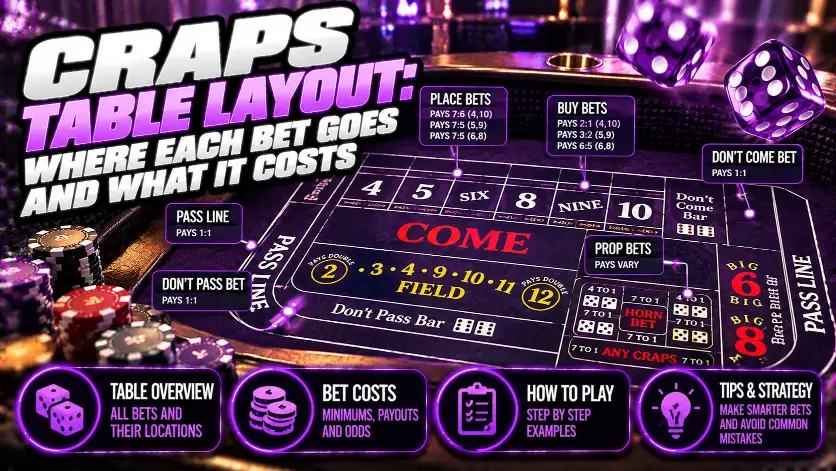
A craps table has two identical wings and a center. The Pass Line zone runs along the rail of each wing with Free Odds placed directly behind it, the Come, Don't Come and Field zones are yours to place, and the dealer fills the number boxes 4, 5, 6, 8, 9 and 10; the center holds one-roll and hardway bets that only the stickman takes. Our calculation shows that the type of bet sets the price, not the box: a 30 stake sitting on number 8 costs from 0 (Free Odds on Come) to 2.73 (Big 8 where offered, Hard 8, or a Come bet already on 8) in expected loss per resolved bet, while the same 30 in the Come area before the roll costs 0.42. This is the general layout; a given casino, Crapless Craps and electronic tables differ.
What makes up the table: wings, center and crew
The table has two identical wings, a shared center and a four-person crew: a stickman, two base dealers and a boxman. This guide covers bet placement, not round rules; see how to play craps for those.
A typical table measures about 12 by 4 feet. Each wing has its own dealer, while players on either side use the shared center.
| Crew role | What they do |
|---|---|
| Stickman | Handles dice with a stick; takes and pays center bets; calls results |
| Base dealer | Places and moves number bets; collects losses and pays wins |
| Boxman | Sits opposite the stickman; supervises the crew, chip bank and disputes |
Source for dimensions, layout and crew roles: Swain Scheps, “The Craps Table Layout Explained: A Complete & Simple Guide”, casino.org, 15 May 2024.
What goes on the wing
Pass Line runs along the rail; the wing also contains Don't Pass, Come, Don't Come, Field, Big 6/Big 8 where offered, and number boxes 4, 5, 6, 8, 9 and 10.
Teaching diagram of a craps table: the center for the stickman, dealer zones and player zones on the wing, and Pass Line with Free Odds at the railTeaching diagram, not a photo of a table: the order and shape of the zones are schematic, and a real layout depends on the casino.
Wing
| Zone or bet | Who places it | Payout | House edge |
|---|---|---|---|
| Pass Line | You | 1 to 1 | 1.41% |
| Don't Pass | You | 1 to 1; 12 pushes | 1.36% |
| Come / Don't Come | You | 1 to 1 | 1.41% / 1.36% |
| Field | You | 1 to 1; 2 and 12 pay 2 to 1 | 5.56% |
| Big 6 / Big 8 | You, where offered | 1 to 1 | 9.09% |
| Numbers: Place 6/8 | Dealer | 7 to 6 | 1.52% |
| Numbers: Place 5/9 | Dealer | 7 to 5 | 4.00% |
| Numbers: Place 4/10 | Dealer | 9 to 5 | 6.67% |
The Come and Don't Come percentages apply when the bet is first placed. Once a Come bet establishes a number, the dealer moves it from Come to that number box.
Big 6/8 is absent from New Jersey’s permitted-bet list in § 13:69F-1.2. Placement and movement of bets are described by Swain Scheps, casino.org, 15 May 2024; Wizard of Odds describes Big 6/8 as paying 1 to 1.
The Field and Place payouts shown here follow New Jersey § 13:69F-1.4. House edges are our calculations per resolved bet, not per roll.
Where Free Odds go
Free Odds have no separate printed zone: after the point is established, place them directly behind Pass Line, nearer you. Give Free Odds on a Come bet to the dealer to place at its number; place Free Odds behind Don't Pass yourself.
Wizard of Odds explains in its craps basics guide that the odds bet goes behind the Pass Line bet, outside the Pass Line area on the side closer to you.
Free Odds on the point pay true odds: 6 to 5 on 6 and 8, 3 to 2 on 5 and 9, and 2 to 1 on 4 and 10. 0% means no house edge, not a free stake.
A 3x-4x-5x Free Odds limit allows up to three times the original stake on 4/10, four times on 5/9 and five times on 6/8. With that multiplier, the house edge on the combined amount falls from 1.41% without Odds to 0.37%, but expected loss on an original 100 Pass Line stake remains 1.41. Bubble Craps odds shows how the combined edge is calculated for each multiplier.
What is in the center, and who places each bet?
All center bets go through the stickman, and both wings share this area. It holds one-roll proposition bets and Hardway bets, which may remain unresolved for several rolls.
Center
| Bet | Payout | House edge |
|---|---|---|
| Hardway 6/8 | 9 to 1 | 9.09% |
| Hardway 4/10 | 7 to 1 | 11.11% |
| Any Craps | 7 to 1 | 11.11% |
| Any Seven | 4 to 1 | 16.67% |
| 3 or 11 | 15 to 1 | 11.11% |
| 2 or 12 | 30 to 1 | 13.89% |
| C&E | Half Any Craps, half 11 | 11.11% |
| Horn | Four parts: 2, 3, 11, 12 | 12.50% |
Source for center, Field and Place payouts: New Jersey regulation, § 13:69F-1.4. C&E is paid as two one-roll bets: half on Any Craps and half on 11. Horn is paid as four separate bets on 2, 3, 11 and 12, as specified in New Jersey regulation 13:69F-1.4(c),(d).
Distinguish “to” from “for” on center bets: “to” states net profit, with the stake returned separately; “for” includes the stake in the stated return. Scheps, casino.org, 15 May 2024, explains this distinction; New Jersey § 13:69F-1.4(a) permits only “to” notation on the layout.
Place yourself: Pass Line, Don't Pass, Free Odds behind the line, Come, Don't Come, Field and Big 6/8 where offered. Through the dealer: Place bets, Buy bets, Lay bets and Free Odds on Come. Through the stickman: every center bet.
Number 8: five bets and their price
Bet type determines the cost: a 30 stake already on number 8 has an expected loss ranging from 0 to 2.73. The largest change comes from when the Come bet is evaluated: 2.73 after it moves to 8 versus 0.42 while still in Come before the roll; rounding an Odds payout at a 12 stake creates a 0.18 loss, while increasing the stake to 60 raises the upper figure to 5.45.
The table uses one common starting point: the bet is already on 8. Payout means net profit in addition to the returned stake.
Number 8: five bets and their price
| Bet | Payout | House edge | Loss on 30 |
|---|---|---|---|
| Come without Free Odds, already on 8 | 30 | 9.09% | 2.73 |
| Free Odds on Come, number 8 | 36 | 0% | 0 |
| Place 8 | 35 | 1.52% | 0.45 |
| Big 8, where offered | 30 | 9.09% | 2.73 |
| Hard 8 | 270 | 9.09% | 2.73 |
All payouts in this example are whole numbers. Expected loss is a calculated average, not an amount you necessarily lose on a single bet.
A Come bet placed in Come before the roll has a 1.41% house edge and an expected loss of 0.42 on a 30 stake. That starting position still includes the next roll, when 7 or 11 wins and 2, 3 or 12 loses; after the move to 8, the flat part of the Come bet costs 9.09%, which matches the rule that Pass Line and Come are contract bets and cannot be removed once their point is established (details below).
Expected loss = stake × house edge. Use the house edge calculator to check this relationship. Percentages and monetary results are rounded for display, so multiplying an already rounded percentage can produce a small discrepancy.
To reproduce the Place example, open the craps payout calculator, select the “Place bets” group, press “Place 6 or 8” and enter 30 in “Stake”. “Payout” shows 35 and “House edge” shows 1.52%.
ToolsGambling craps payout calculator: Place 6 or 8, stake 30, payout 35, house edge 1.52%Frame of the live calculator, 2026-10-17: stake 30 typed by hand, values as the tool shows them.
Headline-figure sensitivity
| Assumption | What changes | Result |
|---|---|---|
| Come still in Come | Before the roll, not after moving | 2.73 → 0.42 |
| Free Odds: 12 stake | Payout rounded from 14.40 to 14 | 0 → 0.18; 1.52% |
| No Big 8 | Hard 8 and Come on 8 remain | Upper limit: 2.73 |
| Stake 60 rather than 30 | Stake scales proportionally | 2.73 → 5.45 |
Rounding Free Odds down at a 12 stake is a separate assumption, not a universal table rule. At 6 to 5, reducing the exact payout of 14.40 to 14 creates the expected loss of 0.18 shown here.
Field sensitivity
| Field payout rule | House edge |
|---|---|
| 2 and 12 both pay 2 to 1 | 5.56% |
| One end pays 3 to 1, the other 2 to 1 | 2.78% |
| Both ends pay 1 to 1 | 11.11% |
Wizard of Odds describes the usual Las Vegas version as 3 to 1 on 12 and 2 to 1 on 2, with the reverse in Reno. These are local examples, not a rule for every table.
Under these assumptions, with the bet already on 8, New Jersey payouts, evaluation through resolution and fair dice, Free Odds and Place 8 have the lowest expected cost on that number. Hard 8 and a Come bet already moved to 8 cost six times as much as Place 8 using the underlying calculated values: displayed losses are 2.73 versus 0.45; Big 8, where offered, has the same cost as those higher-priced bets.
A Field bet paying 3 to 1 at one end has a 2.78% house edge, still almost twice the Pass Line percentage; paying 2 to 1 at both ends makes it almost four times as high. These compare percentages per resolved bet, not cost per unit of playing time: one-roll and multi-roll bets do not resolve at the same pace.
How to place chips clearly
Place bets you handle yourself in the appropriate zone in front of you. For a dealer-placed bet, put the chips in Come and tell the dealer which bet you want.
- Your position: The dealer places your number bet in the corner corresponding to your spot at the table.
- ON/OFF marker (puck): The black OFF side indicates the come-out roll; the white ON side sits on the established point.
- Removing or changing bets: Pass Line and Come are contract bets that cannot be removed or reduced after their point is established. Don't Pass and Don't Come may be removed or reduced, but not subsequently replaced or increased.
- Working on the come-out roll: In New Jersey, Place bets, Buy bets, Free Odds on Come and Hardway bets are off by default. Tell the dealer “ON” if you want them working; an ON marker on the chips indicates that status.
Source for chip positioning: Scheps, casino.org, 15 May 2024; for the puck: Wizard of Odds. Bet-change restrictions and come-out status are New Jersey examples under § 13:69F-1.3(c), (d) and (e).
How Crapless, Bubble and electronic layouts differ
Crapless Craps changes the available numbers and bets, while Bubble Craps and other electronic tables use buttons instead of chips on felt. The standard craps figures above do not carry over to Crapless Craps.
In Crapless Craps, you can bet on 2, 3, 11 or 12 before a 7, and the layout has no Don't Pass or Don't Come zones.
Source for the additional numbers: “Craps”, Wikipedia, en.wikipedia.org; for layout differences: Scheps, casino.org, 15 May 2024.
Extra zones do not change the meaning of the main fields. For example, the Bonus Craps side bet is separate from Pass Line, Come and Field. Before placing chips, check the zone name and printed payout on the table you are using.
Frequently Asked Questions
A position near Don't Pass and Don't Come makes those bets easier to place and follow.
Between rolls, gently toss your chips toward the stickman and name the bet; he places them in the right zone.
A Come bet starts in Come and may then be moved by the dealer to a number box. A Pass Line bet stays near the rail in Pass Line.
“For” includes the returned stake in the stated payout; “to” means profit in addition to the returned stake. With the same stated number, “for” pays one stake less.
You may remove or reduce self-service bets, or ask the dealer to do so for dealer-placed bets. The exceptions are Pass Line and Come after a point is established: those are contract bets.
Evgeniy Volkov
Verified ExpertFullstack developer with a background in mathematics. I build the calculators and game-style tools on ToolsGambling with Pixi.js and modern web tech, and every result uses transparent probability formulas you can verify yourself.