










Contents
Double Double Bonus is a video poker game in which four aces, deuces, threes or fours pay bonus multiples, and more with a qualifying kicker. On the 9/6 paytable it returns 98.98% with optimal play; on the rare 10/6 paytable, 100.07%. The hold rules below explain which cards to keep: a 10/6 paytable changes expected value (EV), not the choice, in the hands we checked.
What is Double Double Bonus?
Double Double Bonus is a video poker variant in which the payout for four of a kind depends on both its rank and the fifth card—the kicker. That changes some familiar decisions about keeping a made hand or an extra card.
For example, four aces with a 2, 3 or 4 kicker pay more than four aces with a 5–K kicker. But a qualifying kicker beside three of a kind is not a reason to hold it: the bonus applies to four of a kind, not an unfinished hand.
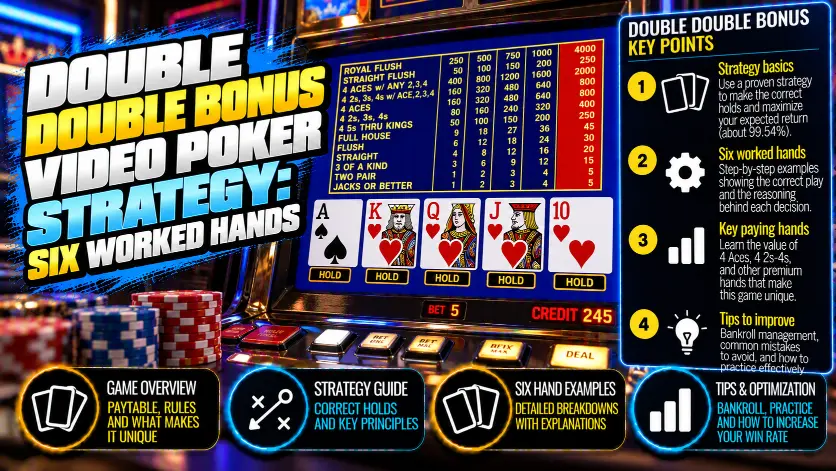
The following payouts come from the Wizard of Odds paytables. Values are coins per coin bet at a full five-coin wager, the basis of every return in this article; on smaller bets a royal flush pays less per coin. Compare the entire paytable, including the royal flush payout.
| Hand | 9/6 | 10/6 |
|---|---|---|
| Royal flush | 800 | 800 |
| Straight flush | 50 | 50 |
| Four aces with a 2, 3 or 4 kicker | 400 | 400 |
| Four 2s, 3s or 4s with an A, 2, 3 or 4 kicker | 160 | 160 |
| Four aces with a 5–K kicker | 160 | 160 |
| Four 2s, 3s or 4s with a 5–K kicker | 80 | 80 |
| Four 5s through Ks | 50 | 50 |
| Full house | 9 | 10 |
| Flush | 6 | 6 |
| Straight | 4 | 4 |
| Three of a kind | 3 | 3 |
| Two pair | 1 | 1 |
| Pair of jacks or better | 1 | 1 |
The names 9/6 and 10/6 identify the full house and flush payouts. On 9/5, a full house pays 9 and a flush pays 5; Wizard of Odds gives its optimal return as 97.87%. The same source notes that Aristocrat also uses the name Aces Kicker for this variant.
Why check the paytable?
Check the paytable before playing because machines with the same game name can have different payouts. The full house and flush rows affect the value of a hold even when they do not change which cards you should keep.
In D1, increasing the full house payout from 9 to 10 raises EV from 1.681 to 1.766 coins. Under these assumptions, holding two pair remains the best choice. In D6, reducing the flush payout from 6 to 5 lowers EV without changing the preferred hold.
The higher theoretical return makes 10/6 worth identifying, but do not assume it is available. According to Pokerology, Tom Leonard, Double Double Bonus Poker Strategy (pokerology.com, updated 13 October 2026), it is rarely offered outside Las Vegas and a few Reno casinos. Check the machine rather than treating that description as confirmation of availability.
Two pair deserve particular attention: they pay only 1. Pokerology says they occur in about 12% of hands, so the reduced payout has a substantial effect on overall return. For comparison, Wizard of Odds gives full-pay 9/6 Jacks or Better a return of 99.54% with optimal play. Larger bonuses for selected four-of-a-kind hands do not automatically make Double Double Bonus the higher-return game.
Nor should you transfer strategy between similarly named bonus variants. Bob Dancer’s 2021 Las Vegas Advisor comparison gives 9/6 Double Double Bonus a return of 98.98%, versus 98.15% for 9/6 Triple Double Bonus. Our Triple Double Bonus guide explains the latter variant’s differences.
How should you choose your holds?
Check four of a kind and its kicker first, then apply the special ace rules; never keep an extra card with three of a kind just because it could qualify as a kicker. The following rules follow Pokerology’s guidance, in order.
- Hold all five cards with four of a kind and a qualifying kicker. For four aces, qualifying kickers are 2, 3 and 4. For four 2s, 3s or 4s, they are A, 2, 3 or 4, excluding the four-of-a-kind rank. If these hands have a 5–K kicker, hold the four matching cards and draw one. In D7, four aces and a five, holding four aces has an EV of 221.277 coins on 9/6, 10/6 and 9/5; holding all five pays 160.
- Do not hold a qualifying kicker with only three of a kind. An ace beside three 2s may look useful, but D3 favors holding the three 2s alone.
- With two pair containing aces, hold only the aces. This differs from the usual two-pair decision. If you are dealt aces full, keep the three aces and discard the pair to draw for the fourth ace. In D2 on 9/6, the aces return 1.886, compared with 1.681 for holding the aces and fours.
- With an ace and one unsuited high card, hold only the ace. This applies to AK, AQ and AJ. Pokerology gives these exceptions: with unsuited A-Q-J, hold QJ; with unsuited A-K-Q-J, hold all four.
- For other situations, the order follows the top of Wizard of Odds’ 9/6 list (highest first; the first playable option wins): royal flush; four of a kind with a qualifying kicker; four of a kind; straight flush; four to a royal; three aces; full house; flush; straight; three 2s through kings; four to a straight flush; pair of aces; two pair; three to a royal with J, Q, K; pair of kings; three to a royal with T, J, Q; pair of jacks or queens; four to a flush; three to a royal with TJK, TQK, TJA, TQA, TKA, JQA, JKA or QKA; four to a straight with 89TJ, 9TJQ or TJQK; pair of 2s through 10s. The full list is longer and is not repeated here; the corrections in rules 1–4 take precedence.
Two pair without aces and three of a kind with a kicker require different decisions. In D1, hold both kings and both fives, not just the kings. In D3 and D5, the extra card reduces EV: hold only three of a kind.
Study diagram: deal Ks Kh 5d 5c 9s, holding two pair — 1.681 coins on the 9/6 paytable and 1.766 on 10/6
Illustrative diagram from our calculation: hold two pair, not one pair. The 9/6 to 10/6 difference here is 0.085 coins.
The table below uses our calculated EV in coins per coin bet, not net profit, with values rounded to three decimal places. Results assume the displayed paytables and the specific deals shown. In the card notation, s means spades, h hearts, d diamonds and c clubs; A is ace, K king, Q queen, J jack and T ten.
| Deal | Hold | 9/6 | 10/6 | Comment |
|---|---|---|---|---|
| D1: Ks Kh 5d 5c 9s | Ks Kh 5d 5c | 1.681 | 1.766 | Kings only: 1.448; kings with the nine: 1.267 on 9/6 |
| D2: As Ah 4c 4d 2s | As Ah | 1.886 | 1.897 | Aces and fours: 1.681 on 9/6 |
| D3: 2s 2h 2d Ac 5s | 2s 2h 2d | 7.457 | 7.518 | Three 2s with the ace: 6.723; with the five: 5.021 on 9/6 |
| D4: Js Ts 9h 8h 8c | Js Ts 9h and either eight | 0.745 | 0.745 | Both holds are equal; also 0.745 on 9/5 |
| D5: 4s 4h 4d Kc 9h | 4s 4h 4d | 7.531 | 7.592 | Three 4s with the king: 5.021 on 9/6 |
| D6: As Ks Qs Jd 9c | As Ks Qs | 1.394 | 1.394 | Adding Jd: 0.596 on 9/6; selected hold on 9/5: 1.353 |
D1’s increase comes from the four cards out of 47 that complete a full house after discarding the nine. The extra full house payout improves the result but does not make one pair preferable to two pair. D1’s EV on 9/5 remains 1.681.
In D6, under these assumptions, hold As Ks Qs—three to a royal. The choice stays the same on 9/5. This is a result for that specific deal, not a universal instruction to hold any three suited cards.
What should you do at the machine?
Read the actual paytable, then use hold decisions for that variant. Do not identify the payout schedule from the game name or machine artwork alone.
- Find the full house, flush, two pair and bonus four-of-a-kind payouts. Compare the royal flush payout with the table above too.
- After the deal, check the special cases: four of a kind with a kicker, three of a kind without an extra kicker, and two pair containing aces.
- Select the cards to hold using the machine’s card-selection controls, then use its draw control to replace the rest. Control names vary by machine.
- If payouts differ, do not reuse the example EVs. Your deal needs a calculation using the actual paytable.
Our video poker calculator (Jacks or Better only) does not calculate Double Double Bonus payouts or hold decisions.
Decide in advance how much you can lose in a session: on 9/6 or 10/6 the result depends on many hands, not one. Our video poker bankroll strategy covers that planning. A large payout for a rare hand is not a substitute for a spending limit.
What are the calculation and strategy limits?
Theoretical return describes optimal play on a specified paytable, not the outcome of an individual session. Even 100.07% does not promise a profit within your playing time.
Double Double Bonus has high volatility because some of its attractive payouts depend on rare hands. Pokerology states that four aces with a qualifying kicker pay half a royal flush and occur about once in every 16,000 hands. That frequency is the source’s claim, not a result of our calculation.
Strategy precision also matters. Wizard of Odds lists 98.9808% for optimal 9/6 strategy and 98.9792% for an exceptionless strategy. The short rule list above is not a complete account of every optimal-play exception.
Our check used 160 random hands containing a pair, with random seed 75. It found no difference in the best hold between 9/6 and 10/6, or between 9/6 and 9/5. The search for differences only samples hands with at least one pair; hands with five distinct ranks are excluded. It neither estimates return nor proves that every hand has the same best hold across those paytables. The hand evaluator was separately checked against all 2,598,960 five-card hands to verify hand classification.
Frequently Asked Questions
Keep all five when the kicker qualifies for the bonus. With four aces or four 2s–4s and a 5–K kicker, keep the four matching cards and replace the kicker.
Yes, when comparing machines already available to you: it offers the higher theoretical return. Verify the displayed payouts rather than assuming a machine has that schedule.
Pokerology attributes the lower return to the loss of the double payout for two pair: Double Double Bonus pays 1, while Jacks or Better pays twice as much. The extra four-of-a-kind bonuses do not fully offset that reduction.
No. It supports Jacks or Better, not Double Double Bonus paytables or decisions.
Evgeniy Volkov
Verified ExpertFullstack developer with a background in mathematics. I build the calculators and game-style tools on ToolsGambling with Pixi.js and modern web tech, and every result uses transparent probability formulas you can verify yourself.