












Contents
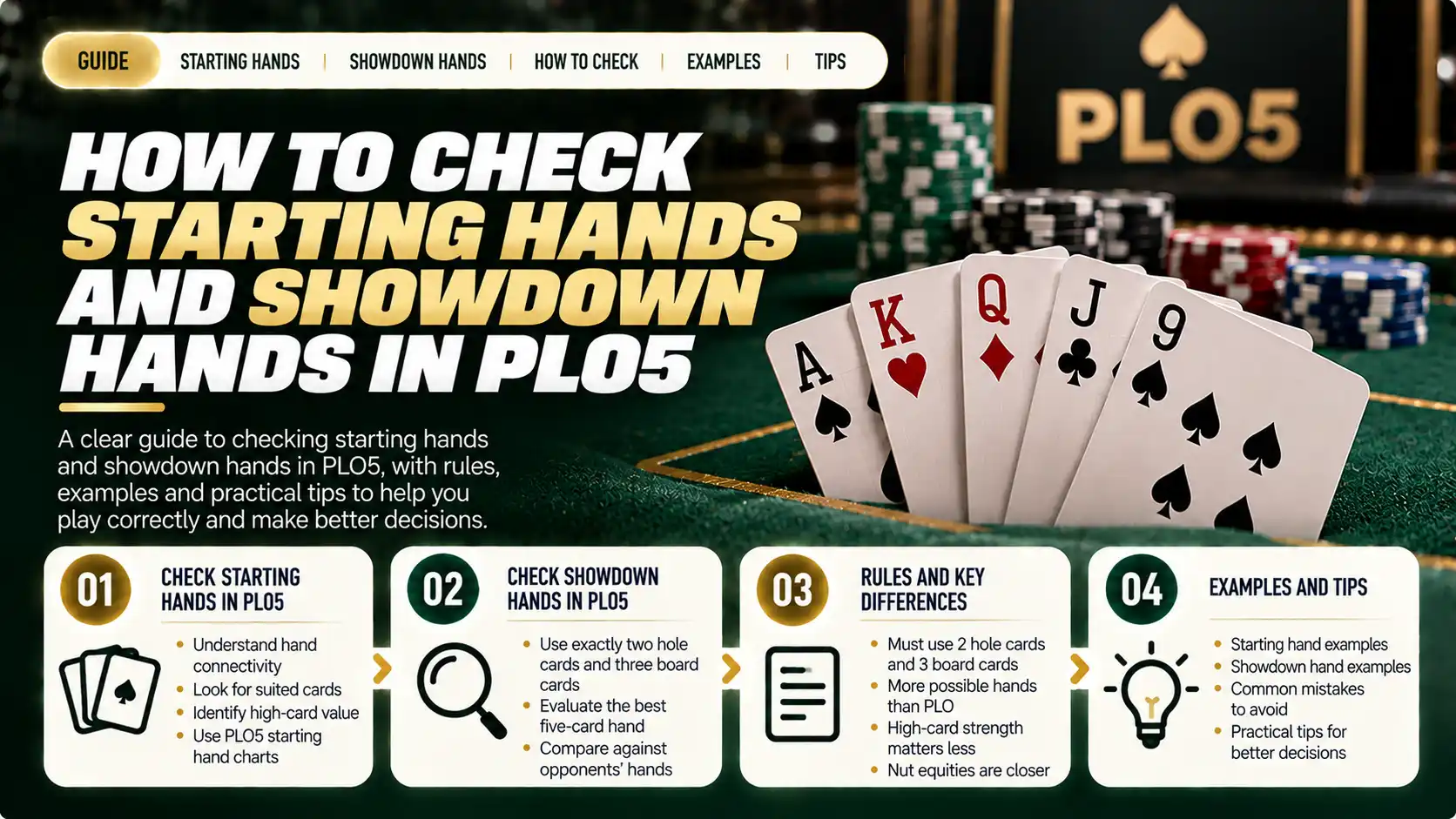
In five-card pot-limit Omaha (PLO5), you receive five hole cards but must use exactly two hole cards and exactly three board cards to make your showdown hand. Evaluate a starting hand by checking nut potential, connected ranks, usable suited pairs, support for paired cards and blockers. Five hole cards give you more two-card selections—not permission to use a third hole card.
This guide covers high-only PLO5. Omaha Hi/Lo, which can split the pot between high and qualifying low hands, and tournament-specific ranges are separate topics.
How does the two-plus-three rule work?
Every final hand must contain exactly two hole cards and three board cards, whether you are making a pair, straight or flush. The official PokerStars 5 Card Omaha rules state this requirement. The pot-limit betting structure also caps the maximum bet or raise according to the pot-limit calculation.
Consider this hypothetical example:
- Hole cards: A♠ K♥ Q♦ J♣ T♥.
- Board: K♠ 9♠ 4♠ 2♦ 3♥.
- Selected hole cards: A♠ K♥.
- Selected board cards: K♠ 9♠ 4♠.
The selected five cards are A♠ K♥ K♠ 9♠ 4♠: a pair of kings. This is a legal selection because it uses exactly two hole cards and three board cards.
Hypothetical PLO5 diagram highlighting hole cards A♠ K♥ and board cards K♠ 9♠ 4♠ for a legal pair of kings; the single private spade cannot make a flush
Original hypothetical diagram, not a real game screenshot. The highlighted two hole cards and three board cards form a legal pair of kings; one private spade is not enough for a flush.
Three spades on the board plus A♠ in your hand do not give you a flush. Under the two-plus-three rule, a flush requires two hole cards of the same suit and three board cards of that suit. Here, you hold only one spade.
This example checks one legal selection. It does not claim that this selection is best among all possible selections or that it beats an opponent. No all-in equity calculation has been made.
What do the ten two-card selections mean?
Five hole cards produce 10 distinct two-card selections. That is a combination count, not equity, a hand-strength score or the probability of making a particular hand.
With five distinct cards, each card has four possible partners. This counts every pair twice, so the number of unique selections is 5 × 4 ÷ 2 = 10. The count is exact; no rounding is needed.
For A♠ K♥ Q♦ J♣ T♥, the selections are:
| First card | Distinct two-card selections |
|---|---|
| A♠ | A♠ K♥; A♠ Q♦; A♠ J♣; A♠ T♥ |
| K♥ | K♥ Q♦; K♥ J♣; K♥ T♥ |
| Q♦ | Q♦ J♣; Q♦ T♥ |
| J♣ | J♣ T♥ |
These selections are not equally useful on every board. Their strengths do not add together: each final hand uses one selected pair and exactly three board cards.
The brief boundary between Omaha formats is:
| Format | Hole cards | Two-card selections | Final-hand requirement |
|---|---|---|---|
| Four-card Omaha | 4 | 6 | Exactly 2 hole cards + 3 board cards |
| Five-card Omaha | 5 | 10 | Exactly 2 hole cards + 3 board cards |
| Six-card Omaha | 6 | 15 | Exactly 2 hole cards + 3 board cards |
The counts are C(4,2) = 6, C(5,2) = 10 and C(6,2) = 15—not equity estimates. The official PokerStars 6 Card Omaha rules confirm the same two-plus-three requirement. Six-card strategy is outside this guide.
How do you audit a five-card starting hand?
Check high and nut potential first, then rank connectivity, usable suits, pair support and finally blockers. This order helps distinguish cards that work together from individually attractive cards with little shared potential.
The nuts is the strongest possible hand on a particular board. Having nut potential before the board is dealt does not mean you already have the nuts. PokerStars Learn’s PLO5 guide, published October 11, 2024, discusses connected and suited cards, nut potential, blockers and the need for caution when moving from four-card Omaha.
Use this repeatable audit:
- High and nut potential. Identify cards that could contribute to high straights and flushes. An ace needs another hole card of its suit to provide ace-high flush potential.
- Connected ranks. Look for ranks that can contribute to straights through legal two-card selections. One isolated high card does not make the whole hand connected.
- Usable suited pairs. Check the actual suit symbols. A lone card of a suit cannot supply the two hole cards needed for a flush.
- Pair support and isolated cards. If you hold aces, examine the side cards rather than stopping at the pair. Do they support other strong hands, or do some function as danglers—cards with little connection to the rest?
- Blockers. Identify the exact cards your opponents cannot hold because you hold them. Treat this as additional information, not a betting instruction.
What does double-suited mean in PLO5?
A double-suited starting hand has two different suits appearing at least twice among its hole cards. In A♠ A♥ K♠ Q♥ J♦, the two usable suited pairs are A♠ K♠ and A♥ Q♥.
The fifth card, J♦, does not create a third suited pair because there is no second diamond. Nor do the two suited pairs make a completed flush: three board cards of the corresponding suit are still required.
Suit quality matters too. A non-nut flush can lose to a higher flush, so merely finding two cards of the same suit does not establish nut potential.
What do the three example starting hands show?
The first hand combines aces with high supporting cards, the second combines connected ranks with two usable suits, and the third shows the limitations of aces with poorly coordinated side cards. These are structural comparisons, not rankings, a range chart or automatic raise/fold instructions.
| Starting hand | Useful features | Limitations |
|---|---|---|
| A♠ A♥ K♠ Q♥ J♦ | A pair of aces; two suited pairs, A♠ K♠ and A♥ Q♥; high side cards that can contribute to straights. | Neither aces nor two usable suits guarantee the nuts. J♦ has no suited partner, and the final hand depends on the board and the selected two hole cards. |
| K♠ Q♠ J♥ T♥ 9♦ | Five consecutive ranks; two suited pairs, K♠ Q♠ and J♥ T♥. The ranks are well connected. | There is no ace among the hole cards, so the private spade pair does not itself provide ace-high flush potential. A completed flush is not necessarily the nuts. |
| A♠ A♦ 8♣ 4♥ 2♠ | A pair of aces; A♠ 2♠ supplies one usable suited pair with nut spade-flush potential. | The side cards have weak rank coordination, and there is no second suited pair. The aces do not remove those limitations. |
In the third hand, A♠ and 2♠ form one usable spade pair; each of the other three suits occurs once. Its weaknesses are limited rank coordination and only one usable suit.
Aces without coordinated support do not automatically make a strong overall structure. Equally, those limitations alone do not justify an automatic fold; an action requires the conditions of the hand.
What does the A♠ blocker prove?
Holding A♠ prevents an opponent from holding that exact card. It does not give you a flush, establish a winning hand or guarantee that an opponent will fold.
Return to the board example:
- Hole cards: A♠ K♥ Q♦ J♣ T♥.
- Board: K♠ 9♠ 4♠ 2♦ 3♥.
Because you hold A♠, no opponent can hold A♠ together with another spade. You therefore remove the opposing hole-card combinations that would make an ace-high spade flush on this board. That is the precise blocker effect.
An opponent can still hold two other spades and make a flush. You cannot: your hole cards contain only one spade. The illustrative selection A♠ K♥ + K♠ 9♠ 4♠ remains a pair of kings, not a flush.
A blocker changes the combinations available to an opponent. It does not reveal their actual hand or determine their response to a bet.
What else is needed before choosing an action?
You need position, effective stacks, previous action, opponent ranges, rake and game conditions before turning a starting-hand audit into a decision. Card structure alone cannot supply a universal opening range.
Before acting, check:
- Position: where you act relative to the other players.
- Stacks: how many chips you and your opponents can commit.
- Previous action: the bets and raises already made and how many players remain.
- Opponent ranges: which hands are plausible given the available information and action.
- Rake and game conditions: the charges and conditions that affect the decision.
Without that context, the three examples cannot become a universal range chart. This guide provides no solver frequencies, equity percentages or profitability promises.
Can the ToolsGambling equity calculator check PLO5?
No. The current ToolsGambling equity calculator has four hole-card fields in its Omaha interface and requires four filled hole-card fields. It has no fifth field, so it cannot accept a five-card starting hand or calculate PLO5 equity.
For a separate four-card Omaha exercise:
- Select Omaha.
- Enter four hole cards in the four available fields.
- Treat the exercise strictly as PLO4, not PLO5.
Do not remove one card from a five-card hand and apply the resulting four-card calculation to the original hand. That changes the problem; the result is not PLO5 equity.
For general hand notation, see the poker preflop chart guide. Its published hold’em range chart is not a PLO5 strategy chart.
What should you check before the next hand?
First confirm that you can identify a legal two-hole-card and three-board-card selection. Then assess how well all five starting cards support one another.
Use this short checklist:
- Which high or nut hands could the cards potentially make?
- Which ranks connect, and which are isolated?
- Are there two usable suited pairs, and does either contain the ace of that suit?
- What support does any pocket pair have?
- Which opposing combinations do your blockers remove—without assuming a guaranteed fold?
- Do you have enough information about position, stacks, ranges, opponents and rake to choose an action?
Keep the three tasks separate: starting-hand structure describes potential, the two-plus-three rule determines a legal final hand, and game conditions inform the action.
Rules, learning sources and calculator limitations checked October 15, 2026. The cited PokerStars Learn guide was published October 11, 2024.
Evgeniy Volkov
Verified ExpertFullstack developer with a background in mathematics. I build the calculators and game-style tools on ToolsGambling with Pixi.js and modern web tech, and every result uses transparent probability formulas you can verify yourself.