












Contents
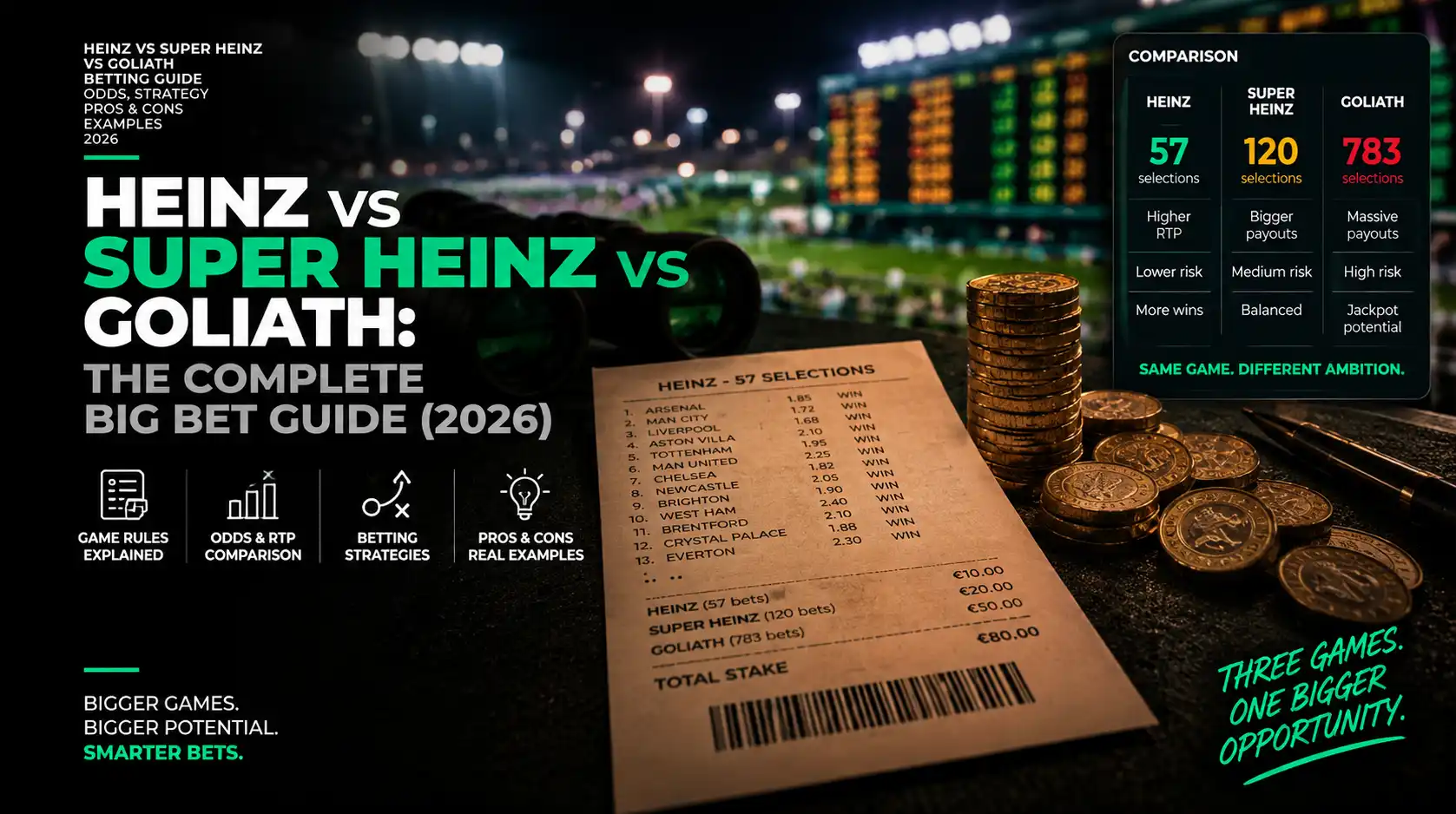
Heinz covers 6 selections in 57 lines, Super Heinz covers 7 in 120, and Goliath covers 8 in 247. All three are full-cover bets containing every double and larger multiple, with no singles. Two winners can produce a return, but a return is not necessarily a profit.
These definitions match Sky Bet's bet-type guide. The important comparison is not simply how many selections you can include: at the same unit stake, each larger system costs substantially more. The examples below are settlement illustrations, not betting tips.
What combinations does each system contain?
Each system contains every combination of two or more selections, up to the accumulator containing all its selections. Heinz has 57 paid lines, Super Heinz has 120 and Goliath has 247.
| Combination size | Heinz | Super Heinz | Goliath |
|---|---|---|---|
| Doubles: 2 selections | 15 | 21 | 28 |
| Trebles: 3 selections | 20 | 35 | 56 |
| 4-folds | 15 | 35 | 70 |
| 5-folds | 6 | 21 | 56 |
| 6-folds | 1 | 7 | 28 |
| 7-folds | 0 | 1 | 8 |
| 8-folds | 0 | 0 | 1 |
| Total lines | 57 | 120 | 247 |
For selections, the number of combinations of size is:
The total line count is:
There are subsets of the selections. Subtract the empty subset and the singles to leave all combinations of size two or more. For the broader concept, see our system bet explanation.
How much do they cost?
The win-only total stake is the unit stake multiplied by the number of lines. A £1 unit stake therefore costs £57 for Heinz, £120 for Super Heinz and £247 for Goliath—not £1 for the whole bet.
| System | Lines | 10p unit stake | 25p unit stake | £1 unit stake |
|---|---|---|---|---|
| Heinz | 57 | £5.70 | £14.25 | £57.00 |
| Super Heinz | 120 | £12.00 | £30.00 | £120.00 |
| Goliath | 247 | £24.70 | £61.75 | £247.00 |
These are win-only costs. An each-way bet has a win part and a place part for every line, doubling the total stake at the same unit stake per part.
Same unit stake is not the same budget. To compare systems within a £20 ceiling, divide £20 by the line count. Assuming the bookmaker permits penny increments, round the unit stake down to avoid exceeding that ceiling:
| System | Unit stake rounded down | Total stake | Unused budget |
|---|---|---|---|
| Heinz | 35p | £19.95 | £0.05 |
| Super Heinz | 16p | £19.20 | £0.80 |
| Goliath | 8p | £19.76 | £0.24 |
These amounts illustrate budgeting, not recommended stakes. Bookmaker minimum stakes or increments may prevent these choices. If a system does not fit your budget, reduce the outlay or do not place it rather than increasing the budget.
How is the payout calculated?
Calculate the return on each winning line, add those returns, then subtract the full original total stake to find net profit. Losing lines still count towards that outlay.
For a winning line, multiply its unit stake by the decimal odds of every selection in that line:
Here, is the unit stake, is the set of selections in that line, and is each selection's decimal odds. Under this win-only model, a line containing a losing selection returns zero.
If is the set of winning selections, the total return is:
Expanding the product generates every subset of the winners. Subtracting 1 removes the empty subset; subtracting the individual odds removes singles.
When all winning selections have the same decimal odds , this simplifies to:
Here, is the number of winners, is the total number of selections, is the original line count, and net profit is .
Worked example: four winners at decimal odds 2.0
Four winners at 2.0 return £72 with a £1 unit stake, regardless of which of these systems contains them. The net profit differs because the original total stake differs.
Assume ordinary win-only settlement, equal unit stakes and all remaining selections losing. There are no voids, deductions, bonuses, caps or tax. Calculations use full precision before displaying monetary amounts to two decimal places; bookmaker per-line rounding can differ.
| Winning combination | Winning lines | Return per line | Total return |
|---|---|---|---|
| Doubles | 6 | £4.00 | £24.00 |
| Trebles | 4 | £8.00 | £32.00 |
| 4-fold | 1 | £16.00 | £16.00 |
| Total | 11 | — | £72.00 |
Subtracting the full outlay gives £15 profit for Heinz, £48 loss for Super Heinz, or £175 loss for Goliath.
The number of winners alone is insufficient. If the four winning prices are instead 4.0, 4.0, 2.0 and 2.0, the total return is £212 at the same £1 unit stake. Settlement arithmetic does not require an assumption that the outcomes are independent; this calculation does not predict their probabilities.
How many winners are needed for a profit?
There is no universal number: the threshold depends on the odds and the original outlay. With every selection at decimal odds 2.0 and a £1 unit stake, Heinz needs four winners for a profit, Super Heinz five and Goliath six.
The table uses the same binary settlement assumptions as the worked example. A dash marks a winner count that the system cannot have.
| Winners | Total return at 2.0 | Heinz net profit | Super Heinz net profit | Goliath net profit |
|---|---|---|---|---|
| 0 or 1 | £0.00 | −£57.00 | −£120.00 | −£247.00 |
| 2 | £4.00 | −£53.00 | −£116.00 | −£243.00 |
| 3 | £20.00 | −£37.00 | −£100.00 | −£227.00 |
| 4 | £72.00 | +£15.00 | −£48.00 | −£175.00 |
| 5 | £232.00 | +£175.00 | +£112.00 | −£15.00 |
| 6 | £716.00 | +£659.00 | +£596.00 | +£469.00 |
| 7 | £2,172.00 | — | +£2,052.00 | +£1,925.00 |
| 8 | £6,544.00 | — | — | +£6,297.00 |
Higher prices change the minimum number of winners needed for strictly positive net profit:
| Equal decimal odds | Heinz | Super Heinz | Goliath |
|---|---|---|---|
| 2.0 | 4 winners | 5 winners | 6 winners |
| 3.0 | 4 winners | 4 winners | 5 winners |
| 4.0 | 3 winners | 4 winners | 4 winners |
These are scenario thresholds, not required win rates or forecasts. Break-even means the return equals the outlay; profit requires it to exceed the outlay.
With exactly two winners, only their double pays. At equal unit stakes, their decimal odds must multiply to more than 57, 120 or 247, respectively, to produce a profit without other adjustments. A smaller product may still provide a partial return while leaving an overall loss.
How do you reproduce the calculator examples?
Use the named preset, overwrite its DEMO inputs, set the outcomes and unit stake, then read the automatically updated result. The system bet calculator has no Calculate button.
These steps reflect the observed local interface, not a claim about a bookmaker's bet slip.
- Select the Heinz preset. It loads DEMO odds and labels: replace all of them rather than retaining example selections.
- Clear the selection labels or use optional anonymous names.
- Set all six decimal odds to 2.
- Select WIN for the first four selections and LOSE for the last two.
- Enter 1 in STAKE PER BET, then choose £ under CURRENCY.
- Read TOTAL BETS: 57, TOTAL STAKE: £57.00, TOTAL RETURN: £72.00, and PROFIT · ROI: £15.00 (+26.3%).
Local Heinz calculator result panel showing £57 stake, £72 return and £15 profit for four winners at 2.0
Localhost calculator result: Heinz, six selections at decimal odds 2.0, four winners and a £1 unit stake. The cropped panel shows totals and ROI, not the inputs.
Next, reproduce the contrasting Goliath scenario:
- Switch to Goliath. This loads a different DEMO: it does not preserve your Heinz odds.
- Replace all eight labels as needed and overwrite all eight odds with 2.
- Recheck STAKE PER BET: 1 and CURRENCY: £.
- Select WIN for the first five selections and LOSE for the last three.
- Read TOTAL BETS: 247, TOTAL STAKE: £247.00, TOTAL RETURN: £232.00, and LOSS · ROI: £15.00 (-6.1%).
Local Goliath calculator result panel showing £247 stake, £232 return and £15 loss for five winners at 2.0
Localhost calculator result: Goliath, eight selections at decimal odds 2.0, five winners and a £1 unit stake. A substantial return still leaves a loss.
For Super Heinz, follow the same process with seven selections and check that the preset shows 120 lines. Overwrite its DEMO inputs too.
ROI here is the scenario's net profit divided by the full total stake, expressed as a percentage. It is not expected value. The tool supports WIN/LOSE only: it does not settle voids, each-way bets, deductions or dead heats, and it does not calculate EV. If using COPY SHARE LINK, recheck currency after opening the link because it is not serialised.
How do each-way systems work?
An each-way system places a separate win part and place part on every original combination, so its cost is . A 10p each-way Heinz therefore costs £11.40, rather than £5.70.
Sky Bet's each-way explanation describes the two parts. For a multiple's win part to pay, every included selection must win. For its place part to pay, every included selection must finish in a paid place; winners also count for the place part where the terms allow. There is no cross-mixing of a win branch on one leg with a place branch on another.
The place fraction applies to profit odds, not the whole decimal price:
Here, is the win decimal odds and is the place fraction. At decimal odds 5.00 with one-quarter place terms, the place odds are 2.00, not 1.25.
Check the bookmaker's paid places, place fraction, deductions, bonuses and minimum stake. The calculator's Win/Lose controls cannot simulate these each-way branches.
What happens if a selection is void or a non-runner?
Under Sky Bet's ordinary non-runner rules, an affected multiple is reduced by removing the non-running leg; the original tickets remain separately staked. This is a bookmaker-rule example, not a calculator instruction or a rule for every market.
See Sky Bet's non-runner help and market rules, sections 2.5–2.6. Ante-post bets can be an exception: a non-runner may be settled as a loser, depending on the terms.
For example, with £1 on each original line:
- A double A–B, where A is void and B wins at 2.0, reduces to B and returns £2.
- A treble A–B–C, where A is void and B and C win at 2.0, reduces to B–C and returns £4.
- The original B–C double also returns £4. It remains a separate ticket from the reduced treble, with its own paid stake.
Do not simply remove A and rebuild a five-selection Canadian with 26 lines. That would discard the original ticket structure and duplicated reduced combinations. Nor should you assume all affected stakes are refunded. In the tool, LOSE is not Void.
Which bet structure should you choose?
Choose the structure by the lines you intend to buy and the total outlay you can afford—not by assuming a larger system is safer. An accumulator buys one all-or-nothing line, singles provide individual returns, and these full-cover systems buy many overlapping multiples that can produce partial returns.
| Structure | What you buy | Ordinary win-only return requirement |
|---|---|---|
| Accumulator | One multiple containing all selections | Every leg must win |
| Singles | A separate line for each selection | Each winning selection pays individually |
| Heinz, Super Heinz or Goliath | All multiples of size two or more | Every leg within a particular line must win |
| Lucky 63 | Heinz's 57 multiples plus six singles | Singles can pay with only one winner |
The Lucky 63 composition is confirmed in Sky Bet's bet-type guide. For the singles-inclusive comparison, see Lucky 31 vs Lucky 63.
Full coverage is not insurance or an edge. Many lines share the same selections, so one losing selection affects numerous tickets. Related outcomes may also be restricted or repriced by a bookmaker; Sky Bet's market rules, sections 3.1–3.3 give a book-specific example.
Before placing a bet:
- Set the total budget first.
- Check the preset, selection count and total line count.
- Confirm decimal odds, unit stake and currency.
- Read the bookmaker's each-way, non-runner and other settlement terms.
- Compare several outcome scenarios, including losses—not just an all-win result.
- Check that the final bet slip's total stake fits the budget.
If the larger system exceeds your budget, do not add selections merely to fill it. Reduce the outlay or stop; do not chase a previous loss.
Frequently Asked Questions
No, not under ordinary win-only settlement. Heinz contains doubles and larger multiples but no singles, so one winning selection cannot complete a winning line.
Yes, if their decimal odds multiply to more than the system's total line count: 57 for Heinz, 120 for Super Heinz or 247 for Goliath. This assumes equal unit stakes, every other selection loses and there are no settlement adjustments.
Do not assume the calculator's presets are available at your bookmaker. Check whether the bet slip supports the exact combinations and review the line count and total stake before placing anything.
No. A bookmaker may impose minimum stakes or permitted increments. A calculated unit stake that fits your budget may therefore be unavailable; do not increase your budget merely to meet a minimum.
The calculator models Win/Lose outcomes only. Bookmaker settlement can also involve voids, each-way terms, deductions, dead heats, bonuses, caps and per-line rounding. Check the applicable rules rather than treating the model as an official settlement.
The observed tool offers COPY SHARE LINK, but currency is not serialised in that link. Check the currency after opening a shared scenario.
Evgeniy Volkov
Verified ExpertFullstack developer with a background in mathematics. I build the calculators and game-style tools on ToolsGambling with Pixi.js and modern web tech, and every result uses transparent probability formulas you can verify yourself.