













Contents
A Yankee on 4 selections is 11 lines: 6 doubles, 4 trebles and 1 fourfold. At ordinary win-only settlement, with no voids, a £1 unit stake means £11 total stake. Two winning selections are the minimum needed for any payout, but two winners do not automatically mean profit.
If you want to check a stake quickly, use the Yankee calculator. The rest of this guide explains what the bet is, how the returns are built, and how to read the calculator without confusing unit stake, total stake and return.
What is a Yankee and what does it cost?
A Yankee is a system bet built from 4 selections with no singles. It consists of:
- 6 doubles
- 4 trebles
- 1 fourfold
That makes 11 combinations in total.
The important distinction is between the selections and the combinations:
- selection: one individual pick
- combination: one betting line inside the system
- unit stake: the amount placed on each combination
- total stake: the full amount spent across all combinations
With a £1 unit stake, the cost is £11. That is not 4 stakes and not 11 selections; it is 11 lines formed from 4 selections.
Bookmakers do not always label the stake fields the same way. One operator may show stake per line first, another may emphasise the total stake, and another may display both. Do not assume every bookmaker uses the same layout. Always inspect the accepted total before confirming.
At bet365, the usual path is to add four selections, open more multiples, choose Yankee, then check the accepted odds and total stake on the bet slip. This placement path is documented by the operator here: how Yankee works at bet365. It applies to that operator’s interface and availability, not every bookmaker.
Separately, the example below uses A 2.00, B 2.50, C 1.80 and D 3.00 at £1 per line. These odds are our independently calculated illustration, not a bet365 example; return includes the winning stake.
| Combination | Product of odds | £1 return |
|---|---|---|
| AB | 2.00 × 2.50 = 5.00 | £5.00 |
| AC | 2.00 × 1.80 = 3.60 | £3.60 |
| AD | 2.00 × 3.00 = 6.00 | £6.00 |
| BC | 2.50 × 1.80 = 4.50 | £4.50 |
| BD | 2.50 × 3.00 = 7.50 | £7.50 |
| CD | 1.80 × 3.00 = 5.40 | £5.40 |
| ABC | 2.00 × 2.50 × 1.80 = 9.00 | £9.00 |
| ABD | 2.00 × 2.50 × 3.00 = 15.00 | £15.00 |
| ACD | 2.00 × 1.80 × 3.00 = 10.80 | £10.80 |
| BCD | 2.50 × 1.80 × 3.00 = 13.50 | £13.50 |
| ABCD | 2.00 × 2.50 × 1.80 × 3.00 = 27.00 | £27.00 |
The table above lists all 11 combinations, but the system still has only 4 selections. That is why a Yankee is 11 lines rather than 11 picks.
What do 0, 1, 2, 3 and 4 wins pay?
With ordinary win-only settlement and no voids, 0 or 1 winners return nothing, 2 winners return one double, 3 winners return three doubles plus one treble, and 4 winners return all eleven lines. The worked example below uses the same mixed odds as the preceding table.
Using these mixed odds:
- A = 2.00
- B = 2.50
- C = 1.80
- D = 3.00
and a £1 unit stake on each line, the total outlay is £11.
| Winning selections | Return | Profit |
|---|---|---|
| 0 | £0 | £-11 |
| A | £0 | £-11 |
| B | £0 | £-11 |
| C | £0 | £-11 |
| D | £0 | £-11 |
| AB | £5.00 | £-6.00 |
| AC | £3.60 | £-7.40 |
| AD | £6.00 | £-5.00 |
| BC | £4.50 | £-6.50 |
| BD | £7.50 | £-3.50 |
| CD | £5.40 | £-5.60 |
| ABC | £22.10 | £11.10 |
| ABD | £33.50 | £22.50 |
| ACD | £25.80 | £14.80 |
| BCD | £30.90 | £19.90 |
| ABCD | £107.30 | £96.30 |
Any selection not listed as a winner loses and contributes nothing to the payout.
For ABC, the return is made from:
- AB = £5.00
- AC = £3.60
- BC = £4.50
- ABC = £9.00
That totals £22.10.
For all 4 winners, the return is:
- all 6 doubles = £32.00
- all 4 trebles = £48.30
- 1 fourfold = £27.00
That totals £107.30.
So the ranges are:
- 2 winners: £3.60 to £7.50 return
- 3 winners: £22.10 to £33.50 return
- 4 winners: £107.30 return
Profit is always return minus all £11 of stake, including the losing lines. Two winners can still be a loss if the pair of odds is too short. Three winners are not automatically profitable either; the result depends on the prices.
The simple break-even check for exactly 2 winners is that the product of the two odds must be at least 11 to cover the full £11 stake. If the two prices are equal, the break-even price is about sqrt(11) ≈ 3.3166 per selection. That is only a payout threshold for a 2-winner result, not a general profitable strategy.
How to use our dedicated calculator
- Open the linked calculator.
- Select Yankee, decimal odds, and £.
- Turn each way off.
- Enter A = 2.00, B = 2.50, C = 1.80, and D = 3.00.
- Enter 1 in the single Unit stake field.
- Check the total stake of £11 and the all-win figures: return £107.30 and net profit £96.30.
- Review the line-by-line breakdown.
The screenshot shows the inputs and the resulting figures.
Yankee calculator with £1 unit stake and four decimal odds
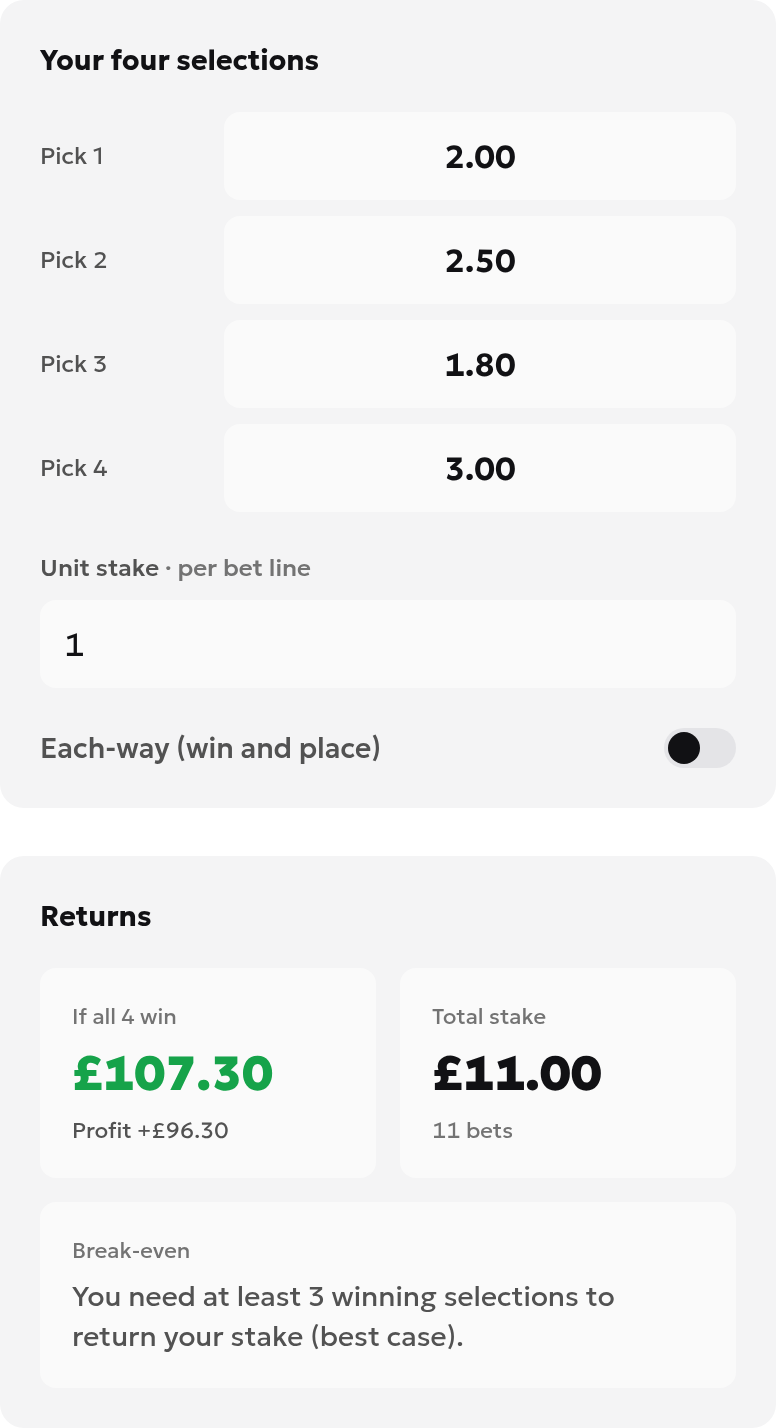
Calculator example: £1 on each of 11 lines, £11 total stake, £107.30 gross return and £96.30 net profit if all 4 selections win.
Enter the stake per line, not the whole budget. So if your total budget is £11, the unit stake is £1 because a Yankee has 11 lines. If you enter £11 as the unit stake, the total stake becomes £121.
The scenario table in the calculator shows net profit, not gross return. For the mixed-odds example above, the net profit range is:
- 2 winners: from £-7.40 to £-3.50
- 3 winners: from £11.10 to £22.50
The label “best case” means the minimum number of winning outcomes for which at least one winning set covers the total stake. It does not mean that every winning set always covers the stake, and it is not a probability statement. In our specific example, every 3-winner set covers £11, but that changes with different prices.
The standalone calculator does not offer separate outputs for voids, Rule 4 or dead heat. It can still show potential each-way payouts, but it is not an exact recreation of a settled coupon with every bookmaker adjustment.
The chart below uses equal starting odds of 3.00, a budget of £11 and a stake of £1 on each combination. This is a different example from the main 2 / 2.5 / 1.8 / 3 calculation.
- 2 winners return £9 and profit £-2
- 3 winners return £54 and profit £43
- 4 winners return £243 and profit £232
In this chart, with the same £11 budget and all four selections at odds of 3.00, the fourfold returns £891 only if all 4 selections win. At a £33 budget, the same fourfold returns £2673. The chart controls let you change the common odds and total stake to compare Yankee and fourfold returns.
Comparing Yankee, Lucky 15, fourfold and singles
Fair comparison only works when the total budget is the same. Using £33 and odds of 3.00 for every selection:
- Yankee: unit £3
- Lucky 15: unit £2.20
- fourfold: £33 on the accumulator
- 4 singles: £8.25 on each single
| Number of winners | Yankee payout | Lucky 15 payout | Fourfold payout | Four singles payout |
|---|---|---|---|---|
| 0 | 0 | 0 | 0 | 0 |
| 1 | 0 | 6.6 | 0 | 24.75 |
| 2 | 27 | 33 | 0 | 49.5 |
| 3 | 162 | 138.6 | 0 | 74.25 |
| 4 | 729 | 561 | 2673 | 99 |
All table figures are returns including stake, so deduct £33 to get the net result for each column. This comparison is only fair on the same £33 budget and under the same assumptions.
Read the table as a comparison of bet structures, not as proof that one format is always best. For example, a Lucky 15 returning £6.60 with one winner is still a £26.40 loss on a £33 budget. There is no universally best format here, and equal-budget comparisons matter most. For a deeper comparison, see Lucky 15 explained, system bet explained and system bet vs accumulator.
How to choose selections and control risk
A practical way to approach a Yankee is to start with the amount you can afford to lose, then choose the selections, then check whether the system fits the prices.
A simple way to approach it is:
- Choose a budget you can afford to lose.
- Pick 4 separate events you actually want to back.
- Do not force a fourth selection just to complete the system.
- Check the calculated min/max return and profit ranges for 2-win and 3-win outcomes.
- Compare the same budget against singles and other system bets.
- Check the bet slip and the bookmaker’s settlement rules before assuming the payout is final; separate events do not automatically make the selections independent.
There is no universal best-odds band for a Yankee. Shorter odds can give more reliable-looking coverage but lower returns; longer odds can create bigger payouts but more volatile outcomes. The value depends on whether your prices are fair, not on a fixed recipe.
If you are thinking in expected value terms, keep the model simple and conditional. Let q = p × o, where p is your estimated true win probability and o is decimal odds. EV here means the expected net result under this conditional model, using a £11 budget for each format.
- EV Yankee =
6q² + 4q³ + q⁴ - 11 - EV singles basket =
11q - 11 - EV fourfold =
11q⁴ - 11
That model assumes independent outcomes, equal true p, and equal decimal o, with a total budget of £11 for each format. The stakes are £1 on each of the 11 Yankee lines, £2.75 on each of the 4 singles, and £11 on the fourfold. There are no bonuses, voids, or deductions.
Two illustrative rows are:
| p | o | q = p × o | EV Yankee | EV fourfold | EV singles |
|---|---|---|---|---|---|
| 0.30 | 3.00 | 0.90 | -2.57 | -3.78 | -1.10 |
| 0.40 | 3.00 | 1.20 | 6.63 | 11.81 | 2.20 |
These figures come from a model in which p is assumed, not measured. The tool does not estimate p, and 1/o is the implied probability from the odds, not a verified true chance. A Yankee does not have a fixed RTP like a casino game: its expectation depends on the odds and the joint probabilities. EV here is a modelled average net result, not a profit promise.
Each way Yankee: 22 lines and separate win and place logic
An each way Yankee doubles the number of lines to 22: 11 win lines and 11 place lines. At £1 each way per line, the total stake is £22.
Each-way bets are settled as separate win-part and place-part accumulators: each-way betting rules at bet365. Every selection in a relevant combination must win for the win part, or qualify for a place for the place part. You do not mix win and place results inside the same line.
- win part: the bet on the selection winning
- place part: the bet on the selection placing
A winning selection usually also qualifies for the place part, but the place part is not the same as the win part. The actual place terms depend on the bookmaker, the market and the event.
A simple place-price formula at a 1/5 fraction is:
1 + (decimal odds - 1) / 5
So 5.00 win odds become 1.80 place odds at 1/5, not 1.00.
In the mixed-price example, the place odds are:
- 1.20
- 1.30
- 1.16
- 1.40
If all 4 selections win, they also all qualify for place. The result is:
- win return: £107.30
- place return: £20.16
- total return: £127.46
- profit: £105.46 after £22 stake
The calculator rounds each winning line to pennies before summing, which is why the place return is £20.16. If you round the unrounded aggregate of £20.17104 once, it becomes £20.17. A bookmaker may use a different rounding rule.
Each way Yankee showing win and place parts
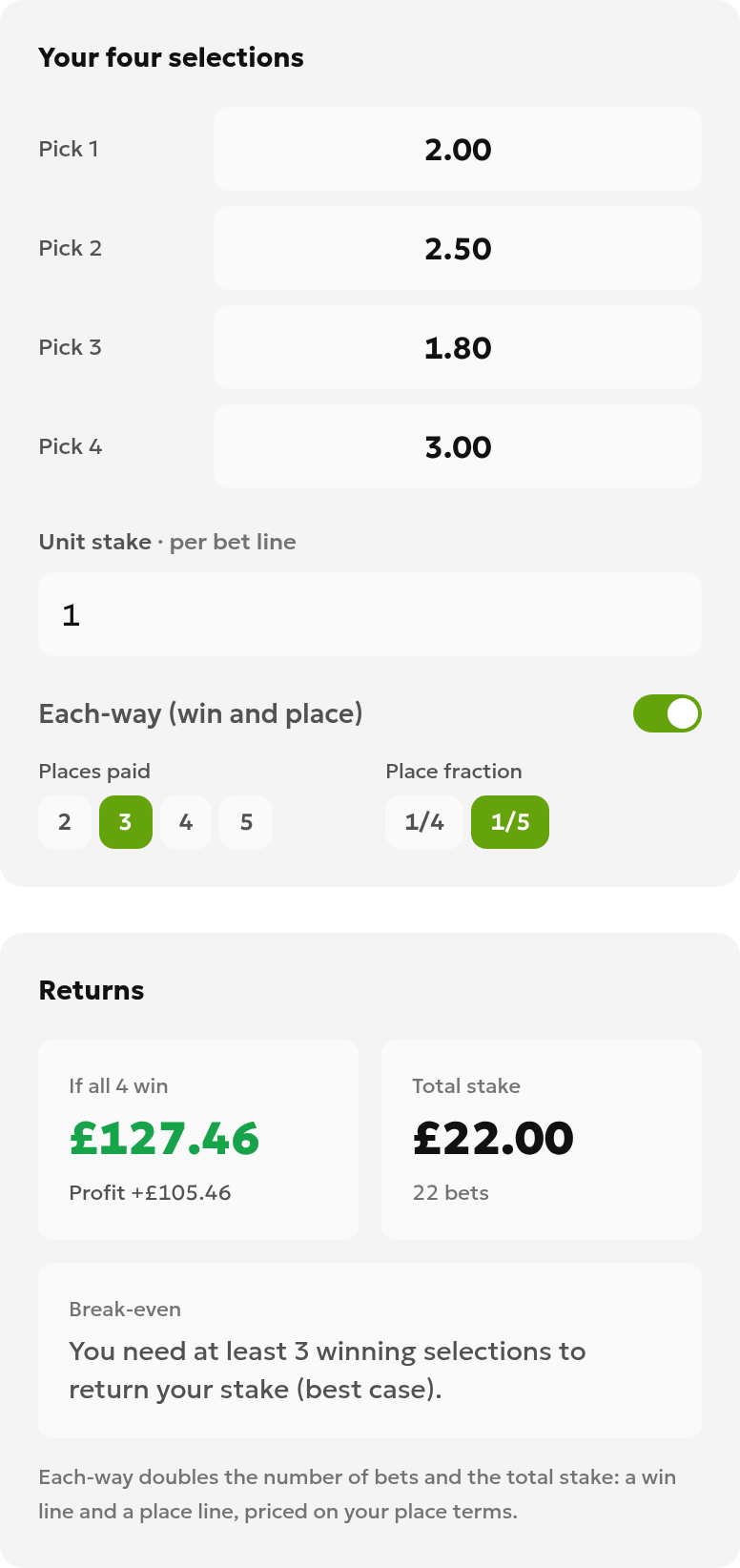
Each way Yankee: win and place are priced separately, and the place selector does not verify the actual finishing position.
To repeat the each-way setup, keep the same odds and enter 1 in the single Unit stake field, switch each way on, choose 3 paid places, and use 1/5. The total stake is £22, and the all-win figures are return £127.46 and profit £105.46. The limitation is specific: the partial-result table and the break-even label remain win-only, so they cannot settle actual each-way results. The calculator also uses one shared 1/5 or 1/4 fraction for all four selections, with no inputs for actual finishing positions, voids, Rule 4, or dead heat.
So if you are reasoning manually, separate the two parts:
- winning selections that qualify for the win part
- qualifying selections that earn a place return under the rules
Add the win returns and the place returns manually, then deduct £22. One winner plus another selection that qualifies for a place can pay a place double. With no singles, one qualifying selection on its own cannot pay.
Why voids, Rule 4 and dead heat change the payout
Real bookmaker settlement can differ from a clean win-only worksheet. Before deciding that a payout is wrong, check:
- accepted odds
- unit stake and total stake
- each way rules
- rounding of line components
- deductions and bonus limits
- the market settlement rules
If a selection is confirmed void, it is settled at 1.00 within each original line. The Yankee still consists of the same 11 stakes; it does not become a new Trixie or any other new bet.
For example, if A at 2.00 wins, B and C lose, and D is void, only AD reduces to a single on A and returns £2. The total outlay is still £11, so the net result is -£9. There is no separate refund for D as a standalone single because a Yankee does not include singles. See the Paddy Power void rules. In ante-post, meaning advance betting before the event, a non-runner may be treated as a loser rather than a void depending on the terms.
Rule 4 affects the profit part, not the whole stake. For example, if a £1 bet at decimal odds 5.00 has a 20% deduction, the adjusted decimal odds are:
1 + (5 - 1) × .8 = 4.2
So the gross return becomes £4.20, not £4.00. That is a conditional example only. The actual application depends on the operator and the event, and this calculator does not implement a Rule 4 engine. Source: Paddy Power Rule 4 rules.
Dead heat means a tied finish or shared paid places. The operator’s market rules determine what fraction of the stake is paid. See the bet365 dead heat rules. There is no dedicated setting for this in our calculator.
Frequently Asked Questions
A Super Yankee is a system bet on 5 selections. It has 26 combinations in total: 10 doubles, 10 trebles, 5 fourfolds and 1 fivefold.
A Yankee on 4 selections has 11 lines: 6 doubles, 4 trebles and 1 fourfold. Lucky 15 uses the same four selections but adds 4 singles, so it has 15 lines. With the same stake per line, the total stakes are different; with the same overall budget, the stake per line is different.
Yes, if the combined return from the winning pair is above the full £11 outlay. With £1 per line and a total stake of £11, two winners are profitable only when the product of the two decimal prices is strictly greater than 11. If it equals 11, that is only break-even.
Fractional 3/1 is decimal 4.00, and decimal 3.00 is fractional 2/1.
Only where the bookmaker offers that system bet on the relevant market. Availability, labels and settlement rules depend on the operator and the event.
Evgeniy Volkov
Verified ExpertFullstack developer with a background in mathematics. I build the calculators and game-style tools on ToolsGambling with Pixi.js and modern web tech, and every result uses transparent probability formulas you can verify yourself.