












Contents
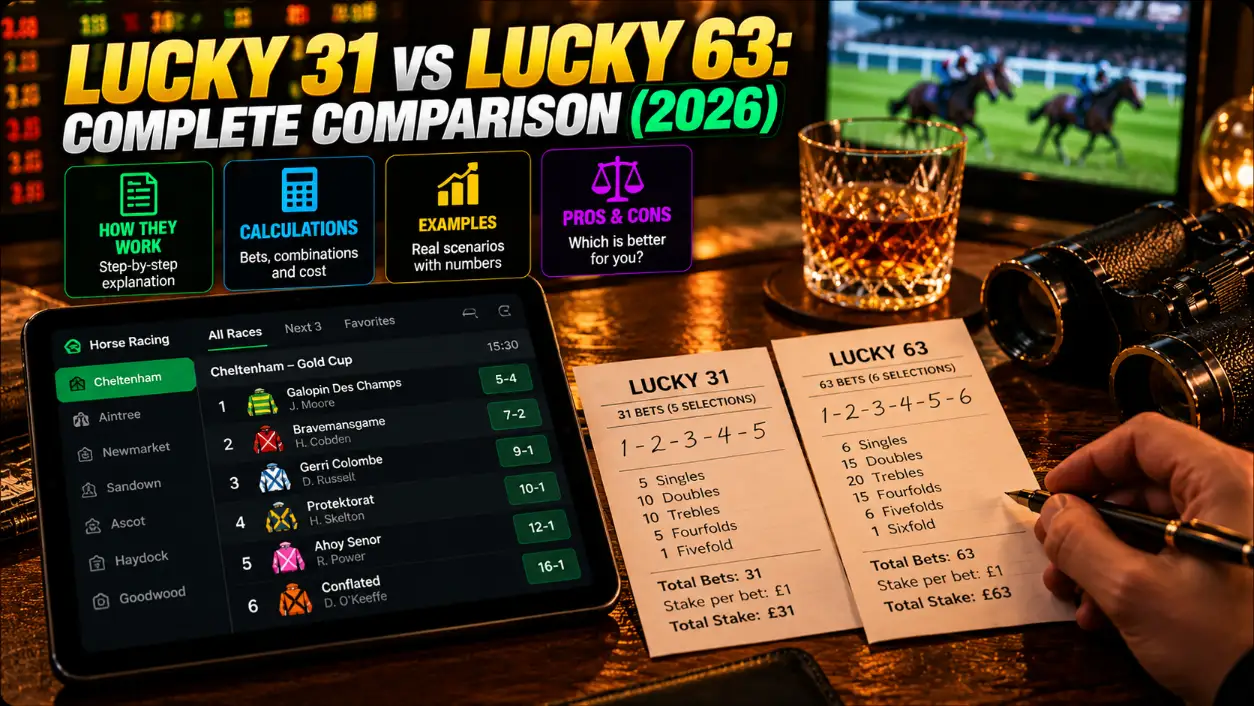
Lucky 31 funds 31 bets across five selections; Lucky 63 funds 63 bets across six. Both provide full cover with singles: every non-empty combination is included. At a £1 unit stake, they cost £31 and £63 respectively. To compare the result, add the gross returns from winning lines and subtract the whole total stake, not just the losing stakes.
Each winning line returns its unit stake multiplied by the decimal odds of every selection in that line. Gross return includes the returned winning stake; net profit is gross return minus the full cost of the betting slip.
One winner produces a return through its single, but does not guarantee a profit. Lucky 63 funds more combinations, which does not automatically make it better value.
Using s for unit stake, n for selections, w for winners and d for equal decimal odds:
- Funded bets:
N = 2^n − 1. - Total stake:
T = N × s. - Winning lines:
2^w − 1. - Gross return at equal odds:
R = s × [(1 + d)^w − 1]. - Net profit:
R − T.
For example, three winners at decimal odds 2 and a £1 unit stake produce three winning singles, three doubles and one treble. Their gross return is 3 × 2 + 3 × 4 + 8 = 26. That £26 return means a £5 loss on Lucky 31 or a £37 loss on Lucky 63.
This calculates specified results, not their likelihood. The main tables assume equal cash unit stakes and binary win/loss results, with no bonuses, voids, each-way bets, taxes, deductions or payout caps. Amounts are shown in pounds; the worked examples need no intermediate rounding. With unequal odds, calculate the actual winning lines, as explained in the system bet calculation guide.
What bets do Lucky 31 and Lucky 63 contain?
Lucky 63 adds exactly 32 betting lines to Lucky 31, and every extra line includes the sixth selection. It is not precisely double: 63 = 2 × 31 + 1.
The composition is confirmed in William Hill’s bet types help page.
| Bet type | Lucky 31 | Lucky 63 | Extra lines |
|---|---|---|---|
| Singles | 5 | 6 | 1 |
| Doubles | 10 | 15 | 5 |
| Trebles | 10 | 20 | 10 |
| 4-folds | 5 | 15 | 10 |
| 5-folds | 1 | 6 | 5 |
| 6-fold | 0 | 1 | 1 |
| Total | 31 | 63 | 32 |
If the sixth selection loses, the original 31 lines produce unchanged returns at the same unit stake. All 32 additional stakes lose, however, increasing the total cost.
How much do they cost, and how do you fit a budget?
Total stake is the number of funded bets multiplied by the unit stake. At the same unit stake, Lucky 63 costs approximately 2.03 times as much as Lucky 31; the extra cost is 32 × s.
| Unit stake | Lucky 31 total stake | Lucky 63 total stake | Extra cost |
|---|---|---|---|
| £0.10 | £3.10 | £6.30 | £3.20 |
| £0.50 | £15.50 | £31.50 | £16.00 |
| £1.00 | £31.00 | £63.00 | £32.00 |
| £2.00 | £62.00 | £126.00 | £64.00 |
To fit a stated total budget, divide it by 31 or 63. Then check the accepted minimum unit stake, permitted decimal precision and actual total. Do not assume a betting slip’s stake field means “per bet” or “whole slip” based on the country.
An exact illustrative budget is £19.53:
- Lucky 31:
31 × 0.63 = 19.53. - Lucky 63:
63 × 0.31 = 19.53.
This budget was chosen to work with two-decimal unit stakes without rounding; it is not a stake recommendation. For another budget, rounding the unit stake may change the final total.
What do partial wins return?
At the same unit stake, equal odds and the same number of ordinary winners, both formats produce the same gross return. Their net profit differs because their total stakes differ.
Here every individual selection has decimal odds 2 and the unit stake is £1. Total stakes are £31 and £63. Negative net profit means a loss; bonuses and other settlement exceptions are excluded.
| Winners | Lucky 31 gross return | Lucky 31 net profit | Lucky 63 gross return | Lucky 63 net profit |
|---|---|---|---|---|
| 0 | £0 | −£31 | £0 | −£63 |
| 1 | £2 | −£29 | £2 | −£61 |
| 2 | £8 | −£23 | £8 | −£55 |
| 3 | £26 | −£5 | £26 | −£37 |
| 4 | £80 | £49 | £80 | £17 |
| 5 | £242 | £211 | £242 | £179 |
| 6 | — | — | £728 | £665 |
Six winners are impossible in Lucky 31, so the table uses a dash rather than a zero return.
Three winners return £26 in either format, leaving both at a loss. Four winners return £80, producing net profits of £49 and £17 respectively. A return and a profit are therefore different outcomes.
With just one ordinary winner and no bonus, its decimal odds must be at least 31 for Lucky 31 or 63 for Lucky 63 to cover the whole £1-unit slip. These are conditional arithmetic thresholds, not advice to chase high odds.
What changes when the total budget is equal?
At an equal total budget, Lucky 63 has a smaller unit stake. If its sixth selection loses, the surviving winning lines pay less than the equivalent lines in Lucky 31.
Both slips below use the same first five selections at decimal odds 2. Lucky 63 adds a sixth selection, also at 2. Each slip costs £19.53, with unit stakes of £0.63 for Lucky 31 and £0.31 for Lucky 63. These amounts are exact to two decimal places.
| Results of the first five | Sixth selection in Lucky 63 | Lucky 31 gross return | Lucky 31 net profit | Lucky 63 gross return | Lucky 63 net profit |
|---|---|---|---|---|---|
| First three win; remaining two lose | Loses | £16.38 | −£3.15 | £8.06 | −£11.47 |
| First three win; remaining two lose | Wins | £16.38 | −£3.15 | £24.80 | £5.27 |
| All five win | Loses | £152.46 | £132.93 | £75.02 | £55.49 |
| All five win | Wins | £152.46 | £132.93 | £225.68 | £206.15 |
Lucky 31’s result stays unchanged within each pair because it has no sixth selection. A winning sixth selection creates extra winning lines in Lucky 63; a losing sixth selection leaves only winning combinations from the first five.
The larger conditional return with six winners says nothing about its likelihood or the bet’s profitability. Do not add a sixth selection simply to fund more lines.
How many winners are needed to break even?
In the equal-odds model, break-even occurs when (1 + d)^w ≥ 2^n. The unit stake cancels from both sides, so changing it does not change this threshold.
| Equal decimal odds | Minimum winners: Lucky 31 | Minimum winners: Lucky 63 |
|---|---|---|
| 2 | 4 | 4 |
| 2.5 | 3 | 4 |
| 3 | 3 | 3 |
| 4 | 3 | 3 |
Break-even here includes an exact zero-profit result. In particular, three winners at decimal odds 3 cover Lucky 63’s cost exactly: they do not produce positive net profit.
These thresholds apply only to the stated model without settlement exceptions. Higher odds do not make selections more likely to win or determine the best format.
How do you reproduce the comparison in the calculator?
Use the system bet calculator to reproduce the three-winner example at decimal odds 2 and a £1 unit stake. You enter the prices and results yourself; the tool neither receives actual event results nor places bets.
- Select the Lucky 31 preset.
- Enter decimal odds 2 for all five selections.
- Select WIN for the first three and LOSE for the last two.
- Enter 1 in Stake per bet.
- Select £ as the currency. Check 31 bets, £31 total stake, £26 gross return and a £5 loss.
Five local calculator rows showing odds 2, three WIN results and two LOSE resultsLocal interface, 12 October 2026: the crop shows only the five odds fields and result controls.
Lucky 31 result cards showing 31 bets, £31 total stake, £26 gross return and £5 lossLocal interface, 12 October 2026: conditional Lucky 31 calculation with a £5 loss and ROI of −16.1%.
Now select Lucky 63. Switching presets reloads demo data, including odds and a unit stake of 10, so you must re-enter the intended comparison values.
- Enter decimal odds 2 for all six selections.
- Select WIN for the first three and LOSE for the last three.
- Set Stake per bet to 1 again and select £.
- Check 63 bets, £63 total stake, £26 gross return and a £37 loss.
Lucky 63 result cards showing 63 bets, £63 total stake, £26 gross return and £37 lossLocal interface, 12 October 2026: conditional Lucky 63 calculation with a £37 loss and ROI of −58.7%.
For the £19.53 equal-budget comparison, re-enter your intended odds and results after selecting each preset. Set Stake per bet to 0.63 for Lucky 31 or 0.31 for Lucky 63, then confirm the £19.53 total.
The tool uses decimal odds here; there is no odds-format selector. It supports standard named bets, binary WIN/LOSE results, currency display and a breakdown by bet size. Do not use it to verify bonuses, each-way bets, void selections, Rule 4 deductions, dead heats, bankers or probabilities.
How can bonuses change the result?
Bonuses depend on the operator’s rules and are excluded from the main tables. There is no universal fourfold or fivefold enhancement for Lucky 31 or Lucky 63.
William Hill’s published help page, checked on 12 October 2026, lists a one-winner consolation doubling profit odds for both formats. It also lists all-winners bonuses of 20% for Lucky 31 and 25% for Lucky 63.
These are published rule examples, not a recommendation or a market-wide claim. Their scope includes horse and greyhound racing, one selection per race, equal unit stakes and all selections running. Starting prices or permitted show/early prices are subject to the stated conditions; ante-post prices do not qualify. For each-way bets, the one-winner consolation applies to the win part.
Doubling fractional or profit odds means d′ = 1 + 2 × (d − 1). Fractional odds 3/1, or decimal 4, therefore become 6/1, or decimal 7—not 8. With a £1 unit stake and only one winner, the gross return is £7: still a £24 loss on Lucky 31 or a £56 loss on Lucky 63.
Check eligibility and the enhancement’s calculation base before relying on it. A percentage of gross return and a percentage of net winnings are not interchangeable. No unverified bonus rule has been applied to the comparison tables.
How do each-way bets and non-runners affect settlement?
Each-way betting funds separate win and place parts, while a void selection may settle at decimal odds 1.00 within the original lines. Neither should be treated as an ordinary loss.
With an equal unit stake s on each part, each-way cost is 2 × s × N. At £1 per part, Lucky 31 costs £62 and Lucky 63 costs £126; at £0.50 per part, they cost £31 and £63.
Place odds are 1 + (d − 1) × f, where f is the place fraction. For example, win odds of decimal 5 with a 1/4 place fraction produce place odds of 2.00, not 1.25.
If only one selection places and none wins under those conditions, a £1 stake per part produces a £2 gross return. Net results are losses of £60 and £124. This is a conditional example, not a universal set of place terms. Win and place parts are calculated separately, so the number of winning selections alone is insufficient. See the each-way guide using golf examples for the mechanics.
Rule 4 deducts from winnings excluding the returned stake. Dead heats—ties for a winning or other paid position—and quarter-handicap settlements require the exact market rules.
Settlement of void selections at 1.00 is described in FONBET’s Russian-language rules, §4.6, and Tower’s English Betting Rules 2.0, §2.25. Check which rules apply to your slip.
Original English extract from Tower section 2.25 describing void settlement at odds 1.00Tower Betting Rules 2.0, §2.25; original English, effective date unknown. Captured 9 October and text checked 12 October 2026.
In this separate Lucky 63 example, the original unit stake is £1 and the total stake remains £63. The sixth selection is void and settles at 1.00; each of the first five has decimal odds 2.
| Results of the first five | Gross return | Net profit |
|---|---|---|
| Three win, two lose | £53 | −£10 |
| All five win | £485 | £422 |
All originally funded lines remain. There are effectively two funded copies of each of the remaining 31 combinations, plus the £1 refund from the original single on the void sixth selection. This is not a cheaper Lucky 31 or a redistribution of the stake.
These figures come from separately enumerating the original combinations, not from the main calculator, which cannot verify this void settlement.
Which structure fits your budget?
Use Lucky 31 for five intended selections or Lucky 63 for six, provided the whole accepted total fits your limit. Neither format is guaranteed to be better value, safer or profitable.
Before choosing:
- Compare equal total stakes, not just equal unit stakes.
- Check the scenario where the sixth selection loses.
- Confirm the minimum unit stake and actual accepted total.
- Check accepted prices, bonus eligibility, place terms, non-runner settlement, deductions and payout caps.
- Do not add a selection simply to enlarge the system.
For four selections, consider the structure explained in the Lucky 15 guide. If you do not want singles, Canadian has 26 bets: Lucky 31 without its five singles. Heinz has 57 bets: Lucky 63 without its six singles.
Use only money you can afford to lose without affecting essential expenses. A calculated return describes a conditional scenario, not an earnings promise.
Frequently Asked Questions
No. Odds let you calculate returns for specified results, not the probability of those results. Expected value requires joint outcome probabilities and the accepted prices.
Switching presets reloads demo data, including odds and the unit stake. Re-enter your intended odds, results and stake, then check the total stake.
No. Use WIN and LOSE results for this comparison. The tool does not verify settlement for void selections, each-way bets, bonuses or special deductions.
Evgeniy Volkov
Verified ExpertFullstack developer with a background in mathematics. I build the calculators and game-style tools on ToolsGambling with Pixi.js and modern web tech, and every result uses transparent probability formulas you can verify yourself.