











Contents
High Card Flush is a casino game in which each player makes the strongest flush from seven cards and decides whether to raise or fold. By ToolsGambling's calculation, the house edge under Mousseau strategy is about 2.74% of the ante (±0.09 percentage points, one standard error) when the dealer qualifies with a 3-card flush, nine-high. Mousseau strategy means raising with a flush of 4 or more cards or a 3-card flush of ten-eight-six or higher, and folding otherwise. Wizard of Odds publishes 2.71%; the difference is within the run’s margin of error.
Key takeaways
- High Card Flush compares the number of cards in each flush first, then the highest cards when the lengths match.
- The maximum raise is up to 1x the ante with a 2–4-card flush, up to 2x with a 5-card flush, and up to 3x with a 6–7-card flush.
- When the dealer does not qualify, the raise is a push and the ante pays 1:1.
- The flush bet is an optional side bet with its own paytable and expected loss, separate from the main game.
What do the rules and paytable tell you?
The comparison rules determine which hand is stronger, while the paytable determines the payout for the separate flush bet. A strong main-game hand and a winning side bet are therefore different questions.
In conventional poker terminology, a flush contains five or more cards of the same suit. High Card Flush also uses the word for shorter same-suit combinations, so a 3-card flush and a 4-card flush are meaningful hands here. Always read the length alongside the word “flush.”
Before committing an ante, identify the hand you would keep, the raise permitted for its length, and the dealer’s qualification requirement. If you also want to place a flush bet, read its paytable separately. A large payout for a rare hand does not, by itself, establish how expensive that side bet is over repeated play.
How to play, step by step
Place the ante before the deal, identify your longest flush, discard the other cards, and choose whether to raise or fold. If you raise, dealer qualification comes before the hand comparison.
- Place the ante before receiving cards. The ante is the mandatory opening bet. The optional flush bet is a separate wager, not part of the ante.
- Find the longest flush in your seven cards. Count the cards in each suit. Keep your attention on the largest same-suit group rather than the most impressive individual card elsewhere in the hand.
- Discard cards outside the longest flush before raising. Hard Rock Atlantic City describes this procedure on its High Card Flush game page, casino.hardrock.com. Discarding those cards prepares your hand for comparison; it is not the same action as choosing to fold.
- Choose whether to fold or raise. Folding means declining the raise and losing the ante. If you continue, the maximum raise depends on your flush length: 2–4 cards means up to 1x the ante, 5 cards up to 2x, and 6–7 cards up to 3x. For example, a 5-card flush permits a raise of up to twice the ante; the original ante remains a separate bet.
- Wait for dealer qualification and comparison. If the dealer does not qualify, the raise is a push, meaning it is returned without a win, and the ante pays 1:1. If the dealer qualifies, compare the two flushes.
A permitted raise size is not a recommendation to continue: the schedule tells you the maximum to raise after deciding to play, not which hands should be played.
Hand steps: ante, discarding cards outside the flush, raise, comparison with the dealerTeaching diagram based on the article text; not a casino interface
How to compare hands
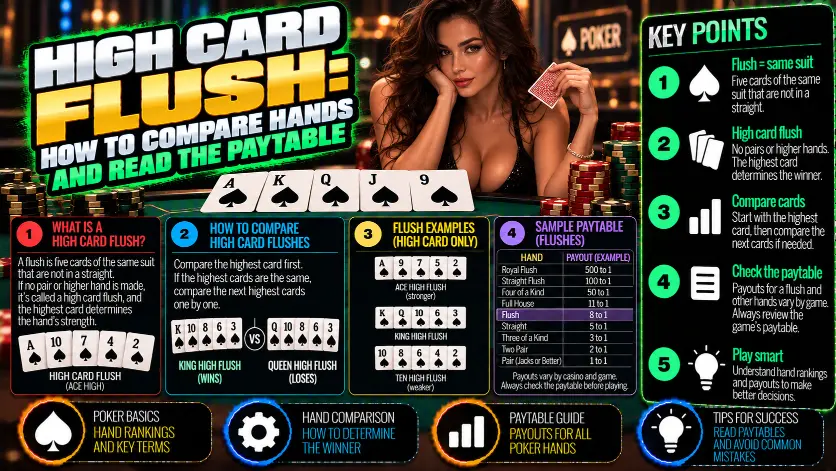
Compare the length of each player’s longest flush first; if the lengths match, compare the cards from highest to lowest. A higher individual card cannot make up for a shorter flush.
For equal-length flushes, start with the highest card in each hand. If those ranks match, move to the next card and continue until the first difference. Cards discarded outside the chosen flush do not strengthen the comparison.
- A 4-card flush K-Q-J-T against K-Q-J-9: the lengths match, as do the kings, queens, and jacks. The ten outranks the nine, so K-Q-J-T is stronger.
- A 5-card flush against a 4-card flush: the 5-card flush wins the comparison. The highest card does not need to break a tie because the lengths already decide the result.
- A 7-card flush against a 6-card flush: the 7-card flush is stronger. Six high cards of one suit do not outrank seven cards of one suit.
Each example assumes that all the listed cards within a hand belong to the same suit. K, Q, J, and T mean king, queen, jack, and ten. These are direct rule comparisons, not probability estimates.
Already revealed hands are ranked by the rules rather than by their chance of improving. An equity calculator offers a useful poker analogy for comparing hands by probability, but it does not replace these rules or calculate High Card Flush.
When does the dealer qualify?
The dealer qualifies with a 3-card flush whose highest card is at least a nine, according to the New Jersey regulator’s proposed rules. Qualification determines whether the dealer proceeds to a hand comparison.
Without qualification, you do not need to beat the dealer’s flush to receive the ante payout. The ante pays 1:1, while the returned raise earns no profit.
Under the “3 cards, nine-high” condition, the dealer qualifies in 75.36% of deals (an exact count by ToolsGambling that matches the Wizard of Odds figure). That percentage measures how often the dealer qualifies, not how often the player wins. Your own hand, the raise decision, and the eventual comparison still affect the outcome.
The flush bet is separate from qualification and continuation. The New Jersey proposed rules call it the Flush Bonus wager and say it can pay even if you fold, so declining the raise does not automatically lose a qualifying side bet.
Paytable and the numbers: what does the flush bet cost?
The two flush-bet paytables have player expected returns of −7.81% and −7.53%, respectively. The following payouts come from the Wizard of Odds High Card Flush analysis, which also publishes a 2.71% main-game house edge under Mousseau strategy.
| Cards in flush | Table 1 | Table 2 |
|---|---|---|
| 7 | 300 | 300 |
| 6 | 100 | 75 |
| 5 | 10 | 5 |
| 4 | 1 | 2 |
The entries express payouts relative to a unit stake: 300 means 300 to 1. A payout is not the probability of receiving the hand. No individual hand-frequency figures accompany these rows, so the paytable cannot tell you how often each payout occurs.
The −7.81% figure for Table 1 and −7.53% figure for Table 2 describe average player losses relative to the flush-bet stake. Both are negative expectations for the player. Table 2 is less unfavorable by that measure even though its payouts for 5-card and 6-card flushes are lower. Comparing just one eye-catching row would miss the overall result.
Hands containing four or more cards of one suit account for 22.6% of seven-card hands (an exact count by ToolsGambling). That combined frequency is not a distribution by flush length. Evaluating the full paytable requires both the frequency of each paid outcome and its payout.
Neither expected-return percentage predicts the loss in a particular evening or guarantees that the evening will end in a loss. Likewise, a winning session does not establish that the side bet has become favorable. The variance simulator illustrates how results can spread across sessions; it is not a dedicated High Card Flush side-bet calculator.
Summary card: flush bet −7.81% and −7.53%, main game about 2.74% by ToolsGambling calculationToolsGambling calculation, 2026-10-29: flush bet on two paytables and the main game with the Mousseau strategy
The main game: what is the house edge?
The published main-game house edge under Mousseau strategy is 2.71% of the ante, while ToolsGambling’s run estimates about 2.74% under the nine-high dealer qualification rule. Those figures exclude side bets.
ToolsGambling summary and published benchmarks — 2026-10-29
| Measure | Value | Basis |
|---|---|---|
| House edge under Mousseau strategy | 2.74% of the ante | ToolsGambling; 3 million deals, ±0.09 percentage points (one standard error) |
| House edge under Mousseau strategy | 2.71% of the ante | Wizard of Odds |
| House edge under optimal strategy | 2.64% | Wizard of Odds |
| Expected loss relative to average total wagers | 1.58% | Mousseau strategy, Wizard of Odds |
| Fold frequency under Mousseau strategy | 32.07% | ToolsGambling |
| Fold frequency under Mousseau strategy | 32.06% | Wizard of Odds |
| Dealer qualification frequency | 75.36% | 3-card flush, nine-high; Wizard of Odds and ToolsGambling calculation |
The figures measure different aspects of play. Fold frequency is the share of hands on which the player declines to continue, not the share of all hands lost. Expected loss relative to average total wagers includes raises in its denominator, whereas a house edge expressed relative to the ante does not. The 1.58% figure therefore cannot replace 2.71% in a statement about losses relative to the ante.
ToolsGambling’s run is a numerical estimate: the player and the dealer are dealt 14 different cards from one deck, and the player always makes the maximum raise. The ±0.09 percentage points is one standard error. The difference from the published 2.71% is about 0.03 percentage points, less than one standard error, so the two values agree within the margin of error. They remain separately attributed numbers.
Dealer qualification is the most sensitive assumption here. Replacing “3 cards, nine-high” with “any 3 cards” changes the calculated house edge to −1.75%. A negative house edge means a player advantage under those altered assumptions, not evidence that the usual table is profitable. A separate test of raising with any 3-card flush produces a house edge of 5.57%, showing that the continuation decision also changes the cost.
Even at a house edge of roughly 2–3%, individual sessions can differ substantially. The session simulator can illustrate that spread, but it does not predict your next casino visit.
Limits and mistakes: which conclusions are safe?
The calculations apply only to matching rules, strategy, and paytables, not to every table bearing the High Card Flush name. Casinos can use different procedures and side-bet terms.
Check dealer qualification, permitted raise sizes, and each side-bet paytable before playing. Do not carry a payout from one paytable to another, and keep side-bet costs separate from the main-game edge: Wizard of Odds reports a 13.11% house edge for the straight flush side bet, but says he observed that wager at only one casino, so it is not the main-game figure and may not match other tables.
No strategy makes the standard game profitable under these assumptions. The optimal-strategy figure of 2.64% is still a positive house edge; reducing the expected loss does not remove it.
By ToolsGambling's calculation, the house edge under Mousseau strategy is about 2.74% of the ante when the dealer qualifies with a 3-card flush, nine-high. Under these assumptions, the main game has a negative expectation for the player. The practical approach is to verify the table’s conditions and assess the ante-and-raise game separately from optional side bets.
Frequently Asked Questions
No. Place the ante before the deal; seeing your cards informs the later raise-or-fold decision.
No. Your main-game opponent is the dealer, so another player’s stronger flush does not determine your result.
No. Consecutive ranks are not required for an ordinary flush; the straight flush side bet is a separate wager.
Not on its own. A standard chart does not capture High Card Flush’s priority of flush length over the usual full-hand poker rankings.
Evgeniy Volkov
Verified ExpertFullstack developer with a background in mathematics. I build the calculators and game-style tools on ToolsGambling with Pixi.js and modern web tech, and every result uses transparent probability formulas you can verify yourself.