












Contents
HORSE is a fixed-limit mixed poker game rotating five variants in order. A random seven-card hand qualifies for an eight-or-better low in 18.34% of deals, assuming “ace is low”; the alternative is 8.49%. This calculation covers one hand without the other players’ cards.
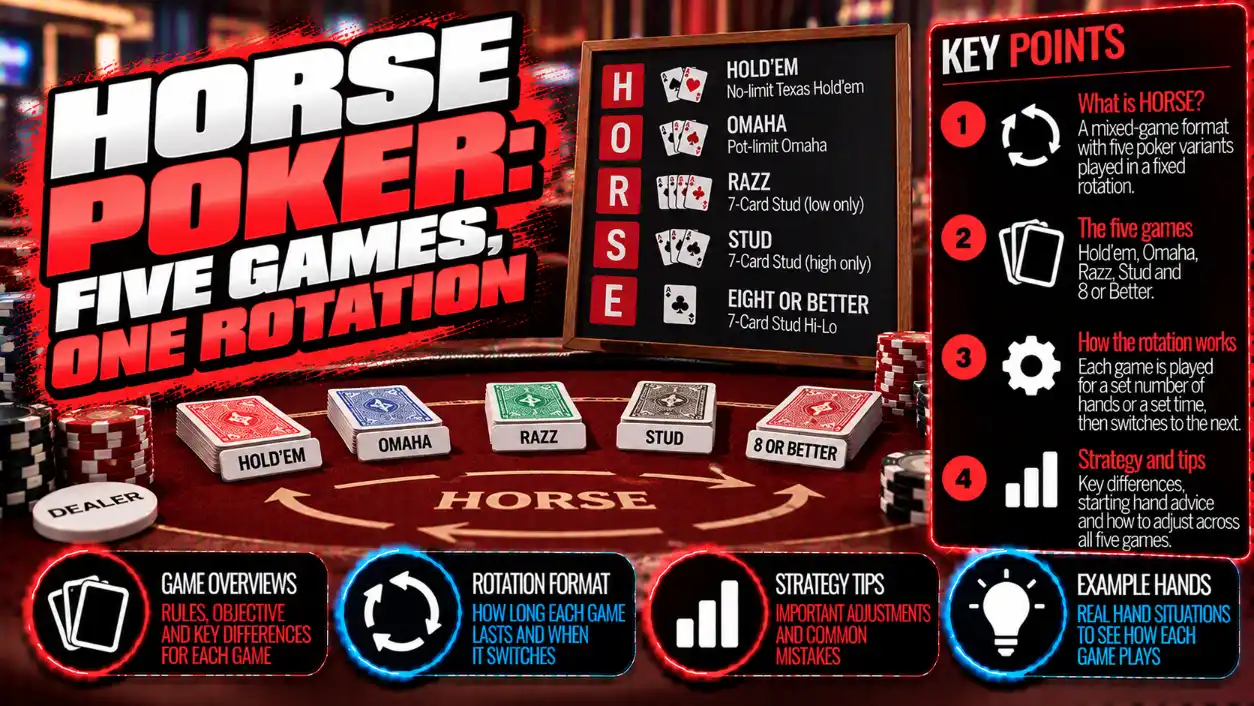
All five games use fixed limits. Switching games follows the table’s rule: in cash games usually after one dealer-button orbit, in tournaments with each blind level. The sequence is hold'em, Omaha Hi-Lo, Razz, stud and stud hi-lo.
For reading a schedule, the key distinction is fixed order versus variable duration. The name tells you which games follow each other, but not necessarily how many hands each lasts. The low qualifier is a separate rule: it applies to Omaha Hi-Lo and stud hi-lo, not to Razz.
What HORSE is
HORSE combines five poker games in a fixed sequence, all played with fixed-limit betting. After stud hi-lo, the rotation returns to hold'em rather than choosing a new order.
The letters provide a reminder of both the sequence and the changing objective. Some games award the pot to the best high hand, Razz rewards the best low hand, and the two hi-lo games allow separate high and low winners.
| Letter | Game | Pot type | What wins |
|---|---|---|---|
| H | hold'em | High | Best high poker hand |
| O | Omaha Hi-Lo | High-low | Best high hand and best qualifying low hand |
| R | Razz | Low | Best ace-to-five low hand |
| S | stud | High | Best high poker hand |
| E | stud hi-lo | High-low | Best high hand and best qualifying low hand |
Fixed limit means that the betting structure sets the permitted bet sizes. The big bet on later streets is double the small bet. This applies throughout HORSE, not just during limit hold'em.
PokerNews, “How to Play HORSE Poker” (pokernews.com), and DeucesCracked, “HORSE Poker Rules” (deucescracked.com), describe the sequence and fixed-limit structure. For a player, the immediate task at every change is to identify what wins the next hand before evaluating the cards.
How the rotation works
Cash games usually change variants after a complete dealer-button orbit; tournaments usually change with each blind level. These methods preserve the same sequence but do not necessarily give each game the same number of hands.
A dealer-button orbit is a complete pass around the table. In stud games, the button does not determine betting order, but it can still move as a hand counter. PokerListings, “How to Play HORSE Poker” (pokerlistings.com), describes that counting function.
DeucesCracked also mentions “bring-in in stud games” as an alternative end point, without defining it. That procedure should not automatically be treated as identical to counting button movements: the relevant question is how the table defines the end of the segment.
| Switching rule | When the game changes | What to track |
|---|---|---|
| Cash: dealer-button orbit | After a complete pass around the table | Completion of the button’s circuit |
| Cash: “bring-in” in stud games (DeucesCracked) | The source adds “(or bring-in in stud games)” without defining it | Ask how the table counts the segment |
| Tournament: blind level | With the next level | The level boundary and completion of the current hand |
Educational diagram: the five HORSE games in one cycle, six hands each at six players, thirty hands in totalEducational diagram. With a full dealer-button orbit and six players, each game runs six hands: five games make a thirty-hand cycle.
With an unchanged player count and a dealer-button orbit rule, the number of hands per game equals the number of players. A full cycle includes all five variants.
| Players | Hands per game under an orbit rule | Hands per full cycle |
|---|---|---|
| 6 | 6 | 30 |
| 7 | 7 | 35 |
| 8 | 8 | 40 |
For example, 120 hands at six players means four full cycles and 24 hands per game. This assumes the player count stays unchanged and the rotation follows a dealer-button orbit. It is not a tournament-level calculation. The table shows six to eight players; the standard HORSE game usually runs eight-handed (PokerListings). The count of hands says nothing about whether every stud player can be dealt seven cards from one deck.
An alternative structure uses a fixed 10 hands per game, producing a 50-hand cycle. That is a separate counting rule, not another name for a dealer-button orbit.
For a rough time estimate, an assumption of 25 hands an hour makes a 30-hand cycle about 1.2 h. This is an assumed pace, not measured playing-speed data. DeucesCracked explains that when a level ends, the current hand finishes; the switch does not interrupt it.
How to play each game
At the start of each segment, check the winning objective, forced bets and first action. The biggest adjustment is not the game’s name but whether you are making a high hand, a low hand or both.
Hold'em
In hold'em, aim for the best high poker hand using your hole cards and the shared board. Start by checking the button, blinds and small-bet size.
At showdown, the best high hand wins; there is no low award.
Here it matters to compare the call decision with the share of the pot you can win. The pot odds calculator helps check that relationship. A fixed betting amount does not, by itself, make a call worthwhile.
Omaha Hi-Lo
In Omaha Hi-Lo, assess your chances of winning the high and low portions separately. At the start, check the blinds and the betting structure.
The best high hand wins the high portion, while the best qualifying low hand wins the low portion.
The two evaluations must stay separate. A strong high holding does not automatically contain a valid low, and several low-looking cards do not automatically form a qualifying low hand.
Razz
In Razz, aim for the lowest ace-to-five hand rather than a high poker combination. Start by checking the exposed cards.
PokerNews says position changes with each street: in Razz the lowest board acts first. The forced opening bet on the first street is not described in the sources used here, so check the table’s bring-in rule.
The best hand is the A-2-3-4-5 wheel. Straights and flushes do not count against it, as DeucesCracked explains.
Track the exposed cards first. When checking outs in Razz and stud, an outs calculator can support your count, but you still need to identify which remaining cards genuinely help and account for the cards already visible.
Stud
In stud, aim for the best high poker hand. Keep an eye on your opponents’ boards as well as your own (PokerNews). PokerNews adds that in stud and stud hi-lo the highest board starts the betting on each street.
In a game without a button, the dealer button only counts hands played (PokerListings), so do not derive betting order from it.
The best high hand wins at showdown. Remember exposed cards when judging which improvements remain possible. As in hold'em, separate the strength of your hand from the price of continuing.
Stud hi-lo
In stud hi-lo, assess both the high hand and the possibility of a qualifying low hand. Begin by checking exposed cards rather than carrying over the previous game’s objective.
Switching from stud to stud hi-lo changes how the pot is awarded: half goes to the best high hand and half to the best low hand (PokerNews).
The best high hand and best qualifying low hand compete for separate portions. The key is distinguishing a hand that can contest only one portion from a hand that might win both. Qualification depends on the completed low hand, not merely on starting with low cards.
Eight-or-better and the split pot
In Omaha Hi-Lo and stud hi-lo, the pot splits into Hi and Lo: half goes to the best high hand and half to the best qualifying low hand. A qualifying low hand contains five different ranks no higher than eight, with the ace low.
Check distinct ranks, not just the number of low cards. Repeated ranks do not supply additional ranks toward the qualifier. Passing the threshold also does not guarantee the low award: qualifying hands still have to be compared with one another.
If nobody has a qualifying low hand, the best high hand takes the whole pot. PokerProfessor states this rule. This high-low division is different from a split pot caused by tied hands at showdown.
What the 18.34% calculation means
Under the assumption “ace is low,” 24,530,944 of 133,784,560 random seven-card hands qualify: 18.34%; the alternative without a low ace is 8.49%. The calculation counts seven-card combinations from a 52-card deck.
| Calculation item | Result |
|---|---|
| Total seven-card hands | 133,784,560 |
| Hands passing eight-or-better | 24,530,944 |
| Qualifying share, ace low | 18.34% |
| Non-qualifying share | 81.66% |
| Qualifying share, ace not low | 8.49% |
| Change without a low ace | −9.85 percentage points |
The displayed percentages are rounded to two decimal places. The alternative tests the effect of the ace assumption; it is not an alternative rule for standard HORSE.
This seven-card count does not apply to Omaha Hi-Lo, which uses a different set of cards. Nor does qualifying establish that a hand beats another low or wins the high portion.
The rule of 2 and 4 gives an outs-based approximation for improving a hand, not for the qualifier. It should not replace this combination count or turn the qualifying share into a prediction about a particular draw.
Scoop and the wheel
Winning both portions is called a scoop. PokerNews calls an ace-to-five straight flush a “steel wheel”: it combines the best low with a strong high hand, but it is not dealt often, and holding a qualifying low says nothing by itself about winning the high comparison.
What to check in each game
Use three separate checks: ace-to-five low rankings for Razz, high poker rankings for stud, and the qualification threshold for the low portion of hi-lo games.
| Game or rule | Ranking check | Common confusion |
|---|---|---|
| Razz | The A-2-3-4-5 wheel is best; straights and flushes do not count against the low | Applying high-hand rankings |
| Stud | Standard high poker rankings decide the winner | Continuing to seek a low after the game changes |
| Eight-or-better | Five distinct ranks no higher than eight, ace low | Treating qualification as an automatic win |
| Stud hi-lo | Evaluate the high hand and qualifying low hand separately | Assuming every pot must have a low winner |
History and tournaments
HORSE debuted at the WSOP in 2002 with a $2,000 buy-in, according to Wikipedia EN, “HORSE (poker)” (en.wikipedia.org); DeucesCracked dates HORSE’s WSOP run from 2006, so the sources disagree. For understanding a current tournament schedule, the event’s rotation structure matters more than the historical date: the name identifies the games and their order, while the tournament rules establish the length of each segment. Rotation by blind level does not promise equal hand counts across all five games.
Limits and mistakes
The exact switching rule is set by the room or organizer. PokerNews uses “one round” without defining it, so that phrase alone does not establish whether the table counts a dealer-button orbit or follows another procedure.
A particularly easy mistake occurs on the last hand of a segment: mentally moving to the next variant too soon. Finish evaluating the current hand under its own rules. A switch approaching on the schedule does not turn an ongoing stud hand into stud hi-lo.
The calculation also does not transfer directly to a real table without seat data and information about available cards. It does not describe the chance that at least one player at the table qualifies, and it does not account for betting decisions or whether a qualifying holding reaches showdown.
Finally, fixed limits do not make the objectives interchangeable. Before acting after a rotation, identify the current game, the first-action rule and the condition for winning. That short reset is more useful than relying on the impression left by the previous hand.
Frequently Asked Questions
The letters identify hold'em, Omaha Hi-Lo, Razz, stud and stud hi-lo, in that order.
Under a dealer-button orbit rule, each game lasts as many hands as there are players: six hands with six players. When tournament rotation follows blind levels, the hand count is not fixed.
Standard HORSE uses fixed limits in all five games. The big bet on later streets is double the small bet.
A player may finish without five different ranks no higher than eight. If nobody has a qualifying low hand, the best high hand takes the whole pot.
Evgeniy Volkov
Verified ExpertFullstack developer with a background in mathematics. I build the calculators and game-style tools on ToolsGambling with Pixi.js and modern web tech, and every result uses transparent probability formulas you can verify yourself.