












Contents
The sportsbook shows Lakers -150 and Celtics +130 for tonight's game. One number has a minus, one has a plus, and a friend three seats over is reading the exact same matchup as 1.67 and 2.30. Same game, same payouts, three different ways of writing it down.
That gap is where most new bettors lose money in 2026. Not on bad picks, but on misreading the price. By the end of this guide you will read American, decimal and fractional odds on sight, flip any price into any other format, and turn that price into a probability so you know what the book actually thinks. There is a converter built into the page so you can test every example as you go. Once you can read a price, the next step is getting the best one: our live odds comparison lines up 20+ books side by side, and our +EV bet scanner flags the ones priced above their fair probability.
TL;DR: Odds in 30 Seconds
Odds do two jobs at once. They set your payout, and they hint at the chance of the outcome. Three formats are in common use, and they all say the same thing.
The three formats at a glance
| Format | Looks like | Reads as |
|---|---|---|
| American | +200 / -150 | Profit on $100, or stake to win $100 |
| Decimal | 3.00 / 1.67 | Total return per $1 staked |
| Fractional | 2/1 / 4/6 | Profit per unit staked |
A favorite is short: low payout, likely to win. An underdog is long: big payout, less likely. Everything below is detail on those two ideas.
What Betting Odds Actually Tell You
Odds are a price tag. The shorter the price, the more the book expects that outcome to happen, and the less it pays you for being right. That is the core of how betting odds work, and it holds across every sport and every format.
Odds = a price plus a probability
Every price carries an implied probability, the chance the number is quietly suggesting. A coin flip priced fairly would be 2.00 in decimal, +100 in American, 1/1 in fractional, and 50 percent implied. Push the price shorter than that and the implied chance climbs above 50 percent. Stretch it longer and the chance drops.
Why one bet shows three different numbers
There is no deep reason a bet "is" American or decimal. It is regional habit. US books default to American moneyline, most of Europe and Australia use decimal, and UK and Irish books still lean on fractions, especially in horse racing. The payout never changes. Only the notation does, which is exactly why a quick conversion habit pays off when you shop lines.
American (Moneyline) Odds
American odds, also called moneyline odds, are built around a $100 bet. This is the format you will see first at any US sportsbook, so it is worth getting fully comfortable with it.
Plus odds: the underdog payout (+200)
A plus number tells you the profit on a $100 stake. At +200, a $100 bet wins $200 profit, and you get your $100 stake back on top, so $300 returns in total. Smaller stake, same ratio: $25 at +200 wins $50. Plus prices always belong to underdogs, the side expected to lose more often than it wins.
Minus odds: the favorite price (-150)
A minus number flips the reference point. It tells you the stake required to win $100. At -150, you risk $150 to win $100 in profit. The favorite pays less because it is more likely to come in. Lakers -150 means the book sees them as the stronger side and charges you accordingly.
What the + and minus really mean
Minus is the favorite, plus is the underdog. The size of the number measures how lopsided the book thinks the matchup is. -110 is close to a coin flip with the book's cut added. -600 is a heavy favorite. +450 is a longshot.
Quick read: +200, -300, -400
Three you will meet constantly. +200 wins $200 on $100, about 33 percent implied. -300 risks $300 to win $100, about 75 percent implied. -400 risks $400 to win $100, about 80 percent implied. The pattern holds throughout: the bigger the minus, the more likely the outcome and the thinner the payout.
Decimal Odds
Decimal odds are the cleanest format for math, which is why most of the world and almost every betting model uses them. If you only learn one format deeply, make it this one.
Reading a decimal price (3.50)
The decimal number is your total return per $1 staked, stake included. At 3.50, a $10 bet returns $35 total. Subtract your $10 stake and the profit is $25. To isolate profit, multiply the stake by the decimal minus one: $10 times 2.50 is $25. Anything above 2.00 is an underdog, anything below 2.00 is a favorite, and 2.00 itself is an even-money coin flip.
Why most of the world uses decimal
Decimal makes comparison effortless. A higher number always means a bigger payout, with no plus or minus signs to juggle mentally. Parlays multiply cleanly too: three legs at 1.50, 2.00 and 2.50 give 1.50 times 2.00 times 2.50, which is 7.50. That property alone is why sports betting odds explained in decimal tend to click fastest for newcomers.
Fractional Odds
Fractional odds are the traditional British format, still standard at UK and Irish books and on the rail at the track. They look old-fashioned, but the logic is simple once you see it.
Reading fractions (5/2, 4/6)
A fraction is profit over stake. 5/1 means five units profit for every one staked. 5/2 means five units profit for every two staked, so a $20 bet wins $50 profit and returns $70. When the first number is smaller, like 4/6, you are on a favorite: stake six to win four. Old-school callers say "six to four on" for that, which trips up plenty of beginners.
Horse racing and UK books
This is why horse racing betting odds explained almost always start with fractions. 7/2, 11/4 and 9/4 are everyday track prices. They convert to decimal by dividing the fraction and adding one: 7/2 is 3.5 plus 1, which is 4.50. The track and the modern app are quoting the same horse, just in different dialects.
Convert Any Format Instantly
Here is the tool. Type a price in any format and read it back as American, decimal, fractional and implied probability at once. Add a stake to see the payout. Try the anchors from this guide: +200, -150, 5/2, 3.50.
The conversion formulas
You rarely need to do this by hand once you have a full odds converter, but knowing the formulas makes the numbers stop feeling like magic. If you bet on football, the correct score predictor turns the same odds into a fair price for every scoreline.
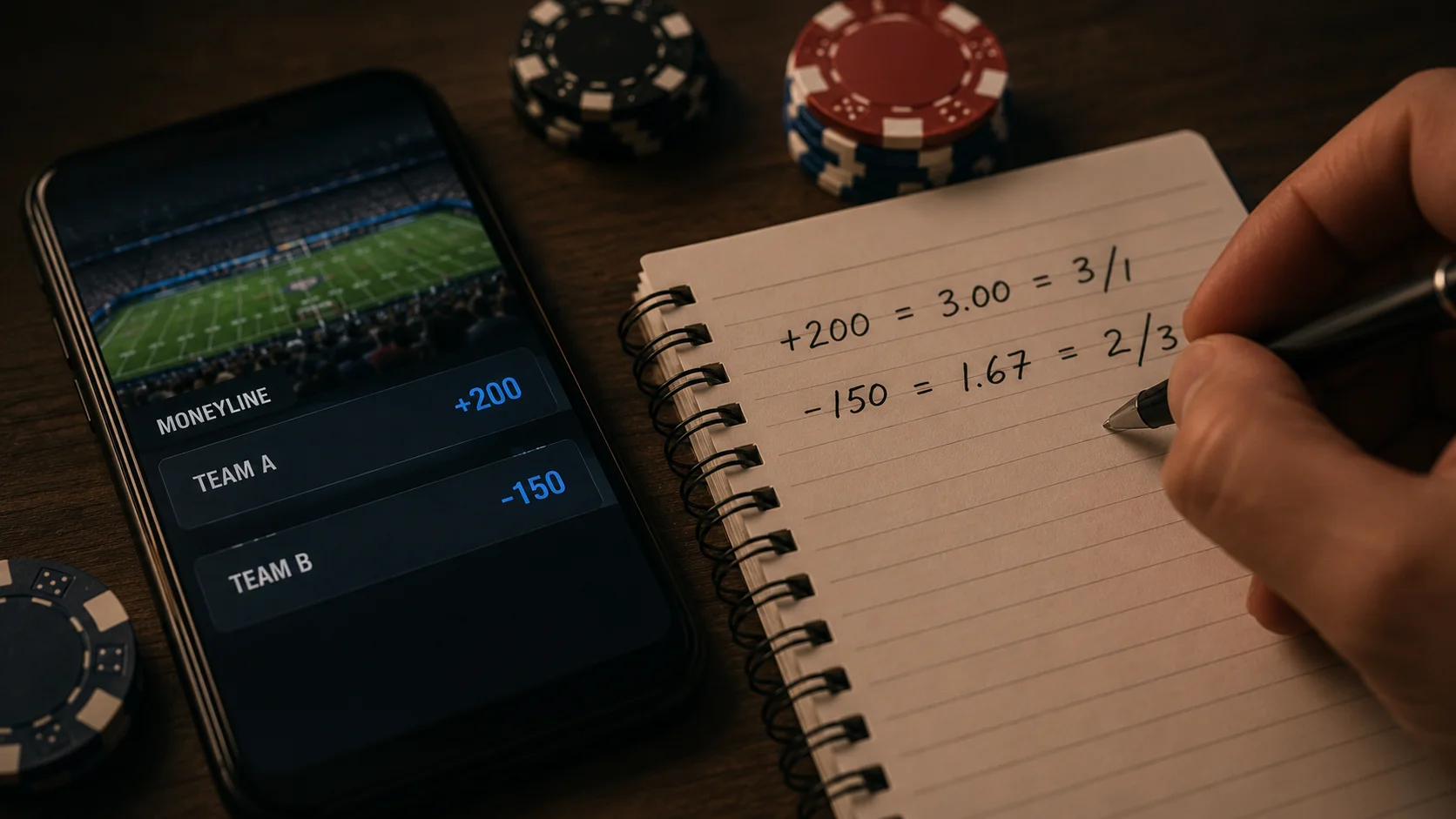
- Plus American to decimal: odds divided by 100, plus 1. So +200 is 2 plus 1, which is 3.00.
- Minus American to decimal: 100 divided by the number, plus 1. So -150 is 0.667 plus 1, which is 1.67.
- Fractional to decimal: numerator divided by denominator, plus 1. So 5/2 is 2.5 plus 1, which is 3.50.
- Decimal back to American: if the decimal is 2.00 or higher, subtract 1 and multiply by 100. Below 2.00, take minus 100 divided by the decimal minus 1.
Decimal as the common bridge
The move that pros use: send everything through decimal. It is the one format every other format converts to in a single step, so it works as a hub. Turn American into decimal, turn fractional into decimal, then compare. No mental gymnastics, no plus and minus signs fighting each other.
Side-by-side reference table
These anchors are worth memorizing. They cover the everyday range you will actually bet.
| American | Decimal | Fractional | Implied % |
|---|---|---|---|
| +200 | 3.00 | 2/1 | 33.3% |
| +100 (evens) | 2.00 | 1/1 | 50.0% |
| -110 | 1.91 | 10/11 | 52.4% |
| -150 | 1.67 | 4/6 | 60.0% |
| +250 | 3.50 | 5/2 | 28.6% |
| -300 | 1.33 | 1/3 | 75.0% |
Odds and Implied Probability
This is the part that separates bettors who win from bettors who donate. A price is not just a payout. It is a percentage in disguise, and that percentage is how you judge whether a bet is worth making.
Turning a price into a percentage
The math is short. For decimal, implied probability is 1 divided by the decimal, times 100. So 3.50 is 1 divided by 3.50, which is 28.6 percent. For plus American, it is 100 divided by the odds plus 100, so +200 is 100 divided by 300, which is 33.3 percent. Our implied probability calculator handles it instantly, but the formula is worth internalizing because you will use it on every bet.
The bookmaker margin (the vig) hidden in the odds
Here is the catch nobody at the sportsbook points out. Add up the implied probabilities of both sides of a bet and you get more than 100 percent. Two sides at -110 each imply 52.4 percent, and 52.4 plus 52.4 is 104.8 percent. That extra 4.8 points is the bookmaker margin, the vig, the house's built-in cut. It is the reason you have to win more than half your -110 bets just to break even.
Why the percentages add up past 100
That overround is not a glitch, it is the business model. On a true coin flip the fair price is +100 on both sides. The book shaves it to -110 each way, and the gap is its edge. To strip the margin out and see the book's honest opinion, run the line through our margin calculator. At -110, your real break-even win rate is 52.38 percent, not 50, and a lot of losing bettors never realize they were fighting that number the whole time.
Using Odds to Make Better Bets
Reading odds is step one. Using them is where the money is. Once a price is just a probability to you, every line becomes a question: does the book have this right, or can you do better?
Find value: compare implied probability to your own estimate
A value bet is one where your estimated chance beats the implied probability in the price. If a price implies 33 percent but you genuinely think the outcome hits 40 percent of the time, that gap is your edge. Our value bet calculator turns that comparison into an EV number, and the edge analyzer shows how thin or fat your margin really is. Want to know whether your prices beat the market over time? The closing line value calculator tracks exactly that.
Size the bet and lock in profit
Finding an edge is only half the job. Bet too big and variance wipes you out before the edge pays off. The Kelly stake calculator sizes each bet to your edge and bankroll. From there the structures open up: combine legs with the parlay calculator or spread risk across a round robin. Already holding a position and want to guarantee a result? The hedge calculator and the arbitrage calculator handle that. For point-based markets, the Asian handicap calculator breaks down the split lines. ToolsGambling keeps all of these in one place so you never have to leave the math to chance.
Common Beginner Mistakes
Two mistakes account for most of the early bankroll damage. Both come straight from misreading the odds.
Confusing payout with profit
Decimal includes your stake. American and fractional show profit only. A bettor who reads 3.50 as "$35 profit on a $10 bet" is overcounting by their own stake every single time. Always check whether the number in front of you includes the stake before you celebrate. The decimal odds entry in our glossary spells this out with more examples if it still feels slippery.
Ignoring the vig
The second mistake is treating implied probability as the true probability. It is not. The margin is baked in, so the book's number is always a touch pessimistic about your side. Strip the vig before you decide a bet is fair. For the bigger picture on how prices are set in the first place, read who sets the odds, and to see formats compound across legs, walk through how to calculate parlay odds.
Last Word
Odds are not a code you have to crack every time. A price and a probability, dressed up in three regional outfits. Once you can read American, decimal and fractional on sight, send them through decimal as your bridge, and convert any price into a percentage, the whole board stops looking like noise and starts looking like a list of offers, some fair, some not.
The bettors who last are the ones who check the probability behind the price and strip the vig before they stake. Bookmark the converter, keep the reference table close, and let the value bet calculator and Kelly stake calculator do the heavy lifting once you spot an edge.
Related reading:
For deeper background, see Wikipedia on odds and the mathematics of bookmaking, Investopedia's breakdown of betting odds, and the Wizard of Odds for house-edge math.
Frequently Asked Questions
Plus 200 means a $100 bet wins $200 in profit, with your stake returned on top, so $300 comes back in total. Plus odds mark an underdog, and the number is what you win on a $100 stake. The implied chance is about 33 percent.
In American odds a minus marks the favorite and a plus marks the underdog. Minus shows the stake needed to win $100, and plus shows the profit on a $100 stake. The bigger the number, the more lopsided the matchup.
Minus 300 means you stake $300 to win $100 in profit. It is a favorite with an implied probability near 75 percent. Heavy favorites carry big minus numbers because they are expected to win.
Minus 400 means a $400 stake wins $100 in profit, an implied chance around 80 percent. The payout is small because the outcome is likely. Drop it into the converter above to see every format at once.
About 33.3 percent. For plus odds the implied probability is 100 divided by the odds plus 100, so 100 divided by 300 is 33.3 percent. The converter shows this for any price you type in.
Fractional odds like 5/1 show profit per unit staked: you win five units for every one you stake. 5/2 wins five for every two staked. Implied probability is the denominator divided by the sum, so 5/2 is 2 divided by 7, which is 28.6 percent.
Decimal odds show the total return per unit, stake included. 3.50 means a $10 bet returns $35 total, which is $25 profit. Implied probability is 1 divided by the decimal, so 1 divided by 3.50 is 28.6 percent.
They all describe the same payout. Decimal is the easiest bridge: plus American is the odds over 100 plus 1, minus American is 100 over the number plus 1, and fractional is the numerator over the denominator plus 1. The converter above switches all four at once.
Implied probability is the chance the odds suggest, with the book's margin baked in. It is 1 divided by the decimal price, or 100 over the odds plus 100 for plus prices. Comparing it to your own estimate is how you spot a value bet.
Evgeniy Volkov
Verified ExpertFullstack developer with a background in mathematics. I build the calculators and game-style tools on ToolsGambling with Pixi.js and modern web tech, and every result uses transparent probability formulas you can verify yourself.