










Contents
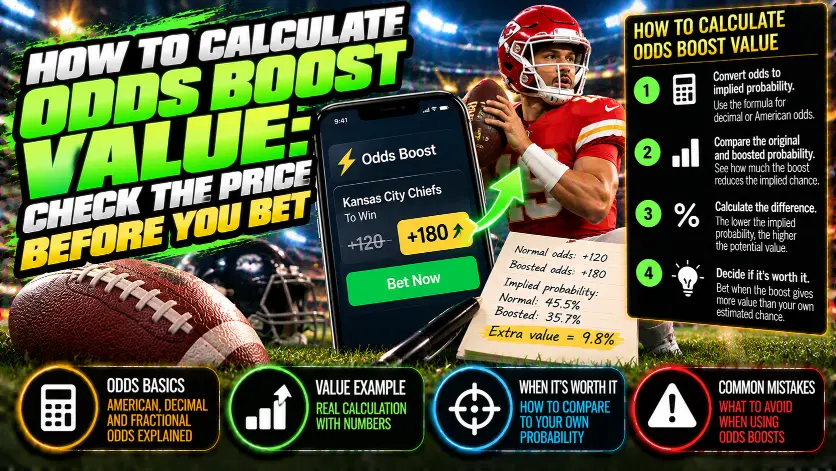
An odds boost is a temporary promotion that raises what a bet pays: either the displayed price goes up, or the sportsbook adds a percentage to your profit. With $10 at +300, a 50% profit boost adds $15 without a cap—but a bigger payout alone does not establish value.
To calculate odds boost value, compare the boosted price with fair odds (no-vig), then calculate expected value (EV) using your own win probability. A payout cap can change the answer.
What is an odds boost?
An odds boost increases the payout through either boosted odds or a percentage added to profit. Identify the mechanism before calculating:
- Boosted odds: the sportsbook replaces the original price with a higher one.
- Profit boost: a percentage applies to net profit, not your stake or the entire payout.
FanDuel help article “Profit Boosts with FanDuel”, snapshot 25 October 2026, domain support.fanduel.com, says a boost changes odds “in your favor” and increases winnings when the bet hits. It does not specify the percentage formula; the example below explicitly assumes a percentage of profit.
Why does the pre-boost price prove nothing?
The original price measures the improvement, not whether the new price is worth taking. The sportsbook sells both prices; the starting price might simply have been poor.
Action Network’s article on calculating odds boosts, updated 27 April 2023, describes the move from +300 to +330 as a change of about 1.75 percentage points in implied probability, using the source’s rounding (our calculation gives 1.74 percentage points).
Estimate the outcome’s probability independently before checking the offer. Otherwise, the advertised improvement can become an anchor for your judgment.
Step 1: Convert odds to probability
Implied probability equals one divided by decimal odds:
Implied probability = 1 / decimal odds.
At +300, or 4.00 decimal, implied probability is 25%. This describes the price’s required win rate, not the outcome’s actual chance.
Use the implied probability calculator for conversion. Do not insert American odds directly into the decimal formula.
The reciprocal also gives the break-even win rate. Your estimated probability must exceed that threshold for positive EV under the applicable payout conditions.
Step 2: Remove the bookmaker margin
Divide each outcome’s implied probability by the sum of all implied probabilities in the line. This proportional no-vig method removes the bookmaker margin (vig).
For a two-way −110/−110 line:
| Measure | Value |
|---|---|
| Implied probability per side | 52.38% |
| Combined implied probability | 104.76% |
| Overround (sum minus 100%) | 4.76 percentage points |
| Probability per side after proportional removal | 50% |
The no-vig calculator continues this calculation. Use both sides of the same line: one price cannot reveal the margin.
This produces an estimate, not a measured true probability. Fair odds (no-vig) and model fair odds come from different methods and should not automatically be treated as interchangeable.
Step 3: Compare the boosted odds with your estimate
Calculate EV using the new decimal odds and your estimated probability, p, expressed as a fraction:
EV per unit staked = p × decimal odds − 1.
Take the 50% per side from Step 2 as the probability estimate for the −110/−110 line.
| Price | Decimal odds | Break-even win rate | EV per stake |
|---|---|---|---|
| +100 | 2.00 | 50% | 0% |
| +120 | 2.20 | 45.45% | +10% |
At +120, that means +10 per 100 staked under the 50/50 assumption. The conclusion depends on that probability, not the size of the advertised increase.
Short rule: break-even = 1 / boosted decimal odds. If your no-vig probability is above that figure, the boost has positive EV; if it is below, it does not.
This formula assumes no push and no fees; it describes an expected net result, not an individual winning payout.
Calculate a profit boost with and without a cap
Calculate the original net profit, apply the boost percentage, then add back the stake. If extra profit is capped, use the smaller of the calculated addition and the cap.
Assume a $10 stake at +300 (4.00 decimal), with a 50% boost on profit. Original profit is $30; the boost adds $15 unless restricted.
| Measure | No cap | $10 extra-profit cap |
|---|---|---|
| Stake | $10 | $10 |
| Original profit | $30 | $30 |
| Extra profit | $15 | $10 |
| Total payout, including stake | $55 | $50 |
| Effective decimal odds | 5.5 | 5.0 |
| Break-even win rate | 18.2% | 20% |
Diagram: break-even win rate for a 50% profit boost on a $10 bet at +300 — 18.2% without a cap, 20% with a $10 cap
Teaching diagram from our own calculation. The threshold is the win probability at which the boost breaks even. Numbers are an example, not a forecast.
Effective odds equal total payout divided by stake. The original 25% threshold falls to 18.2% without a cap (18.18% unrounded). Use the unrounded threshold for decisions close to the boundary.
The cap here limits extra profit, not total payout. A $5 cap would instead raise the threshold to 22.2%.
What changes the verdict most?
Your own win estimate, p, changes the verdict most. For the same uncapped 50% profit boost:
| Your estimate p | EV on $10 | EV as a percentage of stake |
|---|---|---|
| 15% | −$1.75 | −17.5% |
| 18% | −$0.10 | −1% |
| 20% | +$1.00 | +10% |
| 25% | +$3.75 | +37.5% |
Under these assumptions, 20% gives +$1.00 on $10, but 18% flips EV to −$0.10. With a $10 cap and p = 20%, EV is exactly zero.
Under that assumption, without a cap, a win estimate above 18.2% makes the boosted bet positive; with a $10 cap, the bar rises to 20%.
Do not confuse the incremental expected value of a profit boost with full-bet EV. At p = 20%, the original bet has EV of −$2.00; the uncapped boosted bet has +$1.00.
Why does a boosted parlay need a separate check?
A parlay needs the probability that every leg wins together. Multiplying individual probabilities assumes independence.
For two outcomes estimated at 60% and 50%, boosted to +260 (3.60):
| Joint probability assumption | EV |
|---|---|
| 30%, assuming independence | +8% |
| 25% | −10% |
| 36% | +29.6% |
The break-even win rate is 27.8%. Correlation can therefore reverse the verdict at the same price. Here, a joint probability of 25% means negative linkage between outcomes, while 36% means positive linkage. The possible joint range is 10% (max(0, 0.6 + 0.5 − 1)) to 50% (min(0.6, 0.5)). Same-game parlay legs are often positively linked, and the bookmaker may already price that link.
See how to calculate parlay odds for combining legs. Without correlation data, you cannot check the parlay price from individual probabilities alone. If the bookmaker quotes a combined price for a same-game parlay, compare it with the product of the individual decimal odds. Multiplying those odds assumes independence. A gap shows that the bookmaker has priced the link between the legs, but does not prove the combined price is fair. Assessing value still requires a defensible estimate of the probability that all legs win.
Check the calculation in the calculator
The profit boost calculator calculates capped payouts and EV; EV requires your own win probability.
Enter the worked example:
- "Your stake": 10.
- "Original odds (before boost)": +300 or 4.00, matching the selected format.
- "Profit boost": 50%.
- Switch on “Max extra payout cap”, then enter 10 in “Cap on extra profit ($)” for the capped case.
- Open “Promo limits and EV”, switch on “I have a true win estimate (for EV)”, then enter 20 in “Your true win probability (%)”.
The capped results should match effective odds of 5.0, a 20% break-even win rate and zero EV.
Calculate price boosts manually using Step 3, because the calculator handles profit boosts only. Do not enter a price change as a profit boost percentage. To see the EV line, switch on “I have a true win estimate (for EV)” and enter your probability estimate; EV is not shown until that toggle is on.
Check limits and mistakes before betting
Check eligibility and your probability estimate before placing the bet. A boost does not automatically turn a bad bet into a good one; your probability remains the weakest input.
Each profit boost (FanDuel calls it a token) has its own terms. The cited FanDuel help article excludes Bonus Bets and Bonus Funds. Its illustrative 30% token has a $25 maximum bet and minimum odds of −200—not universal offer terms. The FanDuel profit boost rules cover that operator separately.
Do not increase p merely to obtain a positive calculator result. A boost alone does not make a bet worth taking: it improves the payout, not the chance of winning. Start by converting the odds to implied probability, then remove the margin using all outcomes in the same market. Compare that estimate with the break-even probability at the boosted price. Apply any cap on extra profit before assessing expected value. Test the break-even point against a range of your own defensible probability estimates rather than relying on the most optimistic one. Write down your estimate and the reason for it before the bet, so you can compare the outcome with the estimate later. A single bet says little about the long-run average, so judge the rule over many bets at similar prices. For parlays, check correlation between the legs instead of assuming independence. Base your decision on the full calculation and the promotion’s terms, not the advertised size of the boost.
Frequently Asked Questions
It is a promotion that increases the payout through a higher price or extra profit. Identify which mechanism applies before choosing the calculation.
For proportional removal, convert every mutually exclusive outcome’s price to implied probability, then divide each probability by their combined total.
Apply the cap to the calculated extra profit first. Use the resulting total payout to find effective odds and the break-even win rate.
Its value depends on all legs winning together. Individual leg estimates alone do not establish that joint probability when outcomes are linked.
No. Positive EV is conditional on your assumptions and does not ensure a profit on any particular bet.
Evgeniy Volkov
Verified ExpertFullstack developer with a background in mathematics. I build the calculators and game-style tools on ToolsGambling with Pixi.js and modern web tech, and every result uses transparent probability formulas you can verify yourself.