












Contents
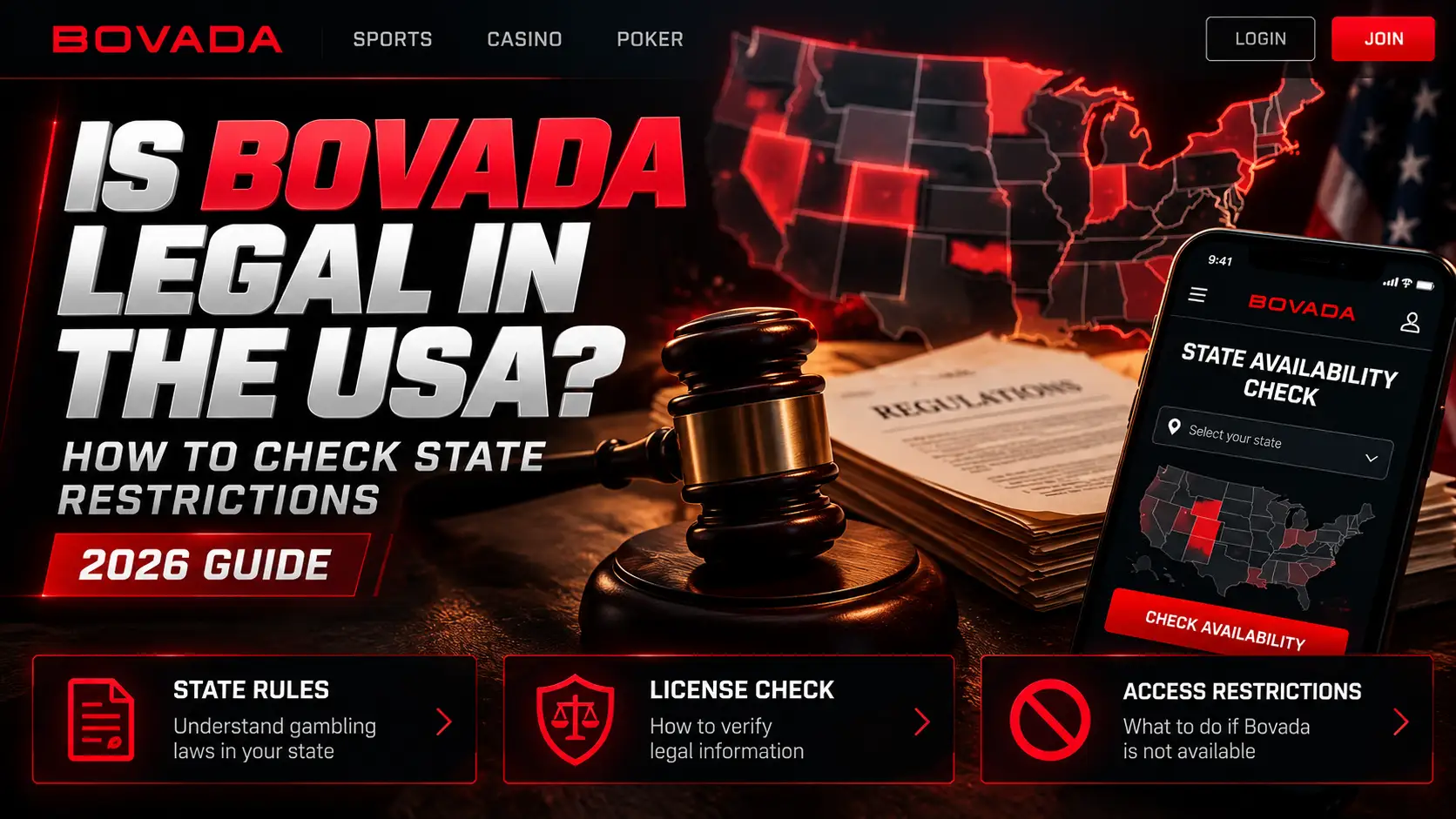
Bovada cannot be treated as a US state-authorized gambling service. If you are asking “is Bovada legal in the US,” a website that accepts your location is not enough: permission depends on the applicable state law, gambling product, and your circumstances. Bovada is an offshore operator, and official Illinois and Massachusetts letters document unlicensed operation in those states. A foreign license claim does not provide US local authorization; this guide does not verify Bovada’s current foreign license status.
There is no single nationwide answer that certifies every individual player’s conduct. Operator authorization, contractual access, player liability, and regulatory enforcement are separate questions.
| What you are checking | What it actually establishes |
|---|---|
| Offshore status or a foreign license claim | It does not establish authorization for a specific US state or product. Foreign ownership alone is not the test. |
| Bovada accepting a state or opening in your browser | This concerns access, not legal permission. Absence from its restricted-states list proves neither authorization nor tested availability. |
| A demand directed at the operator | It addresses operator conduct within the authority’s scope. It does not automatically resolve player liability. |
| Payment acceptance, identity verification, or a withdrawal | None establishes that wagering is lawful. |
| A state-authorized service | Authorization must match the entity, domain, product, location, and current status. Complaint channels may exist, but authorization does not guarantee payouts or universal protection. |
Offshore balances do not come with the protections of the relevant local licensed framework. For the separate question of evaluating credibility and financial risk, see our Bovada trust guide; it is not evidence of legal authorization.
Which states does Bovada restrict?
Bovada’s published restrictions covered 19 states plus the District of Columbia in the snapshot retrieved October 13, 2026. This is an operator access-policy list, not a map of where Bovada is legal.
The list below comes from the operator FAQ, read alongside Terms of Service §2.3.
| Group | Operator-restricted jurisdictions |
|---|---|
| A–L | Arizona, Colorado, Connecticut, Delaware, Kansas, Louisiana |
| M–N | Maryland, Massachusetts, Michigan, Nevada, New Hampshire, New Jersey, New York |
| O–W | Ohio, Pennsylvania, Rhode Island, Tennessee, Vermont, West Virginia |
| Federal district | District of Columbia |
Count normalization: the FAQ refers to DC twice, using “District of Colombia” and “Washington DC.” Counting DC only once produces 19 states plus DC, or 20 unique jurisdictions. Washington state is separate and is not listed above. The terms contain 20 jurisdiction codes.
The page header’s January 3, 2024 date is not a timestamp for the current restriction text. An older PDF listing five states is not the current list either. This snapshot reflects published text, not an account-access test; actual access may differ.
Residence and physical location can both matter, particularly while traveling. Do not infer that an unlisted state permits Bovada, and do not register or place a bet to test permission.
Why does availability not prove authorization?
Illinois provides a direct example: it was absent from Bovada’s restriction snapshot, yet its regulator had already demanded that Bovada stop unlicensed sports wagering there. The Illinois Gaming Board’s February 3, 2025 letter to Harp Media B.V./Bovada identifies the lack of Illinois authorization.
The IGB has neither licensed nor authorized Bovada
Eight-word excerpt from the Illinois Gaming Board letter dated February 3, 2025, retrieved October 13, 2026. The original English letter concerns Bovada sports wagering in Illinois.
The Massachusetts attorney general’s October 3, 2024 letter addresses casino games, sports betting, and horse wagering. It demands cessation and refunds. That demand is not evidence that refunds were actually paid.
A cease-and-desist letter is an authority’s demand. A court order, a filed lawsuit, and a final judgment are different legal events. Neither letter establishes a nationwide final judgment or automatic immunity for players. These historical letters should be read with current state guidance, not presented as newly issued notices.
What about California, Texas, Florida, and Washington?
Do not treat Bovada’s absence from its restriction list in these states as permission to play. The official sources below identify substantive restrictions, including rules that can apply to players—not just operators.
| State | Official position and its limits | Practical conclusion |
|---|---|---|
| California | The California Gambling Control Commission advisory says online gambling is illegal and the commission does not license online casinos. | The commission does not issue online casino licences, so access to Bovada’s website cannot establish that it holds a California online casino licence from this commission. This casino-focused advisory is not a definitive ruling on every possible product. |
| Texas | The State Law Library guide, updated July 7, 2026, explains Penal Code §47.02 offenses involving betting on contests and playing card games for money, with exceptions and defenses. | An unlisted state is not permission. Whether an exception or defense applies requires the actual facts and, where necessary, a qualified Texas attorney. |
| Florida | The Florida Gaming Control Commission FAQ says online sports wagering is generally illegal unless operated by or in conjunction with the Seminole Tribe. It warns of possible player penalties. | Website access—even to a service licensed elsewhere—is insufficient. Bovada access does not establish the specified authorization. |
| Washington state | The Washington State Gambling Commission FAQ warns that both placing and accepting online wagers can violate the law. RCW 9.46.240 addresses knowing transmission of gambling information as a class C felony, subject to applicable exceptions. | Do not interpret this as “every online bet is always a felony.” Legally authorized tribal sports wagering has specific conditions and geolocation rules; it does not authorize Bovada. |
Individual liability varies with the statute and circumstances. A foreign company’s location does not exempt a player from applicable local law. No verified prosecution census or numerical estimate of player legal risk is provided here.
Do federal laws make Bovada legal for individual players?
No. The federal provisions discussed here do not create permission to place a bet that violates applicable state law. Their focus on gambling businesses is not a blanket exemption for players.
The Wire Act, 18 USC §1084 in the official 2024 Code edition, addresses specified wire transmissions by persons engaged in the business of betting or wagering. Subsection (c) does not immunize conduct from state prosecution.
UIGEA’s 31 USC §5363, official 2024 edition, prohibits gambling businesses from knowingly accepting specified payments connected with unlawful internet gambling. Section 5361(b), in the same edition, preserves other applicable federal, state, and compact law.
These links identify the statutory version used; they are not new enforcement notices or a complete review of judicial precedent. Cryptocurrency, a foreign license claim, or the absence of an identified court case does not legalize otherwise unlawful conduct. Our offshore sports betting guide explains the broader distinction.
How can you check authorization without opening an account?
Use the relevant authority’s public directory and current warnings, matching your state and gambling product to the exact operator record. You do not need to register, deposit, or bet to perform this check.
- Identify your physical location and residence. Note travel plans and whether you mean sports betting, casino games, or poker.
- Open the official product-specific directory. Start with the responsible state authority, not a search ad or an operator’s logo.
- Match the record carefully. Check the operator entity, linked domain, product, and current status. A sports wagering listing does not authorize casino games or poker.
- Read current warnings and conditions. Check eligibility, location requirements, and product-specific age rules.
- If authorization cannot be confirmed, do not fund the account. Ask the authority or a qualified state lawyer rather than relying solely on operator support.
Pennsylvania directory example
The Pennsylvania Gaming Control Board’s online sports wagering directory lets you check public operator links without logging in. This example assumes you are checking Pennsylvania online sports wagering—not another state, casino games, or poker.
Open the PGCB online sports wagering operators page. The page contains a BetMGM record linking to this sports wagering domain. That is a neutral example of how an authority connects a listed operator with a domain, not a recommendation to use it.
BetMGM record with its logo and linked label in the PGCB online sports wagering directory
Actual record on the PGCB official directory, in its original English, retrieved October 13, 2026. Its scope is Pennsylvania online sports wagering only; it is not an endorsement or proof of authorization for other products or states.
Read the full current page. You can use your browser’s Ctrl+F or ⌘+F to find a name; this is browser Find, not a regulator search field. Bovada had no entry on this page in the October 13, 2026 snapshot. Absence from this single directory is not a nationwide status audit.
For casino games or poker, consult the authority’s corresponding product directory and guidance. There is no need to click through to a betting account or make a deposit to complete the comparison.
Does an affiliate link change the legal conclusion?
No. Advertising and affiliate relationships do not establish local authorization or alter this guide’s legal conclusion. We may earn a commission from operator links; the legal analysis is independent of those ads.
Our Bovada review is separate editorial coverage. The existing Bovada affiliate link is a commercial redirect, not a permission check or a recommendation to register or deposit.
What should you do if you are blocked, traveling, or already have a balance?
Stop wagering while eligibility is unresolved, and do not bypass location restrictions. Avoid VPN location masking, false addresses, borrowed accounts, or other attempts to evade the operator’s rules. Bovada’s terms may allow closure or forfeiture for bypassing restrictions.
Ask support for a written explanation of your current eligibility, withdrawable balance, pending bets, and bonus conditions. Save account statements, the relevant terms, dated support messages, and screenshots privately. Do not publish identity documents or payment details.
Do not make another deposit or pay an “unlock fee” to obtain an existing balance. Neither cryptocurrency nor a support promise guarantees an immediate or full refund. Our withdrawal guide and customer service guide can help organize an inquiry, but historical processing times do not establish your current rights or timetable.
You can report suspected unauthorized operation to the relevant regulator or law enforcement. Reporting does not guarantee fund recovery or access to remedies available for locally licensed services. For a legal assessment of your own conduct or balance dispute, a qualified state lawyer needs the specific facts.
Do taxes or successful withdrawals prove that betting is lawful?
No. Tax reporting and withdrawals are separate from authorization to gamble. For US casual taxpayers, IRS Topic 419 requires reporting gambling income even when no Form W-2G is received. Reporting income does not legalize the underlying betting.
Tax residency requires its own assessment; Russian citizenship or the language you read does not automatically establish US tax residency. Other tax residencies may involve different rules. Our Bovada tax guide addresses the adjacent reporting question, not permission to wager.
A completed withdrawal, successful identity verification, or favorable review cannot substitute for official local authorization. Likewise, lack of state authorization does not by itself prove every allegation of fraud.
What is the safest decision when permission is unclear?
Do not fund or wager until you can confirm the applicable authorization and your eligibility. Adults still need to meet local age, product, and location rules; there is no single age threshold that covers every US gambling product.
Decline offers you cannot verify, do not borrow to gamble, and do not chase losses. The useful legal check is the authority’s current record and applicable law—not whether a site opens, accepts payment, or promises a payout.
Frequently Asked Questions
No. A review can describe the operator, but local authorization must be checked against official sources for your state, the exact operator entity and domain, and the gambling product.
A screenshot documents the directory entry on a particular date, not permanent permission. Before participating, check the current official directory again and verify authorization for the operator, product, and your location.
Provide the operator name, domain, gambling product, and the state where you would participate. Ask whether that exact service has current authorization. Do not send passwords, full payment credentials, or unnecessary identity documents.
Evgeniy Volkov
Verified ExpertFullstack developer with a background in mathematics. I build the calculators and game-style tools on ToolsGambling with Pixi.js and modern web tech, and every result uses transparent probability formulas you can verify yourself.