












Contents
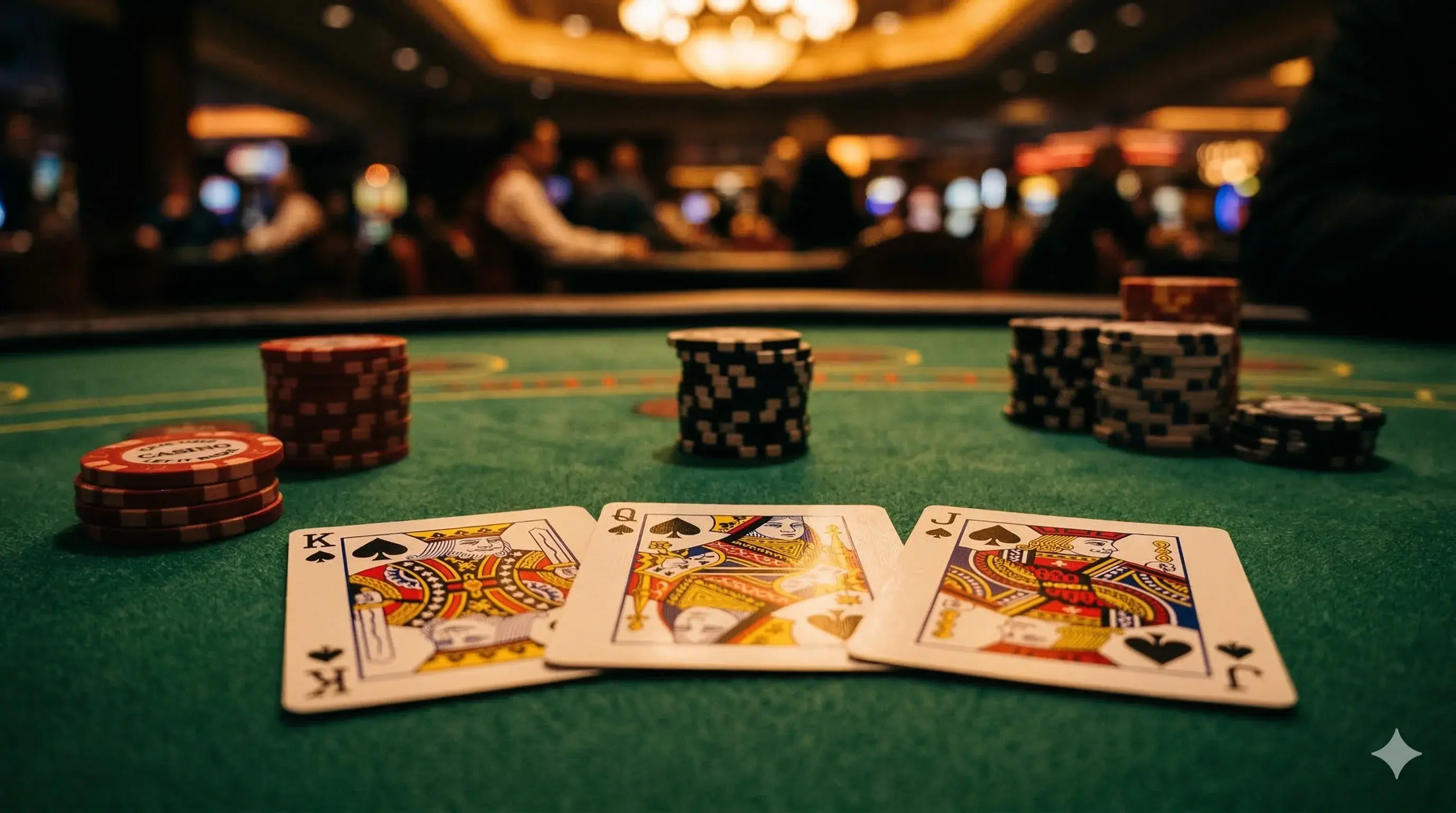
Three cards land in front of you: Q♠ J♠ 10♠. Your pulse ticks up. Three bets sit on the felt, $5 each. The dealer has not revealed either community card yet. Do you let bet #1 ride or pull it back?
If you know the answer instantly, you are already ahead of 90% of Let It Ride players. If you hesitated, this guide will fix that. Every decision in Let It Ride boils down to a simple question: does your current hand qualify to keep the money at risk?
As of 2026, Let It Ride remains one of the most player-friendly table games in the casino, a 3.51% house edge that drops to 2.36% element of risk because you pull back bets so often. But only if you play every hand correctly. One emotional ride on a garbage hand and that edge balloons.
Here is everything you need: the complete optimal strategy for both decisions, a payout breakdown chart, and an interactive analyzer that tells you exactly what to do with any hand.
TL;DR, Let It Ride Quick Strategy
Decision #1 Summary (3 Cards)
Let bet #1 ride ONLY with:
| Hand | Action | Why |
|---|---|---|
| Pair 10s or better | LET IT RIDE | Guaranteed payout |
| Three of a kind | LET IT RIDE | Strong made hand |
| Three to a royal flush | LET IT RIDE | High-value suited draw |
| Three suited consecutive (1+ high card) | LET IT RIDE | Straight flush potential |
| Three suited, 1 gap, 2+ high cards | LET IT RIDE | Strong enough draw |
| Everything else | PULL | Not worth the risk |
Decision #2 Summary (4 Cards)
Let bet #2 ride ONLY with:
| Hand | Action | Why |
|---|---|---|
| Pair 10s+ / Two Pair / Trips+ | LET IT RIDE | Already paying |
| Four to a flush | LET IT RIDE | 9 outs |
| Four to an outside straight | LET IT RIDE | 8 outs |
| Everything else | PULL | Not enough outs |
Print this. Tape it to your phone. You now have the complete Let It Ride cheat sheet that no competitor site bothers to give you in a clean table format.
How Let It Ride Works
The Three-Bet Setup
Let It Ride uses a standard 52-card deck. You place three equal bets before receiving any cards, call them bet #1, bet #2, and the ante. Unlike most poker games, you are not playing against the dealer. You just need a qualifying hand (pair of 10s or better) to get paid.
Here is what makes the game unique: you can take back two of your three bets. After seeing your 3 cards, you decide whether to pull bet #1 back. After the first community card is revealed, you decide on bet #2. The ante always stays.
Step-by-Step Hand Example
- You place $5 on each of three betting circles ($15 total at risk)
- You receive 3 cards face down: K♥ 10♥ 7♣
- Decision #1: K-10 suited with a gap, does not qualify. You pull bet #1 back ($10 at risk)
- First community card revealed: Q♥, now you have K♥ Q♥ 10♥ 7♣ (four to a flush!)
- Decision #2: Four to a flush qualifies. You let bet #2 ride ($10 at risk)
- Second community card: 3♥, Flush! Pays 5:1 on both remaining bets = $50 profit
Standard Payout Table (2026)
| Hand | Payout | Probability |
|---|---|---|
| Royal Flush | 1000:1 | 0.00015% |
| Straight Flush | 200:1 | 0.0014% |
| Four of a Kind | 50:1 | 0.024% |
| Full House | 11:1 | 0.144% |
| Flush | 8:1 | 0.197% |
| Straight | 5:1 | 0.392% |
| Three of a Kind | 3:1 | 2.113% |
| Two Pair | 2:1 | 4.754% |
| Pair 10s or Better | 1:1 | 8.566% |
| Pair 9s or Below | Push | 7.576% |
| No Qualifying Hand | Lose | 76.22% |
Notice that you lose on over 76% of hands. That sounds brutal, until you remember that you pull back 1-2 bets on most of those losers, keeping damage minimal. The 16.2% of hands that pay do the heavy lifting.
Bonus Payout Variations
Some casinos offer higher payouts on the top end (2000:1 for Royal Flush) but reduce the common payouts. Always check the pay table before sitting down. The standard 1-2-3-5-8-11-50-200-1000 table gives a 3.51% house edge. Non-standard tables can push that over 5%.
Use our house edge calculator to verify the exact edge on any pay table you encounter.
Let It Ride Payout & Probability Chart
| Hand | Return Contribution |
|---|---|
| Pair (10s or Better) | 8.57 |
| Two Pair | 9.51 |
| Three of a Kind | 6.33 |
| Straight | 1.97 |
| Full House | 1.59 |
| Flush | 1.57 |
| Four of a Kind | 1.2 |
| Straight Flush | 0.28 |
| Royal Flush | 0.15 |
Reading the Numbers
The chart above shows each hand's contribution to the game's total return. Two Pair (9.51%) and Pair 10+ (8.57%) together account for 18.08% of the 96.49% total return. That is more than the other seven hand types combined.
This tells you something crucial about Let It Ride strategy: you are not chasing royal flushes. You are grinding out small wins from pairs and two pairs. The rare big hands are gravy, the everyday hands pay your rent.
Why the House Edge Lands at 3.51%
The math is straightforward. Sum up every hand's probability times its payout, and you get a return of 96.49 cents per dollar wagered. The missing 3.51 cents is the house edge.
In plain English: for every $100 you bet across all three circles, you lose $3.51 on average. But since you pull back bets 70% of the time, your actual average wager per hand is about 1.49× the ante, not 3×. That is why the element of risk (2.36%) is lower than the raw house edge.
Check the exact return on your session with our RTP calculator.
Optimal Strategy: 3-Card Decisions
This is Decision #1. You have seen your 3 personal cards but neither community card. You decide: let bet #1 ride, or pull it back?
When to Let Bet #1 Ride
Made hands:
- Pair of 10s, Jacks, Queens, Kings, or Aces
- Three of a kind
These are guaranteed payouts. Letting the bet ride is a no-brainer.
Drawing hands:
- Three to a royal flush (e.g., K♠ Q♠ J♠)
- Three suited in a row with at least one high card 10+ (e.g., J♥ 10♥ 9♥)
- Three suited with one gap and two or more high cards (e.g., K♦ Q♦ 10♦)
Drawing Hands Worth Riding
Why do suited consecutive hands qualify? Because they have multiple ways to improve:
- Hit a straight flush (highest payout per probability)
- Hit a flush
- Hit a straight
- Hit a pair 10+
A hand like 9♠ 8♠ 7♠ does NOT qualify, zero high cards. But J♠ 10♠ 9♠ does, because the J gives you extra pair outs on top of the flush and straight draws.
When to Pull Bet #1 Back
Pull on everything else. That includes:
- Low pairs (2s through 9s), they do not pay, so there is no made hand value
- Three to a straight (unsuited), not enough outs
- Three high cards (unsuited), looks pretty but the math says pull
- Any hand with no pair, no suited draw, no straight draw
The hardest hands are three high unsuited cards like K♠ Q♥ J♦. It feels wrong to pull back. But without the flush draw, the hand does not have enough equity to justify the extra bet at risk.
The Suited Straight Flush Exceptions
Not all three-suited hands qualify. The exact rule:
- 0 gaps + 1 high card minimum: J♥ 10♥ 9♥ ✅ but 8♥ 7♥ 6♥ ❌
- 1 gap + 2 high cards minimum: K♦ Q♦ 10♦ ✅ but Q♣ 10♣ 8♣ ❌
- 2+ gaps: Always pull, regardless of high cards
These cutoffs exist because each gap reduces your straight flush outs. One gap still has enough equity with two high cards to compensate. Two gaps never does.
Optimal Strategy: 4-Card Decisions
Decision #2 happens after the first community card is revealed. You now have 4 cards and decide whether to let bet #2 ride.
When to Let Bet #2 Ride
Any paying hand:
- Pair of 10s or better
- Two pair
- Three of a kind or better
If you already have a guaranteed payout, keep the bet out there. The community card can only improve your hand.
Strong draws:
- Four to a flush (any four cards of the same suit)
- Four to an outside straight (four consecutive ranks, e.g., 8-9-10-J)
4-Card Draws That Qualify
Four to a flush is the strongest draw, 9 remaining cards of your suit complete the hand, giving you roughly an 19.6% chance. At 8:1 payout, the expected value is solidly positive.
Four to an outside straight has 8 outs (roughly 17.4%) with a 5:1 payout. This is borderline but still +EV when you factor in the possibility of hitting a higher-paying hand.
When to Pull Bet #2 Back
Pull back on:
- Low pairs (below 10s)
- Four to an inside straight (gutshot, only 4 outs)
- Three to a flush (not enough outs)
- Any random collection of cards
A common mistake: holding J♠ 10♣ 9♥ 7♦ and letting the bet ride because it "almost" looks like a straight. That is a gutshot (only an 8 completes it), 4 outs, 8.7% chance. At 5:1, the EV is negative. Pull every time.
Open-Ended vs Gutshot Straights
This distinction matters enormously in Let It Ride:
| Draw Type | Outs | Hit % | At 5:1 Payout | Verdict |
|---|---|---|---|---|
| Open-ended straight | 8 | 17.4% | +EV | LET IT RIDE |
| Gutshot straight | 4 | 8.7% | −EV | PULL |
The difference is not subtle, one has double the outs of the other. Never confuse the two. If your four cards have a gap in the middle (like 7-8-_-10), that is a gutshot. If the gap is on either end (like -7-8-9 or 7-8-9-), that is open-ended.
For more on rare poker hand probabilities, see our breakdown of quad aces vs royal flush odds.
Let It Ride Strategy Analyzer
How to Use This Tool
- Select your three cards using the rank and suit dropdowns
- The tool instantly shows whether to LET IT RIDE or PULL for Decision #1
- Click "Show 4th Card" to enter the first community card for Decision #2
- The analyzer updates in real-time, try different combinations to build intuition
Use this alongside the session simulator to see how optimal play affects your results over hundreds of hands.
Common Mistakes That Cost You Money
Riding on Gut Feelings
The number one leak in Let It Ride: letting bets ride because the hand "feels" good. Three face cards unsuited? Pull. A pair of 9s? Pull. These feel like decent poker hands, and in Texas Hold'em they would be, but in Let It Ride, if it does not meet the strategy table, pull it back.
Every time you let a non-qualifying hand ride, you are adding money to a negative-EV bet. Do that 10 times per session and your hourly loss can double.
The Side Bet Trap
The $1 bonus side bet looks harmless. One dollar per hand, and you could win $25,000 on a royal flush. But the house edge on most Let It Ride side bets runs 13-25%. That is worse than most slot machines.
At 40 hands per hour, the side bet costs you an extra $5-10/hour in expected losses. Over a 3-hour session, that is $15-30 thrown away on a bet with terrible odds. Skip it.
Want to understand how side bets erode your bankroll? Our loss calculator shows the exact hourly cost.
Playing Too Fast
Let It Ride is designed to be relaxed. There is no dealer hand to beat, no split-second decisions. But some players rush through hands and make snap judgments on borderline draws.
Slow down on hands with 3 suited cards. Count the gaps. Count the high cards. The 5 seconds it takes to verify whether your hand qualifies can save you $5 per mistake.
Let It Ride vs Other Table Games (2026)
vs Mississippi Stud
Both are community card poker games with similar aesthetics, but the mechanics diverge sharply. Mississippi Stud gives you 2 hole cards and 3 community cards with 3 raise decisions (1x-3x). Let It Ride gives you 3 cards and 2 community cards with 2 pull-back decisions.
| Feature | Let It Ride | Mississippi Stud |
|---|---|---|
| House Edge | 3.51% | 4.91% |
| Cards Dealt to You | 3 | 2 |
| Community Cards | 2 | 3 |
| Decisions | 2 (pull back) | 3 (raise) |
| Max Bet Multiple | 3× ante | 10× ante |
| Volatility | Moderate | Very High |
Let It Ride has the lower house edge and lower variance. Mississippi Stud has bigger swing potential because you can raise up to 10× your ante.
If you enjoy this family of games, check out Louisiana Stud poker and Cajun Stud poker for more community card variants.
vs Blackjack
Blackjack with basic strategy gives you a 0.5% house edge, seven times better than Let It Ride. But blackjack requires constant decisions, split-second mental math, and can be stressful at a full table. Let It Ride is a "set it and forget it" game where optimal play is simple enough to memorize in 10 minutes.
For players who want low house edge with strategic depth, blackjack wins. For players who want a relaxed experience with reasonable odds, Let It Ride is the better choice. See how blackjack early payout compares on the EV spectrum.
vs Three Card Poker
Three Card Poker has a 3.37% house edge on the ante-play bet, slightly better than Let It Ride. But Three Card Poker has only one decision (raise or fold), making it less engaging. Let It Ride's two decision points give you more control and more chances to limit losses by pulling bets back.
| Game | House Edge | Decisions | Session Volatility |
|---|---|---|---|
| Let It Ride | 3.51% | 2 | Moderate |
| Three Card Poker | 3.37% | 1 | Higher |
| Mississippi Stud | 4.91% | 3 | Very High |
| Blackjack (basic) | 0.50% | 5+ per hand | Moderate |
Bankroll Management for Let It Ride
Minimum Session Bankroll
For a 2-hour session at $5 ante (with 3 bets, that is $15 per hand at risk initially), bring at least 30× your total starting bet:
That gives you enough runway to absorb a cold streak without going bust. Since you pull back 1-2 bets on most hands, your actual exposure per hand averages about $7.50, but you need the full buy-in to handle variance.
Use our bankroll calculator for custom session length and risk tolerance calculations.
Variance and Losing Streaks
Let It Ride has moderate variance compared to other table games. You will lose 76% of hands (any hand below a pair of 10s). That means streaks of 15-20 consecutive losers happen regularly.
The good news: on losing hands where you pull back both bets, you only lose the $5 ante. Your actual hourly expected loss at $5 stakes is roughly $2.60, cheaper than most table games at the same bet level.
Track your theoretical loss with the volatility calculator and see how Labouchere systems and other progression strategies interact with games like Let It Ride (spoiler: they do not change the house edge).
For context on what happens when you do hit big, like a royal flush triggering a hand pay, see our guide to hand pay at casinos and the tax implications involved.
If you are looking to stretch a small starting stack, our guide on how to turn $100 into $1000 at a casino covers realistic approaches. And for variety on your next casino trip, bubble craps odds breaks down another beginner-friendly game with a comparable house edge.
Try Let It Ride online with a casino bonus for table games, but check the contribution rate first.
Wondering how Let It Ride compares to blackjack as a parlay system? See our Let It Ride vs blackjack breakdown for the full comparison chart and parlay calculator.
Frequently Asked Questions
The house edge is 3.51% of the ante when playing optimal strategy. The element of risk (edge relative to average total bet) is 2.36%, making it competitive with blackjack.
Let it ride with a pair of 10s or better, three of a kind, three to a royal flush, three suited consecutive cards with a high card, or three suited cards with one gap and two high cards. Pull back on everything else.
Let it ride with any paying hand (pair 10s+, two pair, trips or better), four to a flush, or four to an outside straight. Pull back on all other hands.
A Royal Flush pays 1000:1 on all three bets. With $5 bets, that is $15,000. However, the odds are approximately 1 in 649,740 hands.
Blackjack has a lower house edge (0.5% with basic strategy vs 3.51%). However, Let It Ride has lower volatility hour-to-hour and requires no decisions against a dealer hand. It is a more relaxed game.
No. The $1 bonus side bet typically carries a house edge of 13-25% depending on the pay table. It is one of the worst bets in the casino.
You receive 3 cards face down. Two community cards are dealt face down and revealed one at a time. Your final hand is your 3 cards plus the 2 community cards — 5 total.
Technically yes, but the advantage is tiny (0.04% at best) because you only see your own 3 cards before Decision #1. Card counting is not practical for Let It Ride.
Element of risk divides the house edge by the average total bet. Since you often pull bets back, your average total wager is about 1.49x the ante — not 3x. The 2.36% element of risk reflects your actual cost per dollar risked.
Bring at least 30-40 times your total bet (ante × 3) for a 2-hour session. At $5 ante, that is $450-600. Let It Ride has moderate variance — losing streaks of 15-20 hands happen regularly.
No. Both are community card poker games, but Mississippi Stud gives you 2 hole cards and 3 community cards with 3 raise decisions. Let It Ride gives you 3 cards and 2 community cards with 2 pull-back decisions. The strategies are completely different.
Only pairs of 10s, Jacks, Queens, Kings, and Aces pay (1:1). Pairs of 9s and below do not pay — they push. This is critical to strategy because low pairs have zero value.
Yes. You can pull back both bet #1 and bet #2, leaving only your ante at risk. This is the correct play on most hands. You will pull both bets roughly 70% of the time.
They are the same game. ShuffleMaster (now Scientific Games) trademarked 'Let It Ride' and some casinos use 'Let 'Em Ride' to avoid licensing. The rules and strategy are identical.
Let It Ride plays about 40-50 hands per hour, slower than blackjack (60-80) but faster than Caribbean Stud (30-40). The pace is relaxed because there is no dealer hand to resolve.
Evgeniy Volkov
Verified ExpertFullstack developer with a background in mathematics. I build the calculators and game-style tools on ToolsGambling with Pixi.js and modern web tech, and every result uses transparent probability formulas you can verify yourself.