









Contents
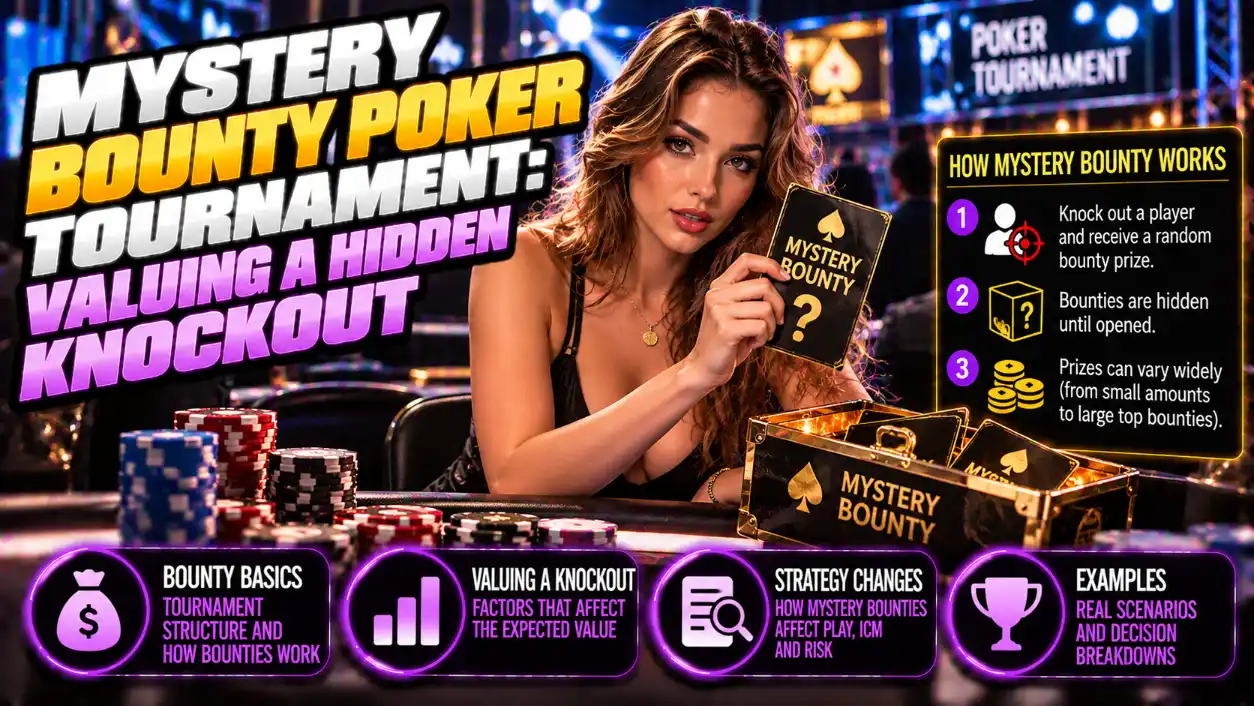
A mystery bounty tournament is a knockout event in which usually half (50%) of each buy-in funds hidden bounties, and only the player who eliminates someone sees the amount.
With an unknown bounty, the expected value (EV) of one knockout equals the average of the bounties still in the pool. In the 200-entry example at 100 units per entry, that is 50, half the buy-in: a bounty pool of 10,000 divided by 200 entries. The assumptions behind this figure are listed in the section “How do you value a knockout while amounts are hidden?”; prize equity (ICM) is outside it, and the bounty you actually collect for one knockout can differ widely from the average.
What makes mystery bounty different from a knockout or PKO?
Mystery bounty hides the payout until the knockout; a standard knockout or progressive knockout (PKO) shows the opponent’s bounty beforehand. In PKO, a player’s bounty can grow as they eliminate opponents. A large hidden mystery bounty does not mean it has grown in the same way.
According to PokerFuse’s format guide, updated 20 April 2026, half of the buy-ins fund the regular prize pool and half fund bounties. The eliminating player discovers the bounty amount and receives it as an immediate cash payment.
| Format | Who sees the bounty amount? | When? | Does the bounty grow? |
|---|---|---|---|
| Known-bounty knockout | All players | Before the knockout | No; each player has a fixed bounty |
| PKO | All players | Before the knockout, with updates after eliminations | Yes; part of the eliminated player’s bounty is added to the winner’s bounty |
| Mystery bounty | The eliminating player sees their payout; public disclosure depends on the rules | After a knockout during the bounty stage | Whether the bounty grows depends on the event rules; per PokerFuse’s guide, the amount is visible only to the eliminating player |
When do bounties become active?
Bounties become active at the stage set by the event rules, not necessarily from the first hand.
PokerFuse describes PartyPoker’s bounty stage as starting when 25% of the field remains, and 888’s as starting from level 17. PokerNews’s description of the 888 format also names Day 2 for multi-day events.
These are review descriptions, not universal operator rules. Check the event description for the exact activation point and which eliminations qualify for a bounty.
How do you value a knockout while amounts are hidden?
Value an unknown bounty at the average of the remaining bounties, as explained in PokerStrategy's article on average bounty value. Whether claimed amounts become public determines how you update that estimate. The example assumes that 50% of each buy-in funds bounties, that a bounty is assigned to every entry, that there are no fees or re-entries, and that the bounty stage does not change the amounts. Only under these assumptions does 50 equal the pool divided by the number of entries. According to PokerFuse and PokerNews, bounties are paid only during the bounty stage, so knockouts before it do not count toward this calculation. Re-entries change the number of entries, not the number of players. In the 2023 PokerStars test, a total of 100 (99.92 by the source table) was split among 27 players after the bubble. That test therefore illustrates the spread of payouts but does not verify the figure of 50, because its bounties were distributed differently.
When amounts remain hidden, there is no new information about the composition of the remaining pool. Under these assumptions, the expected value per knockout stays at the starting average throughout the tournament:
Bounty pool / entries = 10,000 / 200 = 50.00.
This example uses 200 entries, a buy-in of 100 units and a 50% bounty share. The unchanged estimate reflects what you know; it does not mean the actual average of the hidden remainder must always be 50.
When claimed amounts are revealed, use the average of the remaining bounties. It falls after large bounties are claimed. The table shows the largest-first scenario, with amounts in units.
| What is known | Remaining (sum / players) | Expected value per knockout |
|---|---|---|
| Amounts not revealed | 10,000 / 200 | 50.00 |
| One large (1,100) claimed | 8,900 / 199 | 44.72 |
| Two large claimed | 8,400 / 198 | 42.42 |
| Five largest claimed | 6,900 / 195 | 35.38 |
Value of one knockout: 50 with hidden bounties, 44.72 and 35.38 with revealed amountsEducational calculation by ToolsGambling: 200 entries at 100, a 50% bounty pool. This is the expected value of one knockout, excluding prize equity and fees.
Table values are rounded to two decimal places. The fall to 35.38 applies to the five largest revealed payouts, not to any five knockouts.
Why isn’t the average a typical bounty?
An expected value (EV) of 50 does not mean an ordinary knockout pays around 50. Rare large bounties can pull the average well above the typical payout because the average includes those large payouts alongside the much smaller ones.
In a PokerStars test in 2023, 27 bounties totalled 99.92. The mean was 3.70, while the typical bounty was 1.04. The largest bounty was 28, which substantially influenced the sample’s average.
You must not plan a bankroll on the average alone. It does not describe the sequence of payouts you will experience, so your budget needs to account for variance and runs of small bounties rather than assuming regular payments near the mean.
For the example distribution, one bounty has a standard deviation of 101.44, approximately 101, against an expected value of 50. For five knockouts, the expected total is 250 and the standard deviation of the sum is 226.83, approximately 227. These describe spread, not a range within which your result must fall.
A PokerStars test reported by PokerFuse on 4 December 2023 illustrates the difference:
- Buy-in: $1.10, with $0.50 going to bounties.
- Bounties collected after the bubble: 27, totalling $99.92.
- Mean bounty: $3.70.
- Typical bounty in the reported table: $1.04.
- Largest bounty: $28.
The average was much higher than the typical bounty. Do not budget as though each knockout will pay the average.
What win probability justifies a risky bounty call?
In a simplified comparison of bounty value against elimination risk, the threshold is p* = V0 / (V0 + E). If your chance to win is below that threshold, a call justified only by the bounty loses on average in this calculation.
Here:
- p* is the required win probability.
- V0 is the prize equity you lose if eliminated.
- E is the expected bounty for the knockout.
You choose V0 as an assumption, using the same units as E; ICM is not calculated here. The comparison assumes winning earns the bounty and losing costs V0. It is not a complete valuation of a poker call.
| Prize equity lost on elimination V0 | Expected value E = 50 (share 50%) | Expected value E = 30 (share 30%) |
|---|---|---|
| 50 | 50.0% | 62.5% |
| 150 | 75.0% | 83.3% |
| 300 | 85.7% | 90.9% |
For example, at V0 = 150 and E = 50, the threshold is 75%. Under these assumptions, a chance below 75% cannot justify the risk through the bounty alone. Exceeding the threshold does not replace an assessment of the rest of the hand. Percentages are rounded to one decimal place where needed.
Which assumptions change the answer most?
The bounty share changes the expected value; the largest bounty mainly changes the spread when the total pool and entry count stay fixed.
Bounty share: 30% versus 50%. With the same 200 entries and buy-in of 100, expected value is 30 rather than 50. At V0 = 150, the threshold rises from 75% to 83.3%. The headline value of 50 therefore does not carry over to a tournament with a different bounty share.
Largest bounty: 1,100 versus 2,000. With the pool fixed at 10,000 (the other bounties scaled down proportionally) and the same entry count, expected value remains 50. Standard deviation rises from 101.44 to 151.48, approximately 101 versus 151. A bigger top bounty does not make the average knockout worth more when the total pool is unchanged.
Disclosure of payouts. Revealed amounts let you update the remaining average, as the largest-first table shows. Hidden amounts provide no such update on their own.
How should stacks, opponents and the prize pool affect decisions?
Consider the bounty alongside stack sizes and prize equity. The possibility of a hidden payout does not by itself justify risking your tournament life.
According to the Upswing Poker review, avoid busting a short stack before the bounty stage: that elimination pays no bounty yet, and those who cover the stack lose the chance to collect its bounty once the payouts begin. This is a point about timing, not a ban on otherwise worthwhile plays against short stacks. For separate practice with short-stack decisions during the bounty stage, use the ICM Push/Fold trainer.
After bounties activate, fold equity, the chance of making an opponent fold, shrinks because opponents call all-ins more readily to pursue knockouts. PokerNews describes this effect in its 888 strategy coverage. Do not assume opponents will fold as often as before activation.
Prize equity is calculated separately from the bounty. ICM in poker explained covers the value you risk losing from the regular prize pool; the average bounty cannot replace that assessment.
How to apply the calculation in three steps
Start with the decision you face, rather than the largest bounty you could draw. Write down the information available before estimating either side of the comparison. This keeps an attractive possible payout from replacing the expected value (EV) in your calculation.
- First, estimate E, the expected value of a bounty. In this calculation, use 50 while amounts remain hidden. Use 44.72 after one large bounty has been paid only if amounts are revealed and you know that payout has left the pool. This is an estimate for the remaining pool, not a prediction of your next payout.
- Second, identify V0, the prize equity you lose on elimination. Express it in money rather than chips. It represents your stake in the regular prize pool before the decision, not the buy-in you already paid.
- Third, compare your chance of winning with p* = V0/(V0+E). With V0 = 150 and E = 50, the threshold is 75%. At 60%, a call justified only by the bounty loses in this calculation; at 80%, it passes the formula.
Under these assumptions, that comparison is only a simplified test: ICM and the other consequences of the decision are not counted. It is not a complete calling rule.
Pre-tournament checklist
Read the specific event rules before registering. The format’s name alone does not tell you how payments work or what information you will receive. Use this checklist to separate confirmed conditions from assumptions before you put money into the event.
- When do bounties start? Find the exact trigger for the bounty stage and confirm which eliminations qualify. Do not assume every knockout pays a bounty from the opening hand simply because the event uses this format.
- What share of the buy-in funds bounties? Separate that allocation from the regular prize pool. Use the event’s actual breakdown when estimating the bounty pool available to players.
- Are eliminated players’ amounts revealed? Check what everyone can see and what only the eliminating player sees. This determines whether observed payouts let you update the remaining pool.
- What are the fees and re-entry conditions? Establish the full cost of participation and decide your re-entry budget beforehand. Count all spending, not just the portion allocated to bounties.
- What variance can your bankroll withstand? Allow for a run of small payouts rather than treating an occasional large bounty as routine income.
- What counts as prize equity? Define V0 consistently. Keep your monetary share of the regular prize pool separate from chips, entry costs and bounties already collected.
What are the limits and common mistakes?
This calculation estimates bounty value; it does not create an edge or ensure a profit. Expected value per knockout is neither your tournament result nor net profit after the buy-in.
Re-entries and event-specific structures are outside this simplified arithmetic. Unequal bounty amounts are reflected in the spread examples, but dividing the pool by entries alone does not describe their distribution or value an opponent with a known, different bounty.
Do not substitute the largest possible payout for the average or treat a run of small bounties as evidence that the arithmetic failed. Actual tournament results can diverge sharply from expectations; see variance and downswings.
The spread of knockout payouts calls for a financial cushion; the bankroll calculator helps you explore that cushion. Plan separately for a run of tournaments without knockouts, a topic continued in poker bankroll management.
Frequently Asked Questions
It is a knockout tournament where you discover the bounty amount after eliminating an opponent.
The hidden amount is part of the format. Until it is revealed, you assess an average rather than a known payout.
The version discussed here allocates 50%. Check the event terms, because a different share changes the expected value.
It tests whether the expected bounty can justify risking your prize equity in a simplified comparison.
Fees, re-entries, event-specific details and a full ICM assessment of the decision. It does not predict your actual payout.
Evgeniy Volkov
Verified ExpertFullstack developer with a background in mathematics. I build the calculators and game-style tools on ToolsGambling with Pixi.js and modern web tech, and every result uses transparent probability formulas you can verify yourself.