










> Contents
18+
PFR Meaning in Poker: Pre-Flop Raise Stat Guide (2026)
Picture this: you open PokerTracker 4 and see your opponent's HUD popup — 42/8. Two numbers, and they tell you everything you need to exploit this player for the rest of the session. The first number (VPIP) says they play 42% of hands. The second number (PFR) says they only raise 8% of the time. That's a 34-point gap. Translation: this player calls way too much and almost never raises. You just found a calling station — and in 2026, that's free money.
But what does PFR actually mean? How do you calculate it? And what's a "good" PFR for your game?
This guide covers everything: the PFR formula, optimal ranges by position, the critical VPIP/PFR relationship, player type identification, and a free interactive PFR calculator you can use right now.
TL;DR — PFR at a Glance
Key Numbers You Need to Know
| Player Type | Typical VPIP/PFR | What It Means |
|---|---|---|
| TAG | 22/18 | Tight range, mostly raises when entering |
| LAG | 30/25 | Wide range, aggressive preflop |
| Nit | 12/10 | Only plays premium hands |
| Calling Station | 40/8 | Enters many pots but rarely raises |
| Maniac | 50/42 | Raises almost everything |
Bottom line: A good PFR for most players is 15-22% in 6-max and 12-18% in full ring. The gap between your VPIP and PFR should be 3-6 points — any wider and you're calling too much.
What Does PFR Mean in Poker? (Two Definitions)
PFR has two meanings in poker, and confusing them causes problems. Let's separate them clearly.
PFR as a Pre-Flop Raiser (The Action)
In hand histories and forum posts, "PFR" refers to the player who raised preflop. Example: "The PFR c-bet the flop" means the player who raised before the flop made a continuation bet. It's shorthand — just like "BB" means big blind (the player in that position).
PFR as a HUD Statistic (The Percentage)
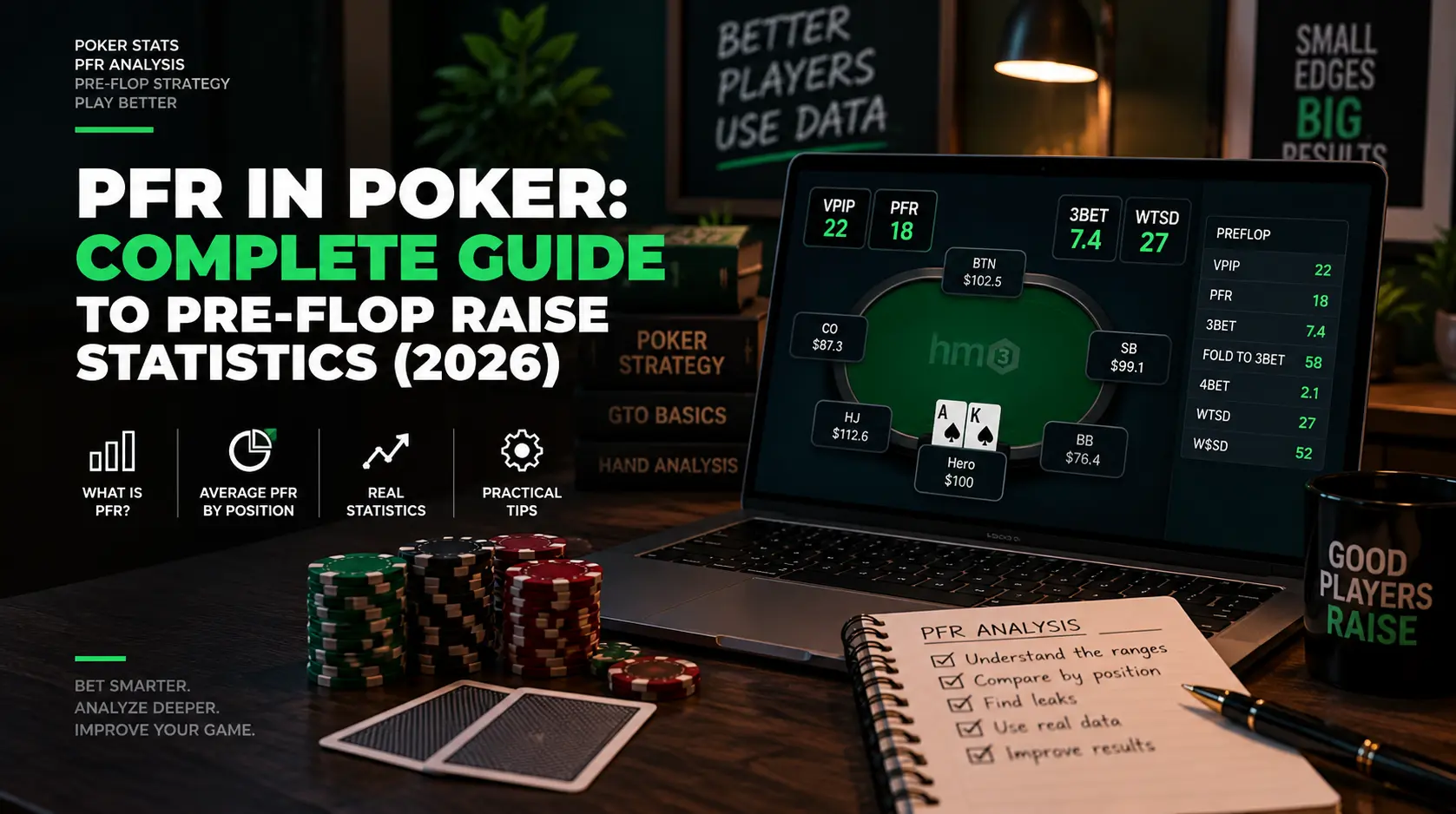
In HUD software like PokerTracker 4 or Hold'em Manager 3, PFR is a percentage stat that shows how often a player raises before the flop. This is the definition that matters for strategy, and it's what the rest of this article focuses on.
When someone says "his PFR is 18%," they mean: out of all hands dealt, this player raised preflop 18% of the time.
How to Calculate PFR: Formula & Example
The PFR Formula
The math is simple:
A "preflop raise" includes any raise before the flop: open raises from any position, 3-bets, 4-bets, and all-in shoves. Limping (just calling the big blind) does NOT count.
Step-by-Step Calculation Example
Say you've played 200 hands at a 6-max table. You go through your session and count:
- Open-raised: 30 times
- 3-bet: 6 times
- 4-bet shoved: 2 times
- Total preflop raises: 38
Your PFR is 19% — right in the TAG range. You raised from UTG with premiums, got wider on the button, and threw in some 3-bets with strong hands. That's solid, winning poker. If you're curious how starting hand quality affects your overall stats, the quad aces probability breakdown shows how rare premium holdings really are.
What Is a Good PFR? Benchmarks by Format (2026)
The "right" PFR depends on three things: game format, number of players, and your intended style. Here are the 2026 benchmarks used by winning regulars.
Optimal PFR for 6-Max Cash Games
6-max is the most popular online format. With only 6 players, you need to fight for blinds — a PFR below 15% leaves money on the table.
| Style | PFR Range | Notes |
|---|---|---|
| TAG | 17-22% | Standard winning approach |
| LAG | 24-30% | High-volume, advanced players |
| Nit | 10-14% | Too tight for 6-max, exploitable |
Optimal PFR for Full Ring (9-max)
More players = tighter ranges from early position. The average PFR at a full ring table is naturally lower.
| Style | PFR Range | Notes |
|---|---|---|
| TAG | 12-18% | Standard full ring approach |
| LAG | 18-24% | Aggressive for 9-handed |
| Nit | 8-12% | Common but exploitable |
Optimal PFR for Tournaments (MTT & SNG)
Tournament PFR shifts dramatically with stack depth and stage. Early in a deep-stacked tournament, play tighter. Once antes kick in and stacks get shorter, raise wider.
| Stage | PFR Range | Why |
|---|---|---|
| Early (100+ BB) | 14-18% | Deep stacks, no antes, play tight |
| Middle (40-80 BB) | 18-22% | Antes start, steal more |
| Late/Bubble (20-40 BB) | 22-30% | Stealing is survival |
| Short stack (<20 BB) | 15-25% | Push/fold mode, all-in or fold |
PFR by Table Position: TAG vs LAG
Typical PFR percentages by seat for tight-aggressive and loose-aggressive players in 6-max cash games. Notice how both styles raise significantly more from late position.
Data represents typical winning player ranges for NL50-NL200 online 6-max cash games (2026). Individual ranges may vary based on table dynamics and opponent tendencies.
PFR vs VPIP: The Most Important Stat Combo
PFR alone tells you part of the story. Combined with VPIP, it tells you everything about a player's preflop tendencies. This is why every HUD displays them side by side: VPIP/PFR.
How to Read VPIP/PFR Together
- VPIP = total percentage of hands voluntarily played (calls + raises)
- PFR = percentage of hands raised preflop
- Gap = VPIP minus PFR = how often they cold call
A player with 22/18 has a gap of 4. They enter 22% of pots, and in 18 out of those 22 percent they raise. Only 4% of the time they cold call. That's an aggressive, solid player.
A player with 40/8 has a gap of 32. They play 40% of hands but only raise 8%. That means 32% of the time they just call preflop. That's a classic calling station — the most profitable player type to sit with.
What a Big VPIP-PFR Gap Tells You
The VPIP-PFR gap is the single most revealing number in poker. Here's the quick read:
| Gap | Meaning | Your Adjustment |
|---|---|---|
| 0-3 | Very aggressive, almost never cold calls | Respect their raises, they mean business |
| 3-6 | Standard TAG/LAG gap, healthy range | Play your normal game |
| 6-10 | Calling a bit too much | Value bet wider, bluff less |
| 10-20 | Significant leak, passive caller | Value bet thin, don't bluff |
| 20+ | Extreme calling station | Pure value, zero bluffs |
The "Gap Theory" Rule of Thumb
A gap under 6 = aggressive player. A gap over 10 = passive player. Memorize this, and you can categorize most opponents in seconds. Then use your pot odds knowledge to extract maximum value.
PFR by Position: How Raises Change by Seat
Strong players don't have a flat PFR across all positions. They raise tight from early position and wide from late position. If someone's positional PFR stats look the same from UTG to BTN — that's a recreational player who doesn't understand position-based strategy.
Early Position (UTG, UTG+1)
TAG PFR: 10-14% | LAG PFR: 14-18%
From UTG with 5 players left to act, you need the tightest range. Think: AA-77, AK-AJs, KQs. There's no shame in a 10% PFR here — the math demands it.
Middle Position (MP, LJ, HJ)
TAG PFR: 14-18% | LAG PFR: 18-24%
The Hijack (HJ) is where you start opening up. Add more suited connectors, suited aces (A2s-A5s), and broadway combos. Your PFR should tick up 2-4% from UTG.
Late Position (CO, BTN)
TAG PFR: 22-30% | LAG PFR: 30-40%
The button is where money is made. With only 2 players behind you (the blinds), you can raise a huge range. Top regulars raise 30-40% from the button. Suited connectors, one-gappers, suited kings — everything goes in. Use the variance simulator to see how these wider ranges perform long-term.
The Blinds (SB, BB)
TAG PFR: 12-16% | LAG PFR: 16-24%
Small blind PFR is a special case. You're out of position postflop, so your raising range needs to be strong enough to survive playing the rest of the hand without position. Some players squeeze (3-bet) more from the SB to compensate — which bumps their SB PFR stat higher.
BB PFR is mostly about 3-betting, since you already have money in. A "BB PFR" of 8-12% means you're 3-betting roughly that often from the big blind, which is standard. Understanding positional dynamics also helps in poker variants like Cajun Stud where preflop aggression decisions differ.
How to Identify Player Types Using PFR
Combine VPIP and PFR and you can name the player type within 100 hands. Here's the identification chart that winning players use:
TAG (Tight-Aggressive): ~22/18
The most common winning style. TAGs select strong hands and play them aggressively. They have a small VPIP-PFR gap (4 points), meaning they rarely cold call. When a TAG raises, they have a real hand.
How to play against: Respect their preflop raises (especially from early position). 3-bet them with a tight range. They fold to pressure more than LAGs. This aggressive image is a far cry from hands like the dirty diaper (7-2 offsuit) that TAGs almost never play.
LAG (Loose-Aggressive): ~30/25
LAGs play more hands and raise with a wider range. They're harder to read because their range includes speculative hands alongside premiums. The gap is still small (5 points) — they're aggressive, not passive.
How to play against: Don't fold too much. Call wider with position. Their range is weaker, so you can profitably call with medium-strength hands. Check your equity in real-time when facing their aggression.
Calling Station: ~40/8
The gift that keeps giving. A calling station enters 40% of pots but rarely raises. That 32-point gap screams "I call with anything." They'll call your river bet with third pair and a backdoor miss.
How to play against: Value bet relentlessly. Bet thin — they call with worse. Never bluff. They don't fold. Adjust your bankroll management to handle the occasional suckout when they call with garbage and hit.
Nit: ~12/10
Nits play almost nothing. A 12/10 means they enter 12% of pots and raise most of the time (gap = 2). When they raise, it's AA-QQ, AK, maybe AQs. When they 3-bet, it's usually KK+.
How to play against: Fold to their raises unless you have a strong hand. Steal their blinds mercilessly — they won't fight back. If they 3-bet you, fold everything except AA and KK. Even in casual poker formats, nits exist — learn to spot them.
Maniac: ~50/42
Maniacs raise everything. 50/42 means they play half their hands and raise 42% of the time. The gap is only 8 points, so they're not calling stations — they're just raising with air.
How to play against: Tighten up and let them hang themselves. Call with medium hands, trap with monsters. They'll bet themselves broke against your strong holdings. Calculate your outs carefully and let them build the pot for you.
How to Adjust Against Opponent's PFR
Knowing someone's PFR is only useful if you change your strategy based on it. Here's the playbook.
Playing Against High PFR (25%+)
Players with PFR 25%+ are raising with a wide range. Their hands are on average weaker than someone raising 15% of the time.
Key Adjustments vs Wide Raisers
- 3-bet more liberally — they open wide, so your 3-bet range expands
- Call more in position — their range includes speculative hands you dominate
- Don't over-fold to c-bets — they continuation bet air frequently
- Check-raise more flops — they bet too many boards, punish them
Playing Against Low PFR (under 10%)
A PFR under 10% means premium hands only. When this player raises, believe them.
Adjustments:
- Fold marginal hands to their raises — don't call with KJo against a nit's UTG open
- Steal their blinds aggressively — they won't defend
- Never bluff them postflop when they've shown preflop aggression — they have a real hand
- 3-bet them tightly — they're only 4-betting with AA/KK, so you need a strong range
PFR in HUD Software: PokerTracker & Hold'em Manager
Setting Up PFR on Your HUD
PFR is a default stat in both major HUD applications. In PokerTracker 4:
- Open HUD Manager → select your profile
- PFR is usually displayed as the second number after VPIP:
VPIP/PFR - Color-code it: green for 14-22%, yellow for 10-14% or 22-28%, red for <10% or >28%
In Hold'em Manager 3 the process is nearly identical. Both tools also let you filter PFR by position — which gives you far more actionable data than an overall PFR number. These stats also apply in video poker strategy optimization where understanding raise frequencies improves decision-making.
For a deeper dive into HUD configuration, check our full HUD stats calculator with built-in player type analysis.
Sample Size: How Many Hands for Reliable PFR
PFR converges faster than some other stats (like c-bet frequency), but you still need data:
| Sample Size | Reliability | What You Can Conclude |
|---|---|---|
| 30-50 hands | Very low | Only extreme values matter (PFR 0% or 60%) |
| 50-100 hands | Low | General tendency (tight vs loose) |
| 100-200 hands | Medium | Reasonable estimate of true PFR |
| 200-500 hands | Good | Reliable enough for strategy adjustments |
| 500+ hands | High | Statistically significant, trust the number |
Pro tip: When you have under 100 hands on someone, focus on their VPIP-PFR gap more than the exact PFR number. The gap is a more robust indicator of play style even in small samples.
Common PFR Mistakes and How to Fix Them
Mistake 1: Same PFR from Every Position
If your overall PFR is 18%, your PokerTracker positional breakdown should NOT show 18% across UTG, MP, CO, and BTN. A winning player might have:
- UTG: 12%
- MP: 15%
- CO: 24%
- BTN: 32%
Overall: still ~18%, but distributed correctly by position. If your positional PFRs are flat, you're playing too many hands from early position or too few from late position.
Mistake 2: Ignoring the VPIP-PFR Gap
Many players track their PFR but never look at the gap. A 20% PFR sounds fine — but if your VPIP is 35%, that 15-point gap means you're cold calling 15% of hands. Cold calling is almost always worse than raising or folding in 2026 poker theory.
The fix: If your gap exceeds 6 points, convert some of your cold calls into either 3-bets or folds. Use the pot odds calculator to decide which hands are worth 3-betting versus folding.
Mistake 3: Over-Adjusting to Small Samples
You see an opponent raise 3 hands in a row and mark them as a maniac. But with only 15 hands of data, those 3 raises give a PFR of 20% — perfectly normal. Small samples lie.
The fix: Don't make dramatic adjustments until you have at least 100 hands. Until then, use population tendencies: most unknown players at your stakes are either TAGs or slightly loose-passive. Play accordingly.
Understanding PFR transforms your poker game from guessing to data-driven decisions. The same analytical approach applies across gambling — whether you're studying NBA betting systems or optimizing your preflop game.
FAQ: PFR Meaning in Poker
Frequently Asked Questions
Bonus allocation is limited per region. Claim before capacity runs out.


