










Contents
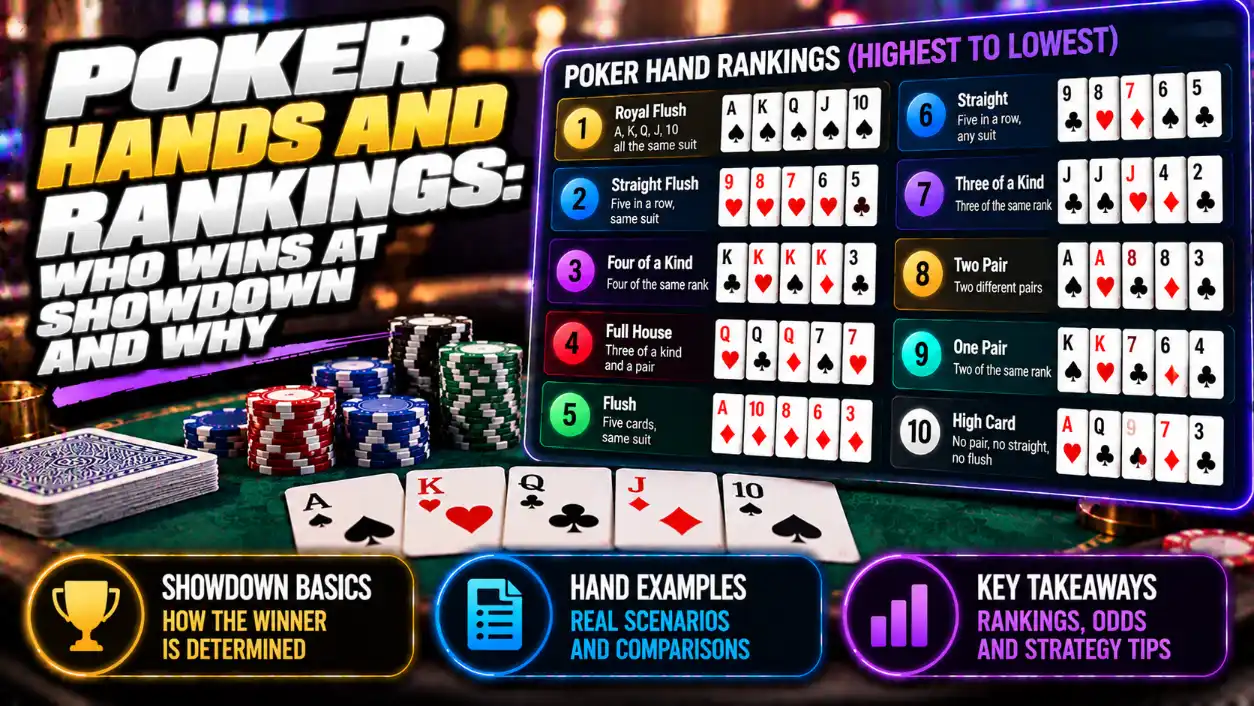
Poker hands and rankings run from straight flush—the royal flush is its highest form—through four of a kind, full house, flush, straight, three of a kind, two pair, one pair and high card. A higher category always wins; within one category, compare the hand-defining ranks, then the kickers. In Hold'em, use the best five of seven cards. First check whether you are playing the board: your best hand has the same strength as the five community cards, so your hole cards add nothing.
Our calculation puts playing the board at 4.89% with random hole cards and a complete river board. The biggest influence is how low the hole cards are: the result rises to 47.33% with 3♠ 2♥, compared with 5.28% for 2♠ 2♥ and 0.50% for A♠ A♥. This guide covers standard high-hand poker without wild cards; low games, short deck (36 cards) and other stripped decks can rank hands differently.
Poker hands ranked from highest to lowest
The hand that sits higher in the table wins; compare cards only when the category is the same.
| Rank | Hand | Example | Compare first | Kickers |
|---|---|---|---|---|
| 1 | Royal flush—the highest straight flush | A♦ K♦ Q♦ J♦ 10♦ | Two royal flushes tie | None |
| 2 | Straight flush | 8♣ 7♣ 6♣ 5♣ 4♣ | Highest card; five for A-2-3-4-5 | None |
| 3 | Four of a kind | 5♠ 5♥ 5♦ 5♣ J♦ | Rank of the four matching cards | One: the fifth card |
| 4 | Full house | 10♠ 10♥ 10♦ 4♠ 4♦ | Three of a kind, then the pair | None |
| 5 | Flush | K♥ 10♥ 8♥ 5♥ 2♥ | Highest card, then each card down to the fifth | No separate kickers: compare all five |
| 6 | Straight | 9♠ 8♥ 7♦ 6♣ 5♠ | Highest card of the straight | None |
| 7 | Three of a kind | Q♠ Q♥ Q♦ 8♣ 3♦ | Rank of the three matching cards | Two, in descending order |
| 8 | Two pair | 9♠ 9♥ 4♦ 4♣ A♠ | Higher pair, then lower pair | One: highest remaining card, including a card from a third pair |
| 9 | One pair | 6♠ 6♥ A♦ J♣ 3♠ | Rank of the pair | Three, in descending order |
| 10 | High card | K♠ Q♦ 9♣ 7♥ 2♠ | Highest card, then each remaining card | No separate kickers: compare all five |
The royal flush has its own row for convenience, but belongs to the straight flush category. Ten rows and nine categories therefore describe the same ranking.
How to compare hands at showdown: five steps
Compare each player's best five cards: category first, then the ranks that define it, and finally any kickers. The hand rankings in the glossary explain the term; the steps below apply it to a showdown.
- Choose each player's best five cards from seven. Use any combination of their two hole cards and the five board cards. Cards outside the best five do not count.
- Compare categories using the chart. A flush beats a straight regardless of their highest cards.
- Within the same category, compare the hand-defining ranks. For two pair, compare the higher pair, then the lower pair. For a full house, compare the three of a kind, then the pair. A straight or straight flush is decided by its highest card. For a flush or high card hand, compare cards in descending order until the first difference.
- If necessary, compare kickers from highest to lowest. One pair has three kickers, three of a kind has two, and two pair and four of a kind each have one. The first different kicker decides.
- If all five compared ranks are equal, it is a split pot. Suits do not make one otherwise equal hand stronger.
Teaching chart of nine poker hand categories with an example hand each; blue cards make the hand, gray cards are kickers used only on a tie, outlined cards of a straight are not compared separately.Teaching chart: which cards break a tie inside each category, left to right. In a straight or straight flush only the top card decides; in a flush or a high card hand the cards are compared one by one.
The category order and the tie-break rules within each category follow Pagat's ranking of poker hands.
12 showdowns checked by code
The best five-card hand decides every example below—not the apparent strength of the two hole cards. Each row gives both best hands and the first difference that settles the result.
| No. | Board | Hand A | Hand B | Best five A | Best five B | Result | Deciding factor |
|---|---|---|---|---|---|---|---|
| 1 | 9♠ 8♠ 7♥ 2♠ K♦ | J♠ 3♠ | 10♥ J♦ | Flush J-9-8-3-2 | Straight J-10-9-8-7 | A wins | Flush beats straight |
| 2 | A♣ 9♦ 6♥ 4♠ 2♣ | A♥ K♦ | A♠ Q♦ | Pair A-A; kickers K-9-6 | Pair A-A; kickers Q-9-6 | A wins | First kicker: K beats Q |
| 3 | K♣ K♦ 8♠ 8♥ 3♣ | Q♠ Q♦ | A♠ 2♦ | Two pair K-K, Q-Q; kicker 8 | Two pair K-K, 8-8; kicker A | A wins | Lower pair: Q beats 8; ace kicker is irrelevant |
| 4 | A♦ K♦ Q♣ J♣ 10♥ | 2♣ 3♣ | 9♦ 4♥ | Board straight A-K-Q-J-10 | Board straight A-K-Q-J-10 | Tie | Both play the board |
| 5 | 8♠ 8♥ 8♦ 5♣ 2♠ | A♣ K♦ | 7♣ 6♦ | Three of a kind 8-8-8; kickers A-K | Three of a kind 8-8-8; kickers 7-6 | A wins | First kicker |
| 6 | Q♥ Q♦ A♣ K♣ 7♠ | 2♥ 3♦ | 5♣ 4♥ | Pair Q-Q; kickers A-K-7 | Pair Q-Q; kickers A-K-7 | Tie | All three kickers are on the board |
| 7 | J♦ J♠ 9♥ 9♣ 4♠ | J♥ 2♣ | 9♦ 3♠ | Full house J-J-J-9-9 | Full house 9-9-9-J-J | A wins | Three of a kind first: J beats 9 |
| 8 | 5♦ 4♠ 3♣ K♥ K♦ | A♥ 2♠ | 6♣ 2♦ | Straight A-2-3-4-5 | Straight 2-3-4-5-6 | B wins | Six-high beats five-high |
| 9 | A♦ 10♦ 7♦ 3♦ 2♣ | K♦ 4♥ | Q♦ 5♠ | Flush A-K-10-7-3 | Flush A-Q-10-7-3 | A wins | Second flush card: K beats Q |
| 10 | 9♣ 9♦ 9♥ 9♠ 4♣ | A♣ 2♦ | K♦ Q♦ | Four of a kind 9-9-9-9; kicker A | Four of a kind 9-9-9-9; kicker K | A wins | Hole-card kicker: A beats K |
| 11 | 9♥ 8♥ 7♥ 7♦ 7♣ | 7♠ 2♣ | 6♥ 5♥ | Four of a kind 7-7-7-7; kicker 9 | Straight flush 9♥ 8♥ 7♥ 6♥ 5♥ | B wins | Straight flush beats four of a kind |
| 12 | K♠ K♦ 9♣ 5♥ 2♦ | A♣ J♦ | A♠ Q♥ | Pair K-K; kickers A-J-9 | Pair K-K; kickers A-Q-9 | B wins | Second kicker: Q beats J |
All 12 outcomes were checked by code: the checks covered duplicate cards and best five-card hands, with results cross-checked against an independent evaluator. The same principle—a straight flush beats four of a kind—appears in a famous hand: quad aces against a royal flush.
- Three pair is not a separate hand. In showdown 3, keep the two highest pairs and one kicker.
- The A-2-3-4-5 straight (the wheel) is the lowest straight. It loses to every other straight, as showdown 8 demonstrates.
- The board can play with only one pair. In showdown 6, neither player's hole cards improve the board's kickers.
- Equal ranks in different suits tie. If the five compared ranks match, suit gives no advantage.
When does the board play, and how often?
With random hole cards and a complete board, a player adds nothing to the board in 4.89% of deals in our calculation. This is a share of all deals before looking at any cards, not a frequency at real showdowns, where the hands that remain tend to be stronger.
A hole card matching the rank of a board card may also leave the hand unchanged; that still counts as playing the board. A player who plays the board ties with any opponent who does the same, but loses to an opponent who improves it.
How the result depends on hole cards
Lower hole cards are more likely to leave the board unchanged, with offsuit 3-2 leaving the board unchanged in almost half of all runouts.
| Hole-card assumption | Board plays for one player |
|---|---|
| Random cards | 4.89% |
| A♠ A♥ | 0.50% |
| Q♠ Q♥ | 0.50% |
| A♠ K♠ | 0.63% |
| A♠ 2♥ | 0.67% |
| 5♠ 5♥ | 2.33% |
| 2♠ 2♥ | 5.28% |
| 7♠ 2♥ | 9.13% |
| 3♠ 2♥ | 47.33% |
A card lower than every board card cannot serve as a kicker. It can improve the board only by pairing a board card, completing a straight or, with four cards of its suit on the board, completing a flush. That helps explain the 47.33% result for offsuit 3-2 versus 9.13% for offsuit 7-2, where the seven often plays as a kicker.
Under these assumptions, even with A♠ A♥ the board sometimes plays (0.50%), and with offsuit 3-2 it plays in almost half of all runouts (47.33%). The practical check is the same: evaluate the board as a hand, then ask whether either hole card improves it.
How the result depends on the board category
A strong made hand on the board is more likely to remain a player's best five, but even four of a kind on the board can require a kicker comparison.
| Board category | Board plays for one player | Board plays for both players |
|---|---|---|
| High card | 1.65% | 0.15% |
| One pair | 4.94% | 0.89% |
| Two pair | 24.00% | 10.26% |
| Three of a kind | 10.89% | 3.29% |
| Straight | 82.26% | 67.80% |
| Flush | 73.30% | 53.24% |
| Full house | 88.53% | 78.18% |
| Four of a kind | 36.57% | 23.35% |
| Straight flush | 96.17% | 92.34% |
Each row is conditional on the board having that category. The first percentage is for one player with random hole cards; the second is for two players with random hands.
Across all heads-up river deals with random hands, exact enumeration gives an overall tie rate of approximately 4.07%. Ties caused by both players playing the board account for 1.50% of all deals. The remaining 2.57% come from equal improvements to the board, such as matching kickers, the same pair or the same straight made using hole cards.
How often does each category occur in Hold'em?
One pair is the most common best five-card hand from seven cards. The ranking order, however, follows category rarity in five-card deals; adding two available cards changes the frequencies, not the comparison rules.
| Category | Seven-card combinations | Share of seven-card hands | Share of five-card hands |
|---|---|---|---|
| Straight flush, including royal flush | 41,584 | 0.0311% | 0.00154% |
| Four of a kind | 224,848 | 0.168% | 0.0240% |
| Full house | 3,473,184 | 2.60% | 0.144% |
| Flush | 4,047,644 | 3.03% | 0.197% |
| Straight | 6,180,020 | 4.62% | 0.392% |
| Three of a kind | 6,461,620 | 4.83% | 2.11% |
| Two pair | 31,433,400 | 23.50% | 4.75% |
| One pair | 58,627,800 | 43.82% | 42.26% |
| High card | 23,294,460 | 17.41% | 50.12% |
The calculation enumerates all 133,784,560 seven-card combinations and 2,598,960 five-card combinations without replacement. Of the seven-card combinations, 4,324 contain a royal flush; these are included in the straight flush row.
To reproduce the distribution, enumerate each unordered combination, classify its best five-card hand and tally each category once. For the five-card distribution, the counts are: straight flush 40, including 4 royal flushes; four of a kind 624; full house 3,744; flush 5,108; straight 10,200; three of a kind 54,912; two pair 123,552; one pair 1,098,240; high card 1,302,540. The category counts sum to the respective totals. The evaluator was also checked against an independent evaluator on 60,000 random pairs of seven-card hands.
With seven cards, one pair and two pair occur more often, and high card hands less often, than with five cards. That does not justify rearranging the ranking chart.
Check a showdown in the Equity Calculator
On a complete board, the Equity Calculator checks which hand wins or whether the result is a tie. To reproduce showdown 12, enter every card:
- Click an empty card slot for Hero and select a card in the card picker. Set Hero to A♣ J♦.
- Use the same process to set Villain to A♠ Q♥.
- Under “Board (flop, turn, river)”, enter K♠ K♦ 9♣ for “Flop”, 5♥ for “Turn” and 2♦ for “River”.
- Click “Calculate equity”.
- Read the line “Win · Tie · Lose”. Villain wins because the second kicker is a queen rather than a jack.
Equity Calculator showing Hero A of clubs J of diamonds losing 100% to Villain A of spades Q of hearts on a board of K K 9 5 2.Observation on the screenshot: with the full board K K 9 5 2 the calculator gives Villain 100.0% and Hero 0.0%: a pair of kings with ace-queen-nine against ace-jack-nine. ToolsGambling, October 17, 2026.
To check playing the board, repeat the entry process with showdown 6: Hero has 2♥ 3♦, Villain has 5♣ 4♥, and the board is Q♥ Q♦ A♣ K♣ 7♠. Both players show “Tie 100.0%”, and each hand’s large equity figure reads 50.0%: their share of the pot is not their probability of winning outright.
On a tie, both hands receive the “Favorite” tag. Read the outcome on the “Tie” line.
Where does this ranking stop applying?
Use the chart only when the game uses standard high-hand rankings. For a different format, check how that game's rules define the winning hand.
| Variant | What changes |
|---|---|
| Low poker | The objective is the lowest hand, not the highest category in this chart |
| 2-7 low | Aces are high; straights and flushes count against a low hand |
| A-5 low | A different system evaluates low hands |
| Short deck and other stripped decks | The category order can differ |
| Games with wild cards | Separate rules govern wild-card use and hand comparison |
Comparing completed hands does not tell you the chance of improving a hand category on the next card; see outs and the rule of 2 and 4. Improving a category, taking the lead and winning at showdown are different events.
Which starting hands to play is a different question, covered by preflop charts and hand ranges. Here, the task is narrower: choose the best five cards and settle the showdown by category, ranks and kickers.
Frequently Asked Questions
There are nine hand categories. The chart has ten rows because it lists the royal flush separately for convenience, although it is the highest straight flush.
They split the pot if neither can improve the board’s flush with a hole card of that suit higher than its lowest card. Otherwise, compare their best five-card flushes from highest card to lowest.
Suits do not break ties between equal hands. House rules decide who receives an odd chip; Pagat notes that some rooms use suit order to allocate a leftover chip, but this never changes hand strength.
No. An ace can be high in an ace-high straight or low in an A-2-3-4-5 straight, but it cannot connect a king to a two.
Yes. Your best five-card hand can use both hole cards, one hole card or neither.
No. Low games, including 2-7 and A-5, short-deck games and games with wild cards require their own rules.
Evgeniy Volkov
Verified ExpertFullstack developer with a background in mathematics. I build the calculators and game-style tools on ToolsGambling with Pixi.js and modern web tech, and every result uses transparent probability formulas you can verify yourself.