










Contents
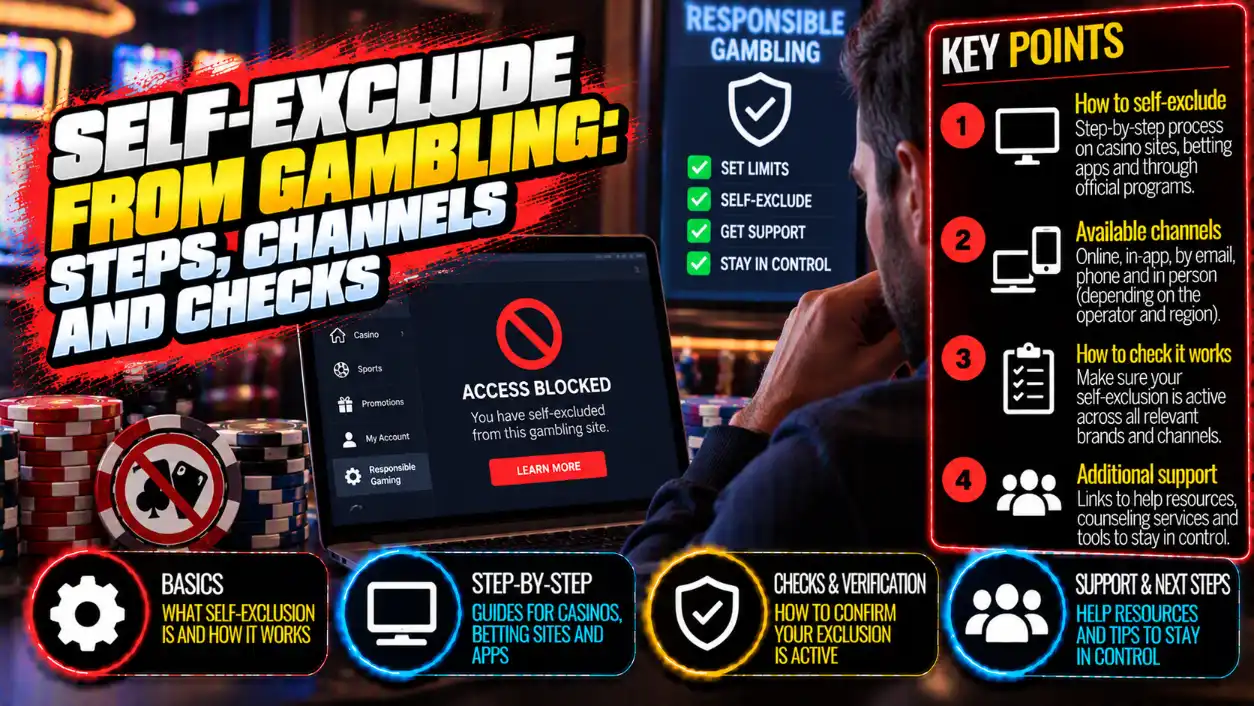
To self-exclude from gambling or sports betting, use your state's program, the operator's responsible-gambling tools or, in the UK, GAMSTOP. Terms run from 6 months (GAMSTOP) to five years or lifetime, depending on the program. A block covers only the programs and operators it names, so check each one in writing. Below, we cover the channels, the terms and how to check that a block works.
Keep in mind that a block does not guarantee that all betting stops. Terms depend on the operator and the program; ask for written confirmation of the terms that apply to you.
How do you self-exclude from sports betting?
Choose the channel that covers your betting, pick a self-exclusion term and scope, and submit the request through that program or operator. Save a record of your submission and get confirmation that the exclusion is active.
| Channel | What it covers | Term | What to check |
|---|---|---|---|
| State program: Pennsylvania example | The PGCB page lists casino, iGaming, VGT and fantasy programs; it does not list a separate sports-betting program. | According to PGCB, casino exclusions for one or five years remain active until removal is requested; the other listed programs expire at the end of the selected period. | Whether the type of gambling you play is listed, which exclusion you selected and whether enrollment is confirmed. |
| Operator tools | The operator restriction described in its terms; do not assume a shared brand means every account is covered. | As described by Sports Betting Dime: DraftKings offers self-exclusion for one or five years; BetMGM offers permanent self-exclusion through its state responsible gambling team. Confirm FanDuel’s available terms directly. | Whether you selected self-exclusion rather than a temporary account block, and which products and accounts it covers. |
| UK GAMSTOP | One GAMSTOP registration blocks gambling websites and apps licensed in Great Britain. | You choose from 6 months to 5 years; GAMSTOP says you cannot cancel during the exclusion period. | Current eligibility, participating operators, available terms and confirmation of registration. |
For operator enrollment, use the controls described by Sports Betting Dime:
- FanDuel: open “Player Protection”, then “Responsible Gaming”, find the user tools area and select “Self exclusion”.
- DraftKings: open “Responsible Gaming”, find the break section and select self-exclusion rather than a short break.
- BetMGM: contact the responsible gambling team for your state to request permanent self-exclusion. Its temporary-break option is a different tool.
Before deciding on a pause, you can log when you played, how long you spent and your recorded spending with the game habits tracker. Those records show your habits; they do not submit an application or confirm a block.
Diagram: which self-exclusion channel covers which betsIllustrative diagram: channel, coverage, term. Choose a channel based on where you bet.
How does a state program work?
A state program uses its own enrollment process and product coverage. The Pennsylvania Gaming Control Board self-exclusion page, checked 2026-10-25, says enrollment is voluntary, you choose the length, and you can enroll online through the PGCB website or by appointment at a PGCB office.
PGCB says only the person seeking exclusion can enroll; a family member cannot place someone else on the list.
For Pennsylvania, follow the process described on the PGCB page:
- Review the listed programs and choose the exclusion or exclusions that match your activity.
- Select the length of each exclusion.
- Complete enrollment online through the PGCB website, or arrange an appointment at a PGCB office.
- Save your submission record and watch for confirmation of enrollment.
According to PGCB, casino exclusions for one or five years continue until you request removal. Its iGaming, VGT and fantasy exclusions expire at the end of the selected period, and you may extend those exclusions before they expire.
For sports betting, first check your state gambling regulator’s website for the current sports wagering self-exclusion program and its enrollment instructions. The PGCB page does not list a separate sports-betting program, so do not treat this Pennsylvania example as a sports betting enrollment route.
Another state may use a separate program. As described in our guide to self-exclusion in Missouri, Missouri’s sports wagering SEP covers online and in-person sports wagering and is separate from its casino exclusion program, DAP.
What do other large betting states offer?
Terms differ a lot between states, so read your regulator's page before you apply. Here is what four regulators publish as of October 2026:
- New Jersey. The Division of Gaming Enforcement runs the Self-Exclusion Program (njoag.gov) for Atlantic City casinos, racetrack sports wagering and online gaming and sports wagering. You can sign up online or through your online player account for one or five years; a lifetime term is available only by appointment, in person or by video call. After a one- or five-year term ends, you can ask to be removed; a lifetime listing cannot be removed.
- New York. The State Gaming Commission keeps the voluntary self-exclusion list (gaming.ny.gov), which covers sports wagering, internet and account wagering, casinos, the lottery and fantasy sports. You choose one, three or five years, or lifetime, and submit a form with a recent photo at a licensed facility or the Commission's Schenectady office, or by mail with a notarized form. When a one-, three- or five-year term ends, you come off the list unless you send a new form within 30 days to extend it.
- Illinois. The Illinois Gaming Board's self-exclusion program (igb.illinois.gov) covers Illinois casinos and sports wagering and has a mandatory minimum of five years. You complete the application in person at a site the Board designates, by appointment. After five years, you may request removal.
- Michigan. The Michigan Gaming Control Board keeps the Responsible Gaming Database for online casino gaming and online sports betting, with a choice of one or five years for each. You apply in person at an MGCB office, or send a notarized application by email or mail; confirmation can take up to 45 days. You cannot remove your name early: it comes off automatically when the term ends.
What does the block cover, and what does it not cover?
A block covers the products, operators and jurisdiction stated in its terms and confirmation—not every possible gambling channel. An operator request does not establish state enrollment, and you should not assume another state or operator is covered.
BettingUSA describes a key distinction: some states allow one request to cover several gambling types, while others require separate requests. Before submitting, identify whether you are selecting casino gambling, online gambling, sports wagering or another listed product. Do not treat a general reference to gambling as proof that every product is included.
Make a short list of your existing accounts and the exclusions you have requested. Next to each, note the program, selected scope and confirmation status. This helps you spot an unanswered request without logging back in to bet. Do not assume offshore sites participate in a state program.
Bank payment restrictions are separate. A bank’s gambling-category block concerns transactions in that category; it does not close your betting account or establish enrollment in a self-exclusion program.
How long does the block last, and when can you remove it?
The selected term and the program’s removal rules determine how long the block lasts. Check both the event that starts the term and whether the end means automatic expiry or eligibility to request removal.
The following calculation uses a sample enrollment date of 2026-10-25. It illustrates a 12-month term, not a universal minimum or a promise of restored access.
| Assumption | Date and meaning |
|---|---|
| The term is counted from the request date, 2026-10-25. | 2027-10-25, assuming counting starts on the request date: the term ends or a removal request becomes possible, depending on the applicable program. |
| The term is assumed to start one day after the request. | 2027-10-26, assuming a one-year term starts one day after the request. |
| The term is assumed to start two days after the request. | 2027-10-27, assuming a one-year term starts two days after the request. |
| Pennsylvania casino exclusion lasts five years, starting on the sample request date. | Counting from the sample date, a five-year term runs to 2031-10-25; the PGCB page does not say whether removal can be requested earlier. |
Under the request-date assumption, the earliest removal request in the 12-month example is 2027-10-25; if the term is assumed to start later instead, the date moves by one or two days, as shown above.
For Pennsylvania casino exclusion, PGCB distinguishes requesting removal from automatic expiry. The PGCB page does not state a processing time, so it is unclear how quickly access returns after a request.
How do you check that the block works?
Check the account status, obtain written confirmation, compare it with a login check that involves no money, and review any bank gambling-category block separately. Never test self-exclusion by depositing or placing a bet.
- Check the operator’s responsible gambling section. Look for the active restriction and its type. Record whether it says self-exclusion or describes a different account restriction.
- Get written confirmation. Ask the operator or state program to confirm that enrollment is active, which products it covers, the start date and the applicable end or removal conditions. A receipt acknowledging your request is not the same as confirmation that it is active.
- Check login access without depositing or betting. Compare the result with the written terms. Being able to sign in does not itself show that wagers are accepted; being unable to sign in does not itself prove state enrollment.
- Check your bank’s gambling-category block, if you have one. Ask whether it is enabled and which transactions it covers. This category restriction does not block the bank account or ordinary payments.
Keep these results together. If the displayed status conflicts with the written confirmation, send the operator or program a factual description of the discrepancy. Ask for clarification of the active restriction instead of testing it with a payment.
How do time-outs, cooling-off and deposit limits differ from self-exclusion?
Time-outs, cooling-off options and deposit limits are separate safer gambling tools, not interchangeable names for self-exclusion. Sports Betting Dime describes DraftKings’ cooling-off option as lasting from one day up to two months; that range describes its temporary break, not its self-exclusion term.
A deposit limit restricts deposits over a defined period within its stated scope. It is not a stake limit, a loss limit or a restriction covering all your accounts.
A session limit is another separate tool. Our bankroll management guide explains session and loss limits, while a session bankroll concerns the amount planned for a session. Neither a bankroll calculation nor a session limit replaces a block.
If your goal is self-exclusion, verify that you have requested that specific restriction—not simply enabled another control in the responsible gambling section.
What happens if you break a self-exclusion?
If gambling already feels out of control, talk to someone as well: in the US, the National Problem Gambling Helpline is 1-800-GAMBLER; in Great Britain, the National Gambling Helpline run by GamCare is 0808 8020 133. Both are free and confidential.
Regulators state this directly. New Jersey's DGE says a casino, sports wagering facility or online site will refuse your wagers and you will be subject to forfeiture of any winnings (self-exclusion FAQ, njoag.gov); New York's Gaming Commission says winnings during the exclusion are forfeited (gaming.ny.gov). Keep the written confirmation with its date in case a wager is accepted anyway.
Frequently Asked Questions
There is no single timeframe across all channels. Ask for written confirmation that includes the date and the status of your self-exclusion.
Ask for a written explanation of the self-exclusion channel, its scope, your current status and the removal conditions. Ask separate questions about account access, whether wagers are accepted and bank payment restrictions.
No. Deleting an app does not register you with a state program or activate an operator restriction. You need confirmation from the channel through which you apply.
It depends on the program. The PGCB page says Pennsylvania iGaming, VGT and fantasy exclusions expire at the end of the chosen term, while casino exclusions last until you request removal if you are eligible. It does not describe early removal, so check your program’s rules before you ask.
Evgeniy Volkov
Verified ExpertFullstack developer with a background in mathematics. I build the calculators and game-style tools on ToolsGambling with Pixi.js and modern web tech, and every result uses transparent probability formulas you can verify yourself.