










Contents
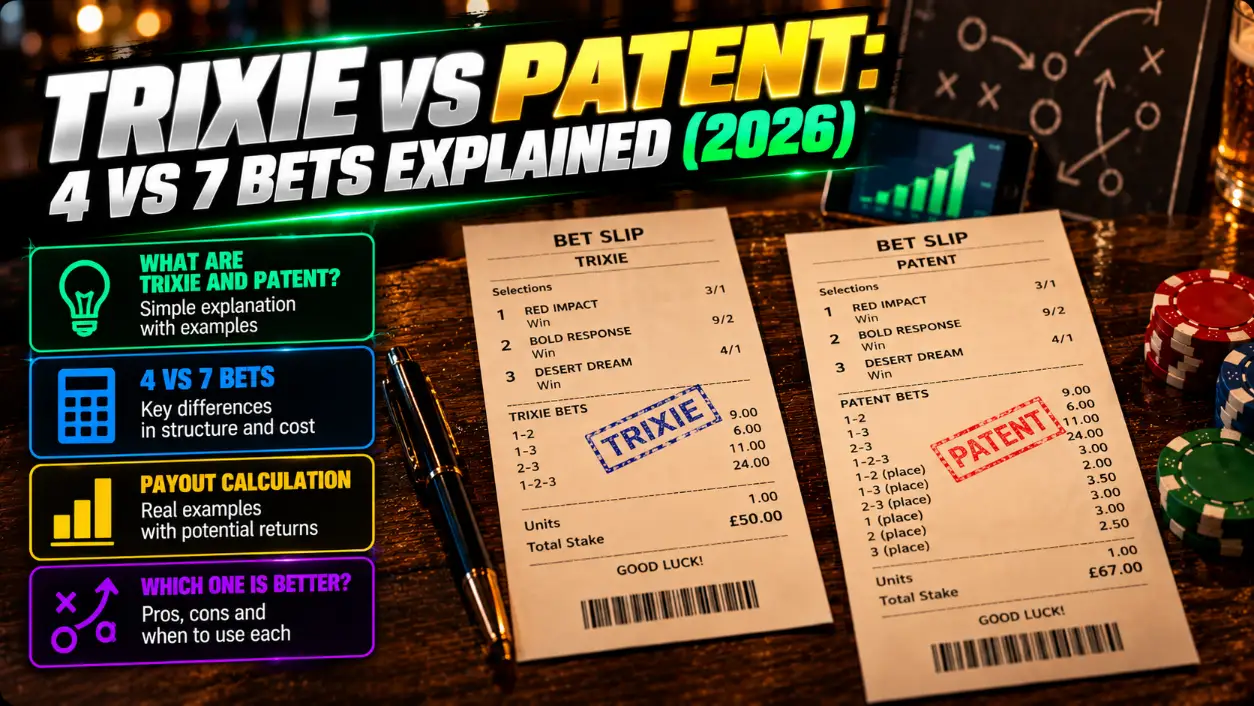
Trixie and Patent use the same three selections, but a Trixie has four components with no singles, while a Patent has seven components, including three singles. At the same unit stake, a Patent costs 75% more and can return money with just one winner. The difference is in cost and how returns are distributed—not guaranteed net profit. Comparing them at the same total budget can change the result.
All main examples below are cash win-only bets at decimal odds. Gross return includes the returned stake; net profit is gross return minus the whole ticket cost, not just the stakes on winning components. The main tables exclude deductions, commission, bonuses and void selections.
What is the main difference between Trixie and Patent?
A Trixie puts the entire stake into three doubles and a treble; a Patent adds three singles on the same selections.
| Feature | Trixie | Patent |
|---|---|---|
| Selections | The same three: A, B, C | The same three: A, B, C |
| Doubles | 3 | 3 |
| Trebles | 1 | 1 |
| Singles | None | 3 |
| Total components | 4 | 7 |
| Total stake at £1 per component | £4 | £7 |
| Minimum winners for a positive gross return | 2 | 1 |
The final row assumes an ordinary win-only bet with no void selections. A positive gross return does not necessarily cover the ticket cost.
These structures are confirmed by William Hill’s Bet Types rules and page 10 of the Tower betting rules PDF. With a unit stake of , the total stake is for a Trixie and for a Patent. The 75% cost difference applies only at the same unit stake, not at the same total budget.
Which components are included?
Both systems contain AB, AC, BC and ABC; the Patent also contains singles A, B and C. The letters identify selections: AB is a double that needs both A and B to win.
| Component | Bet | Trixie | Patent |
|---|---|---|---|
| A | Single on A | No | Yes |
| B | Single on B | No | Yes |
| C | Single on C | No | Yes |
| AB | Double on A and B | Yes | Yes |
| AC | Double on A and C | Yes | Yes |
| BC | Double on B and C | Yes | Yes |
| ABC | Treble on A, B and C | Yes | Yes |
Original English composition column from page 10 of the Tower rules, with Trixie above Patent
Original English extract from page 10: the upper section describes Trixie and the lower section describes Patent. The linked PDF was accessed on 12 October 2026; its effective edition date is unspecified. This is the original extract, not a translated document.
What are the returns at odds of 2.00, 3.00 and 4.00?
At £1 per component, a Trixie costs £4 and a Patent costs £7. Their returns depend on which selections win, not merely how many win.
Let A have decimal odds of 2.00, B of 3.00 and C of 4.00. The table covers all eight outcomes. Any selection not listed as a winner loses. All figures are in GBP (£), using the cash win-only assumptions above. These calculations are exact and require no rounding.
| Winning selections | Trixie gross return | Trixie net profit | Patent gross return | Patent net profit |
|---|---|---|---|---|
| None | £0 | −£4 | £0 | −£7 |
| A only | £0 | −£4 | £2 | −£5 |
| B only | £0 | −£4 | £3 | −£4 |
| C only | £0 | −£4 | £4 | −£3 |
| A and B | £6 | £2 | £11 | £4 |
| A and C | £8 | £4 | £14 | £7 |
| B and C | £12 | £8 | £19 | £12 |
| A, B and C | £50 | £46 | £59 | £52 |
If A and B win and C loses, only the AB double returns money in the Trixie:
That is £6 gross return, less the full £4 ticket cost, giving £2 net profit. In the Patent, singles A and B also win:
Subtract the whole £7 ticket cost from £11. The net profit is £4, not £8.
If only A wins, the Patent returns £2 but makes a net loss of £5. The Trixie returns nothing but loses £4. At the same unit stake, a Patent’s partial return can therefore accompany a larger absolute loss than a Trixie.
With all three selections winning, the Trixie returns £6 + £8 + £12 + £24 = £50. The Patent adds singles returning £2 + £3 + £4, bringing its gross return to £59. Their maximum returns at the same unit stake are not identical.
How do they compare with the same £28 budget?
With a total budget of £28, use a £7 unit stake for the Trixie and a £4 unit stake for the Patent. This compares equal spending rather than tickets with different costs.
The odds remain A at 2.00, B at 3.00 and C at 4.00. Unlisted selections lose, and the other assumptions remain unchanged. The figures are exact.
| Winning selections | Trixie gross return | Trixie net profit | Patent gross return | Patent net profit |
|---|---|---|---|---|
| None | £0 | −£28 | £0 | −£28 |
| A only | £0 | −£28 | £8 | −£20 |
| A and B | £42 | £14 | £44 | £16 |
| A, B and C | £350 | £322 | £236 | £208 |
For example, with A and B winning, the Trixie returns £7 × 2.00 × 3.00 = £42. The Patent returns £4 × (2.00 + 3.00 + 2.00 × 3.00) = £44.
With all three winning, the Trixie returns £350, compared with £236 for the Patent. The odds have not changed: the Patent spreads its budget across seven components, leaving a smaller stake on each double and the treble.
These conditional results do not tell you which system to choose from confidence or prices alone. They show what each outcome pays, not how likely it is.
The chart below also uses the same total budget for both systems, with Trixie unit stake and Patent unit stake . Its component note contains stale wording suggesting equal unit stakes and a Trixie budget of four-sevenths of the Patent budget. That wording conflicts with the actual equal-budget calculation; use the equal-budget model when reading the chart.
At its defaults of B = £7 and equal odds of 3.00, gross returns for 0/1/2/3 winners are £0/£0/£15.75/£94.50 for Trixie and £0/£3/£15/£63 for Patent. These are different parameters from the main 2.00/3.00/4.00 example. Amounts are displayed to two decimal places. The break-even badge applies to the block’s parameters, not a universal forecast.
When does a return cover the cost—and when is there an edge?
Breaking even on a particular outcome is different from having positive expected value (EV). Break-even compares that outcome’s return with the ticket cost; EV requires assumptions about actual winning probabilities.
With unit stake and exactly one winner at decimal odds , a Patent returns against a total cost of :
- At O = 7.00, the return exactly covers the cost.
- Above O = 7.00, the ticket makes a net profit.
- Below O = 7.00, the ticket makes a net loss.
With exactly two winners at odds and , the conditions for covering the whole ticket cost are:
| System | Break-even condition |
|---|---|
| Trixie | |
| Patent |
Equality means zero net profit; exceeding the boundary means positive net profit. For example, if two selections win at odds of 2.00 and the third loses, a £1-unit Trixie returns £4 and breaks even. The Patent returns £4 + £2 + £2 = £8, giving £1 net profit.
These boundaries describe specified outcomes. They are not universal odds rules for choosing bets.
For a single bet, expected net profit per unit staked is:
Here, is the assumed actual probability of winning, not a probability known with certainty from the quoted odds. At the same odds of O = 3.00:
| Hypothetical winning probability | Expected net profit per £1 |
|---|---|
| p = 0.25 | −£0.25 |
| p = 0.40 | +£0.20 |
Both probabilities are hypothetical. The Patent structure does not create an edge by itself.
At the same unit stake, the difference between Patent and Trixie realised net profit is:
The Patent adds singles returns but also costs another . Its additional expected net profit is when assumed probabilities are supplied for each selection. Independence is not required to sum those singles’ expected profits.
However, component returns share selections and are dependent: AB and AC both include A, for example. Assessing the whole system’s EV requires joint probabilities, not just three individual probability estimates.
How can you repeat the calculation in the calculator?
Use the system bet calculator to select each preset, enter the three odds and win/loss states, and set the unit stake. The main A/B-winning example should return £6 for Trixie and £11 for Patent.
- Choose the Trixie preset.
- Enter decimal odds of 2.00, 3.00 and 4.00 in order. Selection #1 is A, #2 is B and #3 is C.
- Select WIN for A and B, and LOSE for C.
- Enter 1 in STAKE PER BET. This is the stake on every component.
- Under CURRENCY, select £.
- Check TOTAL BETS is 4, TOTAL STAKE is £4.00, TOTAL RETURN is £6.00 and PROFIT · ROI shows £2.00 (+50.0%).
Trixie calculator result at odds 2.00, 3.00 and 4.00, with A and B winning, C losing and £1 unit stake: £6.00 gross return and £2.00 net profit
Trixie: A and B win, C loses; odds 2.00/3.00/4.00 and unit stake £1.00. Total stake £4.00, gross return £6.00 and net profit £2.00.
Now choose Patent. Switching presets loads a demonstration example, so do not assume your previous values remain. Re-enter or verify all three odds, the A/B/C win/loss states, unit stake 1 and currency £. For the same inputs, check seven bets, total stake £7.00, gross return £11.00 and net profit £4.00.
Patent calculator result at odds 2.00, 3.00 and 4.00, with A and B winning, C losing and £1 unit stake: £11.00 gross return and £4.00 net profit
Patent: A and B win, C loses; odds 2.00/3.00/4.00 and unit stake £1.00. Total stake £7.00, gross return £11.00 and net profit £4.00.
These two screenshots show the real interface in a local environment using example inputs. They are not real wagers or tests of the production site.
For an equal £28 budget, enter 7 for Trixie and 4 for Patent in STAKE PER BET. Verify every input again after each preset switch. Leaving both unit stakes at 1 compares equal unit stakes, not equal budgets.
The calculator deterministically settles cash bets from the supplied WIN/LOSE states. It does not forecast results or model each-way bets, void selections, bonuses, Rule 4 deductions or dead heats.
What does the interactive example show?
The explorer below shows which components survive when you toggle A, B and C. Its odds are fixed at 3.00 and its unit stake at £1, giving total stakes of £4 for Trixie and £7 for Patent.
With one winner, the Patent returns £3 but makes a £4 net loss. The interface’s “rescue” label means a partial return—not profit or full recovery of the ticket cost.
In its default two-winner state, Trixie returns £9 with £5 net profit, while Patent returns £15 with £8 net profit. These are not the £6/£11 returns from the main example because all three odds here are 3.00. The explorer does not offer editable odds or a live bookmaker connection.
Which bookmaker rules can change the calculation?
Place terms, void selections, deductions and other settlement rules can change costs or returns. The main tables and calculator do not model these adjustments.
Each-way bets. If is the equal stake on each component’s win and place parts, a Trixie costs and a Patent costs . At £1 per part, the total costs are £8 and £14. The cost doubles, but the payout does not necessarily double. The seven-component Patent and its each-way cost are also explained in bet365’s official Patent guide.
The place decimal odds use the place fraction :
The fraction applies to the profit portion of the odds, not the entire decimal price. Settle the win and place parts separately under the actual place terms.
Void selections. Only where the applicable bookmaker rules support it, a void selection can be modelled at odds of 1.00 while keeping the original component stakes. Reduction of affected multiples is covered in William Hill’s Bet Types rules; void provisions also appear in section 2.25 of the Tower rules PDF.
As a separate illustration, suppose A at 2.00 and B at 3.00 win, while C, originally at 4.00, is void. Replacing C’s odds with 1.00 and retaining £1 on every original component gives:
- Trixie gross return: £6 + £2 + £3 + £6 = £17; net profit £13.
- Patent adds singles returns of £2 + £3 + £1, giving gross return £23; net profit £16.
This is a conditional rules-based illustration, not a result from the current calculator. Its interface has no void-selection action.
Other adjustments. Rule 4 deductions under applicable horse-racing rules, dead heats, bonuses, free bets and payout caps can change settlement. Check their terms separately; no universal Trixie or Patent bonus is assumed here.
Before placing a bet, also check whether the bookmaker accepts the combination. William Hill describes Trixie and Patent using selections from different events and separately restricts related contingencies in ordinary multiples. Different events do not, by themselves, establish statistical independence.
Which should you choose: Trixie or Patent?
Choose according to budget and the return distribution you want, not an assumption that one structure creates an edge. You might prefer singles, more exposure to doubles and the treble, or decide not to bet.
At the same unit stake, Patent adds three singles and increases the total cost from to . That allows a partial return with one winner, but does not guarantee a smaller loss.
At the same total budget, Patent allocates some money to singles, while Trixie allocates everything to doubles and the treble. That is why Trixie pays more with all three winners in our equal-budget example, while only Patent pays with one winner. Neither fact tells you which outcome is more likely.
Before choosing, compare total stake, gross return for the outcome you are considering, and net profit after subtracting the whole ticket cost. For more detail on adding component returns, see how to calculate a system bet. If your choice is between a system and one accumulator, read the system bet versus accumulator comparison.
Frequently Asked Questions
Neither structure is limited to one sport. Check that the bookmaker accepts your chosen markets and their combination before betting. Selections from different events are not necessarily statistically independent, and related selections may be excluded from ordinary multiple bets.
Yes. In an ordinary cash win-only bet without void selections or deductions, the sole winner must have decimal odds above 7.00. At exactly 7.00, its return covers the seven unit stakes. Below 7.00, the ticket makes a net loss.
In these examples, £1 means the unit stake on each component, not the total ticket stake. A Trixie costs £4 and a Patent costs £7. For each-way bets with £1 on each win and place part of every component, the costs are £8 and £14.
No. The current calculator handles cash bets with winning and losing selections. It does not model each-way settlement, void selections, Rule 4 deductions, dead heats or bonuses. Those cases require the applicable bookmaker rules.
Evgeniy Volkov
Verified ExpertFullstack developer with a background in mathematics. I build the calculators and game-style tools on ToolsGambling with Pixi.js and modern web tech, and every result uses transparent probability formulas you can verify yourself.