










Contents
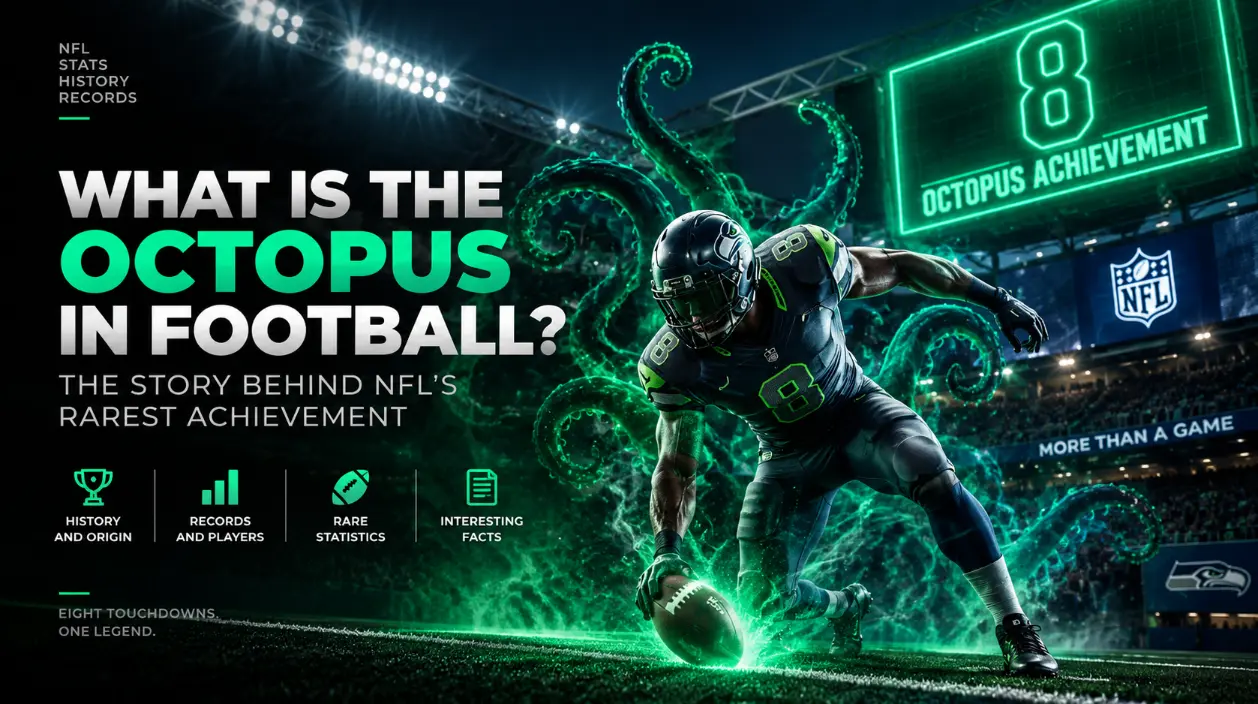
An Octopus in the NFL occurs when the same player scores a touchdown and then personally scores the successful ensuing two-point try on the same drive. The touchdown gives the team six points and the conversion adds two: eight points altogether. This article covers American football, not soccer markets about a player scoring in both halves.
To understand an Octopus wager, separate who scores both plays from how a sportsbook settles its market. The sporting definition does not replace the operator’s current settlement rules.
Which Plays Make an Octopus?
An Octopus requires the same player to score two consecutive plays: a touchdown and the successful two-point conversion immediately after it. If different players are credited with those scores, the sequence does not meet the definition.
The official 2026 NFL Rulebook, Rule 11, Article 2, awards six points for a touchdown and two for a successful try scored by touchdown. The excerpt is on printed page 42, PDF page 49.
Official 2026 NFL rule excerpt showing six points for a touchdown and two points for a successful touchdown try
Scoring values from the official 2026 NFL Rulebook, reproduced in the original English.
For example, a player catches a pass for a touchdown, then catches another pass to score the ensuing two-point conversion. The same player scores both plays, making it an Octopus.
Key rule
Scoring credit matters—not who throws the pass. A scoring pass alone does not make the quarterback the touchdown scorer. An Octopus requires one player to personally score both plays; settlement of a wager still follows the operator’s current market rules.
Where Did the Name Come From?
Mike Wallace suggested “octopus” after Mitch Goldich asked for a name for the event on October 14, 2018. Goldich documents the exchange in his primary account of the term’s origin.
The connection is the eight points: six for the touchdown and two for the conversion, both scored by one player. Attributing the name solely to Goldich or dating its origin to 2019 would be inaccurate.
How Does an Octopus Betting Market Work?
A Yes/No market asks whether an Octopus will occur in the specified game. A named-player selection is available only if the operator explicitly lists it; market availability, wording and settlement conditions vary by event and sportsbook.
This is a prop bet on a scoring event. Read the description of the specific market before selecting an outcome: the general football definition does not answer every settlement question.
One historical, expired example appears on PDF page 16 of William Hill’s Super Bowl LX 2026 packet. Its exact selection labels and American odds were NO −6000 and YES +1500. The source also states that odds were subject to change.
Historical William Hill Super Bowl LX Octopus market listing NO at −6000 and YES at +1500
Past Super Bowl LX line from William Hill’s 2026 packet, PDF page 16. The event took place in February 2026; this line is expired, not a current offer.
What Do These American Odds Mean?
The historical prices imply 98.36% for NO −6000 and 6.25% for YES +1500. Implied probability is the percentage encoded by a price—not the actual probability that the event will happen.
For positive American odds +A, the formula is 100 / (A + 100). For negative American odds −A, it is A / (A + 100), where A is the absolute value. Multiply by 100 to express the result as a percentage:
- NO −6000: 6000 / (6000 + 100) × 100 = 98.36%, rounded.
- YES +1500: 100 / (1500 + 100) × 100 = 6.25%.
- Summed implied probability, or booksum: 104.61%.
- Overround/bookmaker margin: the excess above 100%, here 4.61 percentage points.
This calculation treats YES and NO as a complete, mutually exclusive two-outcome market. Results are rounded to two decimal places; the booksum and margin use unrounded values. With other prices, adding already-rounded percentages may produce a small discrepancy.
The default Multiplicative method proportionally normalizes the implied probabilities to total 100%. It produces no-vig estimates of 94.03% for NO and 5.97% for YES. These method-based estimates are not actual event probabilities, measured frequencies or predictions.
For a payout illustration, a winning 10-unit stake at +1500 would earn 150 units in net winnings, plus the returned 10-unit stake: 160 units gross. This is payout arithmetic only, not evidence that the bet offers value or will be profitable.
How Can You Repeat the Calculation?
Open the implied probability calculator, enter both historical outcomes in American odds, and leave the default Multiplicative method selected. The tool converts the prices and displays their implied probabilities, booksum, margin and no-vig estimates.
- Choose the odds format. Select American.
- Enter the two outcomes. In the first row, enter the name
NOand odds −6000. In the second row, enterYESand +1500. These names match the historical source and calculator captures. - Keep the default method. Leave Multiplicative selected.
- Read the results. The raw implied probabilities are 98.36% and 6.25%; the booksum is 104.61% and the margin is 4.61%. The multiplicative no-vig estimates are 94.03% and 5.97%, respectively.
English desktop calculator showing American odds NO −6000 and YES +1500 with implied probabilities and Multiplicative results
English desktop interface captured from the local app implementation, showing both inputs and the results. This capture does not establish production-site availability.
English mobile results panel showing a 104.61% booksum, 4.61% margin and no-vig estimates of 94.03% and 5.97%
Results for the same calculation in a 390-pixel mobile viewport of the local app. This crop shows the results panel only, not the input fields or a separate calculation.
Enter both mutually exclusive outcomes to evaluate the complete market. Entering only YES converts that price but does not provide the full market’s booksum or margin.
The calculator performs arithmetic on entered prices. It has no NFL frequency or model data, does not analyze players or teams, and does not predict whether an Octopus will occur. Its no-vig estimates depend on the selected method; removing margin does not establish a true probability.
What Should You Check Before Betting?
Check the operator’s exact, current market rules, the market’s availability and its current price. A historical description or screenshot cannot establish today’s terms.
Operator-specific wording can matter, particularly for scoring credit. The DraftKings House Rules, version dated 2025-08-18, page 85, is a historical example of an operator’s event definition—not a universal rule or confirmation of current settlement terms.
Use this short checklist:
- Scoring credit: Who must be credited with the touchdown and two-point conversion under this market’s rules? Do not equate throwing a scoring pass with personally scoring.
- Extra periods: Do events in overtime count?
- Postponement and voiding: When is the wager void, and how is a postponed game handled?
- Official stat corrections: How does the operator handle subsequent official changes?
- Current availability and price: Is the market offered now in your jurisdiction, and what odds does the current offer show?
These checks keep the Octopus definition separate from wager settlement—and the arithmetic of odds separate from assumptions about event probability.
Frequently Asked Questions
Throwing a scoring pass does not make the quarterback the player credited with scoring the touchdown. The Octopus definition requires the same player to personally score both plays. Settlement of a specific wager follows the operator's current market rules.
American odds of +1500 imply 6.25%, while −6000 implies 98.36%. Their summed implied probability is 104.61%, with a bookmaker margin of 4.61 percentage points. These are price-derived percentages, not actual event probabilities.
They are multiplicative no-vig estimates for the two entered prices, obtained by proportional normalization. They depend on the calculation method and are not actual probabilities, estimates of event frequency or predictions.
The example comes from William Hill's historical Super Bowl LX 2026 packet. The event took place in February 2026, and the displayed line has expired. Check the operator for current market availability, prices and settlement rules.
Evgeniy Volkov
Verified ExpertFullstack developer with a background in mathematics. I build the calculators and game-style tools on ToolsGambling with Pixi.js and modern web tech, and every result uses transparent probability formulas you can verify yourself.