












Contents
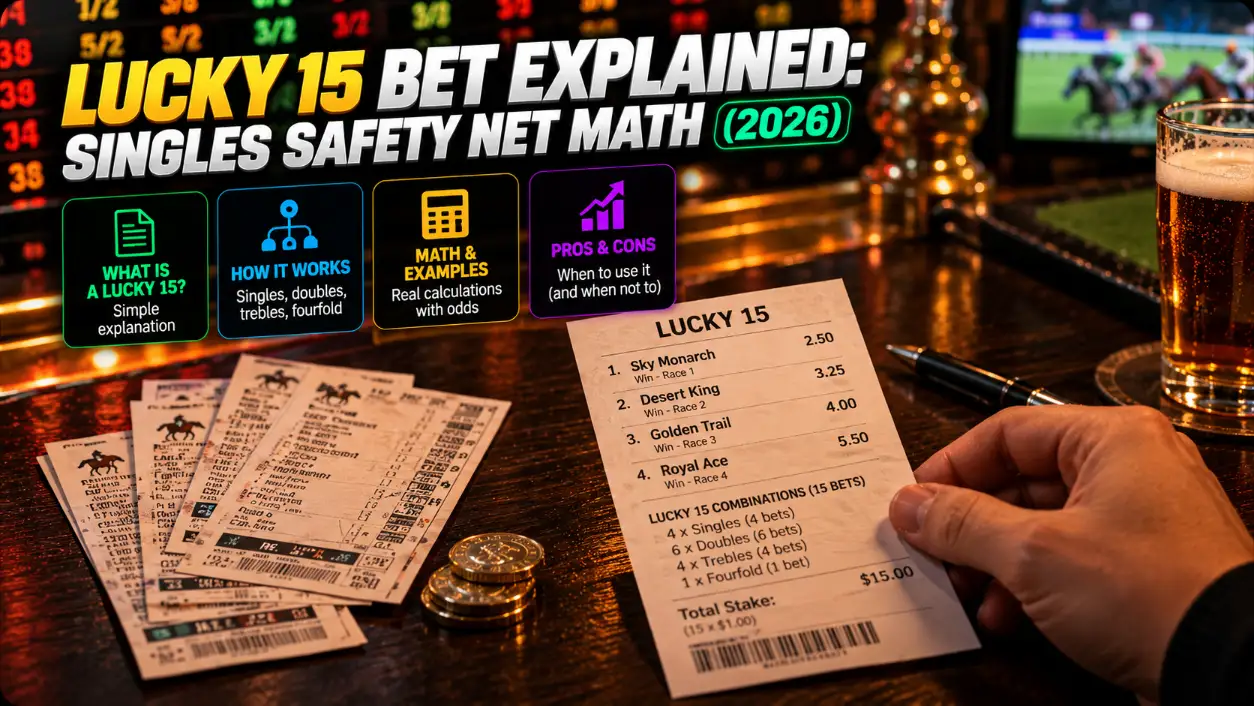
A Lucky 15 combines four selections into 15 separate funded bets: four singles, six doubles, four trebles and one fourfold. A £1 unit stake costs £15 for a win-only ticket. One winner can produce a gross return, but that does not necessarily mean a net profit.
Gross return includes the returned winning stake. Net profit is the gross return minus the full total stake, including losing combinations. If your only winner has decimal odds of 3.00, its £1 single returns £3; after subtracting the £15 ticket cost, you have a £12 net loss.
Which 15 bets are included?
Lucky 15 includes every non-empty combination of four selections, labelled A, B, C and D: 2^4 − 1 = 15. Each letter represents one prediction; the combinations are the separately funded bets.
| Bet size | Combinations | Number | Requirement for a return under ordinary settlement |
|---|---|---|---|
| Single | A, B, C, D | 4 | That selection wins |
| Double | AB, AC, AD, BC, BD, CD | 6 | Both selections win |
| Treble | ABC, ABD, ACD, BCD | 4 | All three selections win |
| Fourfold | ABCD | 1 | All four selections win |
| Total | Every non-empty combination of A–D | 15 | Assumes no voids, deductions or other adjustments |
This structure is confirmed by Sky Bet’s official guide to bet types.
Original English Sky Bet definition of Lucky 15, listing its singles, doubles, trebles and fourfold
The original English Sky Bet extract describes the 15-bet structure.
Separate funding does not make these 15 bets statistically independent. If A loses, every combination containing A loses too. Check that your chosen markets can be combined: related selections may not be permitted in the same accumulator.
Lucky 15 is not the only full-cover format with singles. Patent has seven bets on three selections, Lucky 31 has 31 on five, and Lucky 63 has 63 on six. Our system-bet guide explains the shared principle.
How much does a Lucky 15 cost?
A win-only Lucky 15 costs 15 times the unit stake. An each-way Lucky 15 costs 30 times the unit stake per part, because every combination has a separately funded win part and place part.
For a unit stake s:
- Win-only total stake:
15 × s. - Each-way total stake:
30 × s, wheresis the amount on each part.
| Ticket | Unit stake | Total stake |
|---|---|---|
| Win-only | £1 per combination | £15 |
| Each-way | £1 per part of each combination | £30 |
| Each-way | £0.50 per part of each combination | £15 |
A £15 budget therefore funds either £1 per combination win-only or £0.50 per part each-way. These tickets have different settlement conditions, even though their total cost is identical.
Always check the total shown on the ticket. Do not assume every bookmaker’s stake field uses the same convention.
What are the returns with zero to four winners?
With all four selections at decimal odds of 3.00 and a £1 unit stake, a win-only Lucky 15 returns £0, £3, £15, £63 or £255, depending on the number of winners. Decimal odds of 3.00 are equivalent to fractional odds of 2/1, not 3/1.
The following example costs £15 and excludes bonuses, voids, Rule 4 deductions and dead heats.
| Winning selections | Winning combinations | Gross return | Net profit |
|---|---|---|---|
| 0 | 0 | £0 | −£15 |
| 1 | 1 | £3 | −£12 |
| 2 | 3 | £15 | £0 |
| 3 | 7 | £63 | +£48 |
| 4 | 15 | £255 | +£240 |
If only A and B win, the winning bets are A, B and AB: £3 + £3 + £9 = £15. The other 12 bets lose, so the ticket breaks even.
If A, B and C win, there are three winning singles, three doubles and one treble: £9 + £27 + £27 = £63. Subtracting the £15 total stake leaves £48 net profit.
With all four winners, the calculation is:
| Winning bet type | Calculation | Gross return |
|---|---|---|
| Four singles | 4 × £3 | £12 |
| Six doubles | 6 × £9 | £54 |
| Four trebles | 4 × £27 | £108 |
| One fourfold | £1 × 3 × 3 × 3 × 3 | £81 |
| Total | £12 + £54 + £108 + £81 | £255 |
For equal decimal odds D, unit stake s and w winners, the gross return is R = s × [(1 + D)^w − 1]. This formula assumes ordinary win-only settlement without bonuses or adjustments. Where individual payouts contain fractions of a penny, apply the relevant per-bet rounding convention separately.
The explorer below lets you toggle winners A–D. It uses fixed decimal odds of 3.00, a £1 unit stake and win-only settlement, giving £3, £15, £63 and £255 with one, two, three and four winners respectively.
With unequal odds, the number of winners alone is not enough. Suppose A–D have decimal odds of 2, 3, 4 and 5. Wins for A and B return £2 + £3 + £6 = £11, a £4 net loss. Wins for C and D return £4 + £5 + £20 = £29, a £14 net profit.
Without bonuses, one winner produces a net profit only when its decimal odds are above 15. Odds of 15 give break-even, not profit.
How do you reproduce the example in the calculator?
To reproduce the £255 base gross return, open the Lucky 15 calculator, enter four prices of 3.00 and a £1 unit stake, and change the default all-winners bonus from 10% to 0%.
The three calculator images below show a local demonstration of the tool, not a completed real bet or an audit of a bookmaker’s production service.
- Select decimal odds and GBP (£).
- Enter 3.00 in each of the four odds fields.
- Enter 1 in the unit-stake field. This means £1 per combination, not a £1 total budget.
- Set the all-winners bonus to 0%.
- Choose no one-winner bonus.
- Leave each-way switched off.
Lucky 15 calculator inputs showing four decimal prices of 3.00, a unit stake of 1 and the base-example settings
Base-example inputs: decimal odds, GBP and £1 per combination, with bonuses disabled.
Results update instantly when you change an input; there is no Calculate button. These settings show a potential gross return of £255, a total stake of £15 and £3 for the best winning single. The all-winners net profit is £255 − £15 = £240.
Lucky 15 results showing a potential gross return of 255, a total stake of 15 and a best winning single of 3
The potential return assumes all four selections win; it is not a forecast of their chance of winning.
The one-winner card shows the best winning single among the prices entered, not the actual outcome of a settled ticket. The standalone lower-winner scenario columns show minimum and maximum net profit, not gross return. In win-only mode, their range reflects which selections win at the entered prices; it does not describe the probability of those combinations.
To test another example, change the four odds and the unit stake. Keep bonuses at zero while checking the base arithmetic, then examine any bonus separately.
The calculator has no individual outcome, void, Rule 4 or dead-heat input. It estimates potential returns rather than fully settling a completed ticket.
How does an each-way Lucky 15 work?
An each-way Lucky 15 funds 15 win parts and 15 place parts. At £1 per part, the total stake is £30. Win parts combine with win parts, and place parts combine with place parts.
Place terms specify the eligible finishing positions and the place fraction. At decimal odds of 3.00 and a place fraction of 1/5, the place price is 1 + (3 − 1) / 5 = 1.40. The fraction applies to the profit portion of the price, not the full decimal odds.
To reproduce the each-way example, switch each-way on, select a place fraction of 1/5 and three paid places. Keep the four odds at 3.00, the unit stake at £1 per part and both bonuses disabled.
Joined calculator fragments showing each-way terms of 1/5 and three places, a potential gross return of 287.16 and a total stake of 30
Two unchanged fragments from the same local interface state show the place terms and the corresponding each-way result.
If all four selections win and qualify for place settlement, the win parts return £255 and the place parts return £32.16. That gives £287.16 gross return and £257.16 net profit after the £30 total stake.
The tool rounds place odds to three decimal places and each original bet’s payout to two decimal places before summing. Here, the place payouts are:
4 × £1.40 + 6 × £1.96 + 4 × £2.74 + £3.84 = £32.16.
The rounded trebles contribute £10.96 and the rounded fourfold contributes £3.84. Keeping full precision until the final total would instead give £32.1776, rounded to £32.18: a 2p difference. Operator rounding conventions may vary; that difference alone is not evidence of incorrect settlement.
| Winners | Placed selections, including winners | Gross return | Net profit after £30 |
|---|---|---|---|
| 0 | 2 | £4.76 | −£25.24 |
| 0 | 4 | £32.16 | +£2.16 |
| 2 | 4 | £47.16 | +£17.16 |
| 4 | 4 | £287.16 | +£257.16 |
These are conditional examples involving four different events, all priced at 3.00 with three paid places at 1/5. Winners count as placed selections. Two placed selections with no winners pay two place singles and one place double: £1.40 + £1.40 + £1.96 = £4.76. With two winners and all four placed, the £15 win return plus £32.16 place return totals £47.16.
Three paid places describes settlement eligibility, not the probability of placing. Sky Bet’s horse-racing settlement guidance provides operator-specific explanations of each-way settlement and changing place terms.
The calculator uses one global place fraction and does not accept each runner’s actual finishing position. Its each-way scenario rows with fewer than four winners do not include full place settlement, so do not use them to settle real mixed finishes. The one-winner card still shows only the best win single, not the whole each-way ticket return.
How do bonuses change the return?
Bonuses change returns only under the terms of a particular offer. Check both the qualifying conditions and the amount to which the bonus applies; the calculator’s default 10% is not evidence of an available bookmaker promotion.
A one-winner consolation may apply when exactly one selection wins, subject to eligibility. If it doubles or trebles fractional odds, it multiplies the profit portion of the price and returns the winning stake once: D' = 1 + m × (D − 1).
At decimal odds of 3.00 and a £1 winning single:
| Illustrative concession | Adjusted price | Gross return | Net profit on the £15 ticket |
|---|---|---|---|
| Double fractional odds | 1 + 2 × (3 − 1) = 5 | £5 | −£10 |
| Treble fractional odds | 1 + 3 × (3 − 1) = 7 | £7 | −£8 |
Neither concession means doubling or trebling the full £3 gross return. Neither covers the £15 ticket cost in this example.
The Betfred Multiply Your Odds terms specify conditions including all selections running, exclusions for void and free-bet tickets, and bonuses on winnings rather than stakes. These are an example of offer-specific eligibility, not an endorsement or a promise of current availability.
For an all-winners bonus, the bonus basis matters:
- The calculator’s model applies 10% to gross return:
£255 × 1.10 = £280.50. - A hypothetical 10% addition to net winnings of £240 adds £24:
£255 + £24 = £279gross return.
These are different calculations, not universal offer rules. First establish the return with the bonus set to zero, then apply the stated terms separately. The tool is not a complete eligibility or promotion-settlement checker.
How does Lucky 15 compare with Yankee and a fourfold?
At the same £1 unit stake, Lucky 15 costs £15, Yankee costs £11 and a single fourfold costs £1. The table below therefore compares equal unit stakes but different total costs.
All selections have decimal odds of 3.00, with no bonuses or settlement adjustments.
| Format | Number of bets | Total stake | Winners needed for a return | Gross return with four winners |
|---|---|---|---|---|
| Lucky 15 | 15 | £15 | 1 | £255 |
| Yankee | 11 | £11 | 2 | £243 |
| Single fourfold | 1 | £1 | 4 | £81 |
Yankee contains the same doubles, trebles and fourfold as Lucky 15, but no singles. Its structure is also confirmed in Sky Bet’s bet-type guide. See our Yankee guide for a closer comparison.
With the same £15 total budget, the comparison changes. Lucky 15 uses £1 per combination, Yankee theoretically uses £15 / 11, and the single fourfold uses the full £15. With four winners, their gross returns are £255, £331.36 and £1215 respectively.
The chart below compares the same total budget, defaulting to 15 with odds of 3. It displays gross returns, not net profit. The theoretical Yankee unit stake of 15/11 may not be accepted where stakes must be entered in penny increments; an exactly equal allocation is not necessarily an available ticket.
Neither comparison establishes a universally better format. Lucky 15’s singles allow a return with one winner but cost extra. A fourfold needs all four selections to win. For the next question—how costs change with more selections—see Lucky 31 versus Lucky 63.
What happens with voids and special settlement rules?
Voids, Rule 4 deductions, dead heats and changes to paid places require the applicable market rules to be applied to the original combinations. The ordinary return table is not sufficient, and the Lucky 15 calculator does not settle these situations.
| Situation | What to check |
|---|---|
| Non-runner | Whether the market provides a refund for non-participation; an ante-post selection may instead lose |
| Void selection | Whether the rules assign odds of 1.00 within each original combination |
| Rule 4 | The applicable deduction from the winnings portion, excluding the returned winning stake |
| Dead heat | How the market rules adjust the stake used in settlement; it is not universally “halve the odds” |
| Changed paid places | Which place terms apply to the accepted ticket |
| Bonus ticket | Whether eligibility survives a void or other change |
Sky Bet’s horse-racing settlement guidance illustrates operator-specific rules. Do not automatically transfer them to another bookmaker. For example, a conditional £1 winning bet at odds of 5 with a 20% Rule 4 deduction returns £1 + (£4 × 0.80) = £4.20, not 80% of the entire £5 gross return.
For a conditional void example, suppose A, B and C win at 3.00 and the applicable rules settle D at 1.00. Retaining the original 15 bets at £1 each, with no bonuses or deductions, gives £127 gross return and £112 net profit.
The intermediate totals are:
- Singles:
£3 + £3 + £3 + £1 = £10. - Doubles: three at £9 and three at £3, totalling £36.
- Trebles: one at £27 and three at £9, totalling £54.
- Fourfold: £27.
- Gross return:
£10 + £36 + £54 + £27 = £127.
This is not a rebuilt seven-bet system. Odds of 1.00 apply within every original combination containing D; they do not create a separate guaranteed refund outside those combinations.
Keep the original ticket and its terms, then compare settlement combination by combination before concluding that a payout is wrong. Our guide to calculating system bets explains that manual approach.
Does Lucky 15 reduce the risk of losing money?
Lucky 15 does not guarantee profit. Singles create more outcomes with a payment, but the payment can still be smaller than the ticket cost. This guide is for adults; set a budget limited to money you can afford to lose.
Consider a declared mathematical model: four independent underlying event outcomes, each with a win probability of 0.30, all priced at decimal odds of 3.00. The ticket is win-only, with a £1 unit stake and no bonuses, refunds or adjustments.
In that model:
- Probability of any payment: 75.99%.
- Probability of positive net profit: 8.37%.
- Two winners give break-even.
- Expected value (EV), meaning the average expected net result: −£2.9679 ≈ −£2.97.
The arithmetic is reproducible. A payment requires at least one winner: 1 − 0.7^4 = 0.7599. Positive profit requires three or four winners: 4 × 0.3^3 × 0.7 + 0.3^4 = 0.0837.
For zero through four winners, the probabilities are 0.2401, 0.4116, 0.2646, 0.0756 and 0.0081. Multiplying each by its net result gives:
EV = 0.2401 × (−15) + 0.4116 × (−12) + 0.2646 × 0 + 0.0756 × 48 + 0.0081 × 240 = −2.9679.
These are chosen assumptions, not known real-world probabilities, player observations or a calculator probability feature. Independence refers to the four underlying outcomes, not the 15 overlapping bets. Bookmaker odds alone do not establish the true chance of winning.
What should you check before confirming a ticket?
Check the full cost, market compatibility and settlement terms before confirming; a potential return alone is not enough to assess the ticket.
- Set the budget. Multiply the unit stake by 15 for win-only or by 30 for each-way.
- Check market compatibility. Confirm that all four selections can be combined.
- Check the odds format. Decimal 3.00 equals fractional 2/1.
- Verify the base return. Disable bonuses in the calculator and enter the unit stake, not the full budget.
- Read settlement terms. Check the place fraction, paid positions, non-runner rules, voids, Rule 4 and dead heats.
- Check bonus eligibility and basis. Establish whether the percentage applies to gross return or winnings excluding stakes.
- Keep the accepted ticket. After settlement, subtract the entire total stake from the gross return, not just the stakes on winning bets.
That separates cost from potential return, and gross return from net profit, without treating Lucky 15 as protection against gambling losses.
Frequently Asked Questions
Yes, but for an ordinary cash, win-only Lucky 15 settled without bonuses, void selections, deductions or other adjustments, the sole winning selection must have decimal odds above 15 to produce a net profit. At a £1 unit stake, the ticket costs £15: odds of 15 only break even, while odds of 3.00 give a £3 gross return and a £12 net loss.
If 50p is the unit stake on each part of each combination, the total stake is £15: 15 combinations × 2 parts × £0.50. Check how the stake field is defined and confirm the total on the accepted ticket.
Do not assume the format is available. Lucky 15 consists of 15 specific combinations, but the available bet types and permitted combinations depend on the bookmaker. Check market compatibility and the total stake before confirming a ticket.
No. It has no void-selection setting and does not accept odds of 1.00. If the applicable rules settle a void selection at odds of 1, check each of the original 15 combinations manually rather than rebuilding the ticket as a new seven-bet system.
Evgeniy Volkov
Verified ExpertFullstack developer with a background in mathematics. I build the calculators and game-style tools on ToolsGambling with Pixi.js and modern web tech, and every result uses transparent probability formulas you can verify yourself.