












Contents
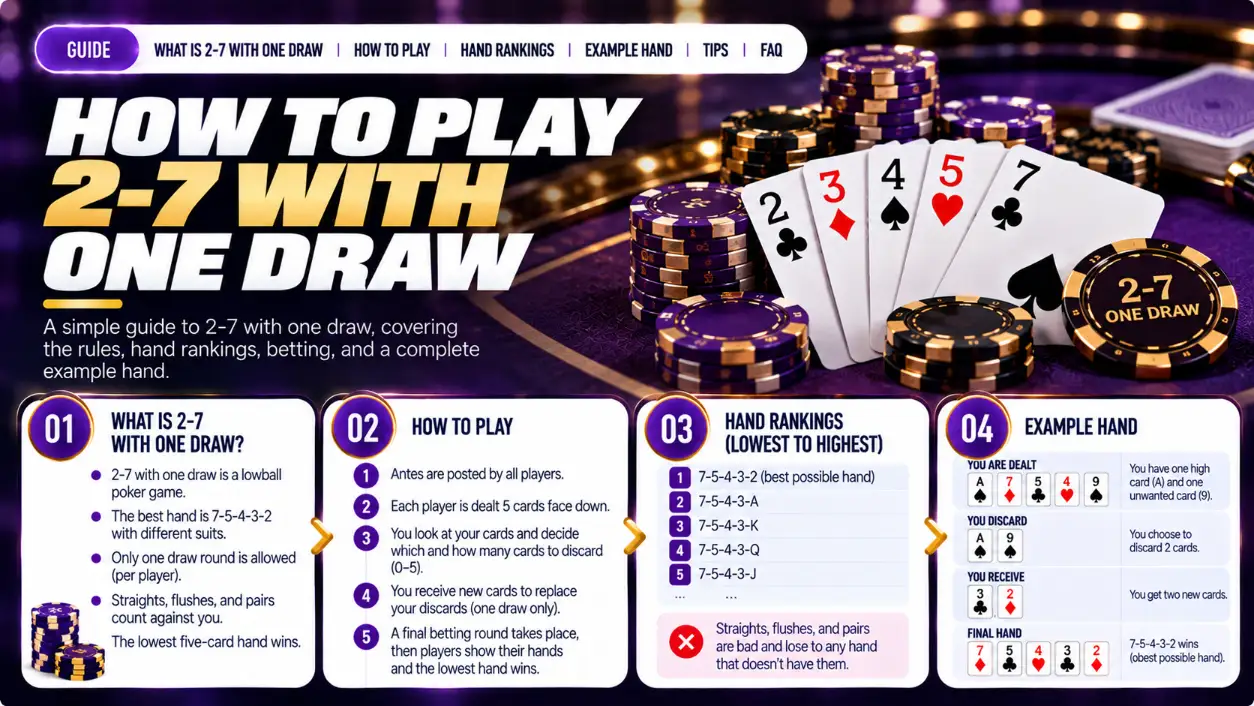
In 2-7 Single Draw, you receive five private cards, play a betting round, replace zero to five cards once, then play a final betting round. At showdown, the best low hand wins: the lowest five-card hand under 2-7 rankings, not the hand with the smallest sum of card values.
The best possible hand is 7-5-4-3-2, not all of the same suit. Aces are always high, while pairs, straights, and flushes count against you. There are no community cards, and this game has nothing to do with playing 7-2 offsuit in Hold’em.
The sequence and core rankings follow the official PokerStars rules, viewed 15 October 2026.
How does Single Draw differ from other lowball games?
2-7 Single Draw has one draw and two betting rounds. One draw means one opportunity to replace cards—not a limit of one replacement card.
| Game | Draws | Betting rounds | Key distinction |
|---|---|---|---|
| 2-7 Single Draw | 1 | 2 | Aces are high; straights and flushes hurt your low hand |
| 2-7 Triple Draw | 3 | 4 | The same basic 2-7 rankings, but three draws |
| Razz | No replacement draw | A different dealing and betting sequence | Different low-hand rankings; its results cannot be applied to 2-7 |
The draw and betting-round counts are confirmed by PokerStars’ official help, viewed 15 October 2026. This guide covers only Single Draw.
How do you play a complete hand?
A complete hand follows five stages: deal, first betting round, draw, final betting round, and showdown if more than one player remains.
- Deal. Each player receives five private cards. The game uses a button and blinds; the table rules may also require an ante, a mandatory contribution before the deal.
- First betting round. In the standard multi-player sequence, action starts to the left of the big blind. Fold to leave the hand, call to match a bet, or raise to increase it. You can check when there is no outstanding bet to match.
- One draw. Choose zero to five cards to replace. Keeping all five is called standing pat. Among players still in the hand, the draw begins with the first active player to the left of the button.
- Final betting round. After the draw, action begins with the first active player to the left of the button.
- Showdown. If multiple players remain, compare their final five-card hands. If everyone but one player folds, no showdown is needed to determine the winner.
This is the sequence in the official rules, viewed 15 October 2026. Heads-up action order can differ; do not automatically apply the multi-player sequence to a two-player game.
Standing pat is not checking: the former keeps your cards, while the latter is a betting action. Drawing two cards is allowed, as is any number from zero to five, but being allowed does not make a choice profitable.
Check the table’s betting structure separately. No-limit describes betting limits, not the number of draws.
How do you identify the better low hand?
Compare the hand category first, then compare ranks from highest to lowest. Adding the card values together does not determine the winner.
Use these checks:
- Look for pairs or other conventional poker combinations. These lose to a hand with no pair, straight, or flush.
- Check the suits. Five cards of the same suit form a flush. Avoiding a flush does not require five different suits—just cards that are not all the same suit.
- Check for consecutive ranks. Five consecutive ranks form a straight. However, A-5-4-3-2 is ace-high, not a straight, because the ace is always high.
- Compare unpaired, non-straight, non-flush hands from the top down. The lower highest card wins. If those cards tie, compare the next highest, continuing until a difference appears.
For worse categories, reverse conventional high-poker rankings: one pair beats two pair, for example, and a lower pair beats a higher pair. These hands remain live rather than being automatically disqualified.
Each row below is an independent ranking example, not part of a jointly dealt hand history. None of the hands shown is a flush.
| Comparison | Better hand | Why |
|---|---|---|
| 7♣5♦4♥3♠2♣ vs. 8♣6♦4♥3♠2♣ | 7♣5♦4♥3♠2♣ | Seven-high beats eight-high |
| 8♣6♦4♥3♠2♣ vs. 8♦6♣5♥3♣2♦ | 8♣6♦4♥3♠2♣ | The eights and sixes tie; the four beats the five |
| A♣5♦4♥3♠2♣ vs. K♣J♦9♥4♠2♣ | K♣J♦9♥4♠2♣ | King-high beats ace-high; A-5-4-3-2 is not a straight |
| 7♣6♦5♥4♠3♣ vs. 9♣7♦5♥3♠2♣ | 9♣7♦5♥3♠2♣ | The first hand is a straight; the second has no pair, straight, or flush |
These comparisons follow the official game rules and the TSG Interactive game plan, printed pages 12–13, both viewed 15 October 2026. The PDF was created on 26 October 2018 and provides historical rules support, not confirmation of every venue’s current procedures.
What can you make by drawing one card to replace a king?
Starting with K♣7♦5♥3♠2♣ and discarding K♣, 12 of 47 possible replacement cards make an eight-low or better in our model: no pair, straight, or flush, and no card higher than an eight.
You keep 7♦5♥3♠2♣ and receive one replacement. For example, 4♦ produces 7♦5♥4♦3♠2♣, the best possible 2-7 low. That four is only one possible outcome.
Original illustrative diagram showing K♣ discarded from K♣7♦5♥3♠2♣ and a possible 4♦ replacement making 7♦5♥4♦3♠2♣; not a screenshot.
Original illustrative diagram: drawing 4♦ in place of K♣ is one possible outcome, not a prediction.
The table gives our complete enumeration. All 47 replacement cards are treated as equally likely: only the original five cards are known, the discarded K♣ is unavailable, and the model excludes known opponent cards and reshuffles.
| Replacement card | Number of cards | Result |
|---|---|---|
| Any 4, 6, or 8 | 12 | Eight-low or better |
| Any 9, 10, J, Q, or remaining K | 19 | Nine-high through king-high, with no pair, straight, or flush |
| Any A | 4 | Unpaired ace-high hand |
| Remaining 7s, 5s, 3s, or 2s | 12 | One pair |
| Total | 47 | Every replacement in the model |
A flush is impossible because of the suits of the four retained cards. A straight is also impossible: one replacement cannot turn 7-5-3-2 into five consecutive ranks.
The resulting probabilities are:
- Eight-low or better: 12/47 = 25.53%.
- Seven-low or better: 8/47 = 17.02%, using the fours and sixes.
Percentages are rounded to two decimal places. This is our calculation of hand-completion probability, not the probability of winning the pot, a command to discard the king, or equity—the expected share of the pot under stated conditions.
How should you use this example when deciding whether to draw or bet?
Use the example to understand possible outcomes, not as a complete strategy. Your decision depends on your current hand, position, opponents’ actions, and the price of continuing.
The number of cards an opponent draws gives information, not certainty about hand strength. Standing pat does not prove a strong hand, and drawing two cards does not prove weakness.
Keep two questions separate:
- How often will I make the target hand? Here, that means counting particular replacements among 47 cards.
- Is calling profitable? That requires considering pot odds, possible opposing hands, and subsequent action. The 25.53% completion rate alone cannot answer it.
The poker equity calculator does not support 2-7. Selecting Razz instead will not produce a valid substitute because its hand rankings differ.
To practice on paper, write down five cards, check for pairs, straights, and flushes, then sort the ranks from highest to lowest. Choose how many cards to replace and list the possible replacements. Start with K♣7♦5♥3♠2♣: separate the 12 target cards from the other 35 and explain why each group belongs in its table row. This checks both your hand comparisons and your understanding of one draw without relying on an unsuitable tool.
Frequently Asked Questions
No. There is no eight-or-better qualifier in 2-7. A higher low hand, a pair, or an even worse hand can win if every opponent has a worse result. The pot is not split between a high hand and a low hand.
No suit takes priority. Hands tied in category and all relevant ranks split the pot. Suits still matter when determining whether a hand is a flush.
PokerStars rules allow a reshuffle when the deck runs short. Follow the venue’s procedure rather than assuming which discarded cards return to the deck. Source: https://www.pokerstars.com/poker/games/draw/2-7/single/ — viewed 15 October 2026.
Evgeniy Volkov
Verified ExpertFullstack developer with a background in mathematics. I build the calculators and game-style tools on ToolsGambling with Pixi.js and modern web tech, and every result uses transparent probability formulas you can verify yourself.