












Contents
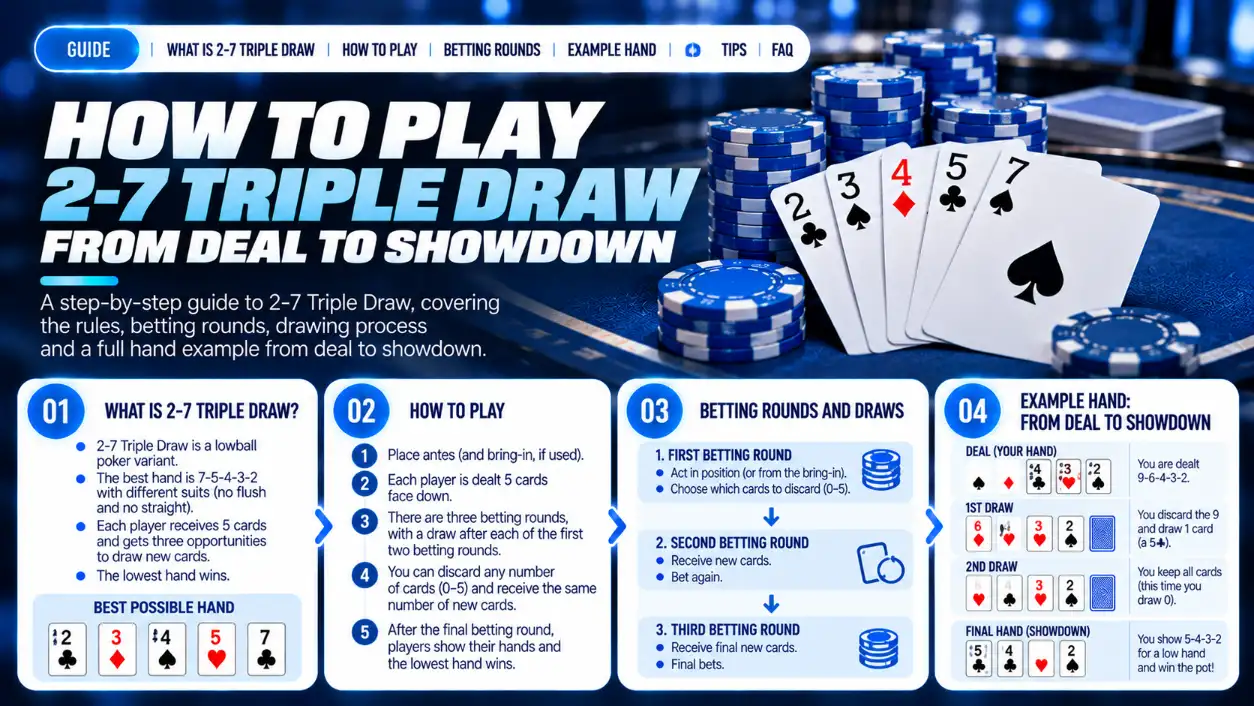
In 2-7 Triple Draw, you receive five private cards and have up to three opportunities to replace cards while trying to make the best 2-7 low hand. There is one betting round before the first draw and another after each draw, for four betting rounds in total. On any draw, you may replace zero to five cards.
Aces are high, and straights and flushes count against you. The best hand is 7-5-4-3-2, not all of the same suit. At showdown, players compare all five cards—not the sum of their ranks. If everyone else folds, the remaining player wins without a showdown or any further draws.
The draw sequence, betting order and hand rankings were checked against the Maryland poker regulations, Chapter 21, pages 56–59. These rules apply to a particular jurisdiction; check your table’s rules separately. Accessed 15 October 2026.
How the Three Draws and Four Betting Rounds Work
A complete hand follows this sequence: five cards → betting round → draw → betting round → draw → betting round → draw → betting round → showdown. Each draw is an opportunity to replace cards, not a requirement to discard any.
The game uses blinds—forced bets posted before the deal. There are no community cards: each player makes a hand from their own five private cards.
| Stage | What happens |
|---|---|
| Deal | You receive five private cards. |
| First betting round | Players act before the first draw. |
| First draw | You may replace zero to five cards. |
| Second betting round | Players bet after the first draw. |
| Second draw | You may again replace zero to five cards, regardless of your previous draw. |
| Third betting round | Players bet after the second draw. |
| Third draw | You have a final opportunity to replace zero to five cards. |
| Fourth betting round | Players make their final betting decisions before showdown. |
| Showdown | The remaining players compare their 2-7 low hands. |
Under the Maryland rules, the first action after the deal depends on the required blind bettor’s position, or on the straddle bettor’s position when a straddle is offered. After each draw, action begins with the first active player to the left of the button. Check the exact opening order for your table’s blind structure.
During a betting round, you may check if no bet is outstanding, or bet when the action allows it. When facing a bet, you may call, raise within the table's rules, or fold. Standing pat does not replace a betting decision: keeping all five cards still leaves you with a decision in the next betting round.
The table shows a complete hand, but play can end earlier. If only one player remains after the others fold, that player takes the pot; the remaining draws are unnecessary.
Which 2-7 Low Hand Wins?
The best five-card hand under 2-7 rankings wins: compare the hand category first, then the relevant ranks. A lower deciding rank is better, but only after accounting for pairs, straights, flushes and other hand categories.
From best to worst, the categories are:
- A hand with no pair, straight or flush.
- One pair.
- Two pair.
- Three of a kind.
- Straight.
- Flush.
- Full house.
- Four of a kind.
- Straight flush.
A pair, straight or flush does not make a hand invalid. You can reach showdown with it, but it loses to a hand in a better 2-7 category. For example, any hand with no pair, straight or flush beats a paired hand.
For hands with no pair, straight or flush, compare them as follows:
- Arrange the five cards from highest rank to lowest.
- Compare the highest cards.
- If they match, compare the second-highest cards, then the third-highest, and so on.
- At the first difference, the lower rank wins.
That is why 7-5-4-3-2 beats 7-6-4-3-2: the sevens match, but the five is lower than the six at the second comparison. Do not add the ranks together.
An ace is always high: A-5-4-3-2 is not the best 2-7 low hand. The sequence 6-5-4-3-2 is a straight, and five cards of the same suit make a flush. The best hand, 7-5-4-3-2, must therefore not be all of the same suit. Suits themselves do not break ties between equal hands.
Worked Example: Two Replacements, Then Stand Pat
In this illustrative hand, you replace one card on the first draw, replace another on the second, and stand pat on the third. Each draw is followed by a separate betting round.
This is a scripted, legal sequence used to explain the rules, not an observed game, a probability calculation or a recommendation about which cards to replace. Assume that you and one opponent remain in the hand through all four betting rounds and reach showdown.
Your starting hand is K♣ 7♦ 5♥ 3♠ 2♣.
| Stage | Cards discarded | Cards received | Your five-card hand | Next step |
|---|---|---|---|---|
| Initial deal | — | K♣ 7♦ 5♥ 3♠ 2♣ | K♣ 7♦ 5♥ 3♠ 2♣ | First betting round |
| First draw | K♣ | 9♣ | 9♣ 7♦ 5♥ 3♠ 2♣ | Second betting round |
| Second draw | 9♣ | 6♥ | 7♦ 6♥ 5♥ 3♠ 2♣ | Third betting round |
| Third draw | None | None | 7♦ 6♥ 5♥ 3♠ 2♣ | Fourth betting round |
After every completed draw, you still have five cards. The first resulting hand, 9-7-5-3-2, has no pair, straight or flush. After the second draw, you have 7-6-5-3-2, also with no pair, straight or flush. On the third draw, you discard nothing: that is what it means to stand pat. You may stand pat on any draw, including on successive draws.
Four rows numbered 0–3: K♣ 7♦ 5♥ 3♠ 2♣, K♣ replaced by 9♣, then 9♣ replaced by 6♥, and the final hand unchanged. The bottom shows the rank comparison 5 > 4.Rows 0–3 show two card replacements and the final hand unchanged, with the rank comparison 5 > 4 at the bottom.
At showdown, your opponent reveals 7♣ 6♦ 4♠ 3♥ 2♦. Here is the comparison:
| Check | Your hand | Opponent's hand | Result |
|---|---|---|---|
| Category | No pair, straight or flush | No pair, straight or flush | Equal |
| Highest rank | 7 | 7 | Equal |
| Second-highest rank | 6 | 6 | Equal |
| Third-highest rank | 5 | 4 | Opponent wins |
7-6-4-3-2 beats 7-6-5-3-2 at the third compared rank: four is lower than five. There is no need to compare the threes or twos.
The opponent's hand is specified here so you can check the result. In a real hand, you do not know an opponent's private cards until they are shown. This example does not establish whether standing pat on the third draw was the right or wrong strategic decision.
Is Triple Draw Always Played with Fixed Limit?
No. Fixed limit is a common betting format for 2-7 Triple Draw, but it is not a universal requirement of the variant. Check the betting structure of the specific table before playing.
2-7 Triple Draw is commonly played with fixed limits: the rules set the bet and raise sizes. That does not mean every game follows one mandatory numerical schedule; the specific amounts depend on the table’s stakes and rules.
How Does Triple Draw Differ from Single Draw, and Which Tools Apply?
The main difference is the number of draw opportunities: Triple Draw has three draws and four betting rounds; Single Draw has one draw and two betting rounds. Both formats use the same 2-7 low-hand rankings.
To verify the example above, record the five cards after each draw, then compare the final hands by category and rank. The ToolsGambling equity calculator does not support 2-7, so it cannot calculate this hand as a 2-7 scenario. Its Razz mode is not a substitute: Razz uses ace-to-five low rankings, a different system.
The rules explain what happens during a hand and who wins at showdown. Choosing which cards to replace, when to stand pat and how to bet are separate strategy questions; one illustrative hand does not answer them. For more on card selection and when to stand pat, see the 2-7 Triple Draw strategy guide.
Frequently Asked Questions
Under the rules used here, discarded cards are reshuffled if the deck runs short. Another venue may use a different procedure; check your table’s rules.
No. The 2-7 Triple Draw rules described here have no eight-or-better qualifier. The best remaining hand under 2-7 rankings wins; even a paired hand can win if the opponents have worse hands.
Evgeniy Volkov
Verified ExpertFullstack developer with a background in mathematics. I build the calculators and game-style tools on ToolsGambling with Pixi.js and modern web tech, and every result uses transparent probability formulas you can verify yourself.