












Contents
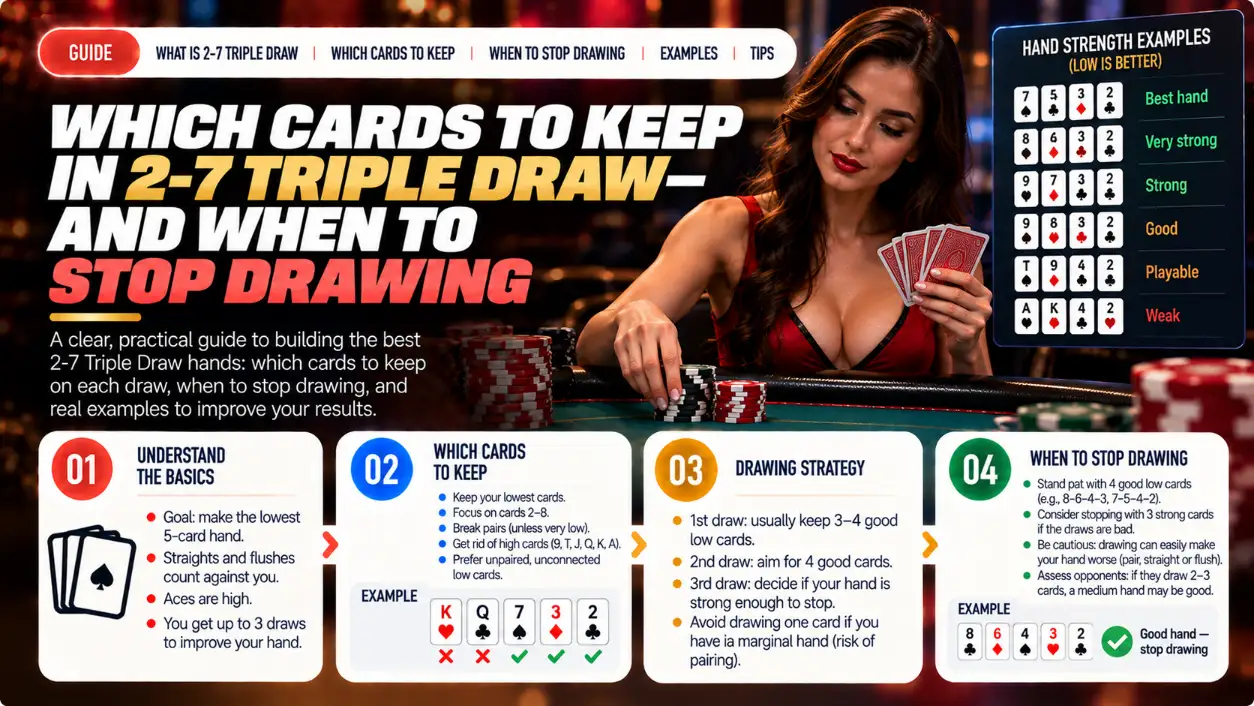
Keep distinct low ranks that can develop into a strong 2-7 low hand without a pair, straight or flush. Duplicates, aces and high cards are usually the first discard candidates. Stand pat—keep all five cards—only after comparing your made hand with the potential benefit of drawing. Consider the draws remaining, opponents’ draw counts, position and the cost of continuing. There is no universal “jack-low or better” threshold: sometimes keeping a made low makes sense; sometimes breaking it offers a better way forward.
Four questions to ask before drawing
Check your made hand, the cards you would keep, the draws remaining and your opponents’ actions together. No single factor settles the decision.
- Do you already have a made low without a pair, straight or flush? If so, compare standing pat with drawing rather than automatically discarding the highest card.
- Which four or three distinct ranks would remain after your discards? Look beyond how low they are: identify replacements that would pair your hand or make a straight.
- How many draws remain? On the final draw, you cannot repair a bad replacement with another exchange.
- What do opponents’ draw counts, position and the bet price suggest? These provide context, not knowledge of their exact cards.
As a brief rules reminder, Maryland poker regulations, Chapter 21, pages 57–59 make aces high and pairs, straights and flushes harmful to a 2-7 low hand. You may discard zero to five cards, so keeping all five is a choice—not an obligation whenever you have a made hand. For more on how the game works, see the 2-7 Triple Draw rules guide.
Which cards to keep before the first draw
Choose distinct low ranks with useful ways to improve, rather than simply keeping the lowest cards individually. A promising group of cards needs good replacement possibilities as well as low ranks.
If you decide to continue with a pair, you will usually consider keeping one card of that rank and discarding the duplicate. An ace does not serve as the lowest card in 2-7: it is high. Kings and other high cards are also common discard candidates, but assess the whole hand before deciding.
Two traps deserve particular attention:
- Connected ranks: Four low cards can look attractive while several replacements would make a straight.
- Matching suits: If you keep four cards of one suit, another card of that suit makes a flush. Rank alone is not enough to evaluate that draw.
You may see draws described as smooth or rough. A smooth draw has lower supporting ranks, offering the prospect of a stronger low; a rough draw has higher supporting ranks, leaving a weaker low even when it improves. Those labels do not replace checking the exact ranks, including straight traps.
Having three or four low cards is not automatically a reason to enter a pot. Assess your starting hand in light of your position and the action. A decision that fits a particular heads-up situation is not a universal rule for starting-hand selection.
Why two one-card draws can differ so much
The four cards you keep determine the quality of a one-card draw. Drawing the same number of cards does not mean having the same number of useful replacements.
Compare these two known five-card holdings. In both, you discard K♥ and aim to finish the immediate draw with an 8-low or better: five unpaired cards, no straight or flush, and no rank above eight. This is a target hand category, not a qualifying rule or a promise of winning.
The model treats all 47 unseen cards as equally likely replacements, excludes all five original cards—including the discarded K♥—and rounds percentages to two decimal places. It does not model opponents, previous discards or later draws.
| Starting hand | Cards kept | Qualifying replacement ranks | Qualifying cards out of 47 | Probability |
|---|---|---|---|---|
| 2♣ 3♦ 4♥ 7♠ K♥ | 2♣ 3♦ 4♥ 7♠ | 5, 6, 8 — all four suits each | 12/47 | 25.53% |
| 4♣ 5♦ 6♥ 7♠ K♥ | 4♣ 5♦ 6♥ 7♠ | Only 2 — all four suits | 4/47 | 8.51% |
Discarding K♥: 2♣ 3♦ 4♥ 7♠ improves to an 8-low or better with a 5, 6 or 8, for 12/47; 4♣ 5♦ 6♥ 7♠ needs a 2, for 4/47, because a 3 or 8 makes a straight.
ToolsGambling’s one-draw comparison measures the probability of making an 8-low or better on the immediate replacement—not the probability of winning.
The first hand has four qualifying cards in each of three ranks: 5, 6 and 8. The second has only the four deuces. A three makes the straight 3-4-5-6-7, while an eight makes 4-5-6-7-8. Both four-card keeps contain mixed suits, so no single replacement can make a flush.
How the 12/47 and 4/47 counts work
The calculation enumerates all 47 unseen physical cards after removing the five original cards from a 52-card deck. It counts replacements that meet the stated target, rather than estimating showdown results.
Each possible replacement is tested against four conditions: five distinct ranks, a highest rank no greater than eight, no straight and no flush. The discarded K♥ remains a known card and is excluded from the possible replacements.
Rounded to two decimal places, the results are 12/47 = 25.53% and 4/47 = 8.51%. Each of the 47 unseen cards is assumed equally likely.
These are probabilities of reaching a specified hand category on one immediate draw. They do not establish:
- Your probability of winning at showdown.
- Your probability of making that hand across all three draws.
- Whether betting or calling is profitable.
- Whether the starting hand is profitable to play in every situation.
Previously discarded or known dead cards, information about opponents, later draws and possible reshuffles require a different model. You cannot simply multiply this result or use a denominator of 47³ for the whole hand.
How to reassess after every draw
Evaluate the new hand from scratch after each draw. Your earlier plan does not commit you to keep drawing—or to stop.
The following is a possible sequence, not a claim of optimal play:
| Decision point | Hand before the decision | Action in this example | Resulting hand |
|---|---|---|---|
| First draw | 2♣ 3♦ 4♥ 7♠ K♥ | Discard K♥ → receive 9♣ | 2♣ 3♦ 4♥ 7♠ 9♣ |
| Second draw | 2♣ 3♦ 4♥ 7♠ 9♣ | Discard 9♣ → receive 8♦ | 2♣ 3♦ 4♥ 7♠ 8♦ |
| Third draw | 2♣ 3♦ 4♥ 7♠ 8♦ | Discard zero cards | 2♣ 3♦ 4♥ 7♠ 8♦ |
Possible draw sequence: start with 2♣ 3♦ 4♥ 7♠ K♥, replace K♥ with 9♣, replace 9♣ with 8♦, then keep all five cards on the final draw.
An illustrative ToolsGambling sequence—not a probability calculation or a recommendation to stand pat with the final hand in every situation.
The first replacement produces 9-7-4-3-2, a made low. Drawing again gives up that nine-low but preserves 2♣ 3♦ 4♥ 7♠ as a four-card draw to a stronger hand. In this sequence, the replacement is 8♦, and the player keeps 8-7-4-3-2.
The final decision to stand pat is not presented as optimal. If an opponent already has a better made low, keeping this eight-low can lose. If the opponent is still drawing one card, standing pat may be defensible, but no win equity has been calculated here.
The first draw deliberately misses the “8-low or better” target by producing 9♣. The sequence therefore does not depict a successful outcome of the 12/47 calculation.
When to stand pat—and when to break a made low
Stand pat when the value of keeping your current hand outweighs the potential benefit and risk of drawing in that situation. Consider breaking a made low when it appears insufficient and the cards you would retain offer a useful route to improvement.
| Situation | What to consider | Why the decision is not automatic |
|---|---|---|
| Made eight-low; opponent is still drawing | Keeping all five cards | Eight-lows differ in their lower ranks, and the opponent can still improve |
| Made nine-low; opponent stands pat | Drawing to improve if discarding the nine leaves a useful four-card draw | The opponent’s pat does not prove strength, and drawing can worsen your hand |
| Made jack-low; opponent is drawing | Comparing the value of keeping the jack with trying to improve | Their draw count, your other four cards, position and cost of continuing all matter |
| Made jack-low; opponent stands pat and bets | Reconsidering both your draw decision and whether to continue | Neither the adequacy of your jack-low nor the opponent’s exact hand is known |
These are decision prompts, not fixed playing ranges.
The quality of the cards you keep and your opponents’ draw counts matter. CardPlayer’s analysis, pages 34–35 shows that a made jack-low may be kept or broken depending on the underlying four-card draw and the action. This is a contextual strategy example, not a rule to “always pat a jack.”
How position and the cost of continuing affect the decision
Use position to gather information and evaluate the bet price separately from draw quality. A count of useful replacements cannot substitute for either assessment.
When you act later in the draw, you can see how many cards opponents replace. Drawing one, drawing several or standing pat helps you assess the situation, but none reveals exact cards.
The price of a call matters too. An attractive draw does not justify paying any bet to pursue it. That decision needs an assessment of your chance of winning, accounting for opponents and future action; the 12/47 count does not provide it.
Before committing, ask:
- What am I keeping, and which replacements actually help?
- Which replacements make a pair, straight or flush?
- Will I have another draw if this one goes badly?
- What has changed in my opponents’ actions?
- Is continuing worth the current price, apart from my desire to improve?
ToolsGambling’s equity calculator does not support 2-7. These examples help you assess one draw’s quality; they are not instructions for entering a hand into that calculator. Do not use 25.53% as your winning probability when evaluating a call.
Frequently Asked Questions
No. A player can keep all five cards as a bluff, representing a strong low. This is called snowing. Draw counts are useful signals, but they do not prove what a player holds.
No. Standing pat means keeping all five cards rather than drawing replacements. Checking is a separate betting decision.
There is no universal requirement to play only hands containing a deuce. A deuce is useful for building a low, but whether to enter a pot depends on your other cards, position, opponents' actions and the cost of continuing.
Evgeniy Volkov
Verified ExpertFullstack developer with a background in mathematics. I build the calculators and game-style tools on ToolsGambling with Pixi.js and modern web tech, and every result uses transparent probability formulas you can verify yourself.