












Contents
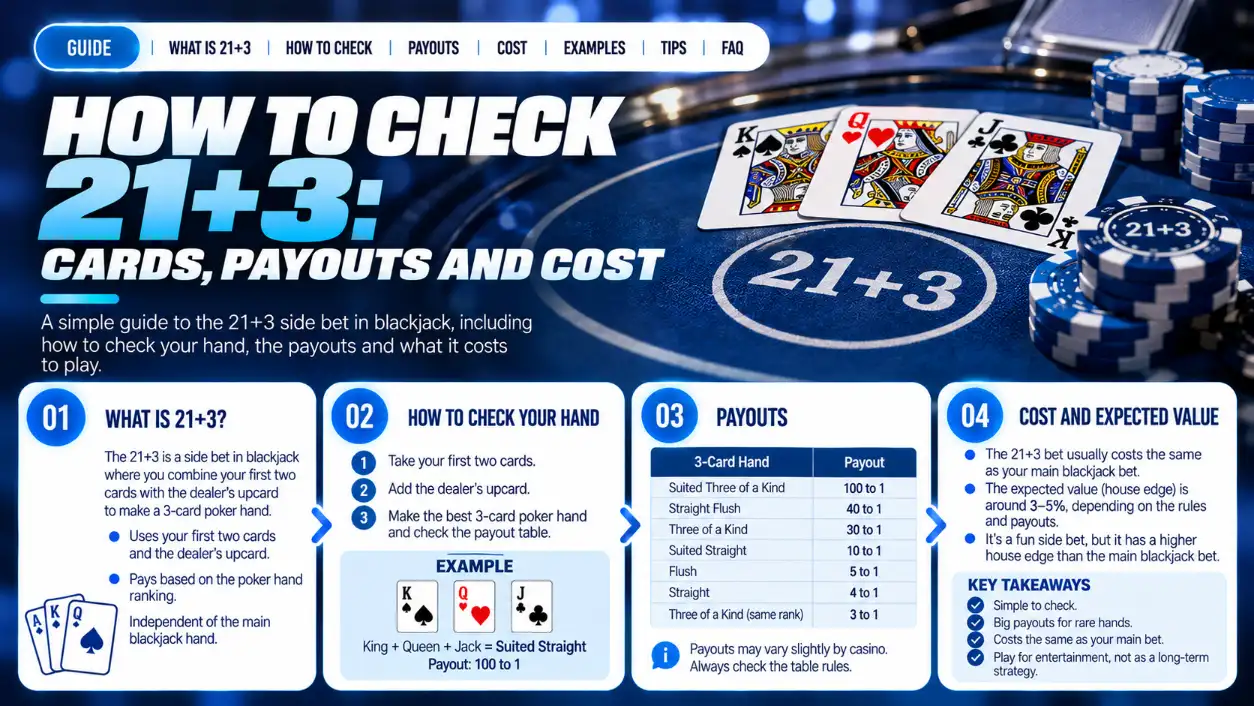
21+3 is a blackjack side bet using the player’s first two cards and the dealer’s upcard to form a three-card poker hand. It does not depend on those cards adding up to 21. The payout depends on the table’s actual paytable—not just the name Classic or Xtreme.
Under the Galaxy Blackjack rules published by the Washington State Gambling Commission, the side bet is placed before any cards are dealt and settled separately from the main wager. A winning blackjack hand is therefore not required for a 21+3 payout, and a winning side bet does not mean the main hand wins. This guide covers those published rules and a separately identified Wizard of Odds paytable, not every version of 21+3.
Which three cards count?
Only the player’s first two cards and the dealer’s upcard count. The dealer’s hole card and any cards drawn later are excluded; see page 2 and Appendices G–H on pages 18–19 of the rules.
For example, a player’s 8♥ and 9♥ combine with the dealer’s 10♥ to make a straight flush: three consecutive ranks of the same suit.
21+3 instructional diagram showing the player’s 8♥ and 9♥ with the dealer’s 10♥ upcard forming a straight flushOriginal instructional diagram, not an actual table screenshot; the payout depends on the actual paytable.
Which hands qualify?
The paytables covered here pay for four categories: a flush, straight, three of a kind and straight flush. Their payouts appear in Appendices G and H of the Galaxy Blackjack rules.
| Hand | Meaning | Example |
|---|---|---|
| Flush | Three cards of the same suit, excluding a straight flush | 2♥, 6♥, J♥ |
| Straight | Three consecutive ranks, not all of the same suit | 8♥, 9♣, 10♦ |
| Three of a kind | Three cards of the same rank | 7♥, 7♣, 7♦ |
| Straight flush | Three consecutive ranks of the same suit | 8♥, 9♥, 10♥ |
These categories are counted separately: a straight flush does not also receive the straight and flush payouts. The same non-overlapping classification is used in the calculations below.
In a multi-deck game, three cards can share both rank and suit—for example, three copies of 7♥ from different decks. The cited PDF paytables do not provide a separate prize for this “suited three of a kind,” so an extra payout must not be assumed.
How do Classic and the two Xtreme paytables differ?
The PDF’s Classic paytable pays 9:1 for all four qualifying hands. The two Xtreme paytables differ on straight flush and three-of-a-kind payouts. Compare every payout rather than relying on the version name.
All ratios below express net profit on a winning side bet. The original stake is returned separately.
| Hand | Classic: regulator PDF, Appendix G | Xtreme: regulator PDF, Appendix H | Xtreme: Wizard of Odds |
|---|---|---|---|
| Straight flush | 9:1 | 40:1 | 30:1 |
| Three of a kind | 9:1 | 30:1 | 20:1 |
| Straight | 9:1 | 10:1 | 10:1 |
| Flush | 9:1 | 5:1 | 5:1 |
| No qualifying hand | Stake lost | Stake lost | Stake lost |
The regulator source is Galaxy Blackjack v5.00, May 31, 2017, amended June 30, 2021, Appendices G–H, pages 18–19. It permits these versions with 2–8 decks; it does not establish the rules of every casino table. The Wizard of Odds analysis, updated August 3, 2026, analyzes a flat 9:1 schedule and an Xtreme schedule of 30/20/10/5, among other versions. It is not the same paytable as the regulator PDF’s 40/30/10/5.
This is not an exhaustive list. Galaxy Gaming’s product page, checked October 15, 2026, describes Xtreme as customizable and describes winning hands as a straight or better. That product description does not establish a particular operator’s payouts. Neither Xtreme schedule above should be treated as universal.
What does 9:1 pay on a $5 bet?
A winning $5 bet at 9:1 earns $45 in net profit, for a $50 total return including the original stake.
- Net profit:
$5 × 9 = $45 - Total return:
$45 + $5 = $50
For comparison, a straight flush under the regulator PDF’s Xtreme schedule pays 40:1: a $5 stake earns $200 in net profit and a $205 total return. These examples assume a qualifying hand under the specified PDF paytable. They describe individual winning outcomes, not the expected result of repeated bets.
What does 21+3 cost in a six-deck model?
The modeled house edge is 3.24% for Classic 9/9/9/9, 6.07% for the regulator PDF’s Xtreme 40/30/10/5, and 13.39% for Wizard of Odds’ Xtreme 30/20/10/5. The 13.39% figure must not be attributed to the PDF version.
House edge measures expected loss per unit of side-bet stake. It is neither the probability of losing nor a percentage of the main blackjack wager.
What probabilities does the model use?
The model counts all unordered three-card combinations from a fresh six-deck shoe of 312 cards, with no information about other exposed or previously dealt cards.
C(312, 3) = 312 × 311 × 310 / 6 = 5,013,320
The category counts match the six-deck counts in the Wizard of Odds mathematical analysis.
| Non-overlapping category | Three-card combinations |
|---|---|
| Straight flush | 10,368 |
| Three of a kind | 26,312 |
| Straight | 155,520 |
| Flush | 292,896 |
| Loss | 4,528,224 |
| Total | 5,013,320 |
To reproduce the house edge, let a, b, c and d be the net-profit payout multipliers for straight flush, three of a kind, straight and flush:
House edge = [4,528,224 − (10,368 × a + 26,312 × b + 155,520 × c + 292,896 × d)] / 5,013,320
| Paytable | Multipliers: a / b / c / d | House edge before rounding | Rounded |
|---|---|---|---|
| Classic from the PDF | 9 / 9 / 9 / 9 | 3.238572% | 3.24% |
| Xtreme from the PDF | 40 / 30 / 10 / 5 | 6.073101% | 6.07% |
| Xtreme from Wizard of Odds | 30 / 20 / 10 / 5 | 13.389610% | 13.39% |
The PDF Xtreme percentage is our calculation using the formula above and Wizard of Odds’ modeled category counts, not a percentage declared by the regulator.
The probability of any payout is the same across these three models because they use the same winning categories:
(10,368 + 26,312 + 155,520 + 292,896) / 5,013,320 × 100% = 9.676143%
That is not theoretical RTP. Theoretical RTP equals one minus the house edge and accounts for payout amounts, not just how often a qualifying hand occurs.
How does house edge translate into expected loss?
Expected loss equals total side-bet turnover multiplied by the applicable house edge.
For a hypothetical 100 bets of $5 under the six-deck Classic model:
Turnover = 100 × $5 = $500
Using the unrounded modeled house edge gives an expected loss of approximately $16.19. Using the rounded 3.24% gives:
$500 × 0.0324 = $16.20
The difference comes from rounding the percentage. This assumes the stated six-deck paytable and model throughout; it is an expectation, not a forecast of personal losses. Actual results over 100 rounds can differ substantially.
How can you check a table and model its cost?
First confirm the table’s deck count and every paytable row; only then use a matching house edge. A shared version name is not enough.
Use this repeatable check:
- Find the deck count in the table rules. The percentages above apply to six decks only.
- Open that table’s paytable. Compare straight flush, three of a kind, straight and flush separately.
- Check for extra categories or exceptions. A separate suited-three-of-a-kind prize or another rule change means the percentages above cannot automatically be reused.
- Check what the payout notation means. In the cited schedules, 9:1 means nine stakes of net profit plus return of the original stake—not a total return of nine stakes.
The ToolsGambling House Edge Calculator models expected loss from an already known house edge. It does not identify table rules, select a 21+3 paytable or calculate the distribution of three-card hands.
To reproduce the rounded Classic cost example:
- Check Enter a custom house edge.
- Enter a house edge of 3.24%.
- Enter $5 in Bet Size per Round.
- Select By rounds.
- Enter 100 in Number of Rounds.
The result is approximately $16.20, because the entered percentage is rounded. Do not use Blackjack (basic strategy) as a 21+3 calculation: that preset concerns the main game.
If the deck count or paytable differs, a matching mathematical calculation is needed first; substituting the nearest familiar percentage is not valid. Decisions on the main hand are covered separately in the blackjack guide and should not be confused with modeling the side bet’s cost.
Frequently Asked Questions
A pair alone does not pay under Classic or Xtreme in Appendices G and H of the Galaxy Blackjack rules. However, the three cards may qualify for another category: in a multi-deck game, two cards of the same rank do not rule out a flush. Check all three cards against the table’s paytable.
Basic strategy governs decisions on the main blackjack hand, not the 21+3 side bet. The side-bet hand is fixed by the player’s first two cards and the dealer’s upcard; later decisions on the main hand do not change it.
Evgeniy Volkov
Verified ExpertFullstack developer with a background in mathematics. I build the calculators and game-style tools on ToolsGambling with Pixi.js and modern web tech, and every result uses transparent probability formulas you can verify yourself.