












Contents
You're at a $15 blackjack table, holding a hard 12 against the dealer's 3. You think you should stand, it feels safe. But that gut decision just cost you money. The mathematically correct play is to hit, and mistakes like this one are why the average player faces a 2-5% house edge instead of the 0.5% that basic strategy promises.
The gap between a clueless player and a well-prepared one is enormous, roughly $50-$100 per hour at a standard table. These 20 blackjack tips are ranked from beginner fundamentals to advanced edge-cutting techniques, and every single one is backed by math, not superstition. As of 2026, these are the same principles used by professional players, card counters, and advantage gamblers worldwide.
Whether you've never touched a blackjack table or you've been playing for years and want to plug leaks in your game, this guide covers everything: complete strategy tables, a rule-variation breakdown, a house edge calculator to test your specific table, and a 10-question quiz to see where you actually stand.
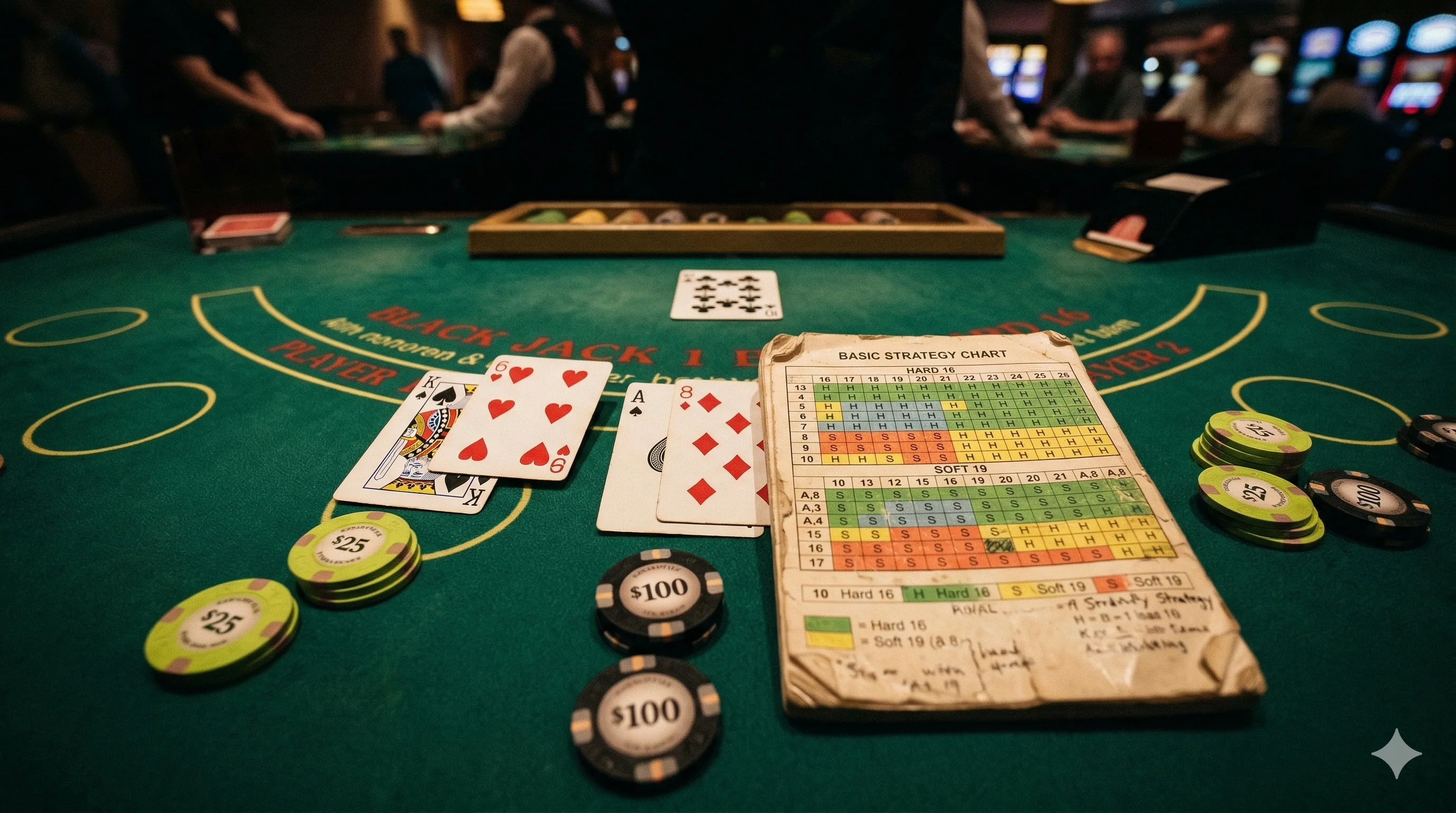
The single biggest tip is to play by a chart, so try our free blackjack cheat sheet generator for the exact play in any game.
TL;DR, Blackjack Tips Quick Reference
The 20 Tips at a Glance
| # | Tip | Impact |
|---|---|---|
| 1 | Learn basic strategy | Cuts edge from ~2.5% to ~0.5% |
| 2 | Never take insurance | Saves 7.4% on that side bet |
| 3 | Always split aces and eights | Turns losing hands into winners |
| 4 | Never split tens or fives | Protects winning positions |
| 5 | Stand on hard 17+ | No improvement possible |
| 6 | Hit hard 12-16 vs dealer 7-A | Dealer likely has 17+ already |
| 7 | Set a bankroll (30-50× min bet) | Survive normal variance |
| 8 | Double on 11 vs 2-10 | Maximum value extraction |
| 9 | Double on 10 vs 2-9 | Strong position, weak dealer |
| 10 | Learn soft hand strategy | Most misplayed category |
| 11 | Choose tables with favorable rules | S17 + 3:2 + DAS = lowest edge |
| 12 | Understand deck count impact | Fewer decks = lower edge |
| 13 | Use stop-loss and win goals | Discipline beats luck |
| 14 | Avoid side bets | 5-11% house edge traps |
| 15 | Learn when to surrender | Save half your bet on bad hands |
| 16 | Adjust strategy for H17 vs S17 | 0.22% edge difference |
| 17 | Use true count awareness | Deck-dependent decisions |
| 18 | Take early payout when offered | EV-positive on specific hands |
| 19 | Practice with free trainers | Build muscle memory risk-free |
| 20 | Know your expected loss per hour | Play with eyes open |
Beginner Blackjack Tips (1-7)
These seven tips alone will take you from "average player" to "better than 90% of the table." None of them require memorization beyond a few simple rules, they're the low-hanging fruit that immediately cuts the house edge.
Tip 1: Learn Basic Strategy Before You Sit Down
Basic strategy is the mathematically optimal play for every possible hand in blackjack. It was derived from computer simulations running billions of hands, and it tells you exactly when to hit, stand, double, split, or surrender based on your cards and the dealer's upcard.
The difference is staggering: without strategy, you face a 2-5% house edge. With perfect basic strategy, that drops to roughly 0.5%. On a $15 table playing 70 hands per hour, that's the difference between losing $52.50/hour and losing $5.25/hour.
You don't need to memorize the entire chart on day one. Start with the basic strategy flashcard trainer, it uses spaced repetition to drill all 270 decisions until they become automatic. Most players achieve full memorization in 2-3 weeks with 15-20 minutes of daily practice.
Tip 2: Never Take Insurance
When the dealer shows an ace, they'll offer you "insurance", a side bet paying 2:1 that the dealer has a 10-value card in the hole. It sounds reasonable. It's not.
Here's the math: in a standard deck, 30.8% of cards are 10-value (10, J, Q, K). For a 2:1 bet to break even, you'd need a 33.3% probability. That gap means insurance carries a 7.4% house edge, roughly 15 times worse than the base game with basic strategy.
Even when you have blackjack yourself and the dealer offers "even money" (which is mathematically identical to insurance), decline it. You'll make more money in the long run by letting the hand play out.
Tip 3: Always Split Aces and Eights
This is one of the few blackjack rules with zero exceptions:
- Aces: Two aces give you either 2 or 12, both terrible starting positions. Split them and you have two hands starting at 11, the strongest foundation in blackjack. Even though most casinos only allow one card per split ace, the expected value is dramatically higher.
- Eights: A pair of eights totals 16, which is the worst hand in blackjack. You can't improve much by hitting, and standing against a dealer showing 7 or higher is equally bad. Splitting gives you two hands starting at 8, with a reasonable chance of drawing to 18.
For more on the math behind splitting decisions, see when to split tens, spoiler: almost never.
Tip 4: Never Split Tens or Fives
Tens: A pair of tens is 20, the second-best hand in blackjack. Only a fool breaks that up hoping for two better hands. The EV of standing on 20 is far higher than splitting into two hands starting at 10, regardless of what the dealer shows.
Fives: A pair of fives is 10, which is a strong doubling hand. If you split, you get two hands starting at 5, one of the weakest positions possible. Always treat 5-5 as a hard 10 and double down against dealer 2-9.
Tip 5: Stand on Hard 17 or Higher
Once your hand totals hard 17 or more, hit the brakes. The probability of improving by hitting is tiny, and the probability of busting is enormous:
| Your Hand | Bust Probability if You Hit |
|---|---|
| Hard 17 | 69.2% |
| Hard 18 | 76.9% |
| Hard 19 | 84.6% |
| Hard 20 | 92.3% |
No basic strategy chart in existence tells you to hit hard 17+. This is the easiest rule to follow and one of the most important.
Tip 6: Hit Hard 12-16 Against Dealer 7-Ace
This is where most players go wrong. When the dealer shows a 7 or higher, their expected final hand is 17+. If you're sitting on hard 14, you're already behind, standing just locks in the loss.
Yes, hitting hard 15 against a dealer 10 feels terrible. You'll bust about 58% of the time. But standing only wins about 23% of the time because the dealer's expected hand is so strong. Hitting is the lesser of two evils.
The exception: hard 12 against dealer 2 or 3. You still hit against 2 (many players don't), but you stand against 4, 5, and 6 because those are the dealer's bust cards. For a deep dive into the hardest of these decisions, check out the 13 vs dealer 2 analysis.
Tip 7: Set a Bankroll Before You Play
The fastest way to lose money at blackjack isn't bad strategy, it's running out of chips during a normal downswing and not having the bankroll to recover. Variance is real, even with perfect play.
Bankroll rule of thumb: Bring 30-50 times your minimum bet per session.
| Table Minimum | Recommended Bankroll |
|---|---|
| $5 | $150 - $250 |
| $10 | $300 - $500 |
| $15 | $450 - $750 |
| $25 | $750 - $1,250 |
Use our bankroll calculator to find the exact number for your risk tolerance. And never play with money you can't afford to lose, that's not a tip, it's a rule.
Basic Strategy Tables, The Complete Cheat Sheet (2026)
These tables represent the mathematically optimal play for standard 4-8 deck games where the dealer stands on soft 17 (S17) and double after split is allowed (DAS). Print them, screenshot them, or keep this page open while you play online, there's zero shame in using a chart.
Hard Totals
| Your Hand | 2 | 3 | 4 | 5 | 6 | 7 | 8 | 9 | 10 | A |
|---|---|---|---|---|---|---|---|---|---|---|
| 5-8 | H | H | H | H | H | H | H | H | H | H |
| 9 | H | D | D | D | D | H | H | H | H | H |
| 10 | D | D | D | D | D | D | D | D | H | H |
| 11 | D | D | D | D | D | D | D | D | D | H |
| 12 | H | H | S | S | S | H | H | H | H | H |
| 13 | S | S | S | S | S | H | H | H | H | H |
| 14 | S | S | S | S | S | H | H | H | H | H |
| 15 | S | S | S | S | S | H | H | H | Rh | H |
| 16 | S | S | S | S | S | H | H | Rh | Rh | Rh |
| 17+ | S | S | S | S | S | S | S | S | S | S |
Soft Totals
| Your Hand | 2 | 3 | 4 | 5 | 6 | 7 | 8 | 9 | 10 | A |
|---|---|---|---|---|---|---|---|---|---|---|
| A,2 | H | H | H | D | D | H | H | H | H | H |
| A,3 | H | H | H | D | D | H | H | H | H | H |
| A,4 | H | H | D | D | D | H | H | H | H | H |
| A,5 | H | H | D | D | D | H | H | H | H | H |
| A,6 | H | D | D | D | D | H | H | H | H | H |
| A,7 | S | Ds | Ds | Ds | Ds | S | S | H | H | H |
| A,8 | S | S | S | S | S | S | S | S | S | S |
| A,9 | S | S | S | S | S | S | S | S | S | S |
Pairs
| Your Hand | 2 | 3 | 4 | 5 | 6 | 7 | 8 | 9 | 10 | A |
|---|---|---|---|---|---|---|---|---|---|---|
| 2,2 | P | P | P | P | P | P | H | H | H | H |
| 3,3 | P | P | P | P | P | P | H | H | H | H |
| 4,4 | H | H | H | P | P | H | H | H | H | H |
| 5,5 | D | D | D | D | D | D | D | D | H | H |
| 6,6 | P | P | P | P | P | H | H | H | H | H |
| 7,7 | P | P | P | P | P | P | H | H | H | H |
| 8,8 | P | P | P | P | P | P | P | P | P | P |
| 9,9 | P | P | P | P | P | S | P | P | S | S |
| 10,10 | S | S | S | S | S | S | S | S | S | S |
| A,A | P | P | P | P | P | P | P | P | P | P |
Key: H/S/D/P/Rh/Ds Explained
- H = Hit
- S = Stand
- D = Double down (hit if not allowed)
- Ds = Double down (stand if not allowed)
- P = Split
- Rh = Surrender (hit if not allowed)
When the Table Rules Change Things
These charts assume S17 + DAS + 3:2 payouts. If your table differs:
- H17 tables: Double on 11 vs Ace, double on soft 18 vs 2, surrender 15 vs Ace
- No DAS: Don't split 2s, 3s, or 6s vs 2 or 3; don't split 4s at all
- 6:5 payouts: The chart still applies, but your expected loss roughly triples, find a 3:2 table instead
For a rule-by-rule breakdown of how double deck changes strategy, we've written a complete guide.
| Strategy | House Edge (%) |
|---|---|
| Deck Count Awareness (1-2D) | 0.35 |
| Perfect Basic Strategy (4D S17 3:2) | 0.5 |
| Table Selection (S17, 3:2, DAS) | 0.75 |
| No Insurance Discipline | 1.2 |
| Proper Splitting | 1.5 |
| Surrender When Available | 1.8 |
| 6:5 Blackjack Payout | 2.0 |
| Average Player (No Strategy) | 2.5 |
| Typical Side Bets | 5.0 |
Intermediate Blackjack Tips (8-14)
Once you've nailed the basics, these seven tips squeeze out additional edge by optimizing your doubling decisions, table selection, and discipline.
Tip 8: Double Down on 11 Against Everything Except Ace
A total of 11 is the strongest doubling hand in blackjack. With the next card, you have roughly a 31% chance of hitting 21. Against dealer upcards 2 through 10, the expected value of doubling vastly exceeds hitting.
The only exception: against a dealer ace on S17 tables, the dealer's advantage is enough to make hitting slightly better than doubling. On H17 tables, you still double on 11 vs ace, the dealer's forced hit on soft 17 swings the math back in your favor.
Tip 9: Double Down on 10 Against 2-9
A hard 10 is nearly as powerful as 11 for doubling. Against dealer upcards 2 through 9, the expected value favors putting out that extra bet. The logic: you're likely to draw to 18-20, and the dealer's upcard range of 2-9 doesn't project strongly enough to overcome your position.
Against 10 or ace, just hit. The dealer's hand is too strong to risk doubling.
Tip 10: Learn Soft Hand Strategy
Soft hands (any hand with an ace counted as 11) are the most misplayed category in blackjack. The key insight: you can't bust on a soft hand by hitting, which means you can afford to be aggressive.
Common mistakes:
- Standing on soft 17 (A,6): You should always hit. Soft 17 averages worse than hard 17 because you have room to improve.
- Standing on soft 18 (A,7) vs 9, 10, or Ace: Hit. The dealer projects to beat 18 too often.
- Not doubling soft 13-17 vs 5 or 6: The dealer is in bust territory, extract maximum value.
Tip 11: Choose Tables with Favorable Rules
Not all blackjack tables are created equal. A few rule changes can double or triple the house edge without most players even noticing.
What to Look For
- 3:2 blackjack payouts, the single most important rule
- Dealer stands on soft 17 (S17), saves you 0.22%
- Double after split allowed (DAS), saves about 0.14%
- Late surrender available, saves about 0.08%
- Re-splitting aces allowed, saves about 0.06%
Red Flags to Avoid
- 6:5 blackjack payouts, adds 1.39% to house edge
- Dealer hits soft 17 (H17), adds 0.22%
- No double after split, adds 0.14%
- Blackjack pays even money, adds 2.27%
- Continuous shuffling machine, makes card counting impossible
The ideal table: 4-6 deck, S17, DAS, late surrender, 3:2 payouts. Run your specific table through our house edge calculator to see the exact number. For a casino-by-casino breakdown, our Atlantic City blackjack rules guide shows how rules vary between properties.
Tip 12: Understand the Impact of Deck Count
Fewer decks mean a lower house edge, about 0.48% difference between single deck and eight deck, all else being equal. Here's why: with fewer decks, blackjacks are slightly more common, doubles are more effective, and the player advantage from 3:2 payouts is amplified.
But here's the trap: casinos know this. Single-deck and double-deck games almost always come with worse rules (6:5 payouts, no DAS, H17) that more than offset the deck-count advantage. Always calculate the total house edge, deck count alone tells you nothing.
See what a shoe actually is and why 6-8 deck games dominate the modern casino floor.
Tip 13: Use Stop-Loss and Win Goals
Basic strategy tells you what to do with each hand, but it says nothing about when to walk away. That's where session management comes in.
Stop-loss: Decide before you sit down how much you're willing to lose. When you hit that number, leave. No exceptions. A 50% stop-loss (lose half your session bankroll) is common.
Win goal: Pick a profit target, 30-50% of your starting bankroll is reasonable. When you hit it, lock up some profit. You don't have to leave, but move your original buy-in plus some winnings to a "don't touch" pile.
These aren't math-based tips, they're psychology-based. The math doesn't change hand to hand. But human brains tilt when losing and get greedy when winning. Structure beats willpower. Try our session simulator to see how variance plays out over 100+ hands.
Tip 14: Avoid Side Bets
Side bets are the casino's greatest revenue tool after slot machines. They look fun, they promise big payouts, and they have house edges that would make a carnival game blush:
| Side Bet | Typical House Edge |
|---|---|
| Insurance | 7.4% |
| Perfect Pairs | 5-11% |
| 21+3 | 3-6% |
| Lucky Ladies | 17-25% |
| Super Sevens | 12% |
| Royal Match | 3.7-6.7% |
Compare these to the base game's 0.5% with basic strategy. Every dollar you put on side bets faces 7-50 times more house edge than your main wager. If you want even better odds than blackjack, Deuces Wild video poker at 100.76% RTP is one of the only casino games with a genuine player edge. If you want to turn $100 into $1,000 at the casino, side bets are the last place you should look. For a table game with even lower minimums, our best bubble craps strategy covers a 1.41% edge game that's easier to learn than blackjack.
Advanced Blackjack Tips (15-20)
These tips require more knowledge and attention but can shave additional fractions off the house edge, or help you avoid traps that even intermediate players fall into.
Tip 15: Learn When to Surrender
Surrender is the most underused play in blackjack, probably because it feels like quitting. But surrendering bad hands saves you money, about 0.08% off the house edge when properly applied.
Late surrender (the common type): You can surrender after the dealer checks for blackjack.
Use it on:
- Hard 16 (not 8-8) vs dealer 9, 10, or ace
- Hard 15 vs dealer 10
- Hard 15 vs dealer ace (H17 tables only)
For a complete breakdown, see our blackjack surrender guide. On H17 tables, surrendering hard 17 vs ace is also correct, one of the most counterintuitive plays in basic strategy.
Tip 16: Adjust Strategy for H17 vs S17
Whether the dealer hits or stands on soft 17 is one of the most impactful rule variations, changing 17 basic strategy decisions. Here are the key differences:
| Situation | S17 Play | H17 Play |
|---|---|---|
| 11 vs Ace | Hit | Double |
| Soft 18 vs 2 | Stand | Double |
| Hard 15 vs Ace | Hit | Surrender |
| Hard 17 vs Ace | Stand | Surrender |
| 8-8 vs Ace | Split | Surrender |
The H17 rule adds about 0.22% to the house edge. If you're not adjusting your strategy for it, you're leaving money on the table.
Tip 17: Use True Count for Deck-Dependent Decisions
You don't need to be a card counter to benefit from count awareness. Even a rough sense of whether the remaining deck is ten-rich or ten-poor helps with a handful of borderline decisions:
- Insurance: Becomes profitable when the true count is +3 or higher (roughly 33%+ tens remaining)
- 16 vs 10: Stand when the deck is ten-rich (true count ≥0), hit when ten-poor
- 15 vs 10: Similar logic, the composition of the remaining deck matters
- Betting spread: Not technically a strategy adjustment, but knowing the count helps with session management
This isn't full card counting, it's "count awareness," and it's legal everywhere. For a deeper dive into Spanish 21's counting systems, see our Spanish 21 card counting guide.
Tip 18: Take Advantage of Early Payout When Offered
Some casinos and online platforms offer an early payout option, the chance to cash out a hand at a calculated value before it plays out. On certain hands, the early payout offer exceeds the expected value of playing.
When early payout is EV-positive (take it):
- Hard 12-16 vs dealer 7-A when the payout exceeds 40% of your bet
- Any hand where the payout exceeds your calculated EV
When to decline:
- Strong hands (17+ against weak dealer cards)
- Hands where you have a double or split opportunity that the payout undervalues
Tip 19: Practice with Free Trainers Before Real Money
You wouldn't take a driving test without practice, and you shouldn't play blackjack with real money until basic strategy feels automatic. Free trainers let you build muscle memory without financial risk.
Our blackjack flashcard trainer drills all 270 decisions using spaced repetition, hands you get wrong appear more frequently until you master them. Most players reach 95%+ accuracy in 2-3 weeks.
Other practice options:
- Free online blackjack games (use basic strategy charts while playing)
- Mobile apps with strategy correction (they buzz when you make a mistake)
- Casino "fun money" tables (some offer no-stakes play)
- Provably fair crypto blackjack (pair with our Aviator hash checker tool if the casino also offers crash games)
Tip 20: Know the Math, Expected Loss Per Hour
The formula for expected loss at blackjack is simple:
In plain English: multiply your average bet by how many hands you play per hour by the house edge percentage.
| Scenario | Avg Bet | Hands/hr | Edge | Loss/hr |
|---|---|---|---|---|
| Basic strategy, 3:2, S17 | $25 | 70 | 0.5% | $8.75 |
| No strategy, 3:2 | $25 | 70 | 2.5% | $43.75 |
| Basic strategy, 6:5 | $25 | 70 | 1.89% | $33.08 |
| No strategy, 6:5 | $25 | 70 | 3.5% | $61.25 |
That's why every tip in this guide matters. The difference between the best case ($8.75/hr) and worst case ($61.25/hr) is $52.50 per hour, money that stays in your pocket instead of the casino's. Use our session simulator to see how these numbers play out over a real session.
Test Your Blackjack Knowledge
Think you've absorbed these tips? Take this 10-question quiz to find out where you really stand. Each question tests a different aspect of smart blackjack play, from basic strategy to rule awareness to bankroll management.
House Edge by Rule Variation
Understanding which rules affect the house edge, and by how much, turns you from a passive player into an active table shopper. Here's the breakdown.
Single Deck vs Multi-Deck
| Deck Count | Base House Edge | Difference from 8-Deck |
|---|---|---|
| 1 deck | 0.17% | -0.48% |
| 2 decks | 0.35% | -0.30% |
| 4 decks | 0.52% | -0.13% |
| 6 decks | 0.58% | -0.07% |
| 8 decks | 0.65% | , |
These numbers assume identical rules across all deck counts. In reality, single-deck games almost always have worse rules that erase the deck advantage. Learn to play with the shoe, that's where the real games are. If you prefer a no-strategy game, our baccarat shoe results and analysis shows how baccarat's 1.06% banker edge compares across 1,000 simulated shoes.
H17 vs S17
| Rule | House Edge Impact |
|---|---|
| Dealer stands on soft 17 (S17) | Base |
| Dealer hits soft 17 (H17) | +0.22% |
This single rule change affects 17 strategy decisions and adds nearly a quarter percent to the house edge. Most Strip casinos in Vegas use H17 on their lower-limit tables. Always check the table felt, it's printed right there.
3:2 vs 6:5 Payouts
| Payout | House Edge Impact |
|---|---|
| 3:2 natural blackjack | Base |
| 6:5 natural blackjack | +1.39% |
| Even money (1:1) | +2.27% |
The Combined Impact
Rules don't exist in isolation. A single-deck game with 6:5 payouts and H17 has a higher house edge than an 8-deck game with 3:2 and S17. Here are three real-world table configurations:
| Table Configuration | Total House Edge |
|---|---|
| 8-deck, S17, DAS, 3:2, late surrender | 0.43% |
| 6-deck, H17, DAS, 3:2, no surrender | 0.66% |
| 1-deck, H17, no DAS, 6:5, no surrender | 1.45% |
The "premium" single-deck table is three times worse than the standard 8-deck table. Don't be fooled by marketing, do the math. Dana White's approach to finding favorable tables is worth reading, even if his bet sizing is... extreme.
Common Mistakes That Cost You Money
These three errors are responsible for the majority of unnecessary losses at the blackjack table. Eliminate them and you're already playing better than most.
The Insurance Trap
Insurance is marketed as "protecting your hand" when the dealer shows an ace. In reality, it's a completely independent side bet with a 7.4% house edge. Taking insurance on a $25 bet costs you an average of $0.93 every time the offer comes up.
The only scenario where insurance is correct: when you're counting cards and the true count is +3 or higher. For everyone else, and that includes you, always decline.
Standing on Soft 17
You might think "I have 17, that's good enough." But soft 17 (A,6) is one of the weakest hands in blackjack when you stand on it. Because you can't bust by hitting (the ace drops from 11 to 1), you should always hit, or even double against dealer 3-6.
Standing on soft 17 costs you about $0.14 per $1 wagered compared to the correct play. Over a session, that adds up fast.
Playing by Gut Feeling
"I'm due for a win." "This seat is cold." "I always split 10s against a 6." Every one of these statements is a fallacy that costs real money. Blackjack hands are mathematically independent, the deck doesn't remember your last 10 losses, and your lucky seat doesn't change the probabilities.
Gut-feeling players face a 2-5% house edge. Strategy players face 0.5%. The cards don't care about your feelings, play the math. To see what losing streaks actually look like mathematically, check our blackjack losing streak calculator.
If you want to see how another high-profile player uses (or ignores) strategy, read about Mikki Mase's blackjack approach. And if you're curious whether you can play blackjack solo, the answer is yes, and it's actually better for practicing.
If you're playing blackjack at a Michigan casino, don't forget about the tax side, use our Michigan gambling tax calculator to see what you'll owe on your session winnings. For players interested in blackjack variants, our Down Under Blackjack guide covers a unique Australian variation with different strategy adjustments. If roulette is more your speed, check out the Romanovsky roulette strategy, a structured coverage system that keeps you in the game longer.
Playing on Stake, BC.Game or another crypto casino? Every in-house blackjack table there is verifiable round by round. Our what is provably fair gambling guide shows the 3-step verification process so you can confirm the shoe was not re-shuffled against you mid-hand. If you play on a Bitcoin casino, use our free fairness calculator to verify each deal against the published seed hash, a zero-trust sanity check between sessions.
Want another low-edge table game? Learn how to play craps and stick to the Pass Line with Odds for one of the best bets in the house.
Want an even lower house edge than standard blackjack? A well-played Spanish 21 table can drop to 0.40%. Our Spanish 21 strategy guide shows exactly how the 48-card game works.
Frequently Asked Questions
Learn basic strategy before you play. It tells you the mathematically correct move for every hand. Using it drops the house edge from 2-5% to roughly 0.5% — that's the single biggest improvement you can make.
Not in the long run without card counting. Basic strategy minimizes losses but the casino still has a 0.5% edge. You'll have winning sessions, but over thousands of hands, the math favors the house.
Yes, always. Two aces give you a terrible total of 12 (soft or hard), but splitting gives you two hands starting with 11 — the strongest possible starting position. This is a universal rule with no exceptions.
Insurance is a side bet paying 2:1 that the dealer has a 10 in the hole. With a standard deck, only 30.8% of cards are 10-value, but you'd need 33.3% to break even. The house edge on insurance is 7.4%.
Single deck gives about 0.48% lower house edge than 8-deck — but only if all other rules are equal. Casinos often compensate single-deck games with 6:5 payouts, which adds 1.39% to the edge and makes them worse.
H17 means the dealer must hit a hand totaling soft 17 (ace + 6). This gives the dealer an extra chance to improve, adding about 0.22% to the house edge compared to tables where the dealer stands on soft 17 (S17).
Bring at least 30-50 times your minimum bet for a single session. For a $10 table, that's $300-$500. This bankroll gives you enough runway to survive normal variance without going broke in 20 minutes.
Almost never. Side bets like Perfect Pairs (5-11% edge), 21+3 (3-6% edge), and Insurance (7.4% edge) carry house edges far worse than the base game's 0.5%. They're designed to increase casino revenue.
With perfect basic strategy on a standard 4-8 deck game (S17, DAS, 3:2 payouts), the house edge is approximately 0.43-0.65% depending on exact table rules. Without any strategy, the average player faces 2-5%.
Hit. Hard 16 vs dealer 10 is the most misplayed hand in blackjack — 62% of players stand when they should hit. Yes, you'll bust often (61.5%), but the dealer's expected hand is even stronger if you stand.
Surrender lets you forfeit half your bet instead of playing the hand. Use late surrender on hard 16 vs 9/10/A and hard 15 vs 10. It saves about 0.08% off the house edge when available.
Counting cards works mathematically but is extremely difficult in practice. Casinos use continuous shuffling machines, 6-8 deck shoes with 1.5+ deck cut, and facial recognition. Advantage play still exists but requires serious commitment.
A 3:2 blackjack pays $15 on a $10 bet; 6:5 pays only $12. That difference adds 1.39% to the house edge — nearly tripling it. Always look for 3:2 tables. If a casino only offers 6:5, find a different casino.
Multiply: average bet × hands per hour × house edge. Example: $25 × 70 hands × 0.005 = $8.75/hour expected loss with basic strategy. At a 6:5 table without strategy, that same player loses $87.50/hour.
Yes, and it's actually easier. You can keep a strategy chart open on screen, take unlimited time per decision, and there's no social pressure. Most online games use standard rules where basic strategy applies perfectly.
Evgeniy Volkov
Verified ExpertFullstack developer with a background in mathematics. I build the calculators and game-style tools on ToolsGambling with Pixi.js and modern web tech, and every result uses transparent probability formulas you can verify yourself.