












Contents
Picture this: You're sitting at a multi-card keno machine, four cards glowing on the screen. You tap your favorite 20 numbers, five on each card, press "Play," and watch 20 numbers light up. Card 1: nothing. Card 2: nothing. Card 3: one catch. Card 4: zero. Twenty numbers picked, 20 numbers drawn, and you matched one.
Meanwhile, the player on the next machine just hit 4 out of 5 on two cards simultaneously, stacking a $300 payout from a $0.50 bet. Same game, same RNG. The difference? How they distributed their numbers across four cards.
That's what a real 4 card keno strategy is about in 2026. You can't predict which numbers the machine draws, every number from 1 to 80 has exactly a 25% chance. But you can control how you spread your picks, how many spots you play, which pay table you choose, and how you manage your bankroll. This guide covers every strategy that actually matters, with odds tables, pattern charts, and real examples you can use on your next session.
Before you lock in a card, run the payouts through our free keno odds calculator to see the real RTP.
TL;DR, 4 Card Keno Strategy Cheat Sheet
Key Numbers at a Glance
| Factor | Recommendation |
|---|---|
| Best Spots Per Card | 4-6 (5 is the sweet spot) |
| Best Strategy | Overlapping numbers across cards |
| Overlap Count | 6-8 shared numbers |
| Session Bankroll | 100-200x your total bet per draw |
| Typical RTP | 86-92% on casino floor machines |
| Common Mistake | Too many spots (8+) on each card |
| Pay Table Check | Always, RTP varies by 15-20% between machines |
Bottom line: Use the overlapping numbers strategy with 4-6 spots per card. Check the pay table first. Budget properly. That's 90% of what you can control. Run your numbers through our session simulator to see how your bankroll holds up over time, or use the bankroll calculator to set proper limits before you play.
What Is 4 Card Keno? How the Game Works
4 card keno is a multi-card version of video keno where you play four independent cards on every draw. You pick numbers on each card (typically 1-10 "spots"), the machine draws 20 numbers from a pool of 80, and each card pays independently based on how many of your picks match the drawn numbers.
The critical point: each card is its own separate bet. Playing 4 cards at $0.25 each means you're wagering $1.00 per draw, not $0.25. This changes your bankroll math completely, which is why 4-card strategy differs from single-card play.
How 4 Card Keno Differs from Standard Keno
| Feature | Single Card Keno | 4 Card Keno |
|---|---|---|
| Cards Per Draw | 1 | 4 |
| Cost Per Draw | 1x bet | 4x bet |
| RTP Per Card | Same | Same |
| Session Volatility | Higher | Lower (smoothed) |
| Shutout Frequency | Higher | Lower |
| Bankroll Burn Rate | 1x | 4x faster |
| Strategy Options | Spot count only | Spot count + number distribution |
| Best For | Jackpot chasers | Consistent play |
The key insight: 4-card keno doesn't improve your odds on any single card. What it does is spread your action across four independent outcomes per draw, which reduces the variance of your session. You'll have fewer draws where every card misses, but you're also betting more per draw.
4 Card Keno vs. 20 Card Keno: Which Is Better?
This is a question nobody else covers well, so let's break it down:
| Factor | 4 Card Keno | 20 Card Keno |
|---|---|---|
| Cards Per Draw | 4 | 20 |
| Cost Per Draw ($0.25/card) | $1.00 | $5.00 |
| Board Coverage | Partial (20-24 numbers) | Near-total (up to 80) |
| Hourly Cost (200 draws/hr, 10% edge) | $20/hr | $100/hr |
| Variance | Moderate | Very low |
| Big Hit Potential | Moderate | Spread thin |
| Complexity | Manageable | Overwhelming |
| Best For | Strategic players | Entertainment seekers |
Our take: 4-card keno is the better choice for most players. It offers enough multi-card coverage to smooth out variance without multiplying your hourly cost by 5x. Twenty-card keno burns bankroll fast and dilutes your attention across too many cards to manage any coherent strategy. Use the loss calculator to see how the hourly cost difference compounds.
Is 4 Card Keno Skill or Luck?
Mostly luck, with controllable edges. The number draw is 100% random, certified RNG, no memory, no patterns, no hot or cold numbers. You cannot predict or influence which 20 numbers appear.
But you do control:
- Spot count, affects RTP and hit frequency (4-6 spots is optimal)
- Number distribution, how you spread picks across cards changes your coverage
- Pay table selection, RTP varies by 15-20% between machines
- Bankroll management, determines how long you play and your risk exposure
- When to stop, the only guaranteed way to lock in a profit
These controllable variables are what separates a strategy-aware player from someone randomly tapping numbers. The math always favors the house, but you can play smarter within that constraint. Our gambler's fallacy simulator demonstrates why "due numbers" don't exist.
How to Play 4 Card Keno: Step-by-Step for Beginners
If you've never played 4-card keno or you've been playing without thinking about strategy, start here. This section gives you everything you need for your first strategic session.
Setting Up Your 4 Cards
- Choose your machine. Casino floor machines typically have 88-92% RTP. Bar-top machines often run 75-85%. This matters more than any number selection strategy.
- Select your bet size. Remember: you're paying for 4 cards per draw. At $0.25/card, that's $1.00 per draw. At 200 draws per hour, that's $200/hour in total wagers.
- Pick your spot count. Start with 4-spot or 5-spot on all 4 cards. This gives you the best RTP-to-hit-frequency ratio.
- Distribute your numbers. Don't just randomly tap, use one of the strategies from the next section. Even a simple quadrant split is better than random placement.
Reading the Pay Table Before You Play
This step alone saves more money than any number pattern:
- Press the "Pay Table" or "Help" button on the machine
- Find the payout for catching 3 out of 4 (on a 4-spot card) or 3 out of 5 (on a 5-spot card)
- Compare these numbers:
- Good 4-spot: 3/4 pays 5x, 4/4 pays 91-120x
- Poor 4-spot: 3/4 pays 2x, 4/4 pays 50-72x
- Good 5-spot: 3/5 pays 3x, 4/5 pays 15-20x, 5/5 pays 300-800x
- Poor 5-spot: 3/5 pays 1x, 4/5 pays 8-12x, 5/5 pays 150-300x
If the mid-tier payouts look low, walk to a different machine. The house edge calculator can help you compare RTP between different pay tables.
Your First Session Checklist
- Budget set: ____ (100-200x total bet per draw)
- Machine: casino floor (not bar-top)
- Pay table checked: mid-tier payouts look strong
- Spot count: 4 or 5 per card
- Strategy chosen: overlapping / quadrant / same numbers
- Stop-loss: walk away at 50% of bankroll
- Win goal: cash out at 150% of bankroll
- Flat bet, no increasing after losses
Best 4 Card Keno Strategies (2026)
This is the core of the guide. Five strategies, each with different strengths. No strategy changes the house edge, but they change how you experience the game: volatility, hit frequency, and the type of payouts you'll see.
Overlapping Numbers Strategy
The most recommended approach for 4-card keno. The idea: share 6-8 numbers across multiple cards so that any single catch benefits more than one card.
How it works:
- Pick 6-8 "core" numbers that appear on 2-3 cards each
- Add 2-3 unique numbers per card to differentiate them
- Total unique numbers: 14-20 (good board coverage)
Why it works: When the machine draws one of your core numbers, multiple cards benefit simultaneously. This creates more frequent multi-card partial catches, which smooths out your session results.
Example: The 8-Number Overlap Pattern
Let's say your 8 core numbers are: 3, 17, 22, 35, 41, 58, 63, 74
| Card | Spots | Shared Numbers | Unique Numbers |
|---|---|---|---|
| Card 1 | 5-spot | 3, 17, 22, 35 | 8, 12 |
| Card 2 | 5-spot | 17, 22, 41, 58 | 29, 33 |
| Card 3 | 5-spot | 22, 35, 58, 63 | 45, 50 |
| Card 4 | 5-spot | 35, 41, 63, 74 | 67, 71 |
Total unique numbers: 16 out of 80 (20% coverage). Number 22 appears on 3 cards, if drawn, three cards benefit. Number 35 appears on 3 cards too. This creates a web of interconnected catches that makes shutouts much rarer.
Cluster Pattern Strategy (Quadrants, Rows, Columns)
Organize your picks by board regions. The keno board is an 8×10 grid of numbers 1-80. You can divide it into quadrants, rows, or columns and assign each card to a specific region.
Why it works: When the machine draws 20 numbers from 80, those draws naturally cluster across regions. By assigning cards to specific zones, you ensure at least one card covers wherever the draws concentrate.
Example: Quadrant Split Setup
Divide the board into four 20-number quadrants:
| Card | Region | Numbers | Spots |
|---|---|---|---|
| Card 1 | Top-left (1-20) | 2, 7, 11, 15, 19 | 5 |
| Card 2 | Top-right (21-40) | 23, 28, 31, 36, 40 | 5 |
| Card 3 | Bottom-left (41-60) | 42, 47, 51, 55, 59 | 5 |
| Card 4 | Bottom-right (61-80) | 62, 68, 71, 75, 80 | 5 |
Coverage: 20 unique numbers, zero overlap. On average, each quadrant gets ~5 of the 20 drawn numbers, so each card should catch about 1-2 spots per draw. The downside: no multi-card catches from shared numbers. Use the volatility calculator to compare variance between overlap and quadrant strategies.
Same Numbers on All 4 Cards
The simplest strategy: play the exact same numbers on all 4 cards. Whatever you catch, you catch it four times.
Pros:
- Maximum jackpot potential (hit 5/5 = 4x the payout)
- Simplest to set up and track
- No decision fatigue
Cons:
- Maximum volatility (shutouts hit 4x harder too)
- Zero variance reduction from multi-card play
- You're essentially playing single-card keno at 4x the bet
Best for: Players who want the biggest possible single-draw payout and don't mind long dry spells. If you hit 5 out of 5 on a $0.25 4-card setup, you're collecting the top-line payout four times.
Mixed Spot Strategy (5-Spot + 7-Spot Combo)
Play different spot counts on different cards to capture both frequent small wins and occasional large hits.
Example setup:
| Card | Spots | Role |
|---|---|---|
| Card 1 | 4-spot | Consistent catches (highest hit freq) |
| Card 2 | 5-spot | Balanced play |
| Card 3 | 6-spot | Medium volatility, bigger catches |
| Card 4 | 7-spot | Jackpot chaser |
The idea: Cards 1-2 provide steady small returns to keep your bankroll alive, while Cards 3-4 take bigger swings at larger payouts. This creates a built-in risk management system within your 4-card layout.
When to Use Mixed Spots
- When you want entertainment variety (different things happening on each card)
- When your bankroll is moderate and you can't afford all-high-spot volatility
- When you've confirmed that ALL spot counts on this machine have decent pay tables (some machines have good 5-spot tables but terrible 7-spot tables)
Bankroll Management for 4 Card Keno
The most overlooked strategy in 4-card keno. Everything above is meaningless if your bankroll runs out in 15 minutes.
The 4-card multiplier effect: At $0.25 per card, you're wagering $1.00 per draw. At 200 draws per hour, that's $200/hour in total action. With a 10% house edge, your expected loss is $20/hour. This burns bankroll 4x faster than single-card play at the same per-card bet.
Bankroll rules for 4-card keno:
- Budget 100-200x your total bet per draw ($1/draw = bring $100-200)
- Set a stop-loss at 50%, walk away when your bankroll drops to half
- Set a win goal at 150%, cash out when bankroll grows by 50%
- Flat bet every draw, never increase bets to chase losses
- Track your hourly rate, if you're losing faster than expected, check if you're on a poor-paytable machine
The bankroll calculator can model your exact session length for any combination of bet size, card count, and RTP.
4 Card Keno Strategy Chart (Updated 2026)
Pattern Comparison Table
Here's the strategy chart that every 4-card keno player should save:
| Strategy | Cards | Spots/Card | Unique Numbers | Coverage | Volatility | Best For |
|---|---|---|---|---|---|---|
| Overlapping Numbers | 4 | 4-6 | 14-20 | High | Low-Medium | Most players |
| Quadrant Split | 4 | 4-6 | 20-24 | Maximum | Medium | Board coverage |
| Same Numbers | 4 | 4-6 | 4-6 | Minimal | Very High | Jackpot chasers |
| Mixed Spots | 4 | 4-7 | 16-22 | Medium-High | Variable | Entertainment |
| Column Cluster | 4 | 4-6 | 16-20 | Medium | Medium | Pattern players |
Quick-Reference Spot Selection Guide
| Spots/Card | Hit Frequency | RTP Range | Best For | Risk Level |
|---|---|---|---|---|
| 3 | 26% any win | 72-82% | Not recommended | Low payout |
| 4 | 26% any win | 84-91% | Conservative players | Low |
| 5 | 34% any win | 86-92% | Best all-around | Medium |
| 6 | 34% any win | 88-93% | Bigger hits seekers | Medium-High |
| 7 | 39% any win | 89-92% | High rollers | High |
| 8+ | 39% any win | 85-92% | Jackpot only | Very High |
Recommendation: Stick to 4-6 spots per card. Below 4, the payouts are capped too low. Above 6, the top-line catches become so rare that your session depends entirely on hitting most of your numbers.
4 Card Keno Odds and Pay Tables Explained
Understanding the actual math is what separates strategy-aware players from blind number pickers. This section covers the probabilities every 4-card keno player should know.
Probability by Spot Count
The probability of catching exactly k numbers when picking s spots follows the hypergeometric distribution:
In plain English: 20 numbers are drawn from 80, and this formula calculates your chance of matching exactly k of your s chosen spots. Here are the key probabilities:
| Spots Played | Typical RTP | Zone |
|---|---|---|
| 1 | 75% | Avoid |
| 2 | 72% | Avoid |
| 3 | 74% | Avoid |
| 4 | 86% | Sweet zone |
| 5 | 88% | Sweet zone |
| 6 | 90% | Sweet zone |
| 7 | 91% | Still strong |
| 8 | 92% | Still strong |
| 9 | 90% | Avoid |
| 10 | 87% | Avoid |
4-Spot Probabilities:
| Catch | Probability | Typical Good Payout | Typical Poor Payout |
|---|---|---|---|
| 0/4 | 30.83% | $0 | $0 |
| 1/4 | 43.27% | $0 | $0 |
| 2/4 | 21.26% | $1 (1x) | $1 (1x) |
| 3/4 | 4.32% | $5 (5x) | $2 (2x) |
| 4/4 | 0.31% | $91 (91x) | $56 (56x) |
5-Spot Probabilities:
| Catch | Probability | Typical Good Payout | Typical Poor Payout |
|---|---|---|---|
| 0/5 | 22.72% | $0 | $0 |
| 1/5 | 40.56% | $0 | $0 |
| 2/5 | 27.05% | $0 | $0 |
| 3/5 | 8.39% | $3 (3x) | $1 (1x) |
| 4/5 | 1.21% | $15 (15x) | $8 (8x) |
| 5/5 | 0.06% | $800 (800x) | $300 (300x) |
6-Spot Probabilities:
| Catch | Probability | Typical Good Payout | Typical Poor Payout |
|---|---|---|---|
| 0/6 | 16.66% | $0 | $0 |
| 1/6 | 36.35% | $0 | $0 |
| 2/6 | 30.83% | $0 | $0 |
| 3/6 | 13.00% | $1 (1x) | $1 (1x) |
| 4/6 | 2.85% | $8 (8x) | $4 (4x) |
| 5/6 | 0.31% | $60 (60x) | $30 (30x) |
| 6/6 | 0.013% | $1,500 (1500x) | $500 (500x) |
Notice the difference between "good" and "poor" pay tables. On a 4-spot card, catching 4/4 pays 91x on a good machine versus 56x on a poor one, that's a 63% difference in your biggest payout. This is why checking the pay table matters more than any number pattern. The win probability calculator can model your exact odds for any session length.
How to Find Machines with the Best Pay Tables
| Keno Variant | RTP Range | Where to Find |
|---|---|---|
| Cleopatra Keno | 92-95% | Casino floor, online |
| Caveman Keno | 91-94% | Casino floor, online |
| Multi-Card Keno (floor) | 88-92% | Major casino properties |
| Standard Video Keno | 85-92% | Casino floor |
| Superball Keno | 87-91% | Online, some casino floors |
| Bar-Top Keno | 75-85% | Bars, restaurants, airports |
| Progressive Keno | 70-88% | Varies with jackpot size |
Pro tip: The same keno game can have different pay tables on different machines, even within the same casino. The machine in the high-traffic bar area might pay 80% RTP while the identical-looking machine on the casino floor pays 90%. Always check, the house edge calculator can convert pay table numbers to RTP for any spot count.
Real 4 Card Keno Examples: Patterns in Action
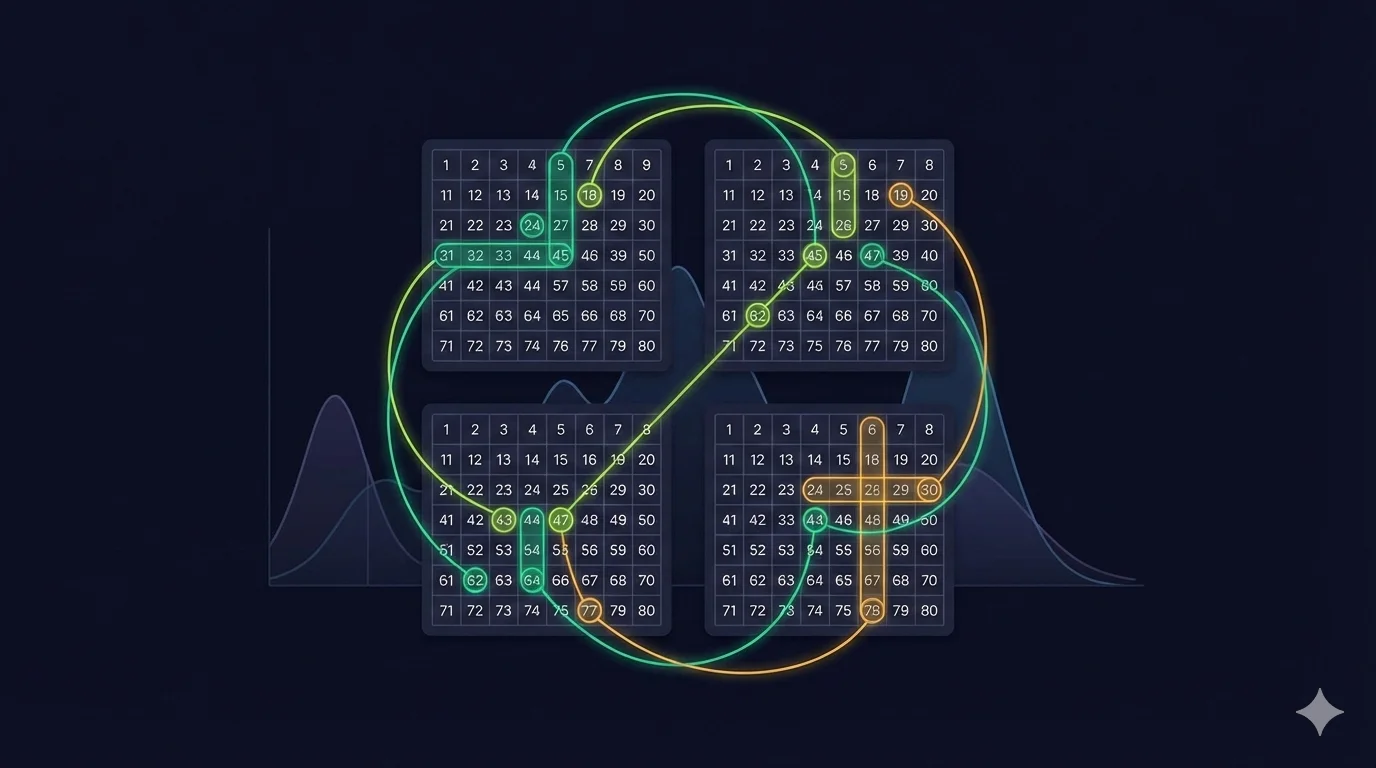
Theory is useful, but seeing the strategies on an actual board makes them click. Here are three common patterns visualized on the 80-number keno grid.
Pattern 1, Quadrant Split (Board Coverage)
The setup: Divide the 8×10 board into four quadrants. Each card gets 5 numbers from its assigned quadrant.
- Card 1 (numbers 1-20): 3, 7, 11, 15, 19
- Card 2 (numbers 21-40): 23, 28, 32, 36, 40
- Card 3 (numbers 41-60): 42, 47, 51, 56, 60
- Card 4 (numbers 61-80): 63, 68, 72, 76, 80
What happens on a typical draw: The machine draws 20 numbers. On average, 5 of those 20 will fall in each quadrant (since each quadrant contains 20 of the 80 numbers). So each card has about 5 numbers drawn from its 20-number zone, and you've picked 5 from that zone. Expected catches: roughly 1-2 per card per draw.
When to use: When you want maximum board coverage and the smoothest possible session. You'll rarely have all 4 cards miss, but you'll also rarely have one card light up with 4+ catches.
Pattern 2, Cross-Over Coverage
An overlap variant where each card shares numbers with its neighbors:
- Card 1: 3, 7, 15, 22, 31
- Card 2: 15, 22, 35, 41, 48
- Card 3: 22, 41, 53, 63, 71
- Card 4: 15, 63, 71, 75, 80
Bold numbers appear on 2+ cards. If number 22 is drawn, three cards benefit. If 15 is drawn, three cards benefit. This creates a "web" of catches that makes partial hits on multiple cards the most common outcome.
When to use: When you want the benefits of both overlap (multi-card catches) and spread (board coverage). This is the recommended starting strategy for beginners.
Pattern 3, Column Cluster
Organize picks by columns on the 8×10 keno grid. Numbers in each column are: 1/11/21/31/41/51/61/71, 2/12/22/32/42/52/62/72, etc.
- Card 1 (column 1-2): 1, 11, 21, 2, 12
- Card 2 (column 3-4): 23, 33, 43, 4, 14
- Card 3 (column 5-6): 25, 35, 45, 16, 26
- Card 4 (column 7-8): 37, 47, 57, 18, 28
When to use: For players who like visual organization on the board. The mathematical properties are similar to quadrant split, good coverage, low overlap. The column approach makes it easy to visually track which areas are "hot" during your session (even though hotness is an illusion, see our video keno strategy guide for the RNG truth).
Common 4 Card Keno Mistakes to Avoid
Three mistakes cost keno players the most money. All are completely avoidable.
Playing Too Many Spots Per Card
The most common beginner mistake: picking 8-10 spots on each card because "more numbers = more chances to win."
The reality: More spots means your jackpot payout goes up, but your hit frequency for meaningful catches drops dramatically. Catching 8/8 hits once in ~230,000 draws. Catching 10/10 hits once in ~8.9 million draws. Unless you're playing thousands of hours, you'll never see these top-line payouts.
Meanwhile, the mid-tier catches (4-5 out of 8-10) don't pay as well as 4-5 out of 5-6 on good pay tables. You're essentially paying a higher price per draw (same bet size) for worse intermediate returns.
Fix: Stick to 4-6 spots. The session simulator lets you compare 1,000-draw sessions at different spot counts, you'll see 5-spot outperforms 8-spot almost every time.
Ignoring Pay Table Differences
Two identical-looking keno machines can have a 15-20% RTP difference. At $1 per draw and 200 draws per hour, that's the difference between losing $16/hour and $36/hour.
The reality: Most players never check the pay table. They sit down, pick numbers, and play. They're unknowingly playing on machines optimized for the casino (high-traffic, low-RTP bar-top machines) instead of machines optimized for players (casino floor, competitive pay tables).
Fix: Check the pay table on every machine before your first draw. Compare 3/4 and 4/4 payouts (for 4-spot) or 3/5 and 4/5 payouts (for 5-spot) against the numbers in our odds section above. If the mid-tier payouts look low, find a different machine.
Chasing Losses Between Cards
After a string of misses, some players increase their per-card bet to "win it back." This is the fastest way to empty your bankroll.
The reality: Every draw is independent. The machine doesn't know or care that you've lost 10 in a row. The RNG produces the same random results whether you bet $0.25 or $2.50. Increasing your bet only increases your expected hourly loss.
Fix: Flat bet every draw. Set a stop-loss before you start. When you hit it, walk away. No exceptions. Read about why loss chasing fails mathematically in our Fibonacci betting system analysis, the same principle applies to keno.
Multi-card play gives you more chances per draw to hit a big payout. See how to target $1,000 at keno with optimal spot and bet combinations.
Curious how variance plays out in other casino games? See how losing streaks actually work in blackjack, the probability math is identical. And for a deeper dive into the RTP vs. volatility tradeoff that affects every keno session, our slot volatility guide covers the concept from every angle.
For a broader look at keno strategies beyond 4-card play, check our complete video keno strategy guide, it covers spot selection, RNG truth, and multi-card tactics that apply to every format.
Prefer single-card play with a bonus twist? Our Caveman Keno strategy guide breaks down the egg multiplier, best spot counts and pay tables.
Frequently Asked Questions
Use overlapping numbers across all 4 cards with 4-6 spots per card. Pick numbers from different board regions for coverage, check the pay table before playing, and budget 100-200x your bet per session. The overlapping strategy reduces volatility while maintaining the same RTP per card.
No. 4 card keno is a game of chance — every draw uses an RNG that makes each number equally likely. However, you can make smarter choices about spot count (4-6 is optimal), pay table selection, bankroll management, and how you distribute numbers across cards.
Pick 4-6 spots per card on machines with 88%+ RTP. The 4-6 spot range offers the best balance of return-to-player and hit frequency. Beyond that, check pay tables before playing and flat bet every draw — no system changes the house edge.
The number selection is pure luck — every number 1-80 has the same 25% chance of being drawn. But choosing how many spots to play, which pay table to use, and how to manage your bankroll are skill-based decisions that affect how long your money lasts.
A comparison table showing different 4-card strategies side by side — overlapping numbers, cluster patterns, same numbers on all cards — with their coverage, volatility, and best use cases. It helps you pick the right approach for your playing style.
4-6 spots per card is the sweet zone. 4-spot gives the most consistent returns with 86%+ RTP. 5-spot offers the best balance of payout size and frequency. 6-spot has the highest potential payouts while keeping RTP above 90% on good machines.
Yes, overlapping numbers is one of the strongest 4-card strategies. By sharing 6-8 numbers across multiple cards, you increase the chance that any single catch benefits more than one card. It reduces session volatility without changing the per-card RTP.
The RTP per card is identical. But 4-card keno reduces variance by spreading your action across independent draws. You get fewer total shutouts and smoother sessions. The trade-off: you're betting 4x per draw, so bankroll management becomes more important.
There are no best numbers. Every number 1-80 has the same probability of being drawn (25%). Pick numbers you enjoy — birthdays, patterns, random taps. The math doesn't care. Focus on spot count and pay table selection instead.
Budget 100-200x your total bet per draw. With 4 cards at $0.25 each ($1 per draw), bring $100-200. At 200 draws per hour, that gives you 1-2 hours of play. Use lower bet sizes for longer sessions.
No. Keno always has a negative expected value — the house edge ensures the casino profits over time. No strategy, pattern, or number selection can overcome this. Play for entertainment, not as an income source.
House edge varies by pay table and spot count, typically 8-25%. Casino floor machines run 8-14% (88-92% RTP). Bar-top machines can be 15-25%. Always check the pay table before playing — the difference is enormous over hundreds of draws.
It's a valid strategy for maximizing jackpot potential — if your numbers hit, they hit on all 4 cards. But it eliminates the variance-reducing benefit of multi-card play. Most experienced players prefer overlapping (shared) numbers with some unique picks per card.
4-card keno offers a simpler game with manageable total bets per draw. 20-card keno lets you cover nearly all 80 numbers but costs 5x more per draw ($5 vs $1 at $0.25/card). Both have the same per-card RTP — the difference is volatility and total wagering speed.
Patterns like quadrant splits and cluster selections don't change your odds on any individual card. But they help you organize your number distribution logically, which can reduce the chance of card overlap and give you more consistent coverage of the drawn numbers.
Evgeniy Volkov
Verified ExpertFullstack developer with a background in mathematics. I build the calculators and game-style tools on ToolsGambling with Pixi.js and modern web tech, and every result uses transparent probability formulas you can verify yourself.