











Contents
Picture this: You're at a bar-top keno machine, tapping your favorite eight numbers for the twentieth time. You've caught 2 out of 8 on every single draw. Meanwhile, the player next to you just nailed 6 out of 6 on a six-spot card and is celebrating a $1,500 payout.
What's the difference? Luck, mostly. But also spot count selection, paytable awareness, and bankroll management, the three things you can control in video keno. In 2026, the video keno strategy conversation hasn't changed because the math hasn't changed. But the games, paytables, and multi-card options have expanded, giving smarter players more tools to stretch their bankroll.
This guide covers the real video keno strategy: which spot counts offer the best return, why "hot numbers" are a myth, how multi-card play affects volatility, and a step-by-step bankroll approach that keeps you playing longer. No miracle systems. No secret patterns. Just the math that actually matters.
Run your machine's paytable through our keno RTP calculator to see exactly what it returns.
TL;DR, Video Keno Strategy Cheat Sheet
Key Numbers at a Glance
| Factor | Recommendation |
|---|---|
| Best Spot Count | 4-6 spots (5 is the sweet spot) |
| Typical RTP Range | 86-92% on casino floor machines |
| Bankroll Per Session | 100-200x your bet size |
| Hot/Cold Numbers | Myth, every number has 25% chance |
| Multi-Card Advantage | Lower volatility, same RTP per card |
| Best Approach | Check paytable → pick 4-6 spots → flat bet → set limits |
Bottom line: You can't predict keno numbers, but you can pick smarter spot counts and better paytables. The difference between a 75% RTP bar-top machine and a 92% casino floor game is enormous over hundreds of draws. Use our session simulator to see how fast different RTPs drain your bankroll, and the bankroll calculator to set proper limits before you play.
What Is Video Keno? Understanding the Game in 2026
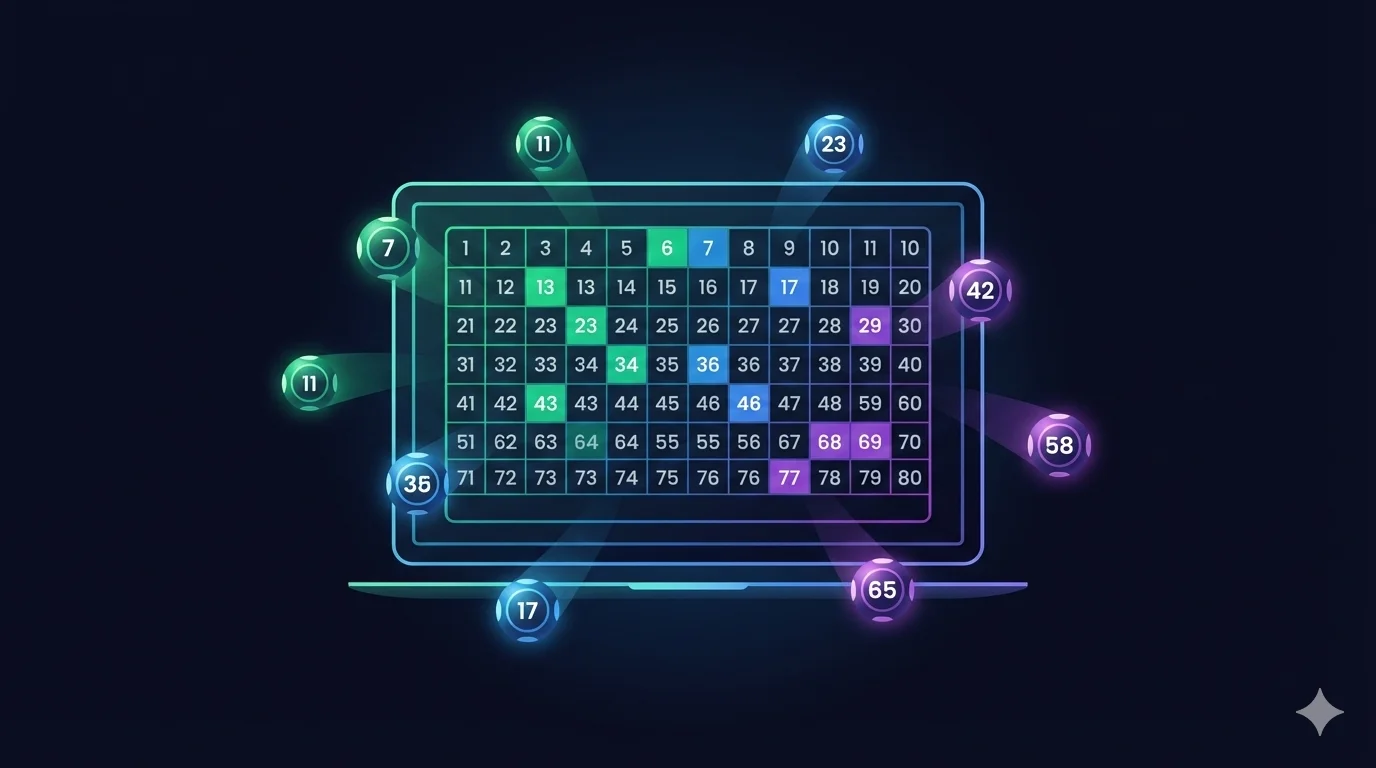
Video keno is the electronic version of the classic lottery-style casino game. You pick 1-10 numbers (called "spots") from a board of 80, then the machine draws 20 numbers at random. The more of your numbers that match ("catch"), the more you win, with payouts determined by a fixed paytable displayed on the machine.
How Video Keno Works: RNG Explained
Every video keno machine uses a Random Number Generator (RNG), a certified algorithm that produces statistically independent results on each draw. This means:
- No memory: The machine doesn't know what numbers hit last game
- No cycles: There's no "due" number or hot/cold pattern
- No manipulation: GLI and BMM labs certify that each number 1-80 has exactly a 20/80 = 25% chance of being drawn
The RNG runs continuously, generating thousands of results per second. The exact moment you press "Play" determines which 20 numbers appear. Nothing before or after that moment matters.
Video Keno vs. Traditional (Live Draw) Keno
Key Differences Table
| Feature | Video Keno | Live Draw Keno |
|---|---|---|
| Speed | 200-400 draws/hour | 10-15 draws/hour |
| RNG | Certified electronic | Ball machine / RNG display |
| Paytable | Fixed per machine | Posted in keno lounge |
| Multi-Card | 4, 10, or 20 cards | Usually 1-3 cards |
| Min Bet | $0.25 - $1 | $1 - $5 |
| Where | Bar-top, casino floor, online | Keno lounge, sportsbook |
| RTP | 75-92% (varies by paytable) | 70-80% (typically lower) |
The biggest difference is speed. Video keno plays 10-20x faster than live keno, which means your bankroll evaporates much faster at the same bet size. This is why bankroll management matters more for video keno than almost any other casino game, check our loss calculator to see the real cost per hour.
Is There a Real Video Keno Strategy? The RNG Truth
Let's be honest upfront: no strategy can change the expected outcome of video keno. The house edge is built into the paytable, and the RNG ensures every draw is independent. No pattern, system, or number selection method can overcome this.
But that doesn't mean all approaches are equal. A "video keno strategy" isn't about predicting numbers, it's about controlling the variables you can control.
What RNG Means for Your Strategy
You cannot control:
- Which numbers are drawn
- When a big hit occurs
- The sequence or frequency of any number
You can control:
- Spot count, directly affects RTP and hit frequency
- Game selection, paytables vary by 10-20% between machines
- Bankroll management, determines how long you play
- Multi-card coverage, affects volatility (not RTP)
- When to stop, the only guaranteed way to lock in a win
This is the real video keno strategy: optimizing what you control while accepting what you can't. If you've ever caught yourself thinking "these numbers are due," check our gambler's fallacy simulator, it demonstrates why that intuition is mathematically wrong.
Can AI Predict Keno Numbers?
No. This question appears in every keno forum, so let's address it directly.
AI and machine learning excel at finding patterns in data. But keno RNG produces data with no patterns to find. Each draw is cryptographically random and statistically independent of all others. Feeding 10 million past keno results into the most sophisticated neural network would produce predictions no better than random guessing.
This isn't an opinion, it's a mathematical property of properly implemented RNGs. The same principle applies to every lottery, slot, and roulette spin. If anyone claims to have an AI that predicts keno numbers, they're either confused or selling something.
Best Video Keno Strategies That Actually Work
This section is the core of any video keno strategy. The spot count you choose has the single biggest impact on your expected return, bigger than number selection, timing, or any "system."
How Many Numbers to Pick: The 4–8 Spot Sweet Zone
Here's the probability table that every keno player should know:
| Spots | Odds (All) | Any-Win Freq | Typical RTP | Verdict |
|---|---|---|---|---|
| 1 | 1 in 4 | 25.0% | ~75% | Poor, low RTP cap |
| 2 | 1 in 16.6 | 6.0% | ~72% | Worst, avoid |
| 3 | 1 in 72 | 26.0% | ~74% | Below average |
| 4 | 1 in 326 | 26.0% | ~86% | Good, sweet zone starts |
| 5 | 1 in 1,551 | 34.0% | ~88% | Great, best balance |
| 6 | 1 in 7,753 | 34.0% | ~90% | Great, highest consistent RTP |
| 7 | 1 in 40,979 | 39.0% | ~91% | Good, still strong |
| 8 | 1 in 230,115 | 39.0% | ~92% | Good, max RTP possible |
| 9 | 1 in 1.38M | 43.0% | ~90% | Diminishing returns |
| 10 | 1 in 8.91M | 43.0% | ~87% | Too volatile for most |
The 4-8 spot range consistently offers the best RTPs because the paytable math works in the player's favor at these counts. Below 4 spots, the payouts are capped too low. Above 8 spots, the top-line hits become so rare that the RTP depends heavily on catching most (but not all) of your numbers.
| Spots Played | Typical RTP | Zone |
|---|---|---|
| 1 | 75% | Avoid |
| 2 | 72% | Avoid |
| 3 | 74% | Avoid |
| 4 | 86% | Sweet zone |
| 5 | 88% | Sweet zone |
| 6 | 90% | Sweet zone |
| 7 | 91% | Still strong |
| 8 | 92% | Still strong |
| 9 | 90% | Avoid |
| 10 | 87% | Avoid |
Spot-by-Spot Breakdown
4-Spot: The entry to the sweet zone. Catching 4/4 pays 72-120x depending on the paytable, with a hit frequency of about 1 in 326. The real value is catching 3/4, which hits about 4.3% of the time and typically pays 3-5x. Total RTP: ~86%. Great for conservative players who want decent payouts without extreme drought periods.
5-Spot: Often the single best choice for balanced play. Catching 5/5 pays 300-800x (paytable dependent), 4/5 pays 12-20x (hits ~1.2% of the time), and 3/5 pays 2-3x (hits ~8.4% of the time). Total RTP: ~88%. The win probability calculator can model your exact odds for any session length.
6-Spot: The sweet spot for players who want bigger hits without sacrificing too much RTP. Catching 6/6 pays 1,000-1,600x, but even 4/6 (hits ~2.9%) pays 4-8x. Total RTP: ~90%. This is where the paytable starts really mattering, a good 6-spot paytable can push 92%+ while a poor one drops to 85%.
7-Spot and 8-Spot: Higher volatility but also potentially the highest RTPs on the board (91-92% on good paytables). The trade-off: 7/7 hits only once in ~41,000 draws, and 8/8 hits once in ~230,000 draws. You're essentially playing for the mid-tier catches (4-5 out of 7-8), which is where most of the return comes from.
Hot and Cold Numbers: Myth or Reality?
Myth. Every single number from 1 to 80 has the same probability of appearing in any draw:
In plain English: 20 numbers are drawn out of 80, so each number has a 25% chance of being selected, every single time, regardless of what happened before.
"But I've seen number 42 come up five draws in a row!" Yes, and that's completely normal. In 1,000 draws, you'd expect each number to appear about 250 times. But those 250 appearances won't be evenly spaced, they'll cluster and gap randomly. These clusters are what your brain interprets as "hot" numbers, and the gaps are "cold" numbers. Neither means anything predictive.
The math is clear: tracking hot and cold numbers is a waste of time that has zero effect on your expected return. Pick numbers you enjoy and focus on what actually matters, spot count and paytable selection.
Bankroll Management for Video Keno
Bankroll management is the only part of video keno strategy that directly controls your session length and loss exposure. Here's how to approach it:
Rule of thumb: Budget 100-200x your bet size per session.
For a $1 per game player, that means bringing $100-$200 for one session. For a $0.25 player, $25-$50 per session.
Session Budget Formula
But forget the formula, use the practical version:
- Decide your max loss: The amount you're genuinely comfortable losing
- Divide by bet size: That gives you your draw count (e.g., $100 ÷ $0.50 = 200 draws)
- Factor in speed: At 300 draws/hour, 200 draws lasts ~40 minutes
- Adjust for entertainment time: Want 2 hours? Either lower your bet or increase your budget
The critical insight: video keno speed is the bankroll killer. At 300 draws per hour with a 10% house edge, you're losing $30/hour at $1 bets. That's $60/hour at $2 bets. The loss calculator puts this in perspective when you see the monthly and yearly totals.
Flat bet. Never increase your bet to chase losses. Never "let it ride" after a win. Flat betting at a consistent amount is the only approach that doesn't accelerate your losses. This principle holds for every betting system ever invented, none of them change the math.
Multi-Card Video Keno Strategy
Multi-card keno lets you play 4, 10, or 20 different number combinations on each draw. This is one area where you have a genuine strategic choice, not about improving RTP, but about managing volatility.
4-Card Keno: Cluster Coverage Strategy
The most popular multi-card format. Here's how the cluster coverage approach works:
Divide the 80-number board into four quadrants:
- Card 1: Numbers 1-20 (pick 5 from this range)
- Card 2: Numbers 21-40 (pick 5 from this range)
- Card 3: Numbers 41-60 (pick 5 from this range)
- Card 4: Numbers 61-80 (pick 5 from this range)
Since the machine draws 20 numbers from the full 80-number board, you're guaranteed decent coverage: each quadrant will likely get 4-6 of the 20 drawn numbers. This means you'll almost always catch something on at least one card.
The honest math: Each card still has the exact same RTP as a single-card game. If the 5-spot paytable pays 88%, each of your four cards returns 88% individually. But your session variance decreases because you're spreading your action. Fewer total shutouts, fewer extreme swings, but also fewer huge single-card jackpots.
This approach works well with the volatility calculator, plug in your multi-card setup to see how the reduced variance affects your session outcomes.
For a complete guide to 4-card strategies including overlapping numbers, pattern charts, and bankroll tips, see our dedicated 4 card keno strategy guide.
20-Card Keno: Board Coverage Approach
20-card keno is the maximum coverage option, available on many casino floor machines. With 20 cards active, you can cover nearly the entire 80-number board if you distribute your numbers.
Strategy: Play 4-spot on each card with different number combinations. With 20 cards × 4 spots = 80 total spots, you can cover all 80 numbers. Since 20 numbers are drawn each round, you're guaranteed to have every drawn number on at least one card.
The catch: You're paying for 20 cards per draw. At $0.25 per card, that's $5 per draw. At 200 draws per hour, that's $1,000/hour in total wagers. With a 10% house edge, your expected loss is $100/hour. The speed of loss accumulation with multi-card play is something the loss calculator can quantify exactly.
Bottom line: Multi-card keno is entertainment optimization, not edge optimization. You get a smoother ride with more frequent small wins, but your expected loss rate stays the same (or increases with the higher total bet per draw).
Video Keno Odds and RTP Explained
Understanding the actual probabilities is what separates informed players from hopeful guessers. Here's the math.
Probability Table by Spot Count
The probability of catching exactly k numbers when you pick s spots follows the hypergeometric distribution:
In plain English: this formula calculates the chance of matching exactly k of your s picked numbers, given that 20 numbers are drawn from 80. Here are the key probabilities for the sweet-zone spot counts:
4-Spot Probabilities:
| Catch | Probability | Typical Payout | Contribution to RTP |
|---|---|---|---|
| 0/4 | 30.83% | $0 | 0% |
| 1/4 | 43.27% | $0 | 0% |
| 2/4 | 21.26% | $1 (1x) | 21.26% |
| 3/4 | 4.32% | $5 (5x) | 21.60% |
| 4/4 | 0.31% | $91 (91x) | 28.21% |
| Total | ~71-91% |
6-Spot Probabilities:
| Catch | Probability | Typical Payout | Contribution to RTP |
|---|---|---|---|
| 0/6 | 16.66% | $0 | 0% |
| 1/6 | 36.35% | $0 | 0% |
| 2/6 | 30.83% | $0 | 0% |
| 3/6 | 13.00% | $1 (1x) | 13.00% |
| 4/6 | 2.85% | $8 (8x) | 22.84% |
| 5/6 | 0.31% | $60 (60x) | 18.37% |
| 6/6 | 0.013% | $1,500 (1500x) | 19.50% |
| Total | ~74-93% |
Notice how the top-line payout (catching all 6) contributes ~20% of the total RTP. This means on any given session, whether you hit that one big catch significantly affects your result. This is what variance looks like in practice.
How to Find Video Keno Games with the Best Payouts
Not all video keno machines are created equal. Paytables vary dramatically, and the RTP difference between the best and worst machines can exceed 20 percentage points.
RTP Comparison: Top Keno Variants
| Keno Variant | RTP Range | Where to Find |
|---|---|---|
| Cleopatra Keno | 92-95% | Casino floor, online |
| Caveman Keno | 91-94% | Casino floor, online |
| Multi-Card Keno (casino floor) | 88-92% | Major casino properties |
| Standard Video Keno | 85-92% | Casino floor |
| Superball Keno | 87-91% | Online, some casino floors |
| Bar-Top Keno | 75-85% | Bars, restaurants, airports |
| Progressive Keno | 70-88% | Varies with jackpot size |
Always check the paytable BEFORE playing. Press the "Paytable" or "Help" button on any video keno machine. Compare the payouts for your chosen spot count against the RTPs above. If a bar-top machine pays only 50x for catching 4/4 (instead of 91x on a casino floor machine), you're playing at a 15%+ worse RTP.
The house edge calculator can help you understand what different RTPs mean for your hourly cost, and the RTP calculator lets you verify your actual return from session results.
Video Keno Strategy for Beginners
If you've never played video keno before, or you've been playing without thinking about strategy, here's your step-by-step starting guide.
Step-by-Step First Session Guide
- Set your budget. Decide the maximum you'll spend before you sit down. This number should be money you'd comfortably spend on any entertainment, dinner, concert tickets, a night out. Not rent money. Not savings.
- Choose 4-5 spots. As a beginner, 4-spot or 5-spot gives you the best combination of reasonable RTP and enjoyable hit frequency. You'll win something about 25-34% of the time, which keeps the session interesting.
- Check the paytable. Before you play a single draw, press the "Help" or "Paytable" button. Look at what catching 3/4 or 3/5 pays. If 3/4 pays less than 3x your bet, find a different machine, the RTP is likely poor.
- Pick random numbers. Birthdays, lucky numbers, random taps, it genuinely doesn't matter. The RNG treats all 80 numbers identically. Don't waste time analyzing previous draws.
- Flat bet every draw. Pick your bet size ($0.25, $0.50, $1) and stick with it. Never increase after a loss ("chasing") or after a win ("riding hot"). Flat betting is the mathematically optimal approach for any negative-EV game.
- Play 50-100 draws per session. At 300 draws/hour, this gives you 10-20 minutes of play. If you want longer sessions, lower your bet size. The session simulator can show you typical outcomes for any combination of bet size and draw count.
- Cash out at your limits. Set two numbers before you start: your stop-loss (walk away when bankroll drops to X) and your win goal (cash out when bankroll reaches Y). A common approach: stop-loss at 50% of buy-in, win goal at 150% of buy-in.
- Track your results. Keep a simple log: date, machine, spot count, buy-in, cash-out. After 10 sessions, you'll see your actual RTP and can adjust your game selection accordingly. Consider using our cashback calculator if your casino offers loyalty rewards.
The key mindset for video keno: you're paying for entertainment, not investing for returns. Every dollar you budget is the cost of having fun, like buying a movie ticket. If you win, that's a bonus, not an expectation. The expected value is always negative, and that's okay if you're playing within your means.
Video keno pays 88-95% RTP vs 65-80% for state lottery keno. Our keno 1000 analysis compares your odds of winning $1,000 across both formats.
Curious how variance affects your results across different games? See how losing streaks actually work in blackjack, the math applies to keno sessions too. And if keno's coverage concept appeals to you, picking more numbers to win more often, the 24+8 roulette strategy uses a similar "cover more numbers" philosophy but with better odds (2.7% house edge vs keno's 8-25%).
Frequently Asked Questions
The best keno strategy is picking 4-8 spots per card and choosing games with the highest paytable RTP (ideally 90%+). You can't predict which numbers will hit — every draw is independent — but you CAN control spot count, game selection, and bankroll management. The 4-8 spot range offers the best balance of RTP and hit frequency.
Yes. Video keno machines use certified Random Number Generators (RNG) tested by labs like GLI and BMM. Every draw is independent of all previous draws — the machine has no memory. Patterns you think you see are normal statistical clusters, not predictive signals.
You can't guarantee wins since keno is a negative-EV game with a house edge. But you can maximize your chances by: picking 4-6 spots for the best RTP, checking paytables before playing, managing your bankroll at 100-200x your bet per session, and avoiding progressive side bets with high house edges.
No. AI, machine learning, and pattern recognition cannot predict keno numbers. Each draw uses a cryptographic RNG that produces statistically independent results. No amount of historical data analysis can predict future outcomes — this is mathematically proven, not an opinion.
4-6 spots is the sweet zone for most players. This range typically offers 86-90% RTP with reasonable hit frequencies. 5-spot is often considered the best balance between payout size and winning probability.
Pick 4-8 spots (5-6 is ideal). Choose games with 90%+ RTP. Budget 100-200x your bet per session. Play random numbers (hot/cold doesn't matter). Flat bet — never chase losses. Check the paytable BEFORE playing. Cash out when you hit your win or loss limit.
No. Every number from 1 to 80 has the exact same probability of being drawn: 20/80 = 25%. The RNG doesn't favor any number, region, or pattern. Pick numbers you enjoy — birthdays, lucky numbers, random selections — the math is identical regardless.
House edge varies by paytable and spot count, typically ranging from 4% to 35%. Bar-top video keno machines often have 15-25% house edge. Casino floor machines run 8-15%. The best video keno games (like Cleopatra Keno) can have as low as 4-8% house edge on optimal spot counts.
4-card keno doesn't change the RTP per card — each card has the same house edge. However, multi-card play reduces volatility by spreading your action across multiple independent draws. You'll have fewer total shutouts and a smoother session, but your expected loss rate stays the same.
It doesn't matter mathematically. Since every draw is independent, switching numbers or keeping them produces the exact same expected results. Play whatever numbers feel comfortable — consistency or variety, the math is identical.
Playing 1-spot or 2-spot keno on bar-top machines with poor paytables. These combinations often return only 72-75% RTP — meaning a 25-28% house edge. Also avoid progressive side bets and 10-spot picks on low-paytable machines.
Very fast. Video keno plays at 200-400 draws per hour — up to 20x faster than live keno. At $1 per game with 10% house edge, expect to lose $20-40 per hour in the long run. Speed is the biggest bankroll killer in video keno.
No. The RNG operates continuously and independently of time, day, or how long since the last big win. Keno machines don't run 'hot' or 'cold' cycles — that's the gambler's fallacy. The payout percentage is determined by the paytable, not by timing.
Video poker involves skill — your decisions (which cards to hold) affect the outcome and RTP. Video keno is pure chance — you pick numbers, then the RNG draws 20 random numbers. Video poker offers 99%+ RTP with perfect strategy; video keno typically offers 86-92% RTP with no strategy to improve it.
No. Video keno always has a negative expected value — the house edge ensures the casino profits over time. No strategy, system, or number selection method can overcome this mathematical reality. Play keno for entertainment, not as an income source.
Evgeniy Volkov
Verified ExpertFullstack developer with a background in mathematics. I build the calculators and game-style tools on ToolsGambling with Pixi.js and modern web tech, and every result uses transparent probability formulas you can verify yourself.