












Contents
The ace five count is a blackjack betting method that adds 1 for every exposed five and subtracts 1 for every exposed ace. Start each shoe at 0. Before the next hand, double your previous initial bet if the running count is +2 or higher, subject to your chosen maximum; at +1 or lower, return to your minimum. Use basic strategy separately for playing decisions.
The algorithm described below is the Ace-Five method published by Wizard of Odds, updated August 3, 2026. +2 is a wagering trigger, not a universal player-edge threshold. Published simulation results apply to a specific scenario, not every blackjack table.
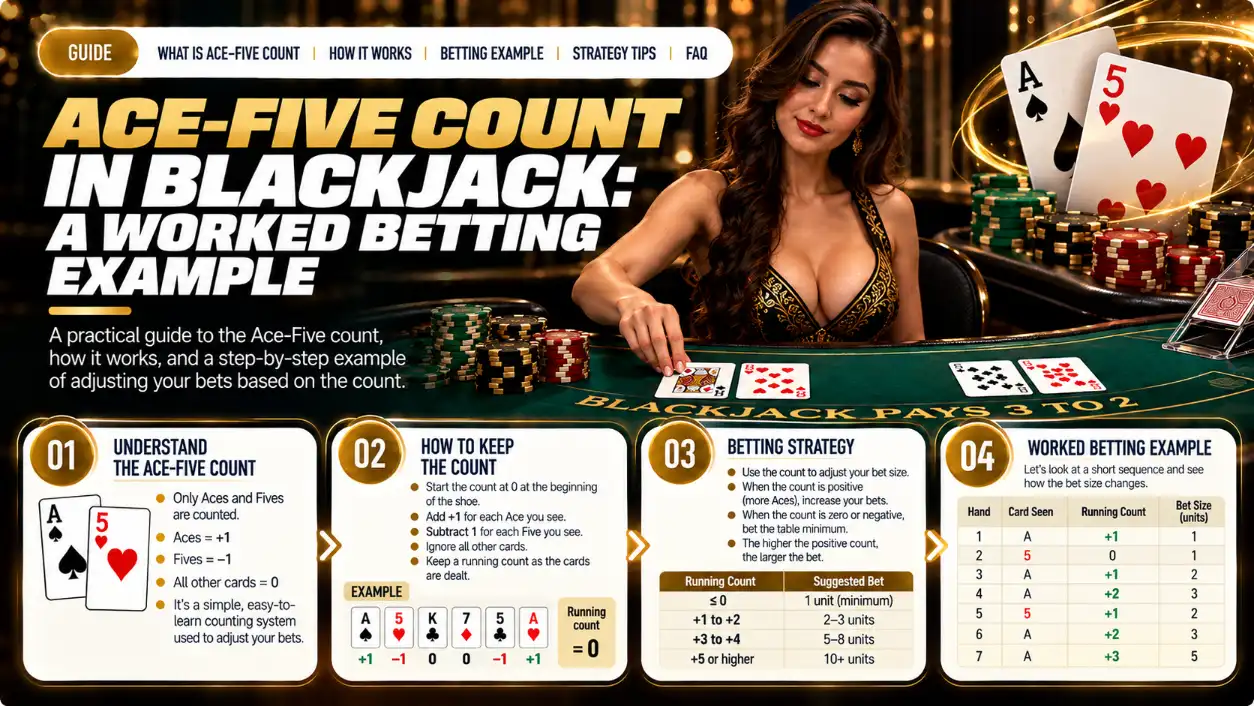
How to keep the Ace-Five running count
Track all exposed cards in the shoe, changing the running count only for fives and aces.
| Exposed card | Running-count change |
|---|---|
| Five | +1 |
| Ace | −1 |
| Any other rank | 0 |
A five and an eight add +1. A five and an ace cancel each other out, producing no change—not resetting the accumulated count.
Apply the method in this order:
- Start each new shoe at 0 and place the minimum initial bet.
- Update the running count as cards are exposed.
- Before the next hand, double the previous initial bet if the count is +2 or higher, without exceeding your cap.
- At +1, 0, or any negative count, bet the minimum.
- Reset the count when a new shoe begins after shuffling.
The previous hand’s outcome does not affect this rule. Doubling only after a win would be a different variant. Likewise, do not change the wager after each five within a hand: update the count as cards appear, then determine the next initial bet before the next hand. This algorithm specifies no true-count conversion.
Six-block example: bets from 10 to 80 units
With a minimum of 10 and a maximum of 80 units, the next initial bets are 10, 10, 20, 40, 80, 10. The opening bet, before these cards appear, is also 10.
Each block represents exposed cards counted before another betting decision, not a complete hand. Amounts are illustrative units. The example excludes hand outcomes and additional wagers from doubling down or splitting; no rounding is needed.
| Block | Exposed cards | Count change | Running count after block | Previous initial bet | Next initial bet |
|---|---|---|---|---|---|
| 1 | Five, eight | +1 | +1 | 10 | 10 |
| 2 | Five, ace | 0 | +1 | 10 | 10 |
| 3 | Five | +1 | +2 | 10 | 20 |
| 4 | Five | +1 | +3 | 20 | 40 |
| 5 | Ace | −1 | +2 | 40 | 80 |
| 6 | Ace, ace | −2 | 0 | 80 | 10 |
After block five, the count falls from +3 to +2, yet the next bet rises from 40 to 80 because the trigger still applies. After block six, the count reaches 0 and the bet returns directly to 10.
If the count remained at least +2 after an 80-unit initial bet, the next bet would stay at 80 because of the cap. This is count-and-bet arithmetic, not a calculation of profit or expected value.
Original Ace-Five diagram showing six exposed-card blocks, the running count, and the next initial bet from 10 to 80 unitsOriginal illustrative diagram: the running counts are +1, +1, +2, +3, +2, and 0; the next initial bets are 10, 10, 20, 40, 80, and 10 units. This teaching example is not a game result or simulation validation.
When the published edge estimates apply
The published numerical results describe a six-deck simulation with 75% penetration and the listed favorable rules—not blackjack in general.
The source recommends:
- Four to eight decks.
- A 3:2 blackjack payout.
- Dealer stands on soft 17.
- Double after splitting allowed.
- Late surrender.
- Resplitting aces allowed.
- At least 75% penetration.
Penetration is the proportion of cards dealt before reshuffling; see the shoe and penetration guide. Although the recommendation says at least 75%, the published figures below use exactly 75%.
| Blackjack bet spread | Published player-edge estimate | Average initial bet, units | SCORE |
|---|---|---|---|
| 1–8 | +0.30% | 2.7 | 3.1 |
| 1–16 | +0.45% | 4.2 | 5.3 |
| 1–32 | +0.57% | 7.1 | 6.5 |
These are the Wizard of Odds simulation results, credited to Norm Wattenberger and Casino Vérité. They are reported here, not independently reproduced.
A blackjack bet spread describes the minimum-to-maximum ratio, not a complete betting policy. The 10–80 example has a 1–8 spread, but that alone does not establish a +0.30% edge in another game. Rules, penetration, and execution must also match. SCORE compares expectation and risk; it is not the percentage of hands won. Neither SCORE nor the edge estimate promises a profitable session.
Why +2 is not proof of an advantage
A +2 running count tells you what this algorithm says to bet; it does not independently establish positive expected value for the next wager. Ace-Five tracks only exposed fives and aces, not the full remaining card composition.
The simulation assumes a 3:2 payout and a dealer who stands on soft 17. A 6:5 payout or a dealer hitting soft 17 falls outside those assumptions. Do not transfer the published results to those rules, shallower penetration, or continuous shuffling. A wider spread also increases the maximum wager relative to the minimum; it does not make the method safe.
Hi-Lo is a different count: 2–6 count +1, 7–9 count 0, and tens through aces count −1. Its true count divides the running count by decks remaining. Do not import those tags, conversions, or playing indices into Ace-Five.
Under the same model, Hi-Lo with a 1–8 spread had a SCORE of 8.40 versus Ace-Five’s 3.1. That is a scenario-specific comparison, not a universal ranking. See the card-counting software guide for related practice options.
How to practice and use the strategy calculator
Practice the running count, initial bet selection, and hand decisions separately. Reproduce the six blocks without looking, then check both the count sequence and the next-bet sequence.
Use the basic strategy guide for rule-specific hand decisions. Ace-Five does not replace basic strategy or supply separate instructions to hit, stand, double down, or split.
In the blackjack strategy calculator, select the rules, player cards, and dealer upcard to obtain a rule-dependent playing action. It does not track the Ace-Five running count, calculate your next wager, or verify a player edge. Check betting arithmetic against the algorithm and playing decisions against the applicable table rules.
Evgeniy Volkov
Verified ExpertFullstack developer with a background in mathematics. I build the calculators and game-style tools on ToolsGambling with Pixi.js and modern web tech, and every result uses transparent probability formulas you can verify yourself.