












Contents
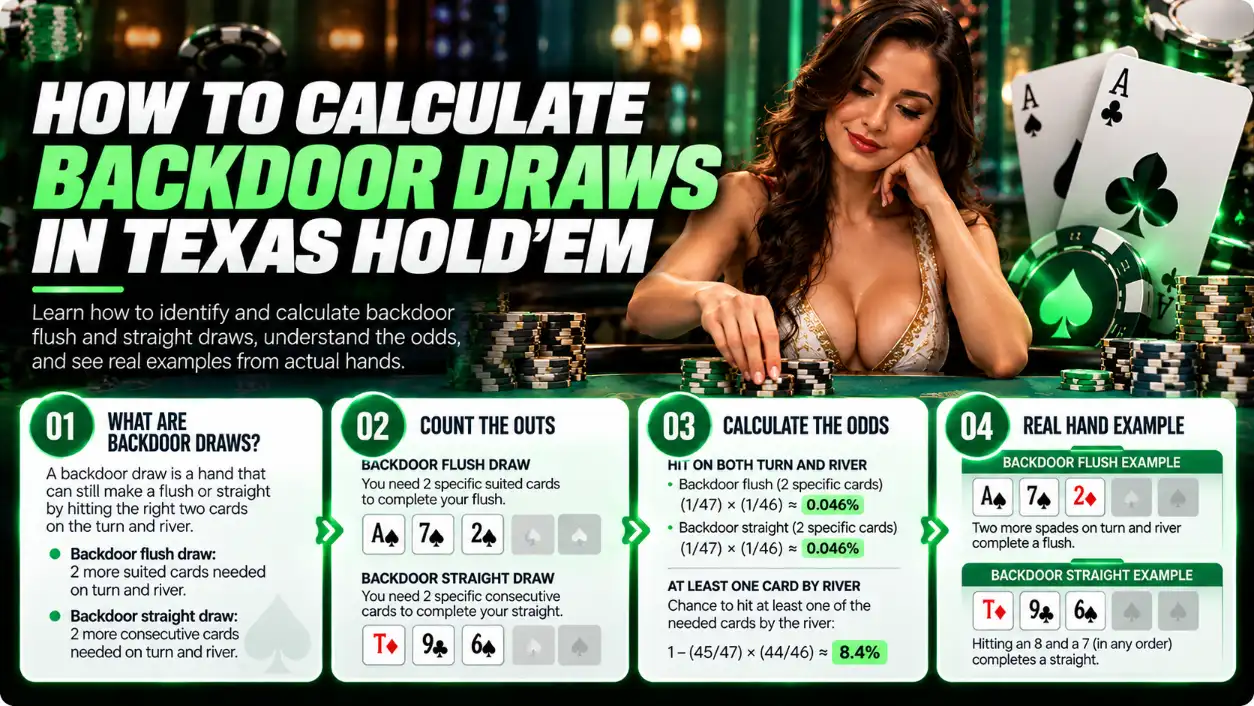
A backdoor flush draw with exactly three hearts among your five known cards on the flop has a 4.16% chance of completing a flush by the river, provided both remaining community cards are dealt. There is no universal backdoor straight percentage: A♥ K♥ on Q♥ 7♣ 2♦ completes a straight 1.48% of the time, while 9♥ 8♥ on 7♥ K♣ 2♦ does so 4.44% of the time. These are completion probabilities—not showdown equity, the chance of winning the pot, or the chance of making a profit.
What counts as a backdoor draw?
A backdoor draw needs a suitable card on both the turn and the river to complete a hand. It is also called a runner-runner draw: one helpful card is not enough.
This guide covers standard 52-card Texas Hold'em high. You receive two hole cards, followed by a three-card flop, one turn card, and one river card, with separate betting rounds. Your final hand is the best five cards out of seven, as described in the PokerStars Texas Hold'em rules (2021 guide, checked October 16, 2026; no edition number stated). These calculations should not be carried over to short deck, Omaha, or a particular live game without checking its rules.
The two types of backdoor draw require different pairs of cards:
- Backdoor flush draw: With three cards of one suit already available, you need two more cards of that suit.
- Backdoor straight draw: You need two ranks that combine with the known cards to form five consecutive ranks. The number of suitable pairs depends on the rank pattern.
Connected ranks, gaps, and the ends of the rank sequence all matter. For example, A–K–Q cannot extend above the ace. A percentage calculated for one backdoor straight draw therefore does not apply to every other one.
If just one more card can complete the hand, it is not a backdoor draw. Four cards of one suit, for example, make an ordinary flush draw. For these ordinary draws, see the guide to outs and the rule of 2 and 4.
Exact probabilities for two flop examples
With A♥ K♥ on Q♥ 7♣ 2♦, only T+J completes a straight. With 9♥ 8♥ on 7♥ K♣ 2♦, three rank pairs work: 5+6, 6+T, and T+J. Both examples need two hearts to complete a flush.
Five cards are known on the flop. Assuming no additional known cards, there are 47 unknown cards and C(47,2) = 1081 unordered turn–river pairs. For completion by the river, either order counts: J followed by T works just as T followed by J does.
| Event by the river | A♥ K♥ / Q♥ 7♣ 2♦ | 9♥ 8♥ / 7♥ K♣ 2♦ |
|---|---|---|
| Complete a flush | Any two of the 10 remaining hearts: 45/1081 = 4.16% | Any two of the 10 remaining hearts: 45/1081 = 4.16% |
| Complete a straight | T+J: 4 × 4 = 16 pairs; 16/1081 = 1.48% | 5+6, 6+T, T+J: 3 × 4 × 4 = 48 pairs; 48/1081 = 4.44% |
The flush calculation can also be written in deal order:
10/47 × 9/46 = 45/1081 ≈ 4.16%.
The turn must be one of 10 hearts among 47 unknown cards. After that, the river must be one of nine hearts among 46 remaining cards.
These calculations assume a standard deck, the exact cards shown, and no additional known cards or specified opponent hand. Percentages are rounded directly to two decimal places unless otherwise stated. The 4.16% figure specifically requires exactly three hearts among the five known cards.
How do you avoid counting a runout twice?
Subtract any overlap before adding the flush and straight probabilities. In the first example, J♥+T♥ allows you to form both a flush and a straight, so that pair appears in both counts.
Teaching diagram for A♥ K♥ / Q♥ 7♣ 2♦: flush 45/1081, straight 16/1081, overlap J♥+T♥ = 1/1081, either = 60/1081
This teaching diagram—not a poker-client screenshot—shows the two completion paths. Subtract the shared J♥+T♥ pair once when combining them.
| Event for A♥ K♥ / Q♥ 7♣ 2♦ | Number of pairs | Probability |
|---|---|---|
| A flush can be formed | 45 | 45/1081 = 4.16% |
| A straight can be formed | 16 | 16/1081 = 1.48% |
| Both can be formed: J♥+T♥ | 1 | 1/1081 |
| At least one can be formed | 45 + 16 − 1 = 60 | 60/1081 = 5.55% |
Being able to form both hands does not mean receiving two payouts. Your best five-card hand is used for the hand comparison.
The combined 5.55% is still only the probability of this event among your seven cards. It is not your probability of winning.
How does the calculation change on the turn?
Recalculate after the turn: a two-card backdoor path either becomes a one-card draw or is no longer possible.
Take A♥ K♥ on Q♥ 7♣ 2♦ with a 4♥ turn. Four of your six known cards are now hearts, leaving nine hearts among 46 unknown cards:
9/46 ≈ 19.57% to complete a flush on the river.
The nine draw-completion cards are:
J♥, T♥, 9♥, 8♥, 7♥, 6♥, 5♥, 3♥, 2♥.
The original T+J straight path is now impossible because only one card remains to come. If the turn had not been a heart, the original backdoor flush could no longer complete: a single heart on the river would not be enough. A T or J turn could, however, preserve the straight path through the other required rank.
Do not call all nine hearts clean outs without checking the opponent's hand or range. They complete a flush, but completing a flush does not guarantee a win.
Do these probabilities justify a call or a bet?
No: backdoor completion probability alone does not justify a call. A routine flop call buys the turn, not a free river. Your opponent may bet again on the turn, requiring another payment to see the final card.
You therefore cannot compare the flop's 4.16% directly with the price of one call as though both future cards were included. The opponent's range, your showdown equity against it, and future betting all matter.
After the 4♥ turn, consider this deliberately limited model:
- The pot is 100 chips before the opponent bets.
- You either fold or call one bet.
- Every one of the nine heart rivers wins; every other river loses.
- There are no further bets, rake, or side pots.
Only under these assumptions can the 19.57% flush completion probability stand in for the probability of winning.
| Opponent's bet | Cost to call | Final pot after your call | Required equity |
|---|---|---|---|
| 20 | 20 | 100 + 20 + 20 = 140 | 20/140 = 14.29% |
| 50 | 50 | 100 + 50 + 50 = 200 | 50/200 = 25% |
The threshold is the call amount divided by the final pot: bet / (pot + 2 × bet). Percentages here are rounded to two decimal places.
In this model, calling 20 clears the threshold: 19.57% exceeds 14.29%. Calling 50 does not: 19.57% is below 25%.
Outside this model, the conclusion can change. A flush might lose, some non-heart rivers might win, and future betting or rake can change the calculation. A real decision requires an equity estimate against a specified hand or range. The guide to pot odds and implied odds explains the price of a call in more detail.
If you are considering betting yourself, a backdoor draw is only one part of the decision. Which hands your opponent continues with or folds also matters. Completion probability supplies neither a mandatory bet size nor an instruction to always bet, and it cannot be converted into a universal fixed outs bonus.
How can you check these calculations in ToolsGambling?
Use the tools for separate tasks: the outs calculator checks selected river cards after the turn, while the pot odds calculator checks the price threshold for a call. Neither task automatically produces showdown equity against an opponent's range.
Check the nine hearts on the turn
In the outs calculator, enter A♥ K♥ with the board Q♥ 7♣ 2♦ 4♥, then clear the auto-selected outs and manually select the nine remaining hearts.
- Set the hole cards to A♥ K♥.
- Set the four board cards to Q♥ 7♣ 2♦ 4♥.
- Click “Clear outs” to remove the 15 auto-selected cards. Then manually select exactly nine hearts: J♥, T♥, 9♥, 8♥, 7♥, 6♥, 5♥, 3♥, 2♥.
- Verify that 9 cards are selected and the river hit probability is approximately 19.6%.
The displayed 19.6% and the 19.57% used above are the same fraction, 9/46, rounded to one and two decimal places respectively.
The tool does not directly calculate conditional two-card backdoor runouts on the flop. Its automatic improvement-card selection can include pairs or other categories, so manually select the nine hearts for this check. The result is the hit probability for those selected cards—not an equity estimate or a guarantee that they win.
Check the call threshold
In the pot odds calculator, enter 100 as the pot before the bet, then test 20 and 50 as the bet to call.
| English interface label | First calculation | Second calculation |
|---|---|---|
| “Pot size (before the bet)” | 100 | 100 |
| “Bet to call” | 20 | 50 |
| Resulting required equity | 14.29% | 25% |
Do not add the opponent's bet to the initial 100: this input is explicitly the pot before that bet.
Treat the result as a price threshold. The optional equity input is supplied by you; it does not estimate the opponent's range. Any call/fold guidance based on that input does not turn backdoor completion probability into showdown equity.
Use these exercises for off-table study. A tool being available does not mean your poker room permits its use during play.
Frequently Asked Questions
Do not subtract cards you cannot identify. These calculations use 47 unknown cards on the flop and 46 on the turn. If additional specific cards are known, recalculate both the number of unknown cards and the available draw-completion cards.
Yes. In Hold'em, your best five-card hand can use one, both, or neither of your hole cards. The numerical examples here apply only to the exact cards shown. Recalculate for a different arrangement, and remember that completing a hand does not rule out a split pot.
Evgeniy Volkov
Verified ExpertFullstack developer with a background in mathematics. I build the calculators and game-style tools on ToolsGambling with Pixi.js and modern web tech, and every result uses transparent probability formulas you can verify yourself.