












Contents
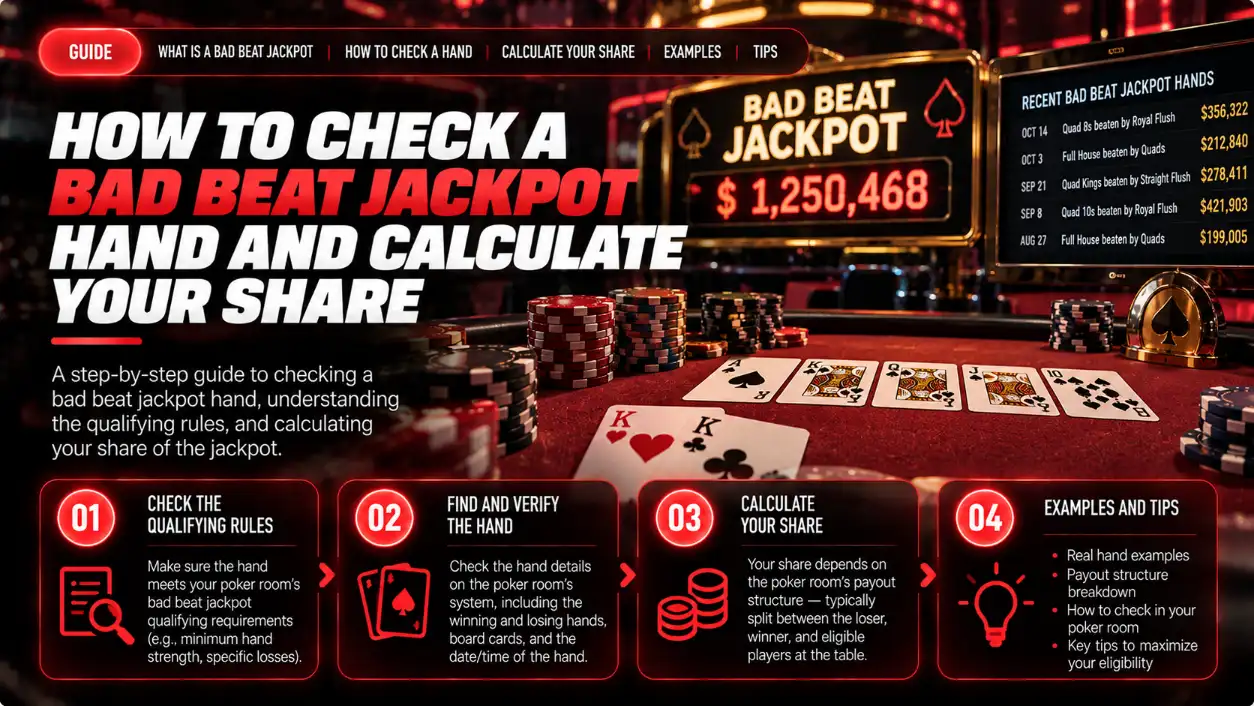
A bad beat jackpot pays a prize when a sufficiently strong hand loses and the hand meets the poker room’s specific rules—not simply whenever someone suffers an unlucky loss. Under the Hollywood Casino at Penn National Race Course rules examined here, the losing player receives 50% of the fund, the winner receives 25%, and the other eligible players at that table split the remaining 25%. For a hypothetical $200,000 fund, those shares are $100,000, $50,000, and $50,000 respectively, before any tax withholding.
This guide covers only the rules approved by the PGCB on September 4, 2024. The official PDF was checked on October 15, 2026; the rules and jackpot balance in effect when you visit have not been verified. The $200,000 figure is an illustrative assumption, not today’s jackpot balance.
What Should You Check Before Comparing the Cards?
Check the game type, player count, pot size, and minimum qualifying losing hand first. Suitable cards alone do not establish eligibility for a payout.
Under the 2024 rules, page 1 §1 and page 2 §5:
- Only Texas Hold’em cash games qualify—not tournaments or mixed games.
- At least four players must be seated and dealt cards at the start of the hand.
- The pot must be at least $10 before rake and the jackpot drop are deducted.
- Both qualifying hands must use both hole cards in their best five-card hand.
- A player making four of a kind must hold a pocket pair.
- All community cards must be dealt, betting must be complete, and the qualifying hands must be exposed at showdown.
The jackpot drop is a separate deduction from a qualifying pot that funds the jackpot and related allocations. It is not the regular rake: this document does not specify the regular rake rate.
The minimum qualifying losing hand depends on the fund size. It is not always the same four-of-a-kind threshold:
| Fund size under the cited rules | Minimum qualifying losing hand |
|---|---|
| Below $250,000, including our hypothetical $200,000 fund | Four tens |
| $250001–500000 | Four nines |
| $500001–750000 | Four eights |
| Above $750000 | Four sevens |
These tiers come from page 1 §4 of the official document. If the fund is exactly at a tier boundary, do not infer the threshold: ask the room which rule applies. Our hypothetical $200,000 fund is deliberately away from those boundaries.
The qualifying four of a kind must lose to higher four of a kind, a straight flush, or a royal flush. Losing with a strong hand is not enough on its own.
Example: Four Aces Lose to a Royal Flush
The hands in this hypothetical example meet the card requirements: the losing player uses a pocket pair of aces to make four of a kind, while the winner uses both hole cards to make a royal flush.
Assume six eligible players are at the table and all six are dealt cards at the start of the hand. At the time of the jackpot, the four other share recipients meet the active-player criteria: each has previously been dealt a hand, has enough chips for the big blind, owes no missed blinds, and has not been away from the table for more than 10 minutes. The pot is $30 before rake and the jackpot drop, and a flop is dealt. All five community cards are dealt, betting is complete, both hands are exposed at showdown, and there are no grounds for disqualification.
Card Schematic and Hand Checks
With these cards, the losing player’s best hand is four aces, and the winning player’s best hand is a royal flush.
COMMUNITY CARDS
[A♠] [A♥] [Q♠] [K♠] [2♦]

LOSING PLAYER
Hole cards:     [A♦] [A♣]
Best five:       A♠ A♥ A♦ A♣ K♠
Result:          Four aces with a king kicker

WINNING PLAYER
Hole cards:     [J♠] [T♠]
Best five:       A♠ K♠ Q♠ J♠ T♠
Result:          Royal flush
| Check | Result in this example |
|---|---|
| Losing hand is at least four tens | Yes: four aces |
| Losing hand is beaten by an allowed hand | Yes: a royal flush |
| Both hole cards are used in the four of a kind | Yes: A♦ and A♣ form a pocket pair |
| Both hole cards are used in the royal flush | Yes: J♠ and T♠ |
| Pot is at least $10 before deductions | Yes: $30 |
| Hands reach showdown and betting is complete | Yes, under the example’s assumptions |
Under these assumptions, the hand passes the checks. However, a complete board does not replace showdown: if the player holding four aces folds before showdown, the same community cards do not establish jackpot eligibility. Four of a kind made using only one hole card also fails the requirements of this version of the rules.
How Is the Hypothetical $200,000 Divided?
The losing player receives $100,000, the winner receives $50,000, and each of the four other eligible players receives $12,500. This distribution comes specifically from page 2 §4 of Hollywood’s 2024 rules; it is not a universal casino payout structure.
| Recipient | Calculation | Payout before any withholding |
|---|---|---|
| Losing player with four aces | $200,000 × 0.50 | $100,000 |
| Winning player with a royal flush | $200,000 × 0.25 | $50,000 |
| Four other eligible players | $50,000 ÷ 4 | $12,500 each |
| Total | $100,000 + $50,000 + 4 × $12,500 | $200,000 |
No rounding is needed in this example: all amounts divide exactly. The winner also receives the ordinary hand pot, separately from the jackpot share.
The winner’s and loser’s shares go only to the players holding the highest and second-highest hands. The remaining share is divided among eligible players at that table; this version does not provide a room-wide share.
The other recipients must meet activity requirements: having previously been dealt a hand, having enough chips for at least the big blind, owing no missed blinds, and having been away from the table for no more than ten minutes. The number of people near the table is therefore not necessarily the number eligible for a payout.
These figures are the rule-based shares before possible tax withholding. They do not establish your exact take-home payment or net profit.
How Does the Jackpot Drop Differ from the Payout?
The jackpot drop from the example’s $30 pot is $2, but that $2 is not allocated using the 50% / 25% / 25% payout split.
Under page 1 §2 and §4 of the document, the first $1 is deducted when the pot reaches $10, and the second when it reaches $20, up to a maximum of $2. A flop is required: no flop means no jackpot drop.
When the displayed fund is below $250,000, each dollar of the drop is allocated as follows:
| Destination | Share of the drop | From the $2 in this example |
|---|---|---|
| Main jackpot fund | 50% | $1 |
| Reserve | 5% | $0.10 |
| Player promotional events | 45% | $0.90 |
This is the funding allocation from one qualifying pot, not the distribution of the accumulated $200,000 to players. Regular rake is deducted separately. The final pot cannot be calculated from this document because it does not specify the rake rate.
What Can Disqualify a Payout?
Procedural violations or an inability to verify the cards can disqualify a payout, even when the hand combinations appear to qualify. Pages 2–3 of the rules address grounds involving collusion, premature exposure of cards, electronic device use, folded or unverifiable hands, misdeals, and problems with the deck.
Before payment, the hand must be verified, and recipients must provide identification and complete registration. Taxes may also be withheld. Even a fully worked example cannot replace the room’s decision on an actual hand.
Where Does This Example Stop Applying?
This calculation applies only to the cited version of the rules and the stated assumptions. Another room may accept a losing full house, require a different player count, use different fund tiers, pay a room-wide share, or handle the jackpot drop and rake differently. Check the venue’s published rules before playing.
A bad beat is an unlucky loss; a bad beat jackpot is a separate prize governed by formal eligibility requirements. One does not guarantee the other.
To estimate the probability of losing after going all-in, use the ToolsGambling all-in probability calculator. It estimates all-in outcome probabilities; it does not check eligibility for this casino’s jackpot or calculate its payout distribution.
Evgeniy Volkov
Verified ExpertFullstack developer with a background in mathematics. I build the calculators and game-style tools on ToolsGambling with Pixi.js and modern web tech, and every result uses transparent probability formulas you can verify yourself.