












Contents
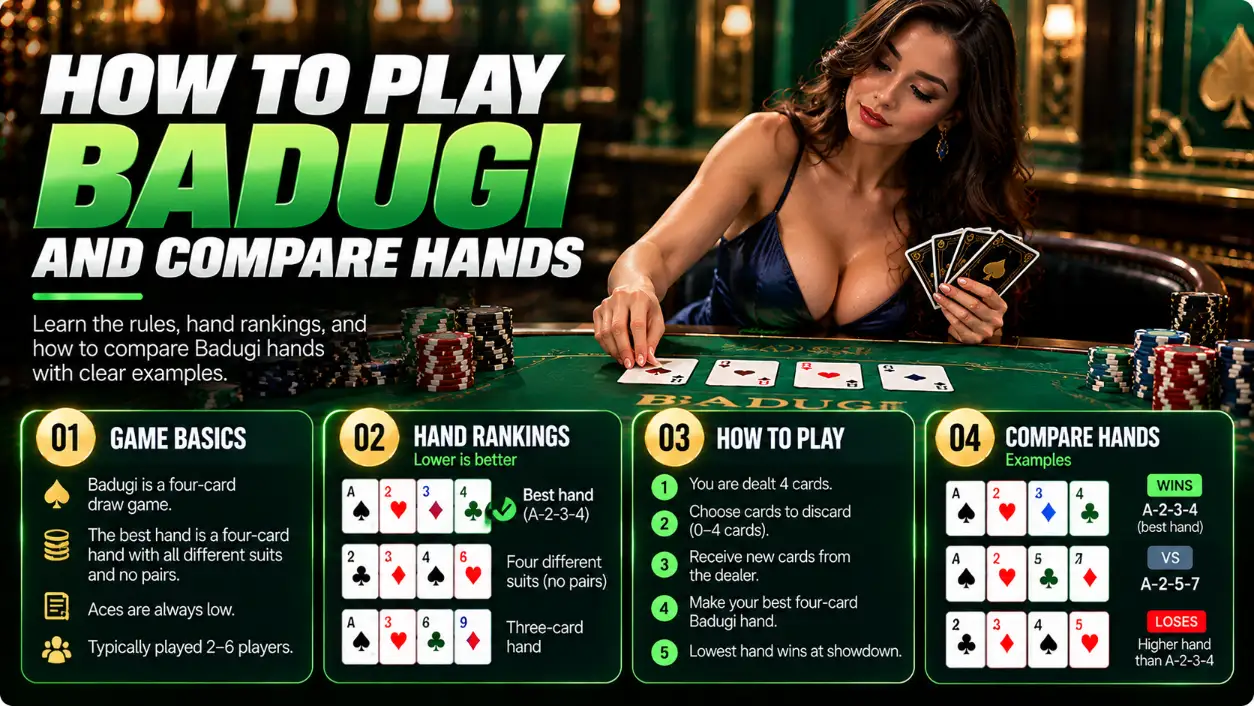
In Badugi, you receive four face-down cards and have up to three opportunities to draw replacements. At showdown, the hand with the most cards of distinct suits and ranks wins. If both hands have the same number of qualifying cards, compare ranks from highest to lowest: the lower hand wins.
This guide covers ordinary four-card Badugi under TSG Interactive plc’s official Game Plan for Online Live Games for pokerstars.cz, accessed 16 October 2026. Its introduction states an effective date of 1 January 2017; the PDF metadata shows file creation in 2023, not a confirmed rules revision. These are not universal rules for all tables: check the betting limits and procedures for your specific table separately.
How does a complete hand work?
A complete hand has four betting rounds and three draws. On each draw, you may discard 0–4 cards and receive the same number of replacements, leaving you with four cards again.
The sequence is:
- Blinds and deal. The small and big blinds are posted, and each player receives four face-down cards.
- First betting round. Players act before the first draw.
- First draw. Each remaining player may discard 0–4 cards and receive replacements.
- Second betting round.
- Second draw. Each remaining player may again exchange 0–4 cards.
- Third betting round.
- Third and final draw. Each remaining player may exchange 0–4 cards.
- Fourth betting round.
- Showdown. If more than one player remains, compare their qualifying cards.
If every opponent folds, no showdown is needed. Badugi can use fixed-limit betting, but that is not the only possible betting structure.
What does it mean to stand pat?
To stand pat means to discard zero cards and keep all four. You receive no replacements on that draw.
Standing pat is not the same as checking: standing pat is a draw decision, while checking is a betting action. Standing pat alone does not prove that an opponent has a strong hand.
Which cards count toward your hand?
Count the largest subset of cards in which no suit or rank repeats. If several subsets have that maximum number of cards, use the lowest-ranking one.
Four qualifying cards form a four-card Badugi. If only three, two or one can count, you have a three-, two- or one-card hand—even though you still physically hold four cards.
The key ranking rules are:
- Aces are low: an ace ranks below a two.
- Straights are ignored: consecutive ranks do not weaken a hand.
- A♠2♥3♦4♣ is the best possible hand: four distinct ranks and four distinct suits.
- Card count comes before ranks: four qualifying cards beat any three, three beat any two, and two beat any one.
To resolve repeated suits or ranks:
- Identify the subsets with no repeated suit or rank.
- Keep only those containing the most cards.
- Put each remaining subset’s ranks in descending order.
- Choose the subset with the lower highest card. If those cards match, compare the next card, and continue as needed.
For example, A♦2♦3♠4♠ can use only one diamond and one spade. Its maximum is two qualifying cards, and its best subset is A♦3♠. Removing just one card cannot produce a valid three-card hand because two pairs of suits conflict.
Pagat’s Badugi rules explain the valid-subset comparison and ties. When the qualifying ranks match completely, the players split the pot: suits do not break the tie.
Who wins in these hand comparisons?
Compare the number of qualifying cards first, then compare their ranks from highest to lowest. Even a king-high four-card Badugi beats the lowest three-card hand.
These are illustrative hands, not records of actual play. Their valid subsets were checked by enumeration; the results demonstrate the ranking rules, not draw probabilities.
| First hand and cards that count | Second hand and cards that count | Result and explanation |
|---|---|---|
| K♠Q♥J♦T♣ → all 4 cards count | A♠2♥3♦4♦ → A♠2♥3♦ count: 3 cards | The first hand wins. The second hand excludes 4♦ because it shares a suit with 3♦. Four qualifying cards beat three, regardless of the second hand’s lower ranks. |
| A♠2♥3♦3♣ → A♠2♥3♦ count: 3 cards | A♦2♦3♠4♠ → A♦3♠ count: 2 cards | The first hand wins. Only one three can count on the left; only one diamond and one spade can count on the right. Three qualifying cards beat two. |
| 7♠6♥4♦A♣ → all 4 cards count | 8♠7♥5♦2♣ → all 4 cards count | The first hand wins. Both have four qualifying cards, so compare the highest cards: 7 is lower than 8. |
| 8♠5♥3♦A♣ → all 4 cards count | 8♥5♣3♠A♦ → all 4 cards count | Tie: split the pot. Both have qualifying ranks of 8-5-3-A. Their different suit assignments give neither hand an advantage. |
In the second row, the first hand could count 3♣ instead of 3♦. It would still have three qualifying cards with ranks 3-2-A.
K♠Q♥J♦T♣ has four qualifying cards and beats A♠2♥3♦4♦, which has three after excluding 4♦
Original illustrative diagram, not a game screenshot: K♠Q♥J♦T♣ has four qualifying cards; A♠2♥3♦4♦ has three after excluding 4♦. The first hand wins.
What does a draw look like in an example?
In this hypothetical example, you discard 3♣ from A♠2♥3♦3♣ and receive 9♣. All four cards then count toward the hand.
- Before the draw: A♠2♥3♦3♣. Because the rank 3 repeats, only three cards count—for example, A♠2♥3♦.
- Discard: 3♣.
- Replacement: assume the card received is 9♣.
- After the draw: A♠2♥3♦9♣. All suits and ranks are distinct, so the hand is read as 9-3-2-A.
The result is a four-card Badugi rather than a three-card hand. This is not observed play, a prediction or advice to make this particular discard. The outcome depends on the replacement card; drawing does not guarantee improvement.
How is Badugi different from 2-7?
Badugi counts up to four qualifying cards, uses aces low, and limits the cards that count when suits repeat. In 2-7, a five-card hand is evaluated under different ranking rules, so those rankings do not apply to Badugi.
For the related game with three draws, see our 2-7 Triple Draw guide. For Badugi, remember the order: most qualifying cards → lowest ranks compared from highest to lowest → split the pot if all qualifying ranks match.
Evgeniy Volkov
Verified ExpertFullstack developer with a background in mathematics. I build the calculators and game-style tools on ToolsGambling with Pixi.js and modern web tech, and every result uses transparent probability formulas you can verify yourself.