











Contents
You slide $200 into a bubble craps machine, tap the screen, and stare at 15 different bet options. Pass Line? Don't Pass? Place 6? Hard 8? The dome lights up, dice start tumbling, and you've got maybe 20 seconds to decide where your money goes.
Most players pick wrong. They scatter chips across prop bets, chase hardways, and wonder why $200 disappears in 45 minutes. But the best bubble craps strategy isn't complicated, it's just the opposite of what the flashy touchscreen wants you to do.
Here's the math as of 2026: a $5 Pass Line bet with maximum 3-4-5x free odds costs you $0.72 per hour in expected losses. That same $5 thrown onto hardways and props? Over $18 per hour. The difference between a smart strategy and a random one is 25x the cost. This guide shows you exactly what to bet, how much to bring, and when to walk away, no matter your budget.
TL;DR -- Bubble Craps Strategy Quick Reference
Strategy Tier Table
| Strategy | Combined Edge | Cost/Hour ($5 bet) | Budget Needed | Best For |
|---|---|---|---|---|
| Don't Pass + 3-4-5x Lay | 0.27% | $0.53 | $250+ | Advanced players |
| Pass Line + 3-4-5x Odds | 0.37% | $0.72 | $150-250 | Everyone (optimal) |
| Pass + Come + Odds | 0.37% each | $2.16 | $300-500 | More action seekers |
| Place 6/8 Only | 1.52% | $2.96 | $150 | Simplicity lovers |
| Pass Line Only (no odds) | 1.41% | $4.58 | $100 | Absolute beginners |
| Full Action (props) | 5-16% | $18+ | Don't | Nobody smart |
Cost Per Hour at a Glance
The sweet spot: Pass Line + maximum free odds. It costs less than a coffee per hour while giving you full craps action. The only strategy that's cheaper is Don't Pass + lay odds, but most players prefer rooting for the shooter.
Pick your tier. Stick to it. Everything below explains why.
What Is Bubble Craps (and Why Strategy Differs)
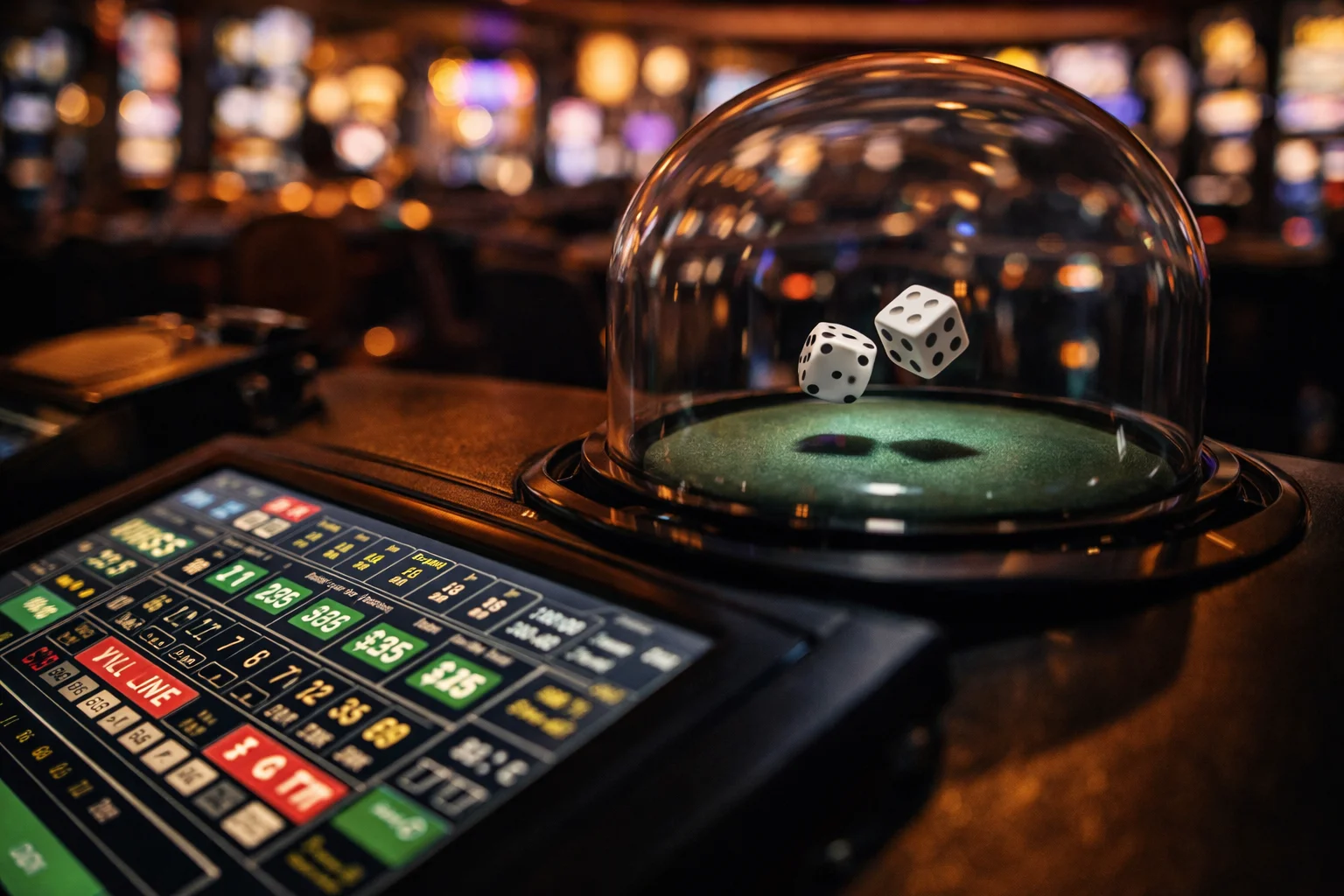
Bubble craps, also called shoot-to-win craps or electronic craps, is a semi-automated craps game where real dice tumble inside a sealed transparent dome. Players bet through individual touchscreens arranged around the "bubble." The dice are physical, the odds are identical to a live table, and the payouts are programmed to match standard craps. For a deep dive into every bet's edge, see the complete bubble craps odds tables.
How Bubble Craps Machines Work
Two standard dice sit inside a sealed plexiglass dome. Compressed air jets fire from multiple angles, launching the dice into chaotic tumbles. After several seconds of bouncing off padded walls and each other, the dice settle. A camera system reads the result and transmits it to every terminal.
There's no software deciding the outcome. No random number generator. No electromagnets. It's physics, the same 36 possible combinations (6 sides × 6 sides) that govern every craps roll on every table in every casino.
Why Bubble Craps Is Better for Strategy Execution
The math is identical to live craps, but the environment is better for disciplined play in two critical ways.
Lower Minimums = Better Odds Access
Most Las Vegas live craps tables run $15-$25 minimums. Bubble craps stations? Usually $5, sometimes $3. Lower minimums mean you can afford to take maximum free odds, the single most important move in craps strategy. At a $25 live table, 3-4-5x odds requires $75-$125 behind your bet. At a $5 bubble machine, it's $15-$25. Same combined edge, fraction of the bankroll. Check other budget-friendly options with our guide to $5 deposit casino sites.
No Social Pressure = Disciplined Play
At a live table, other players groan when you bet Don't Pass. They celebrate hardways. They pressure you into "action" bets. At bubble craps, nobody sees your screen. You can play the mathematically optimal strategy without social friction, and that matters more than most players admit.
Bubble Craps House Edge -- Quick Reference (2026)
Before picking a strategy, you need to know what each bet actually costs. Every craps bet falls into one of three tiers.
The 3-Tier Bet Classification
| Tier | Bets | House Edge | Verdict |
|---|---|---|---|
| Best (lime) | Don't Pass, Pass Line, Come, Don't Come, Place 6/8 | 1.36-1.52% | Your strategy lives here |
| Mid (yellow) | Lay 4/10, Field, Place 5/9, Buy 4/10 | 2.44-4.76% | Acceptable but not optimal |
| Worst (red) | Hard 4/10, Hard 6/8, Any Craps, Any 7, Big 6/8 | 9.09-16.67% | Never bet these |
The full house edge breakdown for all 13 bet types is in our bubble craps odds guide, including payout ratios, true odds, and expected loss per 100 bets. Here's the visual summary:
| Bet Type | House Edge (%) |
|---|---|
| Don't Pass / Don't Come | 1.36 |
| Pass Line / Come | 1.41 |
| Place 6/8 | 1.52 |
| Lay 4/10 | 2.44 |
| Field (2:1 on 12) | 2.78 |
| Place 5/9 | 4.0 |
| Buy 4/10 (5% vig) | 4.76 |
| Place 4/10 | 6.67 |
| Big 6 / Big 8 | 9.09 |
| Hard 6/8 | 9.09 |
| Hard 4/10 | 11.11 |
| Any Craps | 11.11 |
| Any 7 | 16.67 |
The chart makes it obvious: the gap between best bets and worst bets isn't small. It's a 12x difference in cost per hour. Every dollar you move from the green zone to the red zone is money you're donating to the casino.
Beginner Bubble Craps Strategy: Pass Line + Free Odds
If you've never played craps before, this is your strategy. It's the simplest approach that still gives you one of the best edges in the entire casino.
Step-by-Step: Your First 20 Minutes
- Sit down and insert $100-$200. Choose any open terminal, all seats see the same dice roll
- Wait for a new round. The screen will show "COME OUT ROLL" or a puck labeled "OFF"
- Tap "Pass Line" and bet $5. This is your flat bet, the foundation of your strategy
- Watch the come-out roll. If the dice show 7 or 11, you win even money ($5). If 2, 3, or 12, you lose. Any other number (4, 5, 6, 8, 9, 10) becomes "the point"
- When a point is set, tap "ODDS" and bet the maximum. With 3-4-5x odds at a $5 minimum: bet $15 on points of 4/10, $20 on 5/9, or $25 on 6/8
- Wait for the decision. If the point rolls before a 7, you win both bets. If a 7 rolls first, you lose both
- Repeat from step 3
That's it. No other bets. No place bets, no field bets, no hardways. Just Pass Line + max odds, every single round.
How to Place Odds on the Touchscreen
Bubble craps interfaces vary by manufacturer, but the process is always the same:
- After a point is established, an "ODDS" or "FREE ODDS" button appears on screen
- Tap it, and the machine shows your maximum allowed odds amount
- Some machines let you choose 1x, 2x, or max, always pick max
- The odds bet appears visually behind your Pass Line bet on the digital layout
- If the button doesn't appear, your machine may not support odds (rare, find a different machine)
Look for the odds limit before you sit down. Most Strip casinos offer 3-4-5x. Downtown and regional properties sometimes cap at 2x. The higher the multiplier, the better your combined edge, check our casino odds limits table to compare.
Beginner Budget: $100-$200 Session Plan
| Bankroll | Flat Bet | Max Odds | Total/Round | Rounds Covered | Expected Session (4hrs) |
|---|---|---|---|---|---|
| $100 | $5 | None | $5 | ~20 | -$18 expected loss |
| $150 | $5 | 3-4-5x | $20-$30 | ~15 | -$3 expected loss |
| $200 | $5 | 3-4-5x | $20-$30 | ~18 | -$3 expected loss |
At $200 with max odds, your expected loss for a 4-hour session is about $3. You're paying less than a dollar an hour for live casino entertainment. Compare that to the expected hourly cost of slots where even penny slots drain $20-$40/hour.
Intermediate Strategy: Multi-Number Coverage
Once you're comfortable with Pass Line + Odds, you might want more numbers working. This increases your total action (and expected loss) but also increases the frequency of wins, you'll collect payouts more often.
Pass + Come + Odds: Three Numbers Working
The Come bet works exactly like a Pass Line bet, but you can place it after a point is already established. Here's the sequence:
- Bet $5 on Pass Line → point is set → take max odds
- Bet $5 on Come → the next roll establishes your Come point → take max odds on your Come bet
- You now have two points working with max odds on both
- Optionally repeat step 2 for a third Come bet
Each Come bet carries the same 1.41% edge as the Pass Line, and each takes max odds at 0% edge. You're not increasing your per-bet edge, you're increasing your action. More numbers working means more chances to win (and lose) per roll.
Place 6/8 as a Complement
If 6 and 8 aren't already covered by your Pass or Come points, Place them for $6 each. Place 6/8 carries a 1.52% house edge, still in the green zone, and pays 7:6 every time a 6 or 8 rolls.
Why 6 and 8 specifically? They're the most frequently rolled numbers after 7 (five ways each out of 36). Place 4/10 has a 6.67% edge, four times worse. Place 5/9 is 4.00%. Stick with 6 and 8.
Use our house edge calculator to verify the edge on any bet combination.
Intermediate Budget: $300-$500 Session Plan
| Setup | Flat Bets | Odds | Total at Risk | Cost/Hour |
|---|---|---|---|---|
| Pass + 1 Come + odds | $10 flat | $40-$60 odds | $50-$70 | ~$2.16 |
| Pass + 2 Come + odds | $15 flat | $60-$90 odds | $75-$105 | ~$3.24 |
| Pass + Come + Place 6/8 | $10 flat + $12 place | $40-$50 odds | $62-$72 | ~$2.70 |
With $400 and the Pass + 1 Come + odds setup, you've got enough runway for a comfortable 4-hour session. Expected loss: about $8-$9. That's movie-ticket territory. Plan your exact session with the session simulator.
When to Add a Third Come Bet
Only add a third Come bet when:
- Your bankroll can absorb 3 simultaneous losses ($75-$100 total at risk)
- You're comfortable managing multiple bets on the touchscreen
- The table is "cold", meaning you're not already up significantly (adding more bets when winning locks in more risk)
With three Come bets working, you'll have 4 numbers on the board (Pass + 3 Come points). You'll win frequently, but 7 wipes everything. Make sure your bankroll handles that swing.
Advanced Strategy: Don't Pass + Lay Odds
This is the lowest-edge strategy available in any casino. It requires betting against the shooter, which changes the payout structure, but the math is unbeatable at the craps table.
Why 0.27% Edge Is the Best You Can Get
Don't Pass has a 1.36% house edge (vs 1.41% for Pass Line). When you add 3-4-5x lay odds behind it, the combined edge drops to 0.27%, even lower than Pass Line + Odds (0.37%).
The catch: lay odds pay less than even money. When you bet Pass Line odds on a point of 4, you win 2:1. When you lay odds against a point of 4, you win 1:2. You're risking more to win less, because the math is in your favor, 7 is more likely than any individual point.
In plain English: you're paying 27 cents per $100 wagered. At a $5 table with max lay odds, your expected loss is $0.53/hour. That's not gambling, that's paying for a seat.
Combining Don't Pass with Place Bets
Some advanced players run a hybrid:
- $5 Don't Pass + max lay odds (0.27% combined)
- $6 Place 6 + $6 Place 8 (1.52% flat each)
This gives you the lowest-edge flat bet (Don't Pass) while still collecting payouts when 6 or 8 hits. You're rooting against the shooter on the Don't side but profiting from the two most common numbers.
The blended cost is higher than pure Don't Pass + lay, but the win frequency increases significantly. Check the exact numbers with our win probability calculator.
Advanced Budget: $500+ Session Plan
| Setup | At Risk | Combined Edge | Cost/Hour | Why |
|---|---|---|---|---|
| Don't Pass + max lay | $5 + $30-$50 lay | 0.27% | $0.53 | Absolute lowest cost |
| Don't Pass + lay + Place 6/8 | $5 + lay + $12 place | 0.27% + 1.52% | ~$1.60 | Action + low edge |
| Don't Pass + Don't Come + lay | $10 + lay | 0.27% each | ~$1.06 | Multiple dark-side numbers |
With $500 and pure Don't Pass + lay, you could theoretically play for 100+ hours before losing your bankroll mathematically. Variance will shorten or extend that, use the bankroll calculator to model your exact ruin probability.
| Strategy | Cost/Hour |
|---|---|
| Don't Pass + 3-4-5x Lay | 0.53 |
| Pass Line + 3-4-5x Odds | 0.72 |
| Pass + Come + Odds (3 nums) | 2.16 |
| Place 6/8 Only | 2.96 |
| Pass Line Only (no odds) | 4.58 |
| Full Action (Field+Props) | 18.5 |
Crapless Craps on Bubble Machines: The Hidden Trap
Some bubble craps stations offer "Crapless Craps" mode, an alternate rule set that sounds player-friendly but is actually a significant house edge increase. If your machine offers both versions, always choose standard craps.
What Changes in Crapless Craps
In standard craps, rolling 2, 3, or 12 on the come-out is an instant loss on the Pass Line (and 11 is an instant win). In crapless craps, these numbers become additional points instead:
| Roll | Standard Craps (Pass Line) | Crapless Craps |
|---|---|---|
| 2 | Instant loss (craps) | Becomes a point |
| 3 | Instant loss (craps) | Becomes a point |
| 7 | Instant win | Instant win |
| 11 | Instant win | Becomes a point |
| 12 | Instant loss (craps) | Becomes a point |
Looks like a good deal, right? You no longer lose on 2, 3, or 12. But you also no longer win on 11. And that's where the trap is.
Why the House Edge Jumps to 5.38%
Rolling 11 is an instant win in standard craps, 2 combinations out of 36 (5.56% of rolls). In crapless, that instant win becomes a point you need to roll again before 7. The odds of rolling 11 before 7 are only 2:6 = 25%. So a bet that was a guaranteed winner now wins only 25% of the time.
The result: the house edge on the crapless Pass equivalent jumps from 1.41% to 5.38%, nearly 4x worse. And here's the kicker: crapless craps doesn't allow free odds bets on the unusual points (2, 3, 11, 12). So you can't even dilute the edge.
Crapless craps exists because it feels player-friendly but is mathematically terrible. It's the casino equivalent of a candy-coated pill. Avoid it. For similar casino traps to watch for, see our guide on turning $100 into $1,000 at the casino.
Bankroll Management for Bubble Craps
Strategy tells you which bets to make. Bankroll management tells you when to stop. Both matter equally.
Session Bankroll by Bet Size Table
| Flat Bet | Strategy | Min Bankroll (4hr) | Comfortable (4hr) | Safe (8hr) |
|---|---|---|---|---|
| $3 | Pass + odds | $100 | $150 | $250 |
| $5 | Pass + odds | $150 | $250 | $400 |
| $5 | Pass + Come + odds | $250 | $400 | $600 |
| $10 | Pass + odds | $300 | $500 | $800 |
| $10 | Don't Pass + lay | $400 | $600 | $900 |
| $25 | Pass + odds | $750 | $1,250 | $2,000 |
The "comfortable" column is 50× your flat bet, enough to survive a bad streak without busting out. The "safe" column doubles that for extended play. Use the wagering calculator to adjust for your specific odds limits.
Stop-Loss and Win-Goal Rules
Set two numbers before you sit down:
- Stop-loss: The maximum you're willing to lose. When your bankroll hits this floor, stand up. No exceptions. No "one more roll."
- Win-goal: The profit target where you lock in at least a portion. This prevents giving back a winning session.
The 50% Rule for Walk-Away Targets
A simple framework:
- Stop-loss: 50% of your session bankroll. Brought $200? Walk at $100 remaining.
- Win-goal: 50% profit. Brought $200? When you hit $300, pocket $100 and play with the rest.
- Trailing stop: After hitting your win-goal, set a new stop at 25% below your peak. If you ran $200 up to $400, your new walkaway is $300.
This doesn't change the math, the house edge is the house edge. But it prevents catastrophic sessions and helps you walk away during natural variance swings. Track your sessions with the loss calculator. Same discipline principles apply to any table game, 20 blackjack tips uses the same bankroll framework for a different game. If you prefer a structured staking system, Oscar's Grind works well on Pass Line bets, while the Labouchere system offers more aggressive progression.
Is Bubble Craps Rigged? The Science
This question appears in every craps forum, every Reddit thread, and every casino floor conversation. The answer is no, and it's provable.
Compressed Air Randomness
Inside the sealed dome, compressed air jets fire from multiple angles beneath and around the dice. The dice launch upward, tumble chaotically, bounce off padded walls and each other, and settle after several seconds. The key points:
- The air pressure, timing, and jet angles produce chaotic motion, the mathematical definition of unpredictable
- Players cannot touch, influence, or even breathe on the dice
- Each tumble involves dozens of wall bounces before settling
- The dome is transparent, you watch every roll happen in real time
This is actually more random than a live craps table, where skilled dice setters at least claim to influence outcomes. In bubble craps, influence is physically impossible. For the same reason, video roulette uses RNG while bubble craps uses real physics, an important distinction.
Gaming Commission Certification
Every bubble craps machine in a regulated US casino is tested by an independent lab and certified by the state gaming commission:
- Nevada Gaming Control Board tests machines using chi-squared statistical analysis over thousands of rolls
- New Jersey Division of Gaming Enforcement requires periodic re-certification
- GLI (Gaming Laboratories International) tests the camera/sensor system that reads dice results
- Casinos face massive fines and license revocation if machines are found non-random
The testing standard is rigorous: each die face must appear within expected statistical bounds across thousands of rolls, and no patterns can emerge between consecutive rolls. The machines that fail these tests never reach the casino floor.
If bubble craps were rigged, the casino wouldn't need to rig it. The house edge on prop bets is already 11-16%. They make plenty of money from players making bad bets, they don't need to cheat the dice.
5 Common Bubble Craps Mistakes (and How to Fix Them)
| # | Mistake | What It Costs | The Fix |
|---|---|---|---|
| 1 | Skipping free odds | 0.37% → 1.41% (4x higher edge) | Always take max odds behind Pass/Don't Pass |
| 2 | Playing prop bets | $18+/hour vs $0.72/hour | Stick to green-zone bets only |
| 3 | Chasing losses | Bankroll ruin | Set stop-loss before session, obey it |
| 4 | Playing too fast | 25-40% higher hourly cost | Slow down, skip occasional rounds |
| 5 | Playing crapless craps | 1.41% → 5.38% (4x higher edge) | Choose standard craps mode |
Mistake 1: Skipping Free Odds
The most expensive mistake in craps. The free odds bet is the only bet in the entire casino with zero house edge. It pays at true mathematical odds. Skipping it means you're playing at 1.41% instead of 0.37%, nearly 4x worse.
Most players skip odds because they don't understand how they work, or because the touchscreen doesn't make the "ODDS" button obvious. Now you know: that button is the most valuable tap on the screen.
Mistake 2: Playing Proposition Bets for Action
Hardways, hop bets, any craps, any 7, they all look exciting on the touchscreen. Bright colors, big payouts. But they're draining your bankroll at 9-17% per bet. At 65 decisions per hour, a $5 Any 7 bet costs $54 per hour in expected losses.
If you want more action, add a Come bet with odds, not a prop bet. You get more numbers working at 0.37% instead of 16.67%. For strategies that avoid this trap in other games, see the Martingale simulator to understand why progressive systems on prop bets are catastrophic.
Mistake 3: Chasing Losses with Bigger Bets
Down $100 after an hour? The temptation is to double your bet size to "get it back." This is the fastest path to ruin. The house edge doesn't change, you're just increasing the speed at which it grinds you down.
The correct response to a losing streak: check your stop-loss level. If you haven't hit it, continue with the same bet size. If you have, stand up. The dice don't know you're losing.
Mistake 4: Playing Too Fast
Bubble craps runs 50-70 decisions per hour, 25-40% faster than a live table. Some machines have a "rapid" mode pushing 80-100 decisions/hour. Your expected loss is directly proportional to speed:
At $5 Pass Line, going from 50 to 80 decisions/hour costs you an extra $2.12/hour. Over a 4-hour session, that's $8.50, trivial in dollars, but meaningful in percentage terms. Slow down. Skip a round occasionally. Order a drink. Your bankroll will last longer.
Mistake 5: Ignoring Crapless Craps Edge
Some players see "Crapless Craps" on the machine select screen and think it's a better version, fewer ways to lose on the come-out, right? Wrong. The house edge jumps from 1.41% to 5.38%. If your machine defaults to crapless mode, switch it back to standard. Always.
For similar trap avoidance in other games, our Let It Ride strategy guide covers how knowing the rules prevents costly mistakes.
New to the game itself? Start with our how to play craps: rules and bets for beginners guide before you sit at a live table.
Playing full-size craps too? Our craps payout calculator gives the payout, true odds and house edge for every bet.
Frequently Asked Questions
Pass Line plus maximum free odds. With 3-4-5x odds, the combined house edge drops to 0.37% — one of the lowest in any casino. It costs roughly $0.72 per hour at a $5 table.
Yes. Lower minimums ($3-$5 vs $15-$25), no dealer pressure, and a touchscreen that shows every available bet. You can take your time on every decision without holding up the game.
Bring 30-50 times your flat bet for a 4-hour session. At a $5 minimum, that's $150-$250. If you're taking max odds, budget 50x because your total action per round is higher.
Don't Pass has a tiny 0.05% edge advantage (1.36% vs 1.41%), but both are excellent. Play whichever feels comfortable — the mathematical difference is about 50 cents per $1,000 wagered.
A variant where 2, 3, 11, and 12 become point numbers instead of instant outcomes. The house edge jumps from 1.41% to 5.38% on the pass-equivalent bet. Avoid it completely.
No. Bubble craps uses real physical dice tumbled by compressed air inside a sealed transparent dome. Gaming commissions test the machines with chi-squared randomness analysis. The odds are provably identical to live craps.
At $5 Pass Line with no odds: $4.58/hour. With 3-4-5x odds: $0.72/hour. Full action on props and hardways: $18+ per hour. The strategy you choose matters more than the game itself.
Any 7 (16.67% house edge), Any Craps (11.11%), Hard 4/10 (11.11%), and Big 6/Big 8 (9.09%). These prop bets cost 5-12x more per hour than a simple Pass Line bet.
You can try, but no system changes the underlying math. Martingale doubles your bet after losses, risking your entire bankroll on a streak. Flat betting with max odds is mathematically superior.
The math is identical — same bets, same edges. The difference is execution: bubble craps lets you play lower minimums, avoid social pressure, and maintain discipline more easily.
Only if you understand each bet's edge. Pass Line + Odds is better than spreading $30 across 6 different bets. More bets means more total action and higher expected hourly loss.
Use the cost-per-hour calculator in this article to understand the math. Then memorize the 3-tier bet classification: best (under 2%), mid-tier (2-5%), and avoid (over 5%). Start at $5 minimums.
At least 3-4-5x. With 3-4-5x odds, Pass Line drops from 1.41% to 0.37%. At 10x odds (available at some casinos), the combined edge is just 0.18%.
Don't Pass plus maximum lay odds gives a 0.27% combined edge — the absolute lowest available. Add Place 6/8 ($1.52% flat) if you want more action without destroying your edge.
Slower is cheaper. Standard bubble craps runs 50-70 decisions per hour. Rapid-mode machines push 80-100. At the same bet size, rapid mode costs 25-40% more per hour in expected losses.
Evgeniy Volkov
Verified ExpertFullstack developer with a background in mathematics. I build the calculators and game-style tools on ToolsGambling with Pixi.js and modern web tech, and every result uses transparent probability formulas you can verify yourself.