












Contents
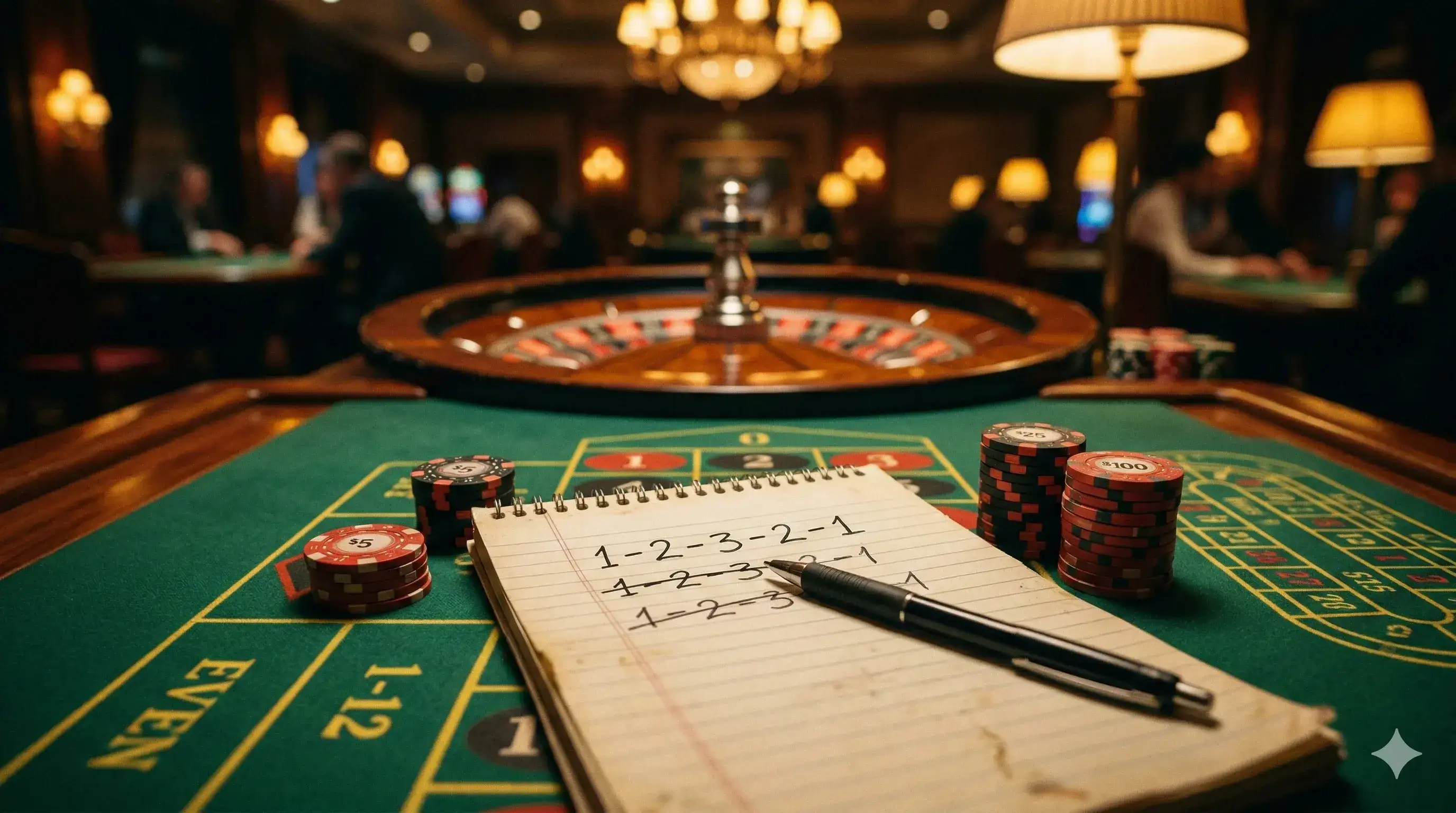
Labouchere is a cancellation system for roulette bets that pay net 1:1: the first stake is the sum of the first and last numbers in the line; after a win, remove both ends, and after a loss, append the lost stake. If the original line is fully cleared without changing the rules, its original sum is the conditional target profit. The roulette house edge remains unchanged, and a bankroll or table limit may stop the cycle first.
Try it free before using money. Open the Labouchere calculator, enter a $10 target and click “Generate Sequence.” The tool creates the line, lets you record results and shows the next stake before each spin. It is an accounting tool, not a way to predict roulette sectors or guarantee income.
TL;DR: Labouchere rules
A line is a list of positive numbers whose total is your target. The stake is the first number plus the last number; when one number remains, stake that number only.
| Event | What happens to the line |
|---|---|
| Win on a net 1:1 bet | Remove the first and last numbers |
| Loss | Add the lost stake to the end |
| One number remains | Bet that one number |
| Line is empty | The cycle ends at the original line total if it was fully played under unchanged rules |
| Next stake exceeds a limit | Stop before placing that stake |
Labouchere is a negative-progression betting system because losses generally increase later required stakes. It does not change the chance of the next roulette spin.
Which roulette bets work with Labouchere?
Classic Labouchere is intended for outside bets with a net 1:1 payout: red/black, even/odd and 1–18/19–36. “Even-money bet” describes the net payout, not a 50% winning chance. Zero belongs to neither side; American roulette also has 00.
| Roulette version | Full-win chance on an outside bet | Net payout | House edge | RTP |
|---|---|---|---|---|
| European, one zero | 18/37 = 48.65% | 1:1 | 2.70% | 97.30% |
| American, zero and 00 | 18/38 = 47.37% | 1:1 | 5.26% | 94.74% |
| French with La Partage | 18/37 = 48.65% | 1:1 on an ordinary win | 1.35% | 98.65% |
RTP is the expected share returned from total wagered over time, not the chance of winning one spin or ending a session ahead. Total wagered, or turnover, is the sum of stakes, not the starting bankroll.
On ordinary European and American tables, zero causes a full loss on these outside bets. With La Partage, zero returns half of an eligible outside stake. That creates three possible outcomes rather than a simple win/loss model, so check the actual table rules. The French Roulette help PDF describes La Partage, but it is an undated operator reference rather than a rule for every table.
Dozens and columns pay 2:1, so the standard rule of removing two ends after a win does not transfer unchanged. There is no universal “cancel three numbers” Labouchere rule.
Choosing a unit and starting line
A unit is a fixed accounting value for an example, not a required percentage of bankroll. If one unit is $1, 2, 2, 2, 2, 2 has a $10 target. In the manual tool you enter a target and it generates a money line; there is no multiplier field. In the embedded simulator, a custom line also uses absolute dollar entries.
The same $10 target can produce very different first stakes.
| Starting line | Target | First stake |
|---|---|---|
1, 1, 1, 1, 1, 1, 1, 1, 1, 1 | $10 | $2 |
2, 2, 2, 2, 2 | $10 | $4 |
1, 2, 3, 4 | $10 | $5 |
5, 5 | $10 | $10 |
10 | $10 | $10 |
A longer line can start with a smaller stake, but that does not make it the safest choice. Before the first spin, compare the first and possible next stake with the table minimum, maximum and chip increment.
Worked example: 2, 2, 2, 2, 2
This table directly shows a $10 teaching path with the preselected outcomes Loss, Win, Loss, Win, Win, Win. Cumulative P/L means cumulative profit or loss.
| Spin | Line before stake | Stake | Result | Line after result | Cumulative P/L |
|---|---|---|---|---|---|
| 1 | 2, 2, 2, 2, 2 | $4 | Loss | 2, 2, 2, 2, 2, 4 | -$4 |
| 2 | 2, 2, 2, 2, 2, 4 | $6 | Win | 2, 2, 2, 2 | $2 |
| 3 | 2, 2, 2, 2 | $4 | Loss | 2, 2, 2, 2, 4 | -$2 |
| 4 | 2, 2, 2, 2, 4 | $6 | Win | 2, 2, 2 | $4 |
| 5 | 2, 2, 2 | $4 | Win | 2 | $8 |
| 6 | 2 | $2 | Win | empty | $10 |
After the first $4 loss, append 4, so the next stake is $2 + $4 = $6. After winning $6, remove the end values 2 and 4. When only 2 remains, stake $2 rather than $4. A net 1:1 payout means a $6 win adds $6 to cumulative P/L.
A useful accounting check is: cumulative P/L + sum of the current line = $10. Once the line is empty, cumulative P/L equals the original target. That is an accounting property of a completed sequence, not proof that every line can finish before a bankroll, loss limit or table limit intervenes. The classical endpoint rules are also discussed in this mathematical study of Labouchere.
What eight losses look like
With 2, 2, 2, 2, 2, eight consecutive losses produce arithmetic stake growth rather than doubling: $4, $6, $8 and so on.
| Losing spin | Stake | Cumulative lost | Next stake |
|---|---|---|---|
| 1 | $4 | $4 | $6 |
| 2 | $6 | $10 | $8 |
| 3 | $8 | $18 | $10 |
| 4 | $10 | $28 | $12 |
| 5 | $12 | $40 | $14 |
| 6 | $14 | $54 | $16 |
| 7 | $16 | $70 | $18 |
| 8 | $18 | $88 | $20 |
These are three separate limit examples, not a suggestion to continue through eight losses under all of them:
- With a $100 session bankroll and no earlier limit, $12 remains after eight losses, so the next $20 stake cannot be placed.
- With a $15 maximum stake, stop before the $16 stake: after six losses and a $54 cumulative loss.
- With a $30 loss budget, stop before the $12 stake: after four losses, when the cumulative loss is $28.
When all limits apply, use the earliest one; here that is the stop after four losses. Resetting a line does not erase a recorded loss. Do not deposit more or raise the target merely to continue the sequence.
Why win count does not equal profit
The “one-third wins” claim mistakes line mechanics for a profit rule. If the original line has n numbers, L is the number of losses, W is the number of ordinary wins while at least two numbers remain, and I is the number of wins on a singleton, then a completed line satisfies:
2W + I = n + L.
This counts numbers added and removed. For a genuinely completed finite line with n > 0, the win fraction is greater than one-third and can approach one-third on long paths, but it is neither a guarantee nor a profit test. Winning stakes have different sizes, and a finite bankroll or limit can stop a line before completion. A 50% win rate is not required to finish, but the number of wins alone does not reveal turnover.
For an ordinary net 1:1 bet, expected net result is (2p − 1) × stake, where p is the probability of winning that ordinary net 1:1 bet. For $1,000 in turnover, expected loss is:
| Roulette version | Expected loss from $1,000 turnover |
|---|---|
| European roulette | $27.03 |
| American roulette | $52.63 |
| French roulette with La Partage | $13.51 |
This is the theoretical cost of that turnover, not a forecast for a stopped session. A pure losing streak makes Labouchere stakes rise arithmetically while the first endpoint stays unchanged, but mixed outcomes create different paths, so overall risk is not always globally linear.
Use the manual Labouchere calculator
The screenshots below were captured from the live interface on our owned mirror. They show a manually entered teaching path, not a casino result. Open the manual Labouchere calculator, enter a $10 target and click “Generate Sequence.”
Five line values of $2 and a $4 next stake
Start of the teaching scenario: line 2, 2, 2, 2, 2, next stake $4, cumulative P/L $0.
Click “I Lost.” Cumulative P/L becomes -$4, 4 is appended and the next stake becomes $6.
Line after a $4 loss and a $6 next stake
After the $4 loss, the line ends in 4, making the next stake $6.
Then click “I Won.” The tool removes the first 2 and final 4, leaves four twos, shows $2 cumulative P/L and sets the next stake to $4.
Line after a $6 win, $2 cumulative P/L and a $4 next stake
After the $6 win: line 2, 2, 2, 2, cumulative P/L $2.
Continue with Loss, Win, Win, Win to finish at $10 with an empty line. The BANKROLL label means cumulative P/L from zero for the manually entered outcomes; it is not casino money and does not establish that the system is profitable. The manual tool does not test roulette probabilities, available funds or table limits. Avoid “Undo” when correcting a sequence: it changes history but does not fully restore the line state. Use “Reset Simulation” and replay the results instead.
What the Monte Carlo simulator shows
The embedded simulator compares random samples; it does not predict your next session. Select European roulette, set bankroll to $500, choose “Custom,” enter 5, 10, 20, 10, 5, set 500 runs and click “Run Simulation.” The actual line sum should be $50 and the first stake $10.
The model uses a win chance of 18/37 for European roulette and 18/38 for American roulette, with full losses. Completion is the fraction of runs that fully clear the line. Avg Spins includes every run. Avg P/L is the mean final net result relative to the start across all runs, so high completion does not imply a positive mean. Max Bet is the largest stake actually placed in that sample, not a guaranteed ceiling.
The interface’s Bust Rate is an unfinished-cycle percentage: the next stake may have exceeded the remaining balance, or the safety cap may have been reached. It does not necessarily mean actual zero cash or full bankroll depletion. Presets can round a target, so use Custom and check the sum when the exact target matters. The simulator does not model table limits, personal stop-losses or La Partage. A displayed sample path is independently random and truncated to 30 spins for display; it is neither a maximum session length nor a worst case.
Reading the simulation chart
The chart runs 1,000 sessions for each roulette type with the same 5, 10, 20, 10, 5 line and $500 bankroll. It produces a fresh random sample when loaded, so no fixed empirical percentages should be quoted.
Read labels rather than bar height alone: counts and percentages can share the visual scale. The unfinished-cycle rate is not a bust rate in the sense of full depletion of funds. The model also excludes individual table limits and half-loss rules.
Labouchere compared with other approaches
Each system changes stake order and size, not the house edge or the probability of the next sector.
| Approach | Rule | Main risk | House edge |
|---|---|---|---|
| Flat betting | Same stake every spin | Turnover accumulates expected loss | Unchanged |
| Labouchere | Remove ends after wins; add stake after losses | Longer line and larger required stakes | Unchanged |
| Martingale | Double after each loss | Very rapid stake growth and table-limit pressure | Unchanged |
| Reverse Labouchere | Add after wins; remove ends after losses | Next stakes and money at risk grow during winning runs | Unchanged |
For the same $4 first stake, eight straight losses look like this:
| System | Total lost across eight losses | Next stake |
|---|---|---|
Labouchere with 2, 2, 2, 2, 2 | $88 | $20 |
| Martingale | $1,020 | $1,024 |
This is one illustrative losing path, not a comparison of equal cycle targets. Reverse Labouchere needs a predefined profit target and session cap; otherwise a winning sequence can keep increasing stakes. For general mechanics beyond roulette, see the Labouchere system guide. For another positive progression, see the Paroli roulette strategy.
Checklist before playing for money
Before starting, check:
- the chosen table’s outside-bet minimum, maximum and chip increment;
- your unit and original line total;
- actual session bankroll separately from the calculator’s BANKROLL figure;
- a loss limit, maximum stake and time cap;
- a rule to stop before the next stake exceeds any limit;
- cumulative P/L and turnover records;
- that you will not increase the target or add funds to chase losses.
Only play with money whose loss will not cause problems. Labouchere remains a cancellation system: remove the first and last numbers after a win, append the stake after a loss, and remember that clearing the original line does not remove the house edge or guarantee that the cycle will finish.
Frequently Asked Questions
No. In a fair roulette model, spins are independent: an outside bet has the same 18/37 full-win chance on European roulette or 18/38 on American roulette. Previous spins do not predict the next sector.
You can mechanically reset and create a new line, but the earlier loss remains part of the session result. Once the line is rewritten, the old target no longer describes the combined session, so do not restart in order to chase losses.
The classic example assumes one binary net 1:1 wager. Combinations of bets or bets with different net payouts need separate accounting; the classic rule does not provide an automatic guarantee for them.
Evgeniy Volkov
Verified ExpertFullstack developer with a background in mathematics. I build the calculators and game-style tools on ToolsGambling with Pixi.js and modern web tech, and every result uses transparent probability formulas you can verify yourself.