












Contents
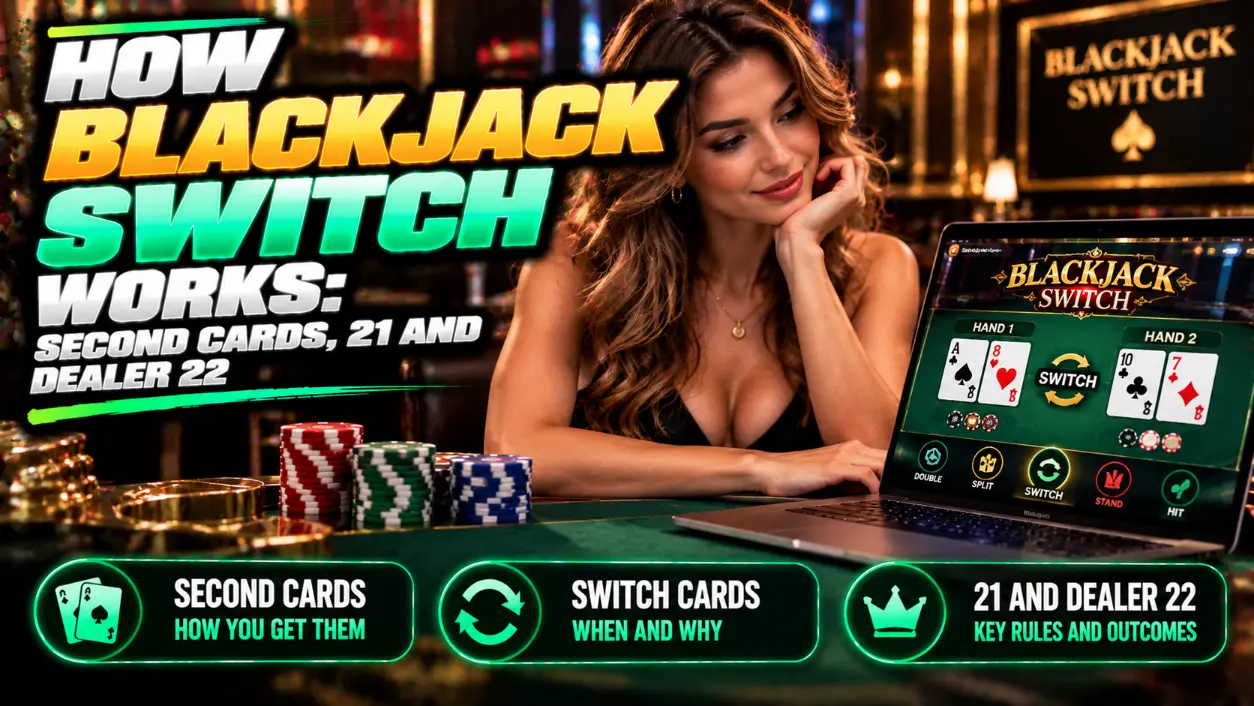
Blackjack Switch is a blackjack game in which you place two equal wagers and may exchange the second cards of your two initial hands. In this version, blackjack pays even money (1:1), the dealer hits soft 17, and dealer hard 22 makes all remaining hands push. A retained natural blackjack is paid immediately; an Ace and a 10-value card formed by switching count only as ordinary 21.
This article explains the version documented in the Fallsview Casino Resort gaming guide, not universal rules for every Blackjack Switch table. The PDF has no date or version number. It documents published rules, not verified conditions at a currently operating table in Canada, Las Vegas, or elsewhere.
When do you switch the second cards?
You decide whether to exchange the second cards after the initial deal and before taking other actions on either hand. You can also keep both hands unchanged. Switching does not move the first cards or draw new cards from the deck.
The sequence is:
- Place equal initial wagers on two hands. At 10 units each, you commit 20 units before any additional actions.
- Examine both initial hands and the dealer's upcard.
- Keep the hands as dealt or exchange their second cards.
- Then play each hand: hit, stand, double down, or split as permitted by the table's rules.
The official guide for this version does not specify when the dealer checks for blackjack. Check the timing at the table before playing.
Worked switch: 15 and 16 become 11 and 20
Exchanging the second cards—10 and 6—turns a hand of 5 + 10 into 5 + 6, and a hand of 10 + 6 into 10 + 10.
| Hand | Before switching | Second card exchanged | After switching |
|---|---|---|---|
| First | 5 + 10 = 15 | 10 moves to the second hand | 5 + 6 = 11 |
| Second | 10 + 6 = 16 | 6 moves to the first hand | 10 + 10 = 20 |
Illustrative second-card exchange: 5 plus 10 and 10 plus 6 become 5 plus 6 and 10 plus 10
Conditional card layout: exchanging the second cards changes totals of 15 and 16 into 11 and 20.
These totals are exact, but they do not establish that switching is optimal. The dealer's upcard, both hands, and subsequent decisions matter; getting one hand to 20 is not enough to recommend a switch. This example includes no additional wagers, doubles, or splits, and requires no rounding.
Is 21 after switching a natural blackjack?
No. A natural, or two-card blackjack, must be an Ace and a 10-value card in the original two-card hand. If switching creates that combination, Fallsview treats it as ordinary 21, not as a natural blackjack.
A 10-value card can be a 10, jack, queen, or king. This example uses a 10:
| Hand | Before switching | After exchanging second cards |
|---|---|---|
| First | Ace + 6 = soft 17 | Ace + 10 = 21 after switching |
| Second | 5 + 10 = 15 | 5 + 6 = 11 |
A soft hand counts an Ace as 11. The first hand becomes 21 after the exchange, but it does not qualify for the natural blackjack payout or its treatment when the dealer reaches hard 22. This is a card-total example only, with no additional actions or rounding.
Under Fallsview's documented rules, an original natural blackjack is paid immediately if you do not switch out of it. Its 1:1 payout means net profit equals the wager; it does not mean the hand has an even chance of winning.
What happens when the dealer has hard 22?
Under Fallsview's guide, dealer hard 22 makes all remaining hands push: their stakes are returned without profit. A retained natural blackjack has already been paid, while a player hand that busted earlier remains a loss.
A hard total counts no Ace as 11. This exception specifically concerns hard 22, not every dealer total above 21. It differs from an ordinary dealer bust, which normally pays surviving player hands.
For the following settlements, assume a 10-unit initial wager on each hand, with no doubles, splits, or side bets. “Total returned” includes the original stake; “net result” excludes it. No rounding is needed.
| Situation | Settlement on a 10-unit hand | Net result |
|---|---|---|
| Original natural blackjack is retained and paid at Fallsview's 1:1 rate | 20 units returned, including the stake | +10 units |
| Another nonbusted hand remains when the dealer reaches hard 22 | Push; 10 units returned | 0 units |
| Ace + 10 was formed by switching, then the dealer reaches hard 22 | Push; 10 units returned | 0 units |
| Player busted before the dealer reached hard 22 | Stake lost; nothing returned | −10 units |
Two separate conditional scenarios illustrate the distinction:
- Retained natural blackjack plus another nonbusted hand: the natural has already earned +10 units. The other hand pushes against dealer hard 22. The combined net result is +10 units.
- Switched 21 plus another nonbusted hand: both hands push against dealer hard 22. The combined net result is 0 units.
These are different card scenarios, not a head-to-head calculation of whether switching is more profitable from one starting position. Dealer hard 22 never revives a hand that has already busted.
How does Blackjack Switch compare with regular blackjack?
The main differences are the two equal initial wagers, the second-card exchange, Fallsview's 1:1 natural blackjack payout, and its dealer hard 22 push rule.
The comparison below deliberately assumes an ordinary blackjack table paying 3:2 for a winning natural. That payout is a condition of this example, not a universal rule for ordinary blackjack tables.
| Feature | Blackjack Switch in Fallsview's guide | Selected ordinary 3:2 blackjack table |
|---|---|---|
| Initial hands and wagers | Two hands with equal wagers | One initial hand for the wager being compared |
| Exchange second cards | Allowed between the two initial hands | Not available |
| Winning natural on a 10-unit wager | +10 units net; 20 units returned | +15 units net; 25 units returned |
| Ace + 10-value card formed by switching | Ordinary 21 | No switching option |
| Dealer hard 22 | Remaining hands push; a retained natural has already been paid | Dealer busts; surviving nonbusted player hands win |
| Dealer soft 17 | Dealer hits | Check the individual table's rule |
The payout comparison assumes a winning natural and no additional wagers; both calculations are exact. A 3:2 payout produces 15 units of profit on a 10-unit wager, compared with 10 units at 1:1.
Ordinary blackjack basic strategy applies to standard blackjack under specified rules. It is not a Blackjack Switch solver and does not evaluate the second-card exchange.
What should you check at a specific table?
Check the switching procedure, natural blackjack treatment, payout, hard 22 exception, and dealer soft 17 rule before wagering. The name “Blackjack Switch” alone does not establish every table condition.
| Item to check | Question to ask |
|---|---|
| Switching timing | Are only the second cards exchanged, after the initial deal and before other actions? |
| Natural blackjack | When is it paid, and what happens if you switch out of it? |
| Switched 21 | Is it treated as ordinary 21 rather than a natural blackjack? |
| Blackjack payout | What payout is posted for this specific table? |
| Dealer hard 22 | Which hands push, and how is a retained natural treated? |
| Dealer soft 17 | Does the dealer hit or stand? Fallsview's guide specifies H17: dealer hits soft 17. |
| Later actions | What restrictions apply to doubling down and splitting? |
| Side bet | Is Super Match separate from the main game, and where is its paytable? |
Treat Super Match as a separate optional side bet. Its outcome does not establish whether a second-card exchange is favorable or replace analysis of the main game.
What can the house edge calculator tell you?
The calculator can estimate expected loss from a house edge you supply. It cannot derive that edge from Blackjack Switch rules or tell you whether to switch.
The 0.58% figure below applies specifically to a Las Vegas Blackjack Switch model, as calculated by Wizard of Odds: six decks, dealer hits soft 17, switched blackjack counts as ordinary 21, and optimal play. It is not a Fallsview estimate. No house edge or RTP figure has been verified here for the documented rules covered in this article.
To reproduce this separate model example in the ToolsGambling house edge calculator:
- Select the custom house edge option and enter 0.58%.
- Set the wager size per round to 20 units: 10 units on each of two hands.
- Select By Rounds and enter 100.
- The expected loss result is 11.60 units.
Local ToolsGambling calculator preview showing a custom 0.58% house edge, 20 units per round, 100 rounds, and 11.60 units expected loss
Local ToolsGambling preview screenshot composed of four unchanged crops from one screen, not the production UI. A separate Las Vegas model, not the version covered here: a 0.58% house edge and a combined initial wager of 20 units per round. The displayed −$11.60 uses the calculator's currency format; 11.60 here represents illustrative units, not real money.
The total initial turnover is 20 × 100 = 2,000 units. The model's expected loss is 2,000 × 0.0058 = 11.60 units, displayed to two decimal places.
The calculator does not separately account for doubles or side bets. Use the custom value for this illustration, not a default ordinary blackjack preset. The result is neither a prediction for the next round nor an actual session loss, and it does not promise any particular outcome.
Frequently Asked Questions
The official guide for this version says betting limits are posted at the table. Check the limits at the specific table before placing a wager.
No. Super Match is a separate optional side bet, not part of exchanging the second cards. Check its rules and paytable separately from the main game.
Evgeniy Volkov
Verified ExpertFullstack developer with a background in mathematics. I build the calculators and game-style tools on ToolsGambling with Pixi.js and modern web tech, and every result uses transparent probability formulas you can verify yourself.