












Contents
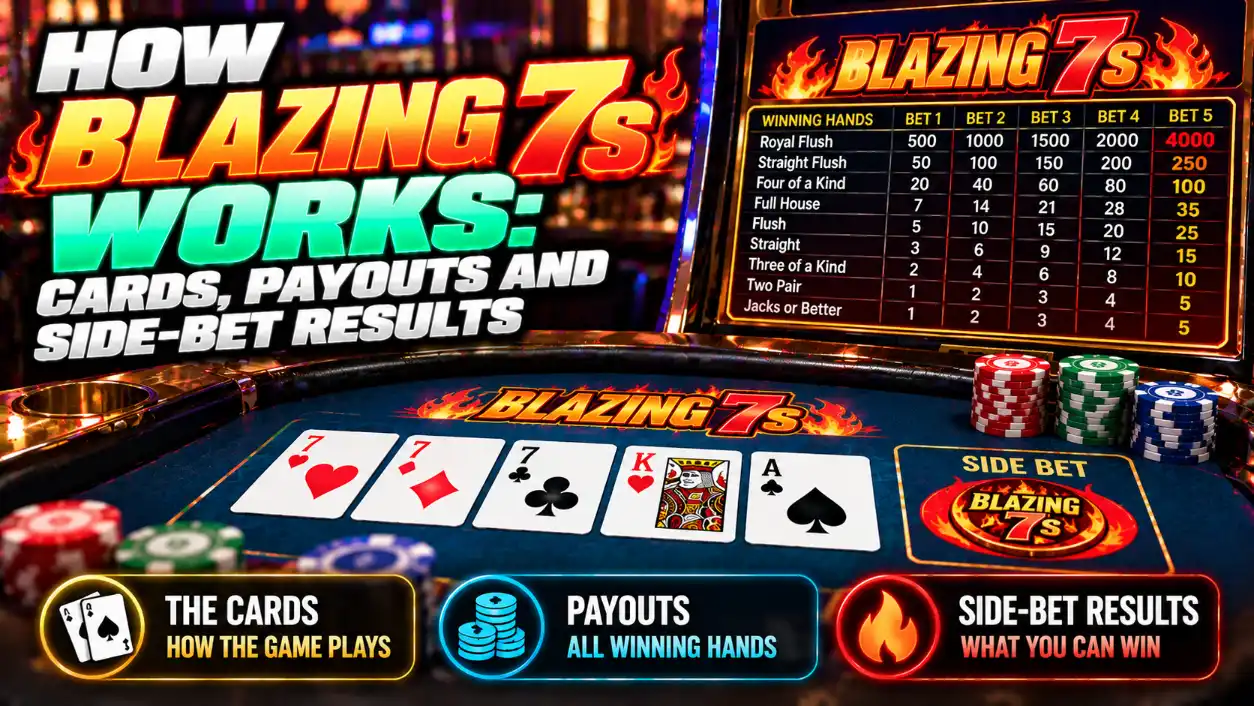
To check a win in the Blazing 7s version covered here, look at the player’s initial two cards and the dealer’s first/up card. Qualifying combinations are one player seven plus a dealer seven, two initial player sevens, or three sevens. A lone player seven without a dealer seven does not pay. Below, our original suit diagram distinguishes the combinations, while a separate net-result table shows the outcome after accounting for the stake.
These rules and the paytable come from page 3 of the official Star Gold Coast blackjack guide approved 6 August 2024. That document defines the selected version; it does not establish another table’s rules, current jackpot amount or deck count.
Which cards count in Blazing 7s?
Only the player’s initial two cards and the dealer’s first card count in this Star schedule. Blazing 7s is an optional progressive side bet placed before the deal, separately from the base blackjack wager.
A later player hit, a card received after splitting, or a later dealer card does not count. The side bet settles independently of the base blackjack wager: the strength or final result of the blackjack hand does not change its payout.
Blazing 7s card sources and suit examples
Original illustrative diagram based on the dated official table—not a screenshot or a live dealt hand.
What does the six-row paytable pay?
Only the highest qualifying tier pays. A three-seven award is not added to the payout for two initial player sevens.
| Qualifying cards | Payout |
|---|---|
| Three 7♦ | Greater of $50,000 or 100% of the jackpot |
| Three same-suit sevens other than diamonds | Greater of $5,000 or 10% of the jackpot |
| Three same-colour sevens that are not all the same suit | 500 to 1 net profit |
| Three mixed-colour sevens | 200 to 1 net profit |
| Two initial player sevens, with no dealer first-card seven | 20 to 1 net profit |
| Exactly one initial player seven plus a dealer first-card seven | 10 to 1 net profit |
These are the six rows in the named 2024 document. Dollar amounts retain the Australian operator document’s printed notation; no currency conversion is made, and they are not guaranteed amounts at other tables.
If both initial player cards and the dealer’s first card are sevens, use the appropriate three-seven tier—not that tier plus 20 to 1. If the player has only one seven and the dealer’s first card is not a seven, there is no paying row.
The Star rules also say that simultaneous major-jackpot winners share jackpots. That is a condition of this schedule, not a universal rule for all Blazing 7s tables.
How do suited and unsuited sevens differ?
Suited three sevens all share one suit; unsuited three sevens do not. In this paytable, unsuited sevens split into same-colour but not all the same suit at 500 to 1, and mixed-colour at 200 to 1.
Each example below is in player card 1 / player card 2 / dealer first card order:
| Three-card example | Qualifying tier |
|---|---|
| 7♦ / 7♦ / 7♦ | Three diamonds: the highest progressive tier |
| 7♠ / 7♠ / 7♠ | Three same-suit sevens other than diamonds: the second progressive tier |
| 7♦ / 7♥ / 7♦ | Same-colour sevens, not all the same suit: 500 to 1 |
| 7♦ / 7♠ / 7♥ | Mixed-colour sevens: 200 to 1 |
Hearts and diamonds are red; spades and clubs are black. “Unsuited” alone therefore does not identify the payout.
These are illustrative multi-deck examples, allowing the same card to appear more than once. The selected PDF does not specify a deck count.
What is the net result of a five-unit side bet?
For a hypothetical separate five-unit side stake, a 10 to 1 payout produces 50 units of net profit and 55 units returned including the stake. No base blackjack stake or blackjack result is included in these calculations.
The example assumes the fixed payouts use X to 1 net-profit odds: profit equals X times the stake, and the winning stake is returned separately. By contrast, X for 1 includes the stake in the quoted return. The two notations are not interchangeable.
| Side-bet result | Paytable odds | Net side-bet result | Total returned including stake |
|---|---|---|---|
| No paying row, including a lone player seven without a dealer seven | None | −5 | 0 |
| Exactly one initial player seven plus dealer first-card seven | 10 to 1 | +50 | 55 |
| Two initial player sevens, with no dealer first-card seven | 20 to 1 | +100 | 105 |
| Three mixed-colour sevens | 200 to 1 | +1000 | 1005 |
| Three same-colour sevens, not all the same suit | 500 to 1 | +2500 | 2505 |
For a winning fixed-odds row:
- Net profit = side stake × payout multiplier.
- Total returned = net profit + returned side stake.
On a loss, the net result is minus the full side stake. All amounts above use whole hypothetical units, so no rounding is required.
The progressive awards remain symbolic because no live jackpot meter is supplied:
- Three same-suit sevens other than diamonds: greater of $5,000 or 10% of the jackpot meter.
- Three 7♦: greater of $50,000 or 100% of the jackpot meter.
These are progressive award rules, not fixed multipliers for the five-unit stake. Any applicable jackpot-sharing conditions also affect the amount received.
Why must you check the Blazing 7s version?
The name Blazing 7s alone does not establish which cards count or what they pay. The version explained here uses only the player’s initial two cards and the dealer’s first/up card.
Before betting, compare your table’s rules with this example: check the qualifying cards, full paytable and current jackpot amount. Before applying these calculations, check your table’s paytable: for a fixed stake and a known winning row, the net win depends on the listed payout multiplier, not the deck count. Deck count affects combination probabilities and whether identical cards can appear more than once.
The Star PDF states that 15% of each jackpot bet is retained by the casino; this share is not, by itself, a calculated side-bet house edge. Calculating house edge or RTP requires the relevant outcome probabilities, exact paytable and jackpot meter. The retained contribution alone does not establish either figure or predict a player’s result.
What should you check before placing the side bet?
Check the current table’s card-selection rule, full paytable, payout notation, permitted stake and jackpot terms before betting. The dated Star document is a worked reference, not confirmation of what a current table offers.
- Identify exactly which cards count. Check the actual table rules for the cards used to settle this bet and whether any later draws count.
- Read every paytable row. Distinguish three diamonds, other suited three sevens, same-colour unsuited sevens and mixed-colour sevens.
- Confirm the side-bet amount and limits. The five-unit stake above is hypothetical, not a stated table requirement.
- Check
to 1versusfor 1. Confirm whether the quoted payout excludes or includes the returned stake. - Check the current jackpot meter and prize floors. Do not assume the dated document’s amounts apply elsewhere.
- Read the jackpot-sharing rules. Simultaneous qualifying winners may affect the award under the applicable rules.
For a comparison with a different three-card side bet, see the 21+3 blackjack side-bet guide. It covers a separate game and is not authority for Blazing 7s rules or payouts.
Evgeniy Volkov
Verified ExpertFullstack developer with a background in mathematics. I build the calculators and game-style tools on ToolsGambling with Pixi.js and modern web tech, and every result uses transparent probability formulas you can verify yourself.